Owner: Earl of Rothes
Lord St. Clair of Dysart
| We wish to acknowledge W. G. Rowntree as the writer of an article entitled "Introduction to the Rothes Papers" from which we have taken a few statements referring to the 18th century coal mines owned by the Earl of Rothes. The writer was grateful to the Glenrothes Development Corporation and Kirkcaldy District Council for permission to reproduce the Papers which were discovered in 1966 in the roof space of an old farm building which was one of several situated near the stables of Leslie House, once the home of the Earls of Rothes. Leslie House lies within the designated area of the new town of Glenrothes, Fife, and the farm building was the property of Glenrothes Development Corporation at the time the Papers were discovered. At one point they were on loan to Kirkcaldy District Museum. The Papers cover dates from 1580 to 1830, and among them are bills, farm tacks, business letters, and accounts relating to coal and salt workings. We trust that we will be able to display these extracts on our website. M. Martin & Webmasters. |
|---|
" ... Among the Papers there is a warrant by George II at the request of his sheriffs for the arrest and apprehension of a Stephen Row. It is dated 27 August 1741, has the seal of George II embossed on it, and carries the King's signet. [The Stephen Row mentioned was an engineer connected with the coal mines owned by the Earl of Rothes.]
Many of the papers deal with coal mining on the estates of the Earl of Rothes.
In 1752, during the time of the tenth Earl, some miners mutinied at Cluny (Clunie), one of the three collieries belonging to the Rothes family, the other two being at Cadham and Strathore. Soldiers were brought along to restore order. The ringleaders of the mutiny were apprehended and put in prison, three at Kirkcaldy and three at Cupar. The prisoners were released after they had signed a document binding them to agree to the terms laid down by the Earl.
There is a letter written to the tenth Earl by Dundas of Dundas dated May 1736. It concerns coal works.
One section mentions '. . . The other thing Mr Adam wants is to have the Water Engine placed as far a dipping on the Coal as it will be sure to draw the full grouth of Water at the deepness of the Sink, which would bring it to stand on the east side of the Highway betwixt the two Bridges on Ore and Lochty, upon the Earl of Leven's Ground, the coal dipping towards the East; . . .'. This indicates that it was sited on the E side of the present A92 at Thornton. It was probably erected at Easter Strathore Colliery about 1739. It cost £229-19-4.
The Mr Adam mentioned is the architect William Adam of Kirkcaldy. The Water Engine would be operating a pump to clear water from the Sinks, and in all probability is one or other of the types described and illustrated later.
From another part of his letter it would seem Dundas passed through what is now the Coaltown of Balgonie on a hunting expedition for he says,' ... in going through a place called Coaltown - belonging to Leven to the Hunting, I noticed a Drift of Old Sinks running from that Village Southwards towards the east end of the height of Ground in Strathore, . . .'
There are papers concerned with coalmines on the estates of the Earl. Those mentioned were at Cadham, Cluny and Strathore.
An account from John Allesones for carrying coal to the Earl in 1646 contains 'for fetching of four loads of coals from Luigtown heugh to the place for my Lady' and 'for one load from Balgonie heugh'.
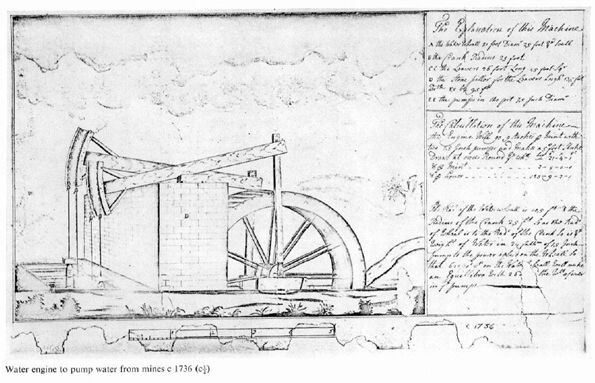
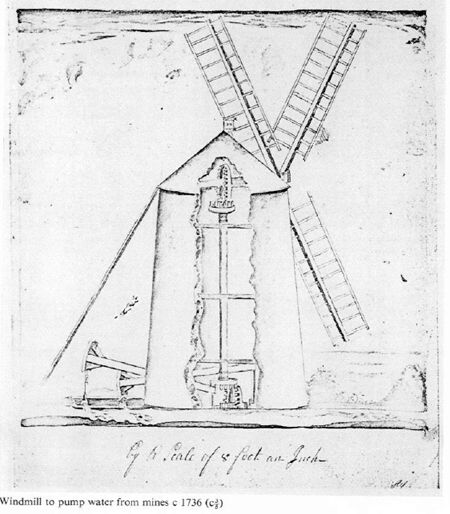
Most of the papers have to do with the coalmines of the tenth Earl in the 18th century. The pits, being near local rivers, were affected by seepage which resulted in the miners having to be transported from one colliery to another until the water was dealt with. The methods used for doing this are shown by two diagrams found with the documents, one for pumps operated by water power and another making use of the wind for the same purpose.
There is a report or 'Memoriall' prepared by the 'Laird of Dundas, William Adam David and Archibald Robertson' dated 13 April 1736. It includes information about levelling carried out for the purpose of siting a water engine in the vicinity of the coalmine at Easter Strathore; how they propose to obtain the water-power for it by means of an aquaduct carried to a damhead, and recommendations about where trial bores should be sunk.
The River Ore was to be harnessed to operate the 'Water Wheel'. From the diagram (p 20) it can be seen that two cranks geared to the 'Water Wheel' give movement to two 'Leavers' supported over a stone pillar.
Thus, the up and down action imparted by the 'Leavers' on chains of 7½ inch diameter suction pumps drew water to the surface from a depth of 144 feet.
There is a letter, dated 1738, addressed to Lord Elphinston from a Robert Ainslie. It describes in detail the capabilities of a windmill for use in pumping water from the mines. Its height from ground to apex of roof was about 41 feet. The turning blades are geared to operate the pumps (p 21). This letter must have been forwarded to the Earl of Rothes and considered when the water engine was under review.
Many aspects of coalmining in the 18th century are covered. Some papers give trial bores for coal at 'Auchmuty ground' which, like Cadham, is within Glenrothes. Others show that the workers were mere serfs living under very hard conditions.
------------------------------------
|
|
A series of questions and answers regarding Lord St Clair's Coal Mines at Strathore are dated 1730.
Two of them are:
What does Lord St. Clair get for a Load of Coals when Delivered on Board Ship?
Lord St. Clair gets for a Load of Coal when Delivered on Shipe load 7/3ld Scots or 7 penc and 1/12th of a penny out of which he pays hewing and Carring.
What is the weight of a Load of Coals? The weight of a load of coals is 18 Ston 12 lbs amsterdam weight.
-----------------------------------------------------
Other information gained from researching these papers, and pertaining to coal workers at early Strathore pits, will be of interest to anyone researching their ancestry.
~1720s:
John Lindsay, collier (no information)
1738/39:
David Arnot or Arnit, oversman.
1739:
Nancy Allan, bearer to John Isack
William Allan, Hill Grieve
Murdoch Anderson, 'Belongs to Earl of Rothes, loaned out to Laird of Dunnikier in 1739'
David Armor (no information)
John Beck, hewer
Alexander Birall, driver of gin horses
John Bullock or Bollack, hewer, 'from Duke of Hamilton's work at Bo'ness - no bearer - 'his wife [Helen Mitchell from Bo'ness] having left him'
George Ewan (no information)
James Fortune - 'my own coal hewer' ... has a 'bearer from the Links work' called Macgregor ... 'his wife did bear formerly'
Alexander Grant, hewer - 'Last from Grange work but no bodys property 2 bearers' - his wife and a bearer from Bo'ness
John Isack, hewer - described as belonging to Earl of Rothes in 1739, came from Col. Erskine's work with 2 bearers Nancy Allan and James Isack
Thomas Keith, coal hewer - Earl of Rothes coal hewer loaned out to Laird of Dunnikier in 1739; John Leard or Laird, hewer - 'From Mr Bruce of Kinnaird's work with 2 Bearers' his wife from Kinnaird and Elizabeth Fisher from the Duke of Hamilton's work at Bo'ness
John Leard or Laird, hewer - 'From Mr Bruce of Kinnaird's work with 2 Bearers' his wife from Kinnaird and Elizabeth Fisher from Duke of Hamilton's work at Bor-ness [Bo'ness]
Alexander McConachie, hewer - With John Paterson and William Paterson belongs to Col. Erskine with 5 bearers
George Mitchell - (no information)
Peter Morison or Moreson - (no information)
Peter Napier and Peter Napier, the younger - The two Napiers are described as coal hewers from Mr Bruce of Kinnairds work with 2 bearers - Margaret Morrice and William Napier. The wife of Napier was a bearer formerly
Thomas Niklson or Nicholson - (no information)
John Paterson, hewer - 'deserted & his bearer' came with William Paterson and Alexander McConachie from Col. Erskine with 5 bearers
William Paterson, hewer - See above. 'Paid for 7 days at clearing the mine at Clunie 1744'
John Reed, wright - (no information)
David Robeson, hewer - (no information)
1739-54:
George Scott - 'Agreement to dig 3 fathoms at 10 pound 5 shillings per fathom. Agrees in December 1744 to work the mine at Clunie for 5 or 6 fathoms. 1754 - Paid for seeking the Smiddie Coal'
1739:
George White, coal hewer/sinker - Belongs to the Earl of Rothes, loaned out to the Laird of Blair in 1739.
1743-1763: George White agrees to run 30 fathoms of the mine at 40 pence per fathom 'he having all the coals, 31 March 1743'. Petition to incarcerate White and Alexander Ewen, 1744. [His son Robert baptised 17 June 1753] .
Thomas Thomson, the elder, and Thomas Thomson, the younger, hewers - Thomas Thomson the elder and younger from Col. Erskine's work with 2 bearers - Jennet Spourt his wife and Helen Thomson
1739-1752:
John Ewan, hewer - Described as 'formerly oversman' in May 1739. Father of Alexander and James Ewan both coal hewers at Strathore. They have 2 bearers in 1739 - John Ewan and Christian Christy 'from Mr Christy's work';
1740-1752:
Alexander Ewan, son of John Ewan, hewer - Note that he will be free at the end of his year's service.
-----------------------------------------------------
| For those website visitors not familiar with Fife locations, the old Cluny (Clunie) Colliery was located just over one mile to east of Cardenden; the early Cadham pits were located just to the north of Glenrothes; and the early Strathore, or Easter Strathore, Colliery was located just east of Thornton village, not far from the location of the present day railway station/halt which serves Thornton and Glenrothes. Please also refer to the entry for Thornton Engine Pit - EAST FIFE INDEX - for slightly later coal works in this area just to the east of Thornton village. M. Martin & Webmasters. |
|---|
