Owner: Rev. Mr Roger, Dunino Manse
The adit of an old mine is present on the south bank of
the Kinaldy (Wakefield) Burn approx. ¼ mile south of
Stravithie (formerly Bridge-end) and we believe this to be
the coal-work on the outer glebe of Dunino Manse which
was put up for lease in 1842 (see newspaper report),
to work the 3 feet coal seam described in the
Statistical Account of 1837 (see below) a few years earlier.
It is unlikely to be the scene of the ironstone extraction
described in the same Account as Stravithie Mill lay some
distance to the north of the site of this adit.
A number of small coal-works are known to have been in
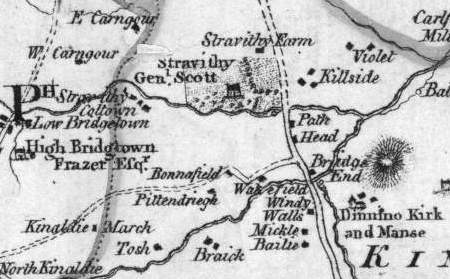
existence to the east of Bridgetown Den and the map section
from 1775 clearly shows the location of Stravithy Coltown
lying to the south of the Cameron Burn and between Bridgetown
Den and Bridge-end (now Stravithie).
 |
 |
| Much of East Fife's rural landscape masks its
industrial past. Many quiet pastures in our lovely
Kingdom were once scenes of coalmining activity in the
eighteenth and early nineteenth centuries. Although
little now survives of these coalmining activities which
were on a very much smaller scale than modern pits, the
fresh ploughing of a field will often reveal some
evidence in the appearance of patches of dark pit waste
from former workings. Examination of aerial photographs
of these areas can reveal a landscape covered with small
indents and markings suggesting the sites of many unnamed
old shafts and shallow workings. Often a brief mention in
an old document is the only evidence that they once
existed. Nevertheless, they too deserve to be recognised
in our record of the coalmines and pits of Fife.
Early Statistical Records for the parish of Dunino reveal the extent of coal mining here in the 18th & 19th centuries, and perhaps even earlier. |
Extract from Statistical Account of Fife
Dunino Parish - 1795
" ... Coal seams, from the vast number of old pits
in various places of the parish, to have, some time ago, been
a very plentiful article here. There is still, it is said,
plenty of it in several estates of this district, but it is
uncertain when any of its proprietors will open these mines,
or rather, whether their future gains would compensate the
expenditure necessary for that purpose.
... The leading subject of complaint, with the inferior
classes of our parishioners, is the scarcity of coals, (the
only article of the parish fuel), even in the land of
coal. By the selfishness of individuals, the people here
seem to be, in a great measure, excluded from those
inestimable and necessary favours, so liberally poured around
them, by the benignity and wisdom of the Almighty. For,
notwithstanding the great quantity of coals formerly raised
in our immediate neighbourhood, the spirit of monopoly has
for many years past deprived us of this bounty of Providence;
and it is hard to say how long the same spirit may continue
to afflict the poor of this parish; the principal proprietor
of the coal-mines here having entered into an agreement with
the proprietor of an adjoining colliery, to keep his own
coal-works shut till those of the other shall be completely
exhausted; in return for which the other has bound himself,
and his heirs, & c. to pay him an annuity of £20
a-year!
Thus the poor of this parish, as well as the adjacent
country, are deprived of a blessing evidently intended for
them by Providence; and obliged to purchase fuel from a
considerable distance, at a higher price, and of a worse
quality. ... "
Extract from Statistical Account of Fife
Dunino Parish - 1837
" ... The parish of Dunino is situated on the
north-east part of the great coal basin of Scotland, supposed
to be 90 miles long, and 33 miles broad. It is believed that
a square mile of this space will answer the demand yearly.
... On every estate in the parish, are vestiges of
coal-working at some former period; and very frequently at
the surface, appears bituminous schistus or blaes, denoting
the presence of this mineral. No coal is at present wrought
in the parish, from a belief it would not pay the expense;
and nothing is more difficult to calculate than the profits
of coal-working.
The strata unexpectedly may be disturbed by mounds of stone.
or may wholly break off or dip beyond reach. Beside the
upland path to the church from Bridge-end, there is a
projection of disintegrated trap ... Proceeding up Dunino
burnside southward, a few projections of red sandstone, in
regular strata appear. Farther upward, the bed of the burn
becomes limestone, and in that proximity the coping of the
ministers' outfield glebe under the surface is also
limestone.
Here also, a stratum of coal, 3 feet thick, has been
discovered 32 feet under the surface, dipping considerably
towards the north. The regulation as to finding coal in
glebes gives little encouragement to the incumbent. His
operations may be suspended by the presbytery or any heritor,
till, after paying expenses, he deposits his profits in some
bank or other sure place, and have only the interest of his
deposit for his pains. Some mineralologists assert that coal
under limestone is not good, but under sandstone excellent.
...
Ironstone or haematites is not uncommon in the parish.
Recently, a person collected forty tons of that mineral from
the side of the rivulet which turns Stravithy-mill, and sent
it cost free to Newcastle as ballast. ...
The fuel used in the parish is coal, which may be found
sea-borne at either of the adjacent towns [St Andrews and
Cupar] ... or at the coal mines in the interior of the
country, not more distant than these towns. ...
"
-----------------------------------
"Fifeshire Journal"
27 January, 1842
COAL AND LIMESTONE
To be Let, on Thursday the 24th
February next, A BED of very fine COAL and LIMESTONE, on the
Outfield Glebe of Denino, consisting of about 21 Acres Imperial;
and lying on the side of the public road half-way between St
Andrews and Anstruther. The surface of the whole Glebe, after a few
feet of earth, consists of a finely-coloured Limestone, most
appropriate either for Agricultural purposes or Building; and under
this is a thick seam of valuable Coal. As there is present no Lime
or Coal-work of note within five miles of this spot, a ready market
may be expected.
Application to be made to the REV. MR. ROGER,
Denino Manse, by St Andrews, who will Let the Premises to a Tenant
of capital and enterprise.
--------------------------------------------
