Owners: Bowman and Co., Buckhaven
Wemyss Coal Company
The Muiredge Colliery, established in the 19th century, was of great importance in the Buckhaven area and her pits - Nos. 1, 2, 3 and the West - were surrounded by the Rosie, Denbeath (later the Wellesley), Wellsgreen and Isabella Collieries.
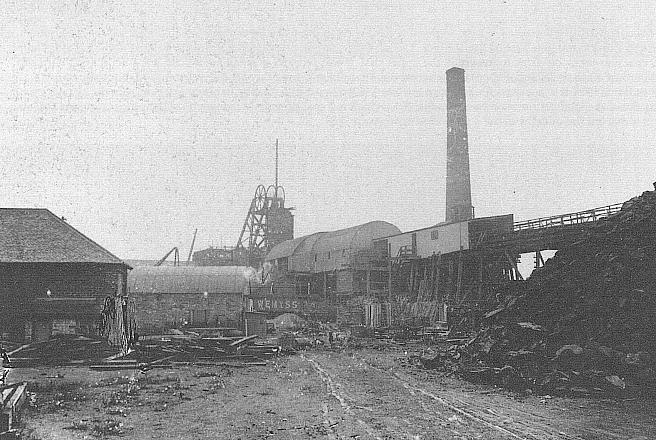 |

|
 |
---------------------------------------------------------
We are always grateful when website visitors pass on contributions to enhance our content and we wish to thank Gordon Sutherland, Methil, Fife, for giving permission to display his unique colourful projects based on photographs of bygone collieries.
Colin Martin & Chris Sparling, Webmasters.
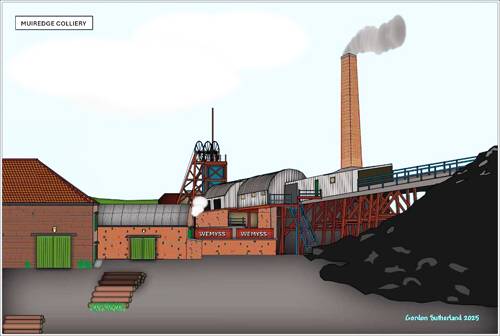
PLEASE NOTE THAT THE ABOVE IMAGE IS © GORDON SUTHERLAND
---------------------------------------------------------
"We are also delighted when website viewers get in touch to contribute personal stories or memorabilia pertaining to their mining
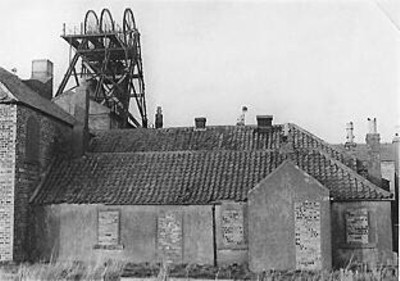
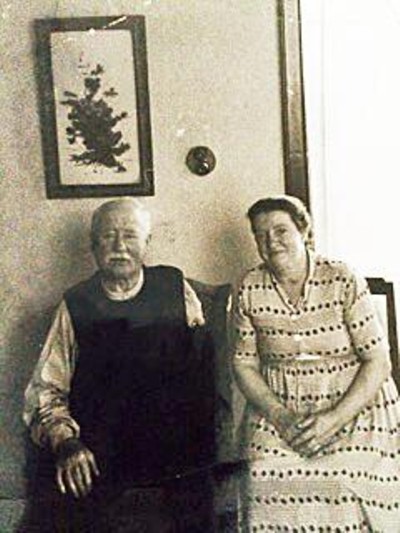
ancestors. In early September 2016, Carole Mallet, Perth, got in touch to say, 'I think the site is oky doky. My dad was born at Muiredge, I have a photo of the cottage and the colliery in the background. My grandad worked in one of the collieries but not sure which one. He lost his arm in a coal pit. His name was Alexander Johnston and his wife's name was Wilhelmina Barnett Johnston.'
A few days later, Carole sent Chris the following photos and expanded on her family information."
M. Martin & Webmasters.
 |
 |
"Hi Chris,
I've included two photos, one of Muiredge Cottages with the colliery at the back. My Grandad was still living there when he married my Grandma Wilhelmina in 1923, and my Dad was born there in 1928. Wilhelmina lived at 39 Wellesley Road before she married and obviously moved into the cottages then!
The other photo is of my Grandad Alexander with his missing arm and my Grandma Wilhelmina. Unfortunately my mum died a year past January and she would have known most likely what pit he lost his arm in. I’m assuming Alexander would have worked in the pits closest as they lived in Buckhaven then moved to East Wemyss. I'm hoping if you can put this on your site someone might recognise them but meanwhile I shall keep digging away! By the way it was 17 Muiredge Cottage where they lived."
Thanks,
Carole
----------------------------------------------------
During the sinking of the first shaft in the early 1850s,
the Chemiss Coal seam was reached at nearly 80 fathoms but
the coal found was of really bad quality as it had volcanic
rock flowing through it. On reaching solid rock, shaft
sinking came to a halt. A few years later, Bowman and Company
successfully cut through this rock to the lower coal seams.
Three shafts were in operation at the colliery by 1879.
We understand that the headgear was replaced by a reinforced
concrete version in 1935 and the shaft was deepened by 14
fathoms to reach the Four Feet Coal seam in what proved,
however, to be a short-lived venture.
The pit-head buildings were used for several years as a
training school for young miners following the 1932 closure.
Muiredge Colliery finally closed in June, 1938.
| Colliery opened: 1856 | Colliery
abandoned due to
finding geological fault (see above) |
|---|---|
| Colliery
reopened: 1864 Colliery reopened: Dec 1935 |
Colliery
closed: 1932
Colliery closed: 1938 |
| Source Date of Information Supplied | |
| Manager / Under-Manager / Men underground / Men above ground / Coal seams worked / Shaft Details | |
| 1860 (Lumphinnans Iron Co.) | |
| 1868/1869 (Messrs Bowman
& Co.)
[as Muiredge and Cameron Colliery] |
|
| 1873 (Bowman & Co.) | |
|
Muiredge: Lawrence Bowman / ------------ / -- / --
/ Chemiss / D'cast (15 x 6) 480 ft. : U'cast (10
x 5) 438 ft.
Furnace ventilation. |
|
| 1874 (Bowman & Co.) | |
| No. 1:
Lawrence Bowman / ------------ / 158 / 37 / Chemiss /
D'cast (15 x 6) 480 ft. : U'cast (10 x 5) 438 ft.
Furnace ventilation. No. 2: listed - 6 feet coal - no other details. |
|
| 1875 (Bowman & Co.) | |
| No. 1:
Andrew Crookston / ------------ / 164 / 40 / Chemiss /
D'cast (15 x 6) 480 ft. : U'cast (10 x 5) 438 ft.
Furnace ventilation. No. 2: listed - 6 feet coal - no other details. |
|
| 1876 (Bowman & Co.) | |
| No. 1:
Andrew Crookston / ------------ / 143 / 31 / Chemiss /
D'cast (15 x 6) 480 ft. : U'cast (10 x 5) 438 ft.
Furnace ventilation. No. 2: listed - 6 feet coal - no other details. |
|
| 1877 (Bowman & Co.) | |
| No. 1:
Andrew Crookston / ------------ / 116 / 26 / Chemiss,
9' 8" / D'cast (15 x 6) 480 ft. : U'cast
(10 x 5) 438 ft.
Furnace ventilation. No. 2: listed - 6 feet, 8 feet - longwall & stoop and room. |
|
| 1878 (Bowman & Co.) | |
| No. 1:
Archibald Bowman / ------------ / 142 / 39 / Chemiss,
9' 8" / D'cast (15 x 6) 480 ft. : U'cast
(10 x 5) 438 ft.
1 person killed. No. 2: listed - 6 feet, 8 feet - longwall & stoop and room. |
|
| 1879 (Bowman & Co.) | |
| No. 1:
Archibald Bowman / ------------ / 104 / 14 / Chemiss,
9' 8", 6 feet, 8 feet / D'cast (15 x 6) 480
ft. : U'cast 420 ft.
2 persons killed. No. 2: Archibald Bowman / ------------ / 63 / 6 / Chemiss (stoop & room) / D'cast 330 ft. : U'cast (10 x 5) 156 ft. No. 3: Archibald Bowman / ------------ / 42 / 7 / Chemiss (longwall) / D'cast (10 x 5) 156 ft. : U'cast ----- |
|
| 1880 (Bowman & Co.) | |
| No. 1:
Archibald Bowman / ------------ / 70 / 14 / Chemiss,
9' 8",6 feet, 8 feet / D'cast (15 x 6) 480
ft. : U'cast 420 ft.
3 persons killed. No. 2: Archibald Bowman / ------------ / -- / -- / Chemiss (stoop & room) / D'cast ----- : U'cast (10 x 5) 438 ft. Fan 15' dia. for ventilation. No. 3: Archibald Bowman / ------------ / 50 / 9 / Chemiss (longwall) / D'cast (10 x 5) 156 ft. : U'cast ----- |
|
| 1881 (Bowman & Co.) | |
| No. 1:
Archibald Bowman / ------------ / 191* / 37* / Chemiss,
10' / D'cast (15 x 6) 330 ft. : U'cast 180
ft.
1 person killed. No. 2: Archibald Bowman / ------------ / shared * / shared * / 8 feet; 5' 6" / D'cast 480 ft. : U'cast (10 x 5) 438 ft. Fan 12' dia. x 5' at No. 2 pit for ventilation. No. 3: Archibald Bowman / ------------ / -- / -- / ---------- / D'cast (10 x 5) 162 ft. : U'cast ----- Two shifts worked in Nos. 1 and 3 pits. |
|
| 1882 (Bowman & Co.) | |
| No. 1:
Archibald Bowman / ------------ / 64 / 5 / Eight feet;
5' / D'cast (15 x 6) 330 ft. : U'cast -----
Fan 12' x 4½' at No. 2 pit. No. 3: Archibald Bowman / ------------ / 142 / 20 / Chemiss, 10' / D'cast 480 ft. : U'cast 438 ft. |
|
| 1890 (Bowman & Co.) | |
| No. 1:
Archibald Bowman / ------------ / 87 / 31 / Parrot /
D'cast (16 x 6) 822 ft. : U'cast (12 x 9) 594 ft.
No. 2: Archibald Bowman / ------------ / 94 / 13 / Eight Foot, Six Foot / D'cast (17 x 9) 918 ft. : U'cast (10 x 5) 282 ft. |
|
| 1896 (Bowman & Co.) | |
| Archibald Bowman / ------------ / 228 / 38 | |
| Gas, household, manufacturing and steam coals and fireclay. | |
| 1902 (Bowman & Co.) | |
| Archibald Bowman / H. Reid / 345 / 42 | |
| Gas, household, manufacturing and steam coals and fireclay. | |
| 1904 (Bowman & Co.) | |
| Archibald Bowman / ------------ / 370 / 45 | |
| Gas, household, manufacturing and steam coals. Fireclay. | |
| 1905 (Wemyss Coal Co. Ltd.) | |
| Archibald Bowman / ------------ / 333 / 44 | |
| 1906 (Wemyss Coal Co. Ltd.) | |
| Nov: Departure of Mr Archibald Bowman, manager, after 25 years service with the Company. | |
| 1908 (Wemyss Coal Co. Ltd.) | |
| Harry Reid / William McGarrity / 483 / 68 | |
| 1911 (Wemyss Coal Co. Ltd.) | |
| Harry Reid / ------------ / 386 / 54 | |
| 1918 (Wemyss Coal Co. Ltd.) | |
| Harry Reid / Robert Cowan Mercer / 286 / 114 | |
| 1920 (Wemyss Coal Co. Ltd.) | |
| Manpower: 515 / 177 | |
| 1928 (Wemyss Coal Co. Ltd.) | |
| William Galloway / Robert Cowan Mercer / 572 / 103 | |
| Household, steam coals and fireclay. Four Feet, Dysart Main, Six Feet and Eight Feet. | |
| 1938 (Wemyss Coal Co. Ltd.) | |
| Harold Baird / ------------ / 184 / 28 / colliery abandoned | |
| This pit had a system of ventilation partly in common with Lochhead, Michael, Rosie and Wellesley Collieries. | |
| Please see Stories Link: Bowman Story, for information on the Bowman family and the association with Buckhaven collieries. |
|---|
Muiredge Colliery (19th century report)
| Name of Coal | Thickness | Quality | Class | ||
|---|---|---|---|---|---|
| Eight Foot Coal | 5 ft. to 6 ft. | Splint and Cherry | Household and Steam | ||
| Six Foot Coal | 6 ft. | Splint and Cherry | Steam | ||
| Chemiss | 7 ft. to 8 ft.
8 ft. to 9 ft. |
> | Splint and
Free |
> | Household and Steam |
| > | > | ||||
| Parrot Coal | 1 ft. 6 in. to 2 ft. 6 in. | Ironstone and Cannel | Gas Coal | ||
| Dysart Main Coal | 9 ft. to 10 ft. | Cherry and Splint | Household and Steam |
... and from a 1900 report ...
From the shale forming the roof of the Chemiss Coal at Muiredge Colliery, Buckhaven, Mr Kirkby, a well-known palaeontologist, collected many fossils*. In the district around Leven, the Chemiss or Main Coal seam (so named because it was the chief workable seam in the field at the time) was succeeded, after an interval in which the Den Coal was represented, by the Six Foot and Eight Foot Coals, which represented the Coxtool and Barncraig Coal seams, respectively, of the Dysart district.
Mr Kirkby, in his notes, wrote, "At the Muiredge and the Leven pits, where the Upper Coxtool is now wrought under the name Six Foot Coal, there is not a fossil worth collecting. In the same way, there are areas in the shale forming the roof of the Chemiss Coal at the Muiredge, Leven and Durie Pits that are fairly full of plants, though such are exceptional."
* "Any student or reader
interested in full details of the fossil types found in the
above mentioned pits, please email me."
M. Martin
| Plans of Abandoned Seams for Muiredge Colliery, Buckhaven | Pits or Mines designated in Plans |
|---|---|
| COAL; Main (1876) | Muiredge No. 2 |
| COAL; Chemiss (1885) | Muiredge No. 3; West |
| COAL; Chemiss (October, 1889) |
Muiredge Nos. 1, 2, 3,
Wellesley (including ancient workings) |
| COAL; Parrot (1890) | Muiredge |
| COAL; Barncraig or Eight Feet (1893) | Muiredge |
| COAL; Parrot (1907) | Muiredge |
| COAL; Coxtool or Six Feet (June, 1907) | Muiredge No. 1 |
| COAL; Four Feet (April, 1911) | Muiredge No. 1 |
| COAL; Bowhouse (October, 1920) | Muiredge No. 1 |
| COAL; Parrot (October, 1928) |
Muiredge Nos. 1, 2
Wellesley No. 1 |
| COAL; Four Feet (February, 1931) | Muiredge No. 1 |
| COAL; Six Feet or Coxtool (May, 1931); Eight Foot or Barncraig (November, 1931) | Muiredge |
| COAL; Four Feet or Wemyss Parrot (June, 1938) | Muiredge |
---------------------------------------------------------------------------
"The Scotsman"
15 March, 1864
COALFIELD IN FIFESHIRE
TO BE LET, for such a number of years as may be agreed on, THE
MIDDLE COALFIELD, on the ESTATE of WEMYSS, FIFESHIRE, situated
between East Wemyss Den and the Muiredge Hitch. It has been newly fitted
to the Eight-Foot, the Six-Foot, and the celebrated Chemiss or Splint Coal.
About FORTY COLLIERS' HOUSES will be LET with the Colliery, which
will have right to Ship at the Harbour of Methil and to connect with the Leven,
East of Fife, and other Railways.
Particulars, with conditions of Let, may be learned on application to THOMAS
BYWATER, Esq., Factor at Wemyss Castle; or to DAVID LANDALE, Esq., M.
E., 6 Forth Street, Edinburgh, with either of whom offers may be lodged, stating
fixed rent and optional lordships.
The Proprietor will not be bound to accept the highest offer.
Wemyss Castle, 14th March 1864.
---------------------------------------------------------------------------

"Dunfermline Press"
8 June, 1867
On Monday, at Muiredge coal-pit, Wemyss estate, which is leased by Bowman and Co., a man named John Mathewson, pit-bottom man, fell down the shaft a considerable depth, and was unfortunately killed. His father met a similar fate a few years since.
Fatal occurrence
(from a local report)
"On Monday, an accident, attended with fatal results, occurred to a man named John Mathewson while employed in Muiredge Colliery. It appears that the shaft of the pit serves for two separate seams of coal, the one in which John Mathewson was employed being 55 fathoms in depth, while the other seam is 80 fathoms. Mathewson was putting a tub of coals on to the cage, as he thought, but the cage having been removed, caused the tub to fall down the shaft and the unfortunate man, being unable to check himself, was precipitated to the bottom, a distance of 25 fathoms. When taken up it was found that death must have been instantaneous. The deceased, who was about thirty two years of age, leaves a widow and two children to mourn his loss. His father met his death in the Albert Coal Pit, under somewhat similar circumstances, about four years ago."
A footnote to the cause of the accident
The death of John Mathewson was caused by carelessness on the part of the pit manager, who caused the cage to stop and act as a bridge from one side of the shaft to the other. The man was returning with an empty tub but someone in his absence caused the cage to be lowered and he fell to his death at the bottom of the shaft.
Thanks are expressed to Stuart Mathewson for this information
Stuart also lost another member of his family at the Muiredge No. 1 Pit on the 19th December, 1880. His great, great, grandfather (James Mathewson) and another miner, James Braid, were descending the shaft in the cage when the rope suddenly snapped, sending them to their deaths at the bottom of the 80 fathom deep shaft.
| Much sympathy is felt for the widows and families of the unfortunate men. A strange fatality seems to be attached to Mathewson's death, as his father and brother were killed in similar circumstances several years earlier. |
|---|
---------------------------------------------------------------------------
"Dunfermline Press"
5 October, 1867
LEVEN - RAILWAY EXTENSION
Operations have begun for the formation of a branch of railway from the Cameron Bridge Station of the Leven Railway to Muiredge Colliery, for the purpose of conveying away the mineral.
---------------------------------------------------------------------------
"Dunfermline Press"
15 July, 1871
BUCKHAVEN - MINERS' STRIKE
The coal works here are almost at a stand still. The miners stopped working on Saturday. One of the pits is closed, and there are only a few working in the other one. The coal masters here have sustained much loss by this warfare, and the miners are suffering considerably. At Methilhill where most of them reside, they have had to leave their houses, which has rendered all the more painful from the fact that many of the miners there can trace one unbroken line of ancestry for many generations who all resided in the place. When a difference arises between employees and employed, it is a pity some measures could not be adopted to effect an agreement between them, without having recourse to the extreme measures which have been resorted to here, and which are so hurtful to everyone connected with them.
---------------------------------------------------------------------------
29 July, 1871
KIRKCALDY - MEETING OF MINERS
A meeting of miners was held on Monday in Dunnikier Schoolroom - Mr James Watters presiding - when it was reported that the miners employed at Muiredge Colliery (Messrs. Bowman & Cairns) were still out on strike, and that a sum amounting to about £100 had been collected by their fellow-workmen towards their support.
---------------------------------------------------------------------------
METHILHILL - THE MINERS' STRIKE
A good many of the miners here, in connection with the Muiredge strike, have left this for employment elsewhere. Two have gone to America; some to different coal works in the country; others to the herring fishing; and the more aged and less active are still lingering about here. There is no indication of an agreement being effected soon. Both coalmasters and miners appear to be determined not to yield, and both are losers in the contest.
---------------------------------------------------------------------------
5 August, 1871
Messrs. Bowman & Co. gave their miners, as usual, two holidays last week and some of them went to Perth Highland Society Show on Friday. The coalmasters refused to have any negotiations with the men on strike; and those at Methilhill who had not left their houses were served with a notice on Friday last to leave immediately. It is said that the coal seam is so easy wrought at Muiredge that the inexperienced miners who are there make about 4s. per day of eight hours. They draw as many coals now as supply their land sale. A few hands were taken on this week, and the output is about 80 tons per day. ... This strike may be considered at an end.
---------------------------------------------------------------------------
12 August, 1871
MINERS' MOVEMENTS
At a largely attended meeting of the miners of the East of Fife, held on Thursday evening at the Caves of Wemyss, it was reported that several of the Muiredge miners presently out on strike for an advance of wages, had returned to work without the sanction of the Union, thus breaking faith with their fellow-workmen. On the recommendation of the Central Board, which was concurred in by Mr. McDonald, who addressed the meeting, it was agreed that the rest of the miners should resume work, and also that an effort should be made with the view of publicly prosecuting blacklegs for obtaining money from the Union on false pretences.
---------------------------------------------------------------------------
THE MINERS' STRIKE AT MUIREDGE
The strike among the miners at Muiredge Colliery, Wemyss, after several weeks continuance, has been brought to a close by the men still residing at the coalworks going into the workings on their old terms.
---------------------------------------------------------------------------
"Dunfermline Press"
14 October, 1871
On Saturday, at the new pit, which is presently being sunk
at Cameron, and which is about 14 fathoms down, William Page,
who was cleaning the pipes at the bottom, met with an
accident under the following circumstances:-
He had just put in his hand to clear away the stones, and
while doing so, the 14 fathom of pipes came down upon him. It
was some time before his hand could be extricated, and it was
very much bruised. Dr. Hay who dressed the hand, found it
necessary to take off one of the fingers.
------------------------------------
"Dunfermline Press"
18 May, 1872
WEMYSS - NEW PIT
A new coal pit has been sunk in this parish at Cameron Bridge. The demand for the "black diamond" is strong, and with higher wages the miners seem now to be contented.
------------------------------------
"Dunfermline Press"
20 July, 1872
CURIOUS DISCOVERY - INSECT LIFE DOWN A COAL PIT
For some time past the miners employed in Muiredge coal
pit, in the district of Buckhaven, in Wemyss parish, have
occasionally been much annoyed by insects fluttering around
their lamps, darting in upon the flame and extinguishing it.
The other day Mr William Semple, East Wemyss, discovered
several gimlet-like holes in the props that support the coal
workings, and on close inspection found one of the insects in
the wood, and about to emerge from its retreat. This insect
is a foreigner of considerable size, with its wings
peculiarly placed on its back. The props are of foreign wood,
and have been from three to four years in the pit.
Mr Jackson, bird-stuffer, insect-preserver, &c.,
Kirkcaldy, has preserved the insect, which is possessed by Mr
Semple, who will gladly show it to those curious in such
matters.
------------------------------------
"Dunfermline Press"
7 September, 1872
BUCKHAVEN
The coals here have been raised 2s. 6d. per ton this week. The common household coal is now 15s. per ton, and the splint 17s. 6d. per ton.
At No. 1 Pit, on Tuesday, some of the facing fell in, and cut Wm. Barker, a young lad, about the left eye. He was taken home and attended to by Dr. Lyall.
------------------------------------
"Dunfermline Press"
19 October, 1872
REDUCTION IN THE PRICE OF COALS
We learn that at Muiredge Colliery, coals have this week been reduced in price at the rate of 2s. 6d. per ton. .... At Muiredge three pits are wrought the daily output at which amounts to two hundred and twenty tons; and at Methilhill one pit is being worked, its daily output being eighty tons. The aggregate amount of coal produced from the pits in this parish [Wemyss] amounts to five hundred and fifty tons. The gross annual value of minerals produced at these pits is not less than £140,000.
------------------------------------
"Dunfermline Press"
5 February, 1876
While Mr. Landale, C. E., was making the usual half-yearly inspection of the workings in No. 2 Pit at Muiredge, on Monday forenoon, a considerable quantity of the face fell away. Mr. Landale had the presence of mind to step back, and thereby saved his life, as the falling mass only reached his feet, crushing his toes in a severe manner. His assistant escaped with a blow in the chest by a passing piece of the debris. Dr. Robertson was promptly on the spot, and dressed the wounded gentleman, who was so far recovered from the shock as to be able to proceed to Dunfermline in the course of the afternoon.
------------------------------------

"Dunfermline Press"
26 January, 1878
On Monday afternoon a shocking accident befell a miner named Alexander Brown, aged 25 years, at the Muiredge Colliery. A fall coming away suddenly from the roof crushed the poor man. He was carefully taken home, and medical advice called in. His injuries proved very serious and he only lingered on till Tuesday morning. He was the sole support of his aged parents in Methilhill, and much sympathy is felt for them in the sudden bereavement of their son and bread-winner.
------------------------------------
"Dunfermline Press"
1 March, 1879
On Saturday afternoon, as several men were engaged at No.
1 Pit, Muiredge Collieries, at a crab winch, removing or
shifting the water bucket, it unfortunately got jammed. The
consequent heavy strain proved too much for the crane, which
gave way and broke down.
A man named John Archibald, a pithead worker, aged 33 years,
residing at East Wemyss, was killed on the spot; and another
workman named John Gordon, aged 18 years, residing in
Buckhaven, was so severely crushed that he only lingered
until Sabbath morning, about nine o'clock, when death put
an end to his suffering.
Both deceased have left widows and young families to mourn
their untimely end.
------------------------------------
"Dunfermline Press"
10 July, 1880
BUCKHAVEN - FATAL TERMINATION OF AN ACCIDENT
A miner named Archibald Izatt when attending to the removal of coals by means of a steam-engine in Percival Coal Pit, in this locality, was a few days ago severely bruised between a number of waggons. On being conveyed home and attended to by a medical man, it was found that his back had been broken, while he was otherwise injured internally. He gradually sank, and expired under the effects of the accident. Izatt has left a widow and young family.
------------------------------------
"Dunfermline Press"
25 December, 1880
TWO MINERS KILLED
An accident, which resulted in the death of two miners
named James Mathewson and James Braid, took place at Muiredge
Pit (Messrs. Bowman, Cairns, & Co.'s), on Sunday
morning. While the cage was being lowered, the wire rope
suddenly snapped, and the two men were precipitated to the
bottom of the shaft, a distance of about 80 fathoms. Death
was instantaneous. They both leave widows and families.
As explaining the cause of the rope breaking, it appears
that it had slipped off the pulley, through the groove, owing
to a part of it being snowed up during the night, and
hardened with the frost. The rope was cut by falling, with
the weight of the cage and men, upon the axle, which, it
seems, is square, and would cut the rope like an axe. From
the axle and pulley being both marked, the cause of the
accident is, doubtless, as we have stated.
------------------------------------
"The Scotsman"
23 November, 1881
BUCKHAVEN.
Owing to the storm yesterday morning, several yawls were sunk in the harbour. ... At No. 1 pit, Muiredge Colliery, the stalk, eighty feet high, fell to the ground, damaging one of the waggons at Methil.
------------------------------------
"The Scotsman"
12 April, 1889
At Cupar Sheriff Court yesterday, David Gray, pitheadman, Buckhaven, was judicially examined on a charge of culpable homicide and neglect of duty. A pit was being sunk, and Gray failed to cover the mouth of it properly, in consequence of which a hutch fell down the pit and killed one of the pit-sinkers, named John MacGill. Gray was liberated on bail.
------------------------------------
"Dunfermline Press"
13 April, 1889
At the sinking of the new pit at Muiredge on Monday,
Joseph McGill, a sinker, met with a fatal accident. The
bucket fell from the mouth of the pit and struck the poor
man. He was taken to Wemyss Hospital, and died shortly
thereafter.
He was 55 years of age. On Tuesday, his remains were taken to
Crossgates, where his family reside. Lady Gillan of Wemyss
Castle put a bouquet of flowers on the coffin before it
left.
------------------------------------
"Dunfermline Press"
27 July, 1889
On Tuesday, Robert Campbell, miner, Buckhaven, succumbed to injuries he had received a few days ago while employed at the underground working in No. 2 Pit, Muiredge Colliery. It would appear that one of the hutches had been passing along the road, when it went off the rails, and came in contact with one of the props supporting the wooden roof, when what is known as the crown gave way, and fell upon Campbell's head, fracturing his skull. Deceased was a young man and much respected in the district.
------------------------------------
"Dunfermline Press"
15 March, 1890
This issue reported that an action had been taken out by the widow and children of Joseph McGill, killed 7th April, 1889, by the kettle falling down the shaft in a pit being resunk at Muiredge. The pit is owned by Archibald Bowman & Co. who are being sued for £500.
------------------------------------
"Dunfermline Press"
1 April, 1890
This issue reported that the sum of £130 had been awarded in damages to the family of Joseph McGill killed 7th April, 1889, in a shaft sinking accident.
------------------------------------
"Dunfermline Press"
23 May, 1891
METHIL - FATAL PIT ACCIDENT
Mr. Robert McKay, Kennoway, was killed at No. 1 Pit, Muiredge, on Monday, a hutch falling on him from the cage. He was in the prime of life, and leaves a widow, but has no family.
------------------------------------

"Dunfermline Press"
27 February, 1892
On Tuesday at No. 1 Pit, Muiredge, a bottomer named Henry Kinnear, about fifteen years of age, was caught between the hutch and the roof below the chin. Death was instantaneous. Deceased belonged to Buckhaven.
------------------------------------
"Dunfermline Press"
24 September, 1892
A miner named McKinnell was fatally injured in No. 2 Pit, Muiredge Colliery, on Saturday. Both his limbs were smashed, and he died after being conveyed to Kirkcaldy Hospital.
------------------------------------
"Dunfermline Press"
10 June, 1893
On Thursday afternoon, a young man named Alexander Deas met with a fatal accident at No.1 Pit, Muiredge. He was in the act of going into the cage at the pit bottom when in motion, and his head came in contact with the roof. Death was instantaneous. His mother is a widow.
------------------------------------
"Dunfermline Press"
29 February, 1896
On Saturday morning, a miner named Andrew Millar, residing at Muiredge Colliery, near Buckhaven, met with an accident which has resulted fatally. It seems that deceased had been knocked down and run over by some railway trucks. One of his arms was completely severed from the body, while he otherwise was very badly bruised and hurt. He was at once removed to Kirkcaldy Cottage Hospital in the ambulance van. He lingered on for a short time after his admission, but he gradually sank and expired. He was 50 years of age.
------------------------------------
"Dunfermline Press"
12 December, 1896
A sad accident occurred on Wednesday at No. 1 Pit, parrot coal, Muiredge, Buckhaven, whereby two young men named Robert Brown and George Hunter were killed. While engaged at work the roof of the pit fell, burying the two poor fellows. It was some time before they were extricated, and when got at they were both dead. Brown was about 21 years of age, and Hunter about 16.
------------------------------------
"Dunfermline Press"
22 January, 1898
On Wednesday forenoon, a heavy fall of coals and debris in Muiredge No. 1 Pit, Buckhaven, caught a young miner named Walter Thomson and completely buried him. Some fellow workmen had narrow escapes of sharing his fate, though a warning had been given that the piece was breaking. A couple of hours elapsed ere the body was extricated from the mass. Thomson was about eighteen years of age, and a son of Mr Robert Thomson, fisherman, Balmoral House. The two men who were engaged at the place had left it for props, and the lad was caught when working with a hutch near the spot.
--------------------------------------------------
"The Scotsman"
9 October, 1899
Walter Foster, a miner residing at Buckhaven, was admitted to Edinburgh Royal Infirmary on Saturday evening suffering from severe internal injuries. He was crushed by a fall of coal from the roof of a pit in which he was working at Buckhaven.
--------------------------------------------------
"Dunfermline Press"
30 August, 1902
About 300 men were thrown idle on Monday last by the breakdown of the No. 1 Pit pumping engine, Muiredge Colliery. The manager offered employment to the men in other parts of the Company's collieries by putting on double shifts with an increased ton price. The men were not satisfied with the offer, but after two deputations had interviewed the manager, it was agreed to give the offer a trial.
-------------------------------------------------
"Dunfermline Press"
23 July, 1904
Shocking fatality occurred at Muiredge Colliery, Buckhaven, on Monday. About six o'clock John Foster, an engine-cleaner, was proceeding along the line to inform his employees that he was unable to go on duty that night, when a pug-engine came up unobserved, throwing him into the four-foot way, and taking off both legs close to the body. He lingered in great agony until nine o'clock the same evening. Foster was about thirty years of age, and unmarried, and lived with his widowed mother. He was well known in dramatic and musical circles throughout Scotland.
--------------------------------------------
"Dunfermline Press"
28 January, 1905
DEATH OF A COALMASTER
Mr David Cairns, of the firm Messrs Bowman &
Company, coalmasters, Buckhaven, died at his residence, Ashburn,
Crail, on Tuesday. A native of Crossgates, he started coal mining
with his brother James, and his brother-in-law, Mr Lawrence Bowman,
father of Mr Archibald Bowman, now the principal partner of the
above-mentioned firm. They began operations in a small way at
Muiredge over forty years ago, and extended their operations year
after year, till now the business is one of the largest and most
prosperous of the kind in the county.
Mr Cairns retired from an active interest in it
some ten years ago, and has since lived quietly in Crail. He was
twice married, and is survived by his second wife (who is a sister
of Mr William Roger, Kingsbarns), by two sons by the second
marriage, and several sons and daughters by the first
marriage.
--------------------------------------------
"Dunfermline Press"
8 July, 1905
It is understood that Wemyss Coal Company are to
take over Denbeath, Rosie, and Muiredge Pits from Messrs Bowman
& Company, whose lease expires at the end of this month. Messrs
Bowman have worked these collieries for nearly forty years, and to
their enterprise was due the rapid development of Buckhaven
coalfield and the consequent growth of the town from a rather
exclusive fishing village to a thriving mining centre. Much
satisfaction prevails in the district that the transaction will be
so smoothly effected that the employees will hardly realise the
change of masters.
Adjoining Muiredge Pit is the Isabella Pit, the
lease of which does not expire till 1912, but negotiations are
going on for this also being taken over by the Wemyss Coal Company.
Once the transfer is effected no time will be lost by the latter
Company in sinking the great pit at Denbeath which is to tap the
coalfield under the Forth.
-------------------------------------------------
"Dunfermline Press"
3 November, 1906
A social meeting was held in the Free Gardeners' Hall, Buckhaven, on Friday evening last week, for the purpose of presenting Mr Archibald Bowman, manager, with a tangible token on the occasion of his leaving the Coal Company with which he has been connected for twenty-five years. Mr Bowman has taken the lease of a coalfield near Leslie, so it was thought that his Buckhaven friends could not let the opportunity to pass without showing their appreciation.
-------------------------------------------------
H. M. Inspector of Mines Report 1907
Mr. Robert McLaren's Report
Fatal Accident at Muiredge, Fife
Owner: Wemyss Coal Co., Ltd.
11 March, 1907
John Johnstone, 17, Drawer. The place of accident was a cut chain brae. The tubs stopped on the brae, and deceased went up to ascertain what was the cause, and the tubs started to run before he was clear of the brae, while they were in motion, the wheel became detached from the wheel tree, allowing the tubs to run free, and deceased was caught by the runaway tubs.
--------------------------------------------
"Dunfermline Press"
10 August, 1912
COAL MINING UNDER THE FORTH
This week the men in one of the main sections of the Wellesley Pit were placed on the ton rate of wages in place of being paid by the hour. This means that the section is now situated for a steady output. The long cutting to make a link with Muiredge has been carried fully 700 yards. Wellesley Pit is being opened out for the purpose of winning coal from under the Forth.
--------------------------------------------
"Dunfermline Press"
15 December, 1917
DEATH OF WELL-KNOWN METHIL MAN
After an illness of two or three weeks, Mr James Dryburgh, Kirklandhill Farm, died on Saturday in his 72nd year. Trained at the desk, Mr Dryburgh became chief of the office staff in Messrs A. Bowman & Son, colliery offices, Muiredge, Buckhaven. ...
--------------------------------------------
"Dunfermline Press"
11 August, 1923
MINER KILLED AT BUCKHAVEN.
A Dundee man, David Money, was the victim of a fatality which took place in Muiredge Colliery, belonging to the Wemyss Coal Company, Buckhaven. When work was about to stop, Money, who was a hanger-on, had gone to ascertain if there were any more hutches to be run for the shift, when a fall of coal broke over the rances, enveloping him in a mass of material. When rescued, he was conscious, and exclaimed - "I am sick," but immediately collapsed and passed away. Deceased lodged at Pirnie Street, Methil. He was 29 years of age. His widowed mother resides in Blackscroft, Dundee. This is the third son she has lost through accidental death.
--------------------------------------------
"The Scotsman"
10 August, 1931
COAL CENTRALISATION
Fife Collieries Affected
The scheme of centralisation of the collieries advocated in many quarters as a remedy for the
difficult times in the coal trade is being applied in Fife. Already the Fife Coal Company have
dropped all their concerns save one in the eastern field. The remaining seams are likely to
be wrought in course of time by the Wemyss Coal Company from other shafts.
The Wemyss Coal Company have also abandoned Earlseat mines, and in the recent dispute
over hours and wages they made it no secret that if Muiredge and Rosie pits stopped they
would be closed for good. Scarcely expected, however, was the notice posted at Muiredge
during the end of the week, giving notice to all hands that the pit was to be closed in a
fortnight. About 700 men and boys are affected.
Wemyss Coal Company have just completed a great shaft at East Wemyss, which, like
their shaft at the Wellesley (Methil), taps all the main seams in the Wemyss field and
also opens up to them the coal under the Forth. They will be able to work out the
remaining coal left at Muiredge, one of the oldest collieries in the area.
More men are being taken on at the Michael (East Wemyss) Pit as the working places
are extended, and it is hoped ere long the double shift will be resumed in the
Wellesley, absorbing most of the men paid off at Muiredge.
Low prices for shipping coal have hastened the decision to close this pit. The Rosie,
close by, is kept going with land-sale orders.
--------------------------------------------
"Dunfermline Press"
19 December, 1931
EFFECT OF COAL QUOTA IN FIFE.
WEMYSS COMPANY'S EFFORT TO KEEP MEN EMPLOYED.
The threatened total suspension of work at Lochhead and Muiredge Collieries,
belonging to the Wemyss Coal Company, Ltd., has been partially averted. The
Company, it will be recollected, had to give notice to 1400 men employed at these
collieries owing to the Company's quota under the Coal Mines Act having been
exhausted. Mr Dugald Baird, general manager of the Company, in an interview
declared that every effort was being made to keep Lochhead Colliery working.
"Muiredge Colliery is idle," he said, "affecting between 500 and 600
men. At Lochhead we are working two shifts per day, and may manage to keep
that up till Monday or Tuesday. Our quota has now been exhausted, but we
have been able to buy unused quotas from other companies."
--------------------------------------------
"Dunfermline Press"
8 December, 1934
PIONEER OF FIFE MINING.
DEATH OF MR ARCHIBALD BOWMAN.
A link with the early days of the development of the Wemyss coalfield has been
severed by the death of Mr Archibald Bowman, Silverside House, Boglily Road, Kirkcaldy,
which occurred at his residence on Monday.
Mr Bowman, who was in his 93rd year, was largely concerned in the development of the
coal industry in the Wemyss, Buckhaven, and Methil districts.
He was a son of the late Mr Lawrence Bowman, a Cowdenbeath merchant, who, in 1864,
along with other two East Fife merchants, Messrs David and James Cairns, took the lease
of the Muiredge Colliery, Buckhaven. This had been sunk by the Wemyss family, but work
was discontinued when a fault was struck in the coal strata.
During the period of disuse a great deal of water had gathered in the pit. These three men
set to work and pumped off the water and drove through the fault. A company was formed,
and shortly after 1870 they appointed Mr A. Bowman as general manager. From the day
of his appointment progress became even more marked than it had been previously.
Mr Bowman was a man of exceptional enterprise. He was largely behind the schemes
which were shortly afterwards promoted for the sinking of three new pits at Methilhill,
Denbeath, and between Buckhaven and East Wemyss, known today as Rosie Colliery.
All these collieries flourished, and very soon Buckhaven and district, which had been largely
a fishing community, became an important industrial area.
Indications of the prosperity which attended these ventures were the successive house
building scheme in close proximity to each of the collieries. The houses were built by the
company.
In 1879 Mr James Cairns died, and in 1892 Mr Bowman's father also passed away.
Mr David Cairns retired some time later, and Mr Bowman was thus left in entire charge
of the operations.
In 1905 the Bowman collieries, as they were known, were purchased by the Wemyss
Coal Co., Ltd., the present owners, and Mr Bowman became a director of the company.
He was also one of the founders of the Bowhill Coal Co., Ltd., and was director of this
concern until it was purchased by the Fife Coal Co., Ltd.
--------------------------------------------
"Dunfermline Press"
22 December, 1934
FIFE COLLIERY ROMANCES.
I. - LATE MR ARCHIBALD BOWMAN'S
REMARKABLE CAREER.
Carlyle writes:- "The Age of Romance has not ceased; it never ceases; it does not, if we will think of it, so much as very sensibly decline."
A colliery is perhaps the last place in the world many people would think of visiting in
search of the romance which "never ceases", as Carlyle puts it. Yet I cannot
help feeling that romance lingers in some of the features connected with the founding of
Muiredge Colliery, at which Mr Archibald Bowman, who died the other day, spent his life's work.
Passing to school through the Main Street of Crossgates one morning in 1864, the writer's
youthful imagination was quickened by the fact that painters were blotting out the names on
two sign boards on business premises, and it transpired that at the same time a similar process
was going on at a building in Cowdenbeath. The latter premises were occupied by Lawrence
Bowman, and the Crossgates shops were in the occupancy of David Cairns and his
brother James Cairns. It turned out that the trio had taken a lease of part of the Wemyss
coalfield at Muiredge, near Buckhaven, and were cutting their business connection with
the western district of the county.
A "LIFT" ON A BREWER'S VAN.
There was no railway nor yet a bus to Wemyss in 1864, Dysart being the nearest railway
station. A week before the Crossgates and Cowdenbeath incidents, Mr Bowman and the
Messrs Cairns journeyed to Dysart with a view to visiting Wemyss Castle in connection with
the proposed lease. On their arrival at Dysart the three caught sight of a young brewer who
was driving a horse and spring cart, and who had disposed of his load.
"Is this the road to Wemyss Castle?", asked one of the men. "Yes," was
the frank reply, "I pass the entrance to the avenue; jump on and I'll give you a lift."
The visitors did not need a second invitation. They leapt on to the cart, and the weather being
fine they enjoyed the "trundle" to the "Whitegates", which marked the
entrance to the castle.
WOOING "FICKLE FORTUNE".
Muiredge Colliery consisted of a shaft which had been sunk to a depth of eighty fathoms to the
Chemiss splint coal seam. The pit went down on coal, which, in the days of volcanic disturbances,
had been subjected to s strong heat, and was therefore considered of little use, and water had
risen fathoms up the shaft.
Despite the uninviting conditions the three adventurers put their savings together, formed a
company under the name of Bowman & Company, and decided to "woo fickle fortune."
Mr Bowman knew something of colliery management, and his partners had had some experience of pit work.
Making a survey of the district, they discovered the site of "The Happy Mine", which was
run from the shore near Methil in the strata for a distance of two miles by the second Earl of Wemyss in 1660-5,
and they soon had the Muiredge shaft drained of water. The burnt coal was pierced and clean coal was
struck in a short time, and this was followed up by the piercing of the Buckhaven Dyke.
On the west side of the fault a great area of clean coal was tapped. On sites west of Muiredge, north and
south-east pits were sunk and the coal tackled inland and under the Forth.
A BIG WAGES BILL.
From a wages bill of £50 a fortnight the combined earnings of workers soon rose to £100,
and in 1891 the total touched £4000.
Early in the seventies the company appointed the late Mr Archibald Bowman, who was a son of one of the
founders, as manager. Golden days for owners and miners were experienced in 1872-3. After the Franco-Prussian
War, Mr Bowman turned the surplus cash of the boom to good account, and sunk and fitted pits, and the
colliery under his management became one of the best in the county.
IN EAST WEMYSS CEMETERY.
Mr James Cairns died in 1879, Mr Laurence Bowman in 1882, and Mr David Cairns in 1905.
Fittingly, the remains of all three lie side by side under the shadow of Macduff's Castle, in East
Wemyss Cemetery, and last week, Mr Archibald Bowman found a last resting place near the spot
where his father sleeps.
Blessed with a sound constitution, the latter often, in recent years, hoped to see the century, but
he fell short of his ambition by seven years.
Messrs Bowman & Co.'s lease expired in 1905, and under the chairmanship of the
late Mr Randolph Wemyss, the sinking of a new shaft at Denbeath and the deepening of the
old shaft was taken up.
II. - THE LATE MR R. G. E. WEMYSS ENTERPRISE.
Another industrial romance connected with the district was Methil dock and the Buckhaven
and Methil railway.
In these trying days of unemployment, one hears so much about starting new industries.
The Fife people will find an excellent example of industrial enterprise in the life of the late
Randolph Gordon Erskine Wemyss, the father of the present laird. Even before he came
of age, Mr Wemyss exhibited extraordinary foresight.
He felt that the motto of the House of Wemyss had been to do their "judicious best"
to ensure progress, and he came to the conclusion that the parish could not move forward
without a railway.
He accordingly launched, as a private concern, the Thornton-Buckhaven railway, and
followed this up by the construction of the first Methil dock and the extension of the
railway line to Methil.
Then came the tackling of big housing schemes, and the linking up of Kirkcaldy with
Leven by tramway, and sometime before he died he contemplated the establishment
of a big motor work.
The railway and dock were acquired by the North British Railway Company at an
approximate cost of £227,000. Two additional docks were built by the
Railway Company, at a cost of £1,100,000.
To the Fife coal trade the dock schemes have been worth the outlay.
SIXTIES OF LAST CENTURY: A CONTRAST.
More coals are shipped at Methil than at any other dock in Scotland. The
shipments of from 60,000 to 80,000 tons a week present a striking contrast to
the appearance of Methil harbour in the sixties, when Bowman & Company
began operations at Muiredge.
The loaded hutches as they came out of the pit were run through Denbeath
Glen to the pier. Ultimately, a horse waggon-way was constructed, and then
followed a railway connection with the Leven line at Cameron Bridge.
NEARLY THREE CENTURIES AGO.
Writing in 1660, David, the second Earl of Wemyss, says: "The King (Charles II), God bless him, did give me a new gift to build a harbour at Methil, and the Bishop of St Andrews did erect Methil in a free burgh of baronie, with a weekly market and two public fairs." It was on the site of the harbour of 1660 that Randolph Wemyss constructed the first Methil dock, and part of the stone work of 1600-5 may be seen incorporated in one of the walls of the dock. The fact that the dock should have been built by a direct descendant of the man who in 1600-5 constructed the first harbour is another feature which gives colour to Carlyle's theory that "romance never ceases."
WELLESLEY COLLIERY.
The Wellesley Colliery of today is situated within a few yards of the mouth of Earl
David's "Happy Mine".
The Earl ran his mine inland from high water mark, and caught the crop coals as they
were struck for two miles.
The two great pits at Denbeath, which comprise the Wellesley Colliery, are sunk to a
depth of upwards of 300 fathoms and are working the Dysart Main and other seams
of the true coal measures under the Forth and inland.
Between East Wemyss and Wemyss Castle the new Michael pit has been sunk to the
Dysart Main, and the two great collieries have a hold of many seams of household and
steam coals of excellent quality.
The Wellesley has an output of 2000 tons per day and the New Michael is touching 3500
with the prospect of reaching 4000. The New Michael gives the Wemyss Coal Company
the distinction of having a pit with by far the biggest output in Scotland.
It is amazing the changes which have been brought about in coal getting since Bowman &
Company re-opened, in 1864, the Muiredge Pit. At that time few pits in Scotland had an
output of more than 100 tons a day, and the great ambition of many managers was to
touch 200 tons. Underground and above-ground colliery mechanisation has reached
a high state of efficiency in the county of Fife, and with a revival of trade the output
would in an amazing short time jump up, indeed beyond, the pre-war level.
III. - MR MICHAEL WEMYSS.
Mr Randolph Wemyss died in 1908. He was succeeded by his son, Mr Michael
Wemyss. He was a captain in the Great War, and on his return it was thought by
some friends that he would take up a political career. Instead of entering politics,
Mr Wemyss has devoted his whole working day to mining and other matters
connected with the estate. He is Chairman of the Wemyss Coal Co., and the
Wemyss Colliery Trust, and under his chairmanship the Wemyss Coal Company
have fitted and sunk the great Michael No. III Pit.
This pit, like the Wellesley shafts, is above 300 fathoms in depth, and is operating
on seams of coal under the sea and inland, including the Dysart Main, the Chemiss
Splint, the Barncraig (Wemyss Jewel), and Bowhouse.
--------------------------------------------
"Cowdenbeath & Lochgelly Times"
10 July, 1935
MINE TRAINING IN FIFE
SAFETY-FIRST MEASURE ADOPTED BY COAL COMPANY
The Wemyss Coal Company (Ltd.), East Wemyss,
have this week opened a new training school for boys at the now
disused Muiredge Colliery, Buckhaven. All boys before entering the
mines must attend this school, where instruction is provided in
safety-first principles. A staff of qualified teachers provide the
instruction. The course lasts for five weeks, and the boys, after
each lecture, are escorted round the various mines in the district,
accompanied by the heads of departments, who explain the
precautions which must be taken to prevent accidents.
The Company inaugurated this system of
instruction about two years ago, and it has proved highly
successful. Previously boys entering the mines at 14 years of age
were regarded as a potential danger to all concerned, owing to the
lack of elementary knowledge of modern mining.
--------------------------------------------
"Dunfermline Press"
14 December, 1935
FIFE COLLIERY TO BE RE-OPENED.
WORK FOR HUNDREDS OF MINERS.
As a result of big developments in the Wemyss coalfield several
hundred miners will, it is stated, find employment early in the new year.
The Wemyss Coal Company, Ltd., are reopening Muiredge Colliery,
which was closed about four years ago owing to the coal seams
being too far away from the shaft.
The new seam being developed is situated roughly 28 yards from the
bottom of the old shaft and is known as the "Four Feet" seam.
The new pit bottom is being constructed here, the sides being lined with
brickwork. As the seam is opened out men will be engaged gradually.
The old pithead and machinery have been entirely dismantled, and
engineers are at present constructing the new and larger pithead with
steel girders and re-inforced concrete.
The machinery to be introduced will include patent coal tipplers which
will automatically empty the hutches into the screening plant, and an
anti-coal breaking device to prevent the coal being smashed while
being loaded into the waggons.
--------------------------------------------
"Dunfermline Press"
27 June, 1936
WEMYSS COLLIERY DEVELOPMENTS.
... The Wemyss Company are also making rapid progress at Muiredge
Colliery, which was shut down for several years owing to the distance of the
workings from the pit bottom. Here a new seam has been tapped, which
will give employment to many miners for several years.
The old wooden pithead has been dismantled, and a large pithead is now
completed with steel girders.
Patent coal tippers will automatically empty the hutches into the screening
plant, and the anti-coal breaking device prevents the coal being smashed
when loaded into the waggons.
At the New Michael Colliery, East Wemyss, the construction of pithead
baths is nearly completed at a cost of approximately £35,000.
--------------------------------------------
