Owners: Earl of Rosslyn's Collieries Ltd.
Fife Coal Co. Ltd.
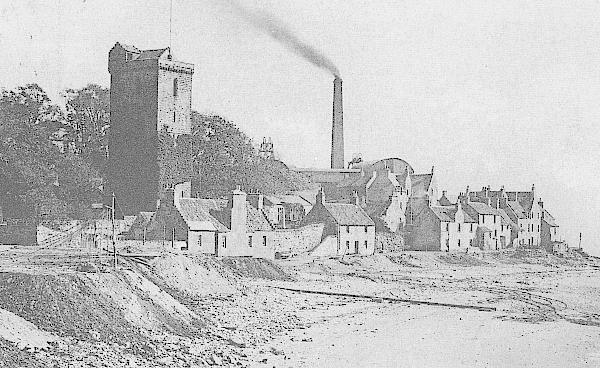
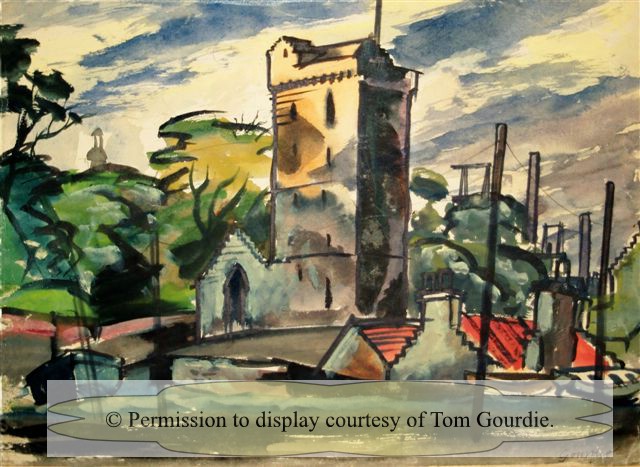
In 1753, an engine pit was sunk 258 ft. to the Dysart Main
Coal seam for pumping. It later became the Lady Blanche No. 1
Pit which lay on the shore at Dysart's Pan Ha'
(Panhall). The early pit worked what was known as the
'stoop and room' method which left large pillars of
coal (the stoops) to support the roof while the coal was
extracted around them leaving empty space (the rooms).
The pit may also have been referred to by locals in the late
18th century as the 'Fitzroy Pit'.
The locations of two shafts, close by the Engine Brae,
clearly feature on a map from 1895.
 |
 |
 |
| Pit opened: 1753 (as engine pit) | Pit closed: 1928 |
|---|
| Source Date of Information Supplied |
|---|
| Manager / Under-Manager / Men underground / Men above ground / Coal seams worked / Shaft details |
| 1873 (Earl of Rosslyn) |
| James McLay /
------------ / --- / --- / Main / D'cast (6 x 6) 120
ft. : U'cast (9 x 9) 198 ft.
Furnace ventilation. |
| 1874 |
| James McLay /
------------ / 90 / 17 / Main / D'cast (6 x 6) 120
ft. : U'cast (9 x 6) 198 ft.
Furnace ventilation. |
| 1875 |
| James McLay /
------------ / 90 / 18 / Main / D'cast (6 x 6) 120
ft. : U'cast (9 x 6) 198 ft.
Furnace ventilation. |
| 1876 |
| James McLay /
------------ / 102 / 14 / Main / D'cast (6 x 6) 120
ft. : U'cast (9 x 6) 198 ft.
Furnace ventilation. |
| 1877 |
| James McLay /
------------ / 88 / 20 / Main / D'cast (6 x 4) 120
ft. : U'cast (9 x 6) 198 ft.
Furnace ventilation. |
| 1878 |
| James McLay /
------------ / 90 / 30 / Main / D'cast (6 x 4) 120
ft. : U'cast (9 x 6) 198 ft.
Furnace ventilation. |
| 1879 |
| James McLay /
------------ / 64 / 24 / Main, 9' / D'cast (6 x
4) 120 ft. : U'cast (9 x 6) 198 ft.
Furnace ventilation. |
| 1880 |
| James McLay /
------------ / 77 / 23 / Main, 13' / D'cast (6 x
4) 120 ft. : U'cast (9 x 6) 198 ft.
Furnace ventilation. |
| 1881 |
| James McLay /
------------ / 80 / 23 / Dysart Main / D'cast (6 x 4)
120 ft. : U'cast (9 x 6) 198 ft.
Natural ventilation. [One fatality recorded - see Fitzroy Pit entry] |
| 1882 |
| James McLay / ------------ / 65 / 21 / Main / D'cast (6 x 4) 120 ft. : U'cast ----- / Natural ventilation. |
| 1890 |
| A. Paterson / C. Methven
/ 86 / 32 / Dysart Main
D'cast (6 x 4) 120 ft. : U'cast (9 x 6) 198 ft. Natural ventilation. |
| 1896 |
| A. G. Patterson /
------------ / 252* / 62*
* These figures include the Frances and Randolph Pits |
| Manufacturing and steam coal. |
| 1904 |
| John Irvine /
------------ / 354* / 70*
* These figures include the Frances and Randolph Pits |
| Manufacturing and steam coal. |
| 1918 |
| David Reid / John Loudon
/ 616* / 178*
* These figures for the Lady Blanche, Randolph and Frances Pits. |
| A Lady Blanche shaft was used for ventilating the Frances to which it was linked underground. |
| Plan of Abandoned Seams for Lady Blanche Pit | Pits or Mines designated in Plan |
|---|---|
| COAL; Dysart Main | DYSART
Lady Blanche |
------------------------------------
"Dunfermline Press"
27 July, 1872
On Tuesday about noon, a miner, named John Philp, while busily engaged at work in the Lady Blanche Pit, a large portion of coal unexpectedly came away, and he being in a stooping position, it alighted upon him, by which he was severely bruised. He was expeditiously relieved, and was taken to bank and conveyed home to his residence in Gallatown, where Dr. Todd was promptly in attendance. Although seriously bruised none of his bones are broken.
------------------------------------
"The Scotsman"
21 June, 1879
DYSART - SERIOUS ACCIDENT. - On Thursday morning while three men, named Archibald Smith, James Smith, and David Chrystal, were at work in the "Lady Blanche" pit, Dysart, a large mass came away without the least warning, and James Smith and Chrystal were bruised about the arms and legs, and Archibald Smith sustained serious internal injuries.
------------------------------------
"Dunfermline Press"
28 February, 1880
On the evening of Friday last, a miner named Adamson, went on the night-shift along with one of his sons, and while busy at work, about ten o'clock, a portion of coal suddenly came away upon the old man, injuring him rather severely. He was as quickly as circumstances would permit brought up to the bank and conveyed home. Medical aid was promptly in attendance, when it was found that several of his ribs were broken, besides being otherwise seriously injured.
------------------------------------
"Dunfermline Press"
25 September, 1880
A miner named Alexander Campbell, while tending on Sabbath an engine on Lady Blanche Pit, Dysart, was severely injured on the arm, which has been amputated by Dr. Goodenough.
-----------
On Tuesday, a miner named Andrew Sharp was at work in the same pit when a portion of the seam unexpectedly gave way, striking him a severe blow on the left side, and breaking his left leg.
------------------------------------
"Dunfermline Press"
12 February, 1881
On Tuesday, an accident occurred at Lady Blanche Pit. While Peter Hunter, miner, was engaged working at the coal face, a huge piece of what is known as the bottom coal came away, and fell on Hunter, crushing him severely. His companions at once went and had him extricated from his perilous position, and taken to the top of the shaft, when he was conveyed home, and attended by Dr. Porteous.
------------------------------------
"Dunfermline Press"
11 September, 1886
DYSART - FIRE AT A PIT
On Thursday morning it was discovered that fire had broken out in the engine-room of the Lady Blanche Pit, belonging to the Earl of Rosslyn. The flames spread with such rapidity that the whole building, which was of wood, was soon consumed, together with a number of boiler houses. The cause of the outbreak is assigned to over-heating. The loss is estimated at about £300, and is not insured. Between 50 and 60 miners will be thrown idle fro a few weeks.
------------------------------------
"Dunfermline Press"
18 December, 1886
On Thursday, while William Smith, fireman at the Lady Blanche Pit, Dysart Colliery, was in the act of wheeling away the furnace ashes, the slippery state of the road caused him to fall, and he sustained a fracture of one of his legs.
------------------------------------

"Dunfermline Press"
9 July, 1887
TERRIBLE ACCIDENT AT DYSART COLLIERY
FALL OF ENGINEMAN DOWN A PIT SHAFT
On Monday night, while James Penman, engine-man, was
engaged oiling the journal of a pulley at the Lady Blanche
Pit, Dysart Colliery, the pulley which works the wire rope of
an incline in the works below being in motion, Penman, for
some cause as yet unknown, laid hold of the moving pulley,
when his left hand got jammed between the wheel and the rope.
The poor man was by this means drawn off the scaffold on
which he was standing out over the open pit, suspended by his
fingers. The engine-man, who was working the shaft hearing
his cries, instantly stopped the engine, but the weight of
the body being too much for the shattered hand, the fingers
parted from it, precipitating him into the shaft.
At first it was thought that the poor man must have fallen
to the bottom of the pit, which is about 100 fathoms deep,
but on a search being made he was found lying insensible on
some cross beams or scaffolding, 40 or 50 feet from where he
fell.
He was removed home with all speed, and Dr. Goodenough was
soon attending the sufferer. Penman is upwards of 40 years of
age, and much sympathy is being expressed for his wife and
numerous family, who are all young.
------------------------------------
"The Scotsman"
15 August, 1887
THE FIRE IN A DYSART COAL PIT. - It is believed that the fire in the Dysart coal pit has now been stamped out, as no trace of it can be found. Several miners engaged in Francis pit and a few employed on the "up load" of the Lady Blanche pit were idle during the past week in consequence of the fire.
------------------------------------
"Dunfermline Press"
15 October, 1887
On Saturday morning an accident occurred in the Lady Blanche Pit, belonging to the Earl of Rosslyn, whereby a young man named William Adamson, aged nineteen, was instantaneously killed. The deceased, along with his father, was engaged in cutting their "head coal", and while in the act of preparing a hutch for filling, the coal suddenly gave way and fell heavily upon both men. The young man's head, being caught between the falling coal and the hutch, was fearfully mutilated, but the father when extricated was not very seriously hurt.
------------------------------------
"Dunfermline Press"
11 August, 1888
DYSART - PIT ON FIRE
Fire broke out on Monday morning in the underground
workings of the Dubbie Pit, Dysart Colliery, belonging to the
Earl of Rosslyn. It seems to have originated in the high
workings, and so great was the smoke when the men went down
the pit about five o'clock that they had to re-ascend the
pit at once. The men employed at the Lady Blanche Pit, had
also to stop work; the workings of both pits being connected,
the smoke coming through the passage was so great that it was
considered dangerous to remain longer down. On the alarm
being given, an effort was made to have the fire built up.
The origin of the fire seems to have arisen from the refuse
that is left in the workings by the miners after the coal is
removed.
About 180 men will be thrown idle by the occurrence. This is
the second time that fire has broken out in the same mine
during the last twelve months. The fire has since been got
under by the building-up of the passages. The miners have
again resumed work.
------------------------------------
"Dunfermline Press"
24 August, 1889
On Monday, while James Grant, miner, was working in Lady Blanche Pit, a quantity of stone fell upon him from a height of eight feet. He was attended to by Dr. Proudfoot, who found he had received severe internal injuries.
------------------------------------
"The Scotsman"
18 August, 1891
THE EARL OF ROSSLYN AND DYSART HARBOUR. - The Earl of Rosslyn intends to develop the coal export from Dysart Harbour. All the coal for shipment has at present to be carted to the vessel side, but a tunnel is now to be constructed from Lady Blanche pit to the harbour. Operations have already commenced, and the Countess of Rosslyn, in company with Lady Compton, Lady Sybil, and Lady Angelina, performed the opening ceremony by firing the first two blasts. The tunnel will run under the policies of Dysart House to the harbour, and is expected to take about eighteen months to complete.
William H. MacLeod, Guardbridge, a frequent contributor to the website, who spent much of his boyhood
in Kirkcaldy, has sent us some more of his recollections:
"The Dysart Tunnel was a failure. The reasons are obscure but relate to the
variation in coal type demanded by shippers, but have I never had this explained. The tunnel started
at the Lady Blanche but I have never definitively established as to whether from the pit yard or direcly
from the underground galleries. As the coal would have to be screened, to some degree at least, I suspect
the former. As a child the tunnel mouth had a great fascination. The exit was only provided with an
increasingly dilapidated sparred wooden barrier. Eventually this disintegrated and for a time removed
but we were either not brave enough or foolhardy enough to venture in. Now it has a decent steel
door or so I seem to recall. When coaling stopped in 1927 it would have no function at all but it
went out of use long ere that. It was whispered that the mining engineer, a Mr Patterson, received
some discredit from the venture but this is probably an unjustified libel. I have a picture of this somewhere.
There still is a tunnel from the harbour to the beach where the ships coming in in-ballast disposed of their
ballast. The ballast bank comprised many interesting stones including flints."
------------------------------------
"Dunfermline Press"
27 May, 1893
Early on Tuesday morning, a pit worker named Alexander Barclay, residing in Cross Street, sustained severe injuries while working in Lady Blanche Pit, by a heavy piece of coal falling from the roof, striking him on the head, cutting and bruising him severely. For several hours he was in an unconscious state, and was conveyed to Kirkcaldy Cottage Hospital.
[Alexander Barclay died later as a result of this accident.]
------------------------------------
"The Scotsman"
18 May, 1895
IMPROVED COALING FACILITIES AT DYSART.- The Earl of Rosslyn, who has taken a special interest in endeavouring to facilitate the shipment of coal at Dysart harbour, is just completing an extensive tunnelling operation between his collieries and the harbour. By this means coal will be run from the pit right down to the ship's side.
------------------------------------
"The Scotsman"
30 December, 1899
FATAL MINING ACCIDENT. - An accident occurred at Lady Blanche Pit, Dysart, yesterday, resulting in the death of David Pow, miner, twenty-four years of age, who resided at Fitzroy Square, Dysart. Deceased was working at the coal face, when a heavy fall of coal and stone came from the roof. Several men, who were in the vicinity, went to Pow's assistance when they found him under a piece of coal weighing about five tons. Deceased leaves a widow and five children.
------------------------------------
"Dunfermline Press"
23 March, 1901
James Lessels, twenty-one years of age, residing at Fitzroy Square, Dysart, was killed on Tuesday by a fall of coal from the roof in Lady Blanche Pit, Dysart Collieries. His father was working near him at the time of the accident. There was still life in him when extricated, and Dr McIntosh was immediately in attendance, but the efforts of the doctor were of no avail.
------------------------------------
"The Scotsman"
12 April, 1901
FATAL ACCIDENT INQUIRIES. - Before Sheriff Armour and a jury, a number of fatal accidents inquiries were conducted at Cupar yesterday. These related to [several including] ... James Leslie, miner, Coalgate, Dysart, who was killed through being buried by a fall of coal, while in the act of shearing out a pillar of coal in the underground workings in the Lady Blanche Pit, Dysart ... Formal verdicts were returned in each case.
-----------------------------------------------
"The Scotsman"
12 April, 1901
FIRE AT EARL OF ROSSLYN'S COLLIERY. - Fire has broken out in an old working in one of the Dysart collieries, between the Lady Blanche and Frances pits. The smoke became so intense that the miners had to leave the pits. At Lady Blanche pit an experiment was made by lowering down to the bottom of the shaft a cage containing several mice for the purpose of ascertaining as to whether the air was foul, and if it would be safe for the men to descend to work. When the cage was drawn up to the pithead it was found that all the mice were suffocated, thus showing that the pit was unsafe. A number of workmen, however, were able to descend the Frances pit, and are now engaged building up the passages leading to that portion of the workings where the fire existed. The men engaged at both pits have, unfortunately, been thrown idle.
-----------------------------------------------
"The Scotsman"
28 September, 1910
FIRE AT DYSART COAL PIT. - Yesterday morning an outbreak of fire occurred at Lady Blanche Pit, Earl of Rosslyn's colliery, Dysart. Although the outbreak was not of a serious nature, it was considered advisable to withdraw the men to avoid danger from poisonous gas. A staff of workmen are employed building in the fire.
-----------------------------------------------
"The Scotsman"
17 January, 1914
DYSART PIT EXPERIMENT. - At the Earl of Rosslyn's Collieries (Limited), Dysart, an experiment with far-reaching possibilities is about to be made. The pit is one of the oldest in the county, and the workings extend for a considerable distance under the Firth of Forth. The seam, which is a very thick one, has been worked on the long-wall system - a very safe principle, but one which necessitates about half of the coal being left in the form of pillars to support the roof - and the proposal is to fill up the present workings by means of hydraulic stowage, so that the pillars or walls of coal referred to may be worked out. For this purpose it is proposed to sink a bore on the beach to the eastwards of Dysart, where the main dook of the Lady Blanche Pit will be reached at a depth of about sixty fathoms, and through this bore it is proposed to pump sand and other material mixed with water into the workings. The material will be packed in tight by hydraulic pressure, and will form a safe support to the roof, and allow the coal to be worked out as stated. The experiment has been tried with success in Germany and France, and the operation will be much simplified in the case of the Dysart pit, where the coal has all been worked on the "dip", instead of, as in many collieries, on the "rise", which will make the work of stowage very much easier.
-----------------------------------------------
"Dunfermline Press"
24 April, 1915
DYSART PIT ON FIRE
Over 200 men have been thrown idle through an outbreak of fire in the Lady Blanche Pit, Dysart. The fire broke out during the weekend in an old working on the south side of the dook. Steps were at once taken to cope with the outbreak, but on Tuesday, to avoid any danger from after-damp, it was considered advisable to set both the Lady Blanche Pit and the Frances Pit idle. The affected area is being built off, and the work is proceeding satisfactorily, although it may be some time before it is completed. On account of the fire, work at the harbour, which is at present crowded with vessels awaiting coal cargoes, has been entirely suspended.
-----------------------------------------------
"The Scotsman"
12 May, 1915
THE DYSART PIT FIRE - WORK RESUMED. - After having been idle for about three weeks on account of an extensive outbreak of fire in the workings, the Frances Pit, Dysart, was restarted yesterday. The outbreak occurred in the old workings on the south side of the dook of the Lady Blanche Pit, and although steps were immediately taken to have the affected area built off, both the Lady Blanche and the Frances Pits were thrown idle. A week later the work had progressed sufficiently to permit of two sections of the Lady Blanche Pit being reopened, but owing to the pressure of black damp in large quantities the Frances Pit could not be restarted until a new road had been driven through one of the coal pillars for ventilation purposes. This was completed towards the end of last week, and yesterday the miners, numbering over 200, resumed work.
-----------------------------------------------
"Dunfermline Press"
12 February, 1916
DYSART PIT ACCIDENT.
An accident occurred in the underground workings of Lady Blanche Pit, Earl of Rosslyn's Colliery, Dysart, on Wednesday, whereby two men were injured, one very severely, whilst three others had narrow escapes. A working party of five men had been transferring from one part of the pit to another, when the foremost of a race of hutches on which they were travelling collided with one of the ventilating doors, with the result that the coupling parted, and the hutches began to run back on the steep gradient. Three of the men managed to jump clear, but two others - Archibald Stoddart, pit roadsman, 23 Cross Street, Dysart, and David Taylor, bricklayer, 227 Rosslyn Street, Kirkcaldy - remained in the hutches, which, after travelling about 100 yards, overturned, throwing both men out. Stoddart, who was severely crushed and bruised about the back, and received severe scalp wounds, was removed to Kirkcaldy Hospital. Taylor, although suffering from severe injury to his left side, was able to proceed home.
-----------------------------------------------
"The Scotsman"
25 December, 1918
James Muir (14), pit-boy, residing at 63 Nether Street, Kirkcaldy, died in Kirkcaldy Hospital from injuries sustained through being crushed by a fall of coal in the Lady Blanche Pit, Dysart.
-----------------------------------------------
"Cowdenbeath & Lochgelly Times & Advertiser"
20 July, 1921
DYSART MINER KILLED BY FALL OF COAL
A fall of coal in the Blanche Pit, Earl of Rosslyn's Collieries, has resulted in fatal injuries to a miner, Thomas Young (29), residing at 34 Relief Street, Dysart. The deceased man was so badly crushed by the fall that he died on being removed to the surface. He leaves a widow and six of a family.
-----------------------------------------------
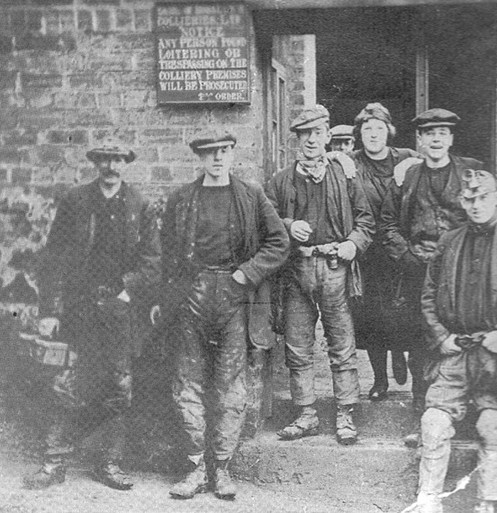
Lady Blanche workers - 1921
[Contributed by W. H. MacLeod, Guardbridge]
 |
-----------------------------------------------
"The Scotsman"
4 December, 1922
DYSART HARBOUR EXTENSION
LORD ROSSLYN'S £50,000 SCHEME.
Lord Rosslyn has put before Dysart Town Council a big scheme for the extension of
Dysart Harbour at an estimated cost of £50,000. For many years past practically the whole
business done at the harbour has been the shipment of coal from the Lady Blanche Pit,
belonging to the Earl of Rosslyn's Collieries (Limited). Despite the lack of modern
arrangements for the export of coal. trade has experienced a considerable fillip, and this year
the figures have broken all previous records, and will almost certainly amount to 100,000 tons.
Sailing vessels and small steamers only can at present be accommodated in the harbour, and,
in view of the fact that the expenditure involved in any extension would be too heavy for a
body such as the Town Council of Dysart, his Lordship proposes to form a subsidiary company
to lease the harbour from the Town Council at a rental of £400 per annum.
This company, it is proposed, will release the Council of all taxes and expenses for repairs, and
will, at a cost of £50,000, carry out extensions to the harbour, which will, at the expiry of the lease,
revert to the town. It is anticipated that part of the capital for the scheme will be forthcoming in the
form of a grant under the Trades Facilities Act.
Under the scheme proposed by his Lordship, a considerable enlargement will be made at the
harbour, whereby it will be capable of accommodating ships of 1500 to 2000 tons. The approval
of the scheme, it is thought, will bring about big developments at Dysart Colliery, and it is
expected that the Lady Blanche Pit alone will be able to maintain an output of 1000 to 1200 tons
per day.
Waggons running from the underground workings of the Lady Blanche Pit to the quayside via a
tunnel will provide a means of conveying the coal, which at present is accomplished by carts.
-----------------------------------------------
"The Scotsman"
4 August, 1924
IMPROVEMENTS AT DYSART HARBOUR. - The Harbour Committee of Dysart Town Council have decided on a scheme of improvement, principally to the dock gates, estimated at £3000. As practically the whole output of Lady Blanche Pit is shipped from Dysart Harbour, and the repairs will necessitate the closing of the dock for a month, some three hundred workers will be thrown idle.
-----------------------------------------------
"The Scotsman"
20 August, 1927
DYSART MINER KILLED. - Henry Page, 43 years of age, a miner, who resided at 24 Watt Street, Dysart, was accidentally killed in the Lady Blanche Pit, Dysart, belonging to the Fife Coal Company, yesterday, through a fall of material from the roof. Death was instantaneous. Deceased leaves a widow and a young family. On account of the accident an idle day was declared at the pit.
-----------------------------------------------
"The Scotsman"
3 March 1928
DYSART PIT TO CLOSE
A notice has been posted at the Lady Blanche pit, Dysart, to the effect that on and after March 16, the engagement of all persons employed, with the exception of boiler firemen and surface haulage engineers, will terminate. The Lady Blanche, which is owned by the Fife Coal Company, usually employs about 200 men, but for some time past the number has been reduced to about 60. It is understood an effort will be made to find employment for them in the adjoining pits belonging to the same company.
-----------------------------------------------
"The Scotsman"
4 April, 1928
CLOSING OF A FIFE PIT.
EFFECT ON DYSART HARBOUR.
At a meeting of Dysart Town Council last night, the question of the closing of the
Lady Blanche pit by the Fife Coal Company was considered. This pit usually employs
about 200 men, but the number has decreased in recent years, and when the pit was
closed in March, only about 60 men were employed. The trade at the harbour has
decreased accordingly, and the closing of the pit meant that the harbour itself would
be as good as closed.
Provost Macleod stated that a deputation from the Council had been received by the
managing director of the Fife Coal Company, and it had been pointed out to him that the
Council had spent various sums in repairs to the harbour to the extent of about £5000,
on the assurance of the Coal Company that efforts would be made to revive trade. This
money had therefore been spent uselessly. The reply was to the effect that no definite
promise of a revival of trade was given, and when it was referred to, it was only as a
hope that such a thing would take place. The Coal Company had only closed the pit,
and the harbour was the Council's own affair.
The Provost suggested that the directors of the Fife Coal Company should be asked to
reconsider the matter with a view to recompensing the Council for the expenses they
had incurred. This was unanimously agreed to.
-----------------------------------------------
William H. MacLeod, Guardbridge, recalls:
"A great source of interest in my earlier days was the Lady Blanche. This pit stopped coaling in
1928 but continued as a ventilation shaft for the Frances (and, I suspect an emergency shaft before the
mine was driven at the Dubbie.)
The Lancashire boiler range could be seen from the adjacent street which was high above the boilers the
full details of which could be studied. The air intakes were very elaborate brick structures with arched entries
facing the sea and I suspect that the fan sat between these and delivered the air into the upcast(?) shaft whose
headgear was still in position. The fan was driven by a steam engine mounted some height above the ground, its
house being entered by an inclined steel ladder-way. I would have loved to climb that ladder-way and look inside
but boys did not do such things in those earlier days! However, we prowled round and round that site and
watched eagerly as the shift boiler-fireman would occasionally mount the ladder and enter. The engine was
non-condensing and exhausted a great cloud of steam continuously. We christened it the 'Ever Working'
and felt cheated when it was electrified in the very early forties - I seem to recall."
-----------------------------------------------
| See also Dysart Colliery entry - East Fife Index. |
|---|
