| Much of East Fife's rural landscape masks its industrial past. Many quiet pastures in our lovely Kingdom were once scenes of coalmining activity in the eighteenth and early nineteenth centuries. Although little now survives of these coalmining activities which were on a very much smaller scale than modern pits, the fresh ploughing of a field will often reveal some evidence in the appearance of patches of dark pit waste from former workings. Examination of aerial photographs of these areas can reveal a landscape covered with small indents and markings suggesting the sites of many unnamed old shafts and shallow workings. Often a brief mention in an old document is the only evidence that they once existed. Nevertheless, they too deserve to be recognised in our record of the coalmines and pits of Fife. |
A settlement in the East Neuk of Fife, Lochty is situated
4 miles north-west of Anstruther and 7 miles west of Crail.
In addition to the old shallow workings known to have worked
the crops of the Fore and Back Coals between Lovelyhill and
north of Silverhall [see Lovelyhill-Silverhall entry],
only two old shafts have been identified to date - one to the
north-west of Lochty Place (now Nether Lochty) in the field
immediately south-east of the remains of Pittarthie Castle, a
17th-century fortified house associated with the Bruce
family; the other south-east of Lochty Place and several
hundred yards east of Lochty farm.
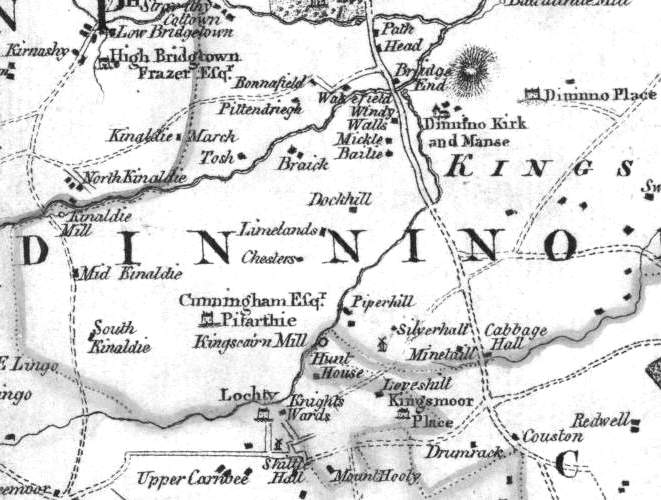
The old windmill by Lochty (see 1775 map section) may have
been employed in the working of coals or draining the mines
in the vicinity.
In 1966 the Fife Railway Preservation Society began to
operate a private railway as a working Steam Railway Museum
on a remnant of the 15-mile-long Lochty branch railway line
which had been opened in 1898 to serve the farms and the coal
pits in the area. The remnant of the railway still shows on
modern OS maps.
 |
 |
The names of these small individual pits is not known but they could have been sunk by James Bell, Markinch, in the period 1896-1900.
--------------------------------
Information on coals worked at, or near, Lochty
There are records of a great deal of boring in this
district especially to the south and south-east of Lochty
farm, probably around 1900 by the newly formed Lochty Coal
Company, and also earlier in the 1870s by the Fife Coal
Company who bored to the two coals at Lochty, two miles to
the north of Kellie Colliery. However, the results of the
latter borings were not such as to induce operations for
working the coals.
A record of the seams from the Fife Coal Company bores is
given below:
| Back Coal (The Upper Seam) | |
| Coal | 9 in. |
| Stone | 1 in. |
| Coal | 1 ft. |
| Fireclay - coaly | 6 in. |
| Coal - clean | 2 ft. 3 in. |
| Coal - brassy | 6 in. |
| Coal | 8 in. |
| Fakes | 1 in. |
| Coal | 9 in. |
| Fakes | 1 in. |
| Coal | 1 ft. 3 in. |
| Fireclay | - |
| Total thickness | 7 ft. 11 in. |
| Fore Coal (The Lower Seam) | |
| Coal | 2 in. |
| Coal - soft | 4 in. |
| Stone | ½ in. |
| Coal | 1 ft. 3 in. |
| Fakes | 1 in. |
| Coal | 1 ft. 6 in. |
| Fireclay and fakes | - |
| Total thickness | 3 ft. 4½ in. |
The outcrops of the Back and Fore coals, worked to some
extent during the 19th century also around Arncroach and
Kellie, and which Landale (1837) first described as being of
'comparatively little value', were believed to be cut
off by a fault south of Kingscairn Mill (see 1775 map
section). Landale also sought to recognise the Back and Fore
coals on the north side of this fault in the Gilmerton area
(see entry for Brigton pits and mines) largely on the
basis of the occurrence of black shale and shell-limestone in
the waste heaps there.
Such materials, however, commonly occur in the roofs of coals
in east Fife and their presence is not necessarily indicative
of the Back and Fore coals.
In January, 1900, the East of Fife Record reported the setting up of the Lochty Coal Company to work coal on the estates of Lochty, Pittarthie and Chesters.
"The properties are situated fully five miles from Anstruther and six from St Andrews, and will have a connection with the East Fife Central Railway to ensure quick despatch to all the shipping ports in the country." It was estimated that there was "sufficient quantity in the properties to yield an output of 500 tons per day for 50 years. The coalfield... should prove a profitable undertaking and a good sound investment."
The above report from 1900 was greatly exaggerated because in addition to the 19th century bores, those drilled in the period 1936-38 resulted in no further mining operations at Lochty!
A report from 1977 contains some detail obtained from the
more important boreholes.
In Lochty Nos. 2 and 3 boreholes the coal taken to be the
Fore Coal is nearly 4 ft. thick in two leaves but the roof
was found to be composed of hard brown well-cemented
sandstone, not shell-limestone. In the older boreholes the
Back Coal was recorded as being from 6 ft. 6 in. to 7 ft. 4
in. thick, in several leaves, with a black shale roof.
In Lochty No. 3 bore, however, it is apparently represented
by a 2 in. seam, with a black shale roof, around 23 fathoms
above the Fore Coal; and in Lochty No. 2 bore it was not
found at all! The differences are described as
'probably due to rapid lateral variation', and
this raises the possibility that the Back and Fore coals
proved at Lochty may not be the same seam as the Back
and Fore Coals of Arncroach and Kellie.
--------------------------------
Lochty
| Source Date of Information (Owner) |
|---|
| Manager / Under-Manager / Men underground / Men above ground [Pit/Mine] / Coal seams worked |
| 1896 (James Bell, Markinch) |
| W. Murdoch / ------------ / 4 / 1 [Lochty] |
| Sinking |
| 1900 (Lochty Coal Company) |
------------------------------------
"Dunfermline Saturday Press"
27 December, 1873
COAL WORKING
The old coal pit at Balbuthie, on the estate of
Kilconquhar, has been reopened, and the "cherry"
seam is now being again wrought with encouraging prospects of
success.
This seam was first wrought by the late Sir Henry Bethune,
who sank a pit, which is about seventeen fathoms deep, and
drew the coals with horse power; but in those days of cheap
and plentiful fuel, the Balbuthie coals were, after a short
trial, abandoned as unprofitable.
In the event, however, of the produce of the mine not
realising a return in the neighbourhood, it is understood
that the lessee, Mr. Terrace, of Edinburgh, will work the
mineral in connection with his extensive lime quarries, and
there is thus every prospect of this coal field being
utilised to a considerable extent.
We also learn that the lessee of the Kellie minerals is
intending to examine the coal field on the Lochty lands, with
the view of working the "splint" seam which is
believed to exist in that quarter.
Mr. Skinner is also actively prosecuting the sinking of the
coal-pit at Clephington. The miners, in the course of their
work, have struck upon a fourteen-inch seam of excellent
ironstone.
------------------------------------
"Dunfermline Saturday Press"
2 July, 1892
LARGO - NEW PIT
On Monday, operations were begun in sinking a coal pit for the Messrs Brown, coalmasters, Largoward, at Lochty, in the parish of Carnbee, about three and a half miles north from Pittenweem. The estate and minerals thereon are the property of General Briggs of Strathairly, on which it is said coal was worked many years ago.
------------------------------------
"Dunfermline Press"
24 August, 1907
PROPOSED OPENING OF NEW COALFIELDS IN FIFE
For some time back boring operations have been conducted on the estates of Grangemuir and Dunino, near Anstruther. On the farm of Chesters two seams have been tapped, one 5 feet thick and another 8½ feet, with a seam of fireclay between them. It is believed that these seams are a continuation of those formerly in operations at the Lower Lochty. Negotiations are proceeding for the working of the coal by a syndicate, and it is hoped that the operations will be begun within the next two months.
--------------------------------------------
"Dunfermline Press"
28 November, 1936
BORING FOR COAL NEAR ST ANDREWS.
Boring operations for coal are now in progress on Lochty estate, a short distance south of Lochty goods station, and about five miles from St Andrews. The bore is being sunk by the Fife Coal Company, in order to ascertain the probable quantity of coal which is known to be in the area. Coal was worked some eighty years ago on Lochty estate, the mineral rights on which are owned by the Fife Coal Company. If coal is available, the Company, it is understood, intend to sink a pit, but it will take several years to develop the scheme.
--------------------------------------------
