The Lathones pits were located in the parish of Cameron,
just north of Largoward but to the south of Brewsterwells
Colliery. The Lathones coals, a different set of coal seams
from those in the Largoward coalfield only a few miles to the
south, were worked in the 1890s. It is not certain at this
stage if the pit and engine house (on 1856 OS map), on the
north side of the road leading to Lathockar Bridge, was part
of this colliery or the Brewsterwells Colliery.
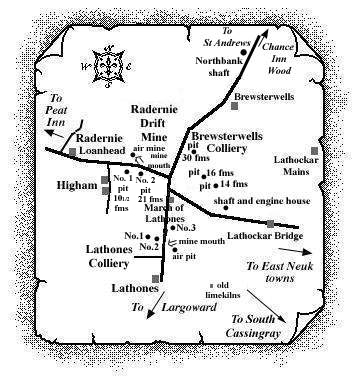
The Lathones Nos. 1, 2 and 3 pits, sunk to 5, 6 and 12
fathoms respectively, worked the area south of March of
Lathones (see map).
Records show that two pits of the Lathones colliery were in
full production in 1900 and a Lathones coal-work was still
producing coals in the early 1920s, probably the mine located
just south-east of the old No. 2 shaft.
 |
| Lathones
- 18th C employee
(service dates unknown) |
|---|
| Thomas Bisset, collier in the ground of Lathons |
Extract from the Statistical Accounts of Scotland (1795)
Parish of Cameron
"... upon the lands of Lathockar, belonging to Miss Scott, who, it is to be hoped, when she arrives at majority, will give proper encouragement to cultivate that barren spot. What has been of singular service in making such an alteration is the limestone and coal, with which this parish abounds."
"The article of coals is very much advanced in price within these 40 years: A cart load at the hill cost only 1s. 4d.; but now, for the same quantity, 3s., and sometimes 3s. 6d. is paid. Indeed, it must be owned, that the expense of working coal is greatly increased. Two fire engines are employed for that purpose, in this parish, by Mr. Durham of Largo, and the coal-hewers receive more wages. Adjacent to one of these fire engines, he has lately erected a number of houses to accommodate the workmen."
Sadly, this account does not identify the location
of these old coal-works within Cameron parish.
M. Martin & Webmasters.
| Source Date of Information (Owner) |
| Manager / Under-Manager / Men underground / Men above ground / Coal seams worked |
| 1902 (Ireland & Wilson, Lathones, St Andrews) |
| Thomas Ireland / ------------ / 14 / 3 |
| Household, manufacturing and steam coals. |
| 1904 & 1905 (Ireland & Wilson, Lathones, St Andrews) |
| ------------ / ------------ / 5 / 2 [Lathones] |
| Household, manufacturing and steam coals. |
| 1920 (Falfield Coal Co. Ltd.) |
| ------------ / ------------ / 6 / 6 [Lathones] |
"The East of Fife Record"
11 May, 1900
"The miners in the district have found temporary employment at the new pit at Cassingray. The pit, which is managed by a Glasgow firm, promises to be a great boon to the area ... There are also prospects of the Drumhead Colliery, belonging to Messrs. Mitchell and Laing, being restarted. The two pits at Lathones, owned by Messrs. Ireland and Wilson, are working full time ..."
-----------------------------------------
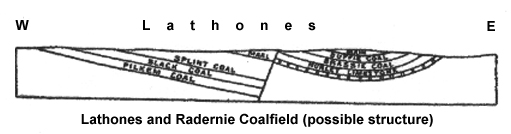
The Lathones - Radernie Coalfield
The great dislocation which truncated the Largoward coalfield on the north was a far more powerful fault than any of the others of that field. It completely cut off all the coals in their northward extension and brought in another group of coal seams and an entirely different geological structure - the perfectly distinct Lathones and Radernie coalfield which ran in a north-westerly direction between South Cassingray and Higham.
Information on coals worked at, or near, Lathones Pits
(based on a report from 1900)
The exposure of the Hurlet Limestone in the line of quarries east from the March of Lathones showed the position of the coal seams which belonged to the lowest group of the lower coals. Four seams have been worked and some of them were still being mined at Lathones, on a small scale, into the 1920s.
About 50 feet above the Hurlet Limestone lay the Brassie (or Brasso) Coal said to have been 3 feet thick in the workings of the early part of the nineteenth century. A section met with in the later pits was as follows:
| Limestone | 4 ft. |
| Fakes (shaly sandstone) | 0 - 4 ft. |
| COAL | 2 ft. 3 in. |
| Sandstone | - |
The next seam, known as the Duffie (or Duffo) Coal, was described as 3 ft. 6 in. thick with 4 in. of shale. The following composition was typical of the workings at Lathones around 1900:
| Blaes (shale) | - |
| COAL | 1 ft. 3 in. |
| Stone | 1 ft. 6 in. |
| COAL | 2 ft. 9 in. |
| Sandstone | - |
A third seam, called the Main or Marl Coal, was 3 ft. 4
in. thick in the old pits and lay about 100 feet above the
Hurlet Limestone. A fourth seam, the Cherry Coal, is said to
have been worked with a thickness of 4 ft. 6 in.
As the little basin opened out towards the north, the coals
on its eastern strike towards the north-east are said to have
been worked formerly to a depth of 72 ft. between Lathockar
and Brewsterwells.
A section to illustrate the probable structure of the
Lathones - Radernie Coalfield is shown below:
| Plans of Abandoned Seams for Lathones | Pits or Mines designated in Plans |
| COAL; Splint | Lathones |
| COAL; Duffo; Marl; Brasso; Main (1905) | Lathones Nos. 1, 2, 3 |
| COAL; Duffo (1921) | Lathones |
-------------------------------------------------
"The Scotsman"
2 August, 1823
At Lathones, on Saturday morning, an elderly female put a period to her existence, by throwing herself into a coal-pit. It seems she had quarrelled with her family on the preceding day, and threatened self-destruction. Her son, dreading an attempt to execute this threat, watched her during the night. Towards morning, overcome by fatigue, he fell asleep; and the old woman snatched the opportunity to perpetrate her awful purpose. The son having awakened from his slumbers, was alarmed at the absence of his charge, and immediately began a search; but it was not till hill and dale had been traversed in vain, that an apron was observed suspended on a paling which surrounded an old coal-pit at a short distance from the house. Some colliers were procured, who descended the pit, and succeeded in bringing up the mangled corpse of the unhappy woman.
-------------------------------------------------
"Fife Herald"
18 March, 1847
NEW EAST OF FIFE COLLIERY
A plentiful supply of GOOD COAL is now to be had at LATHONES COLLIERY at 1s 2d per load of 3½ cwt.
JAMES SKINNER, Lathones, 18th March 1847.
[We are grateful to Maxine Dundas for supplying the above newspaper article.]
M. Martin & Webmasters.
-------------------------------------------------

"Fifeshire Journal"
18 October, 1849
EARLSFERRY - MELANCHOLY ACCIDENT
On Saturday the 6th inst., as William Foster, collier here, was about to descend into the pit at Lathones coal-work, where he had been employed for some time, the rope broke, or the splicing wherewith it had been repaired gave way, and the unfortunate man was instantly precipitated to the bottom. He was got up and conveyed to this place, but in so fearfully a mangled condition that he lingered in extreme pain till Sunday last, when death put a period to his suffering. He has left a widow and four infant children in destitute circumstances. This affair is now taken up by the county authorities for immediate investigation.
-------------------------------------------------
[While the above newspaper report states that the accident took place at a Lathones coal-work, Maxine Dundas, a ggg-granddaughter of William Foster, contacted us in April 2013, to say that, according to Court papers, the accident had actually occurred in the Gin Pit of Higham Colliery. We have decided to also include this information within this Lathones Colliery entry.]
M. Martin & Webmasters.
Probably sunk in the 1840s, at, or close to Higham Farm,
then or lately occupied by William Wilson, farmer, the Gin Pit,
the depth of which was around eighty-three feet, is known to
have been worked by a Mr James Skinner, tacksman. Sadly,
on 6th October 1849, William Foster fell down the shaft of the
Gin Pit and was so severely injured that he died on 14th October.
According to Maxine, the circumstances of this accident resulted in the tacksman being charged with the culpable homicide of William Foster at the said Gin Pit. Details of this Indictment have been presented in the Higham (or Radernie) Colliery pit entry.
To date, we have been unable to determine the location of the Gin Pit, close to Higham Farm, but note the presence of an engine house and shaft on an early O.S. map some distance to the east of Higham Farm, and east of March of Lathones.
-------------------------------------------------
