Owners: possibly Wemyss Collieries
The earliest date/record of the mining of coal by the
banks of the River Leven, close to Methilhill, has been given
as 1611. At Kirkland, water-powered engines were used to pump
water from the small pits back into the River Leven. On the
other side of this river, there were also a number of small
pits on the estate of Durie (see separate entry).
A lade is believed to have been dug in the 18th
century to bring water from Burnmill Dam to the pits at
Kirkland, to power the engines. It is believed that,
around 1785, the engines of the Kirkland pits fell into such
a poor state that they were, in fact, not repaired by the pit
owner of that time.
A little earlier, a waggonway had been built close to the
site of present-day Methil Brae for the purpose of
transporting coals from the Kirkland engine pits to the busy
harbour at Methil.
The exact opening and closing dates of these engine pits are
not known.
 |
------------------------------------------------
One abandonment plan indicates that at least two seams of coal were wrought at these early pits. See also *** at the foot of this entry.
| Plan of Abandoned Seams for Kirkland Engine Pit | Pits or Mines designated in Plan |
|---|---|
| COAL; Eight Feet; Seam unnamed. |
METHILHILL; Kirkland Engine
Plan Custodian: Williamson, Miller & Currie, Edinburgh. |
------------------------------------------------
We were delighted when Gordon Sutherland, Methil, got in touch in
June 2009, to relate that he had found some information on the Kirkland pits in an article called 'Kirkland Village History Trail'. Printed in the 1970s, the author of this booklet was Mary Cameron. She acknowledges the information on the early Kirkland pits was from an article by A. S. Cunningham (1904). We hope we cause no copyright infringement by presenting some of the notes contained in the original article.
M. Martin & Webmasters.
Kirkland Coals.
The 1215 Charter is reaffirmed in a charter of 1484, which indicates that there were coal heughs
in existence. When coal was discovered at Kirkland No. 1 the "power" used was from
the putters who carried the coal on their backs. The Kirkland Slope opened out as an outcropping
seam of coal.
Kirkland was the focus within the Burgh Barony of Methil at that time for the coal industry. From the
C14th to the C16th many different methods were used to extract the coal. The area of the Kirkland
coals had been operated manually, then by horse gin, the last of which ceased to operate independently in
1572. In 1572 the Egyptian chain and bucket system powered by water wheel was introduced. However,
particularly at Kirkland, water drainage became a problem.
In 1633, John, the First Earl of Wemyss, solved the problem of gas and damp by driving through a
passage in the coal strata, from both the Maiden Hill and Pirnie and the Kirkland to the Dene Burn at
present Denbeath.
By 1650 onwards there was a great demand for Kirkland coals. Kirkland
was in a period of transition and we find different methods of extraction working together. In Kirkland
the water wheel had been introduced but was operating alongside the horse gin; the water wheel
extracting the water and the horse gin extracting the coal.
In the 1580s a weir was constructed to drive the water wheel. The homes for the miners were
situated where the steelworks stand now.
David Lord Elcho who managed the coals at this time had his residence at Kirkland and it was
this residence that was called Kirkland Tower House. His residence lay to the west of Kirkland
mining village but not a trace of it remains.
By 1775, the Kirkland coals were once again endangered by water and the great pumping engines
that had been installed by that time were broken down. The lower workings of the pit were water-logged.
From then the future of the Kirkland pits was to lie dormant until the C20th.
Messrs Greenhill and Company
at this time took over the site to build a large spinning factory; the site offered an advantageous position
near the River Leven where there was a water supply to use as a power source.
They also ran a successful industry on this site just as the Earls of Wemyss had done before them.
Kirkland remained a populated area at that time. The coming of the mills necessitated the building of
houses for the workers. The original village coming into industrial times was situated along the site
from Methilbrae to Methilmill Cemetery.
Kirkland and the Court of Session:1790.
Another interesting period in the history of Kirkland was the case of Wemyss versus Durie that
came before the Court of Session in 1790.
The Lairds of Durie, owners of the Burnmill Industrial Estate in Leven, were the main objectors to
the proposed siting of the new Kirkland Mill. It is in the evidence led at the Court of Session that
we find evidence of the Kirkland Pits of those days. The Christies of Durie had inherited the
successful industrial site at Burnmill that was dependent on the volume of water that the Laird of
Wemyss allowed to pass over Kirkland Dam Dyke, for its power. The Wemyss had in 1717 sold
the Haughlands to the Gibsons of Durie while exercising this privilege, so when the Christies
took over the Gibsons' lands in 1785, they came under this condition as previously exercised.
They objected to the proposed enlargement of the amount of water being drawn off and this
led to the Leven Water Dispute of the 1790s in the Court of Session.
In the evidence we hear how important Kirkland Dam Dyke was in the C18th.
It had been built into the river many years ago and the land flooded to the extent of 2 acres to
supply the head of water to generate the power from the water wheels. From the C16th the dam
water was used to power the pumping engines to keep the Kirkland Pits free of water.
According to the witness in the Court of Session, two engines were worked in 1725 by the dam
water, acting on the chain and bucket system. By 1740 these engines were replaced by pump
engines, both of these systems required water wheels. However, the objection that the Christies
had was to the erection of a giant water wheel, which would be in constant use by the
proprietors of the new Kirkland Mills.
The water wheel would be 13 metres in diameter and one metre wide, with water vane paddles
25cm wide, for which sufficient volume of water was needed to guarantee three full revolutions
of the wheel every minute.
However, Durie lost the case as the Wemyss Family were only exercising their rights under
confirmed charters from the C14th onwards.
When the dispute was over the spinning mill came to Kirkland.
Kirkland Water Power.
An interesting use of Kirkland water power drawn from the River Leven, was the construction
of a stone lead from the River Leven to the Kirkland Pits and the water wheel of the chain
and bucket system. The size of the aqueduct was 220cm by 258 cm.
To increase the flow of water in that channel the weir was raised by boarding, as a result
both sides of the weir were flooded. This provided a massive water supply with good
construction and was an advantageous resource for the new proprietors of the new Kirkland Spinning Mills.
------------------------------------------------
Methil man's wonderful Kirkland project
Gordon Sutherland, Methil, got in touch with us again, in December 2024, to offer us the opportunity to display several of his wonderful drawings constructed from his interest and research into the old Kirkland pits. He also acknowledges information from the article by A. S. Cunningham (1904) and, again, we hope we cause no copyright infringement by including some of the notes contained in the original article.
C. Martin & C. Sparling, Webmasters.
Kirkland Dam-Dyke
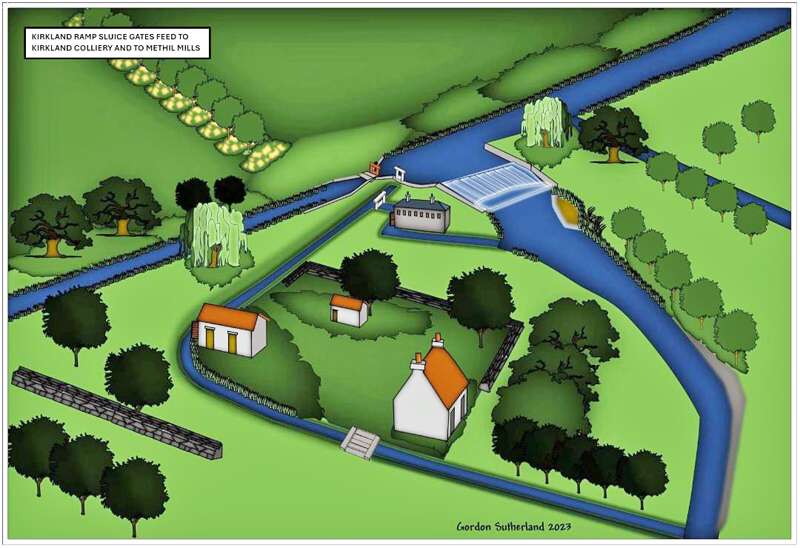
Kirkland Ramp Sluice Gates Feed to Kirkland Colliery and to Methil Mill
------------------------------------------------
Extract from A. S. Cunningham
RAMBLES IN THE PARISHES OF SCOONIE AND WEMYSS
Hundreds of years ago the Kirkland dam-dyke was erected on the Leven and ground was flooded to the extent of two and a half acres. From this dam water was for more than 150 years drawn for working the pumping engines through which the Kirkland pits were kept free of water.
Kirkland Waterpower.
An interesting use of Kirkland waterpower drawn from the River
Leven, was the construction of a stone lead from the River Leven to
the Kirkland Pits and the water wheel of the chain and bucket
system.
To increase the flow of water in that channel the weir was raised by
boarding, as a result both sides of the weir were flooded. This
provided a massive water supply with good construction and was an
advantageous resource for the new proprietors of the new Kirkland
Spinning Mills.
------------------------------------------------
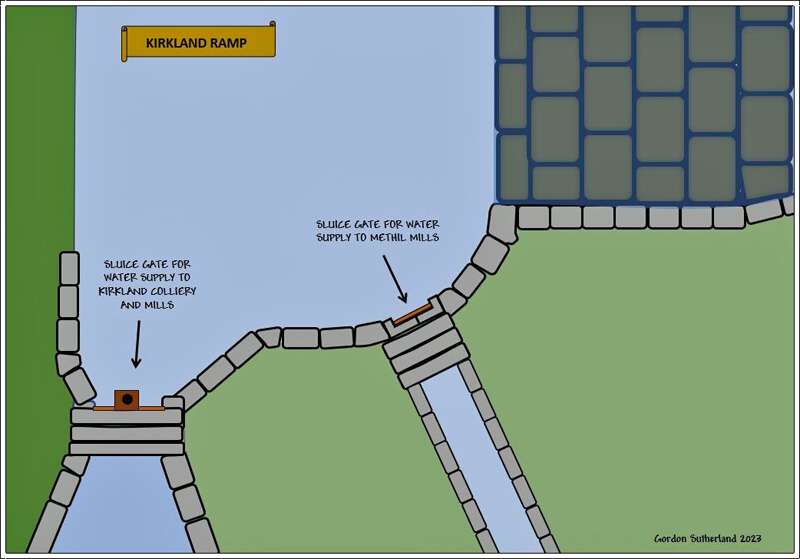
Kirkland Ramp
------------------------------------------------
Kirkland Gin Pit & Water Wheels 1750
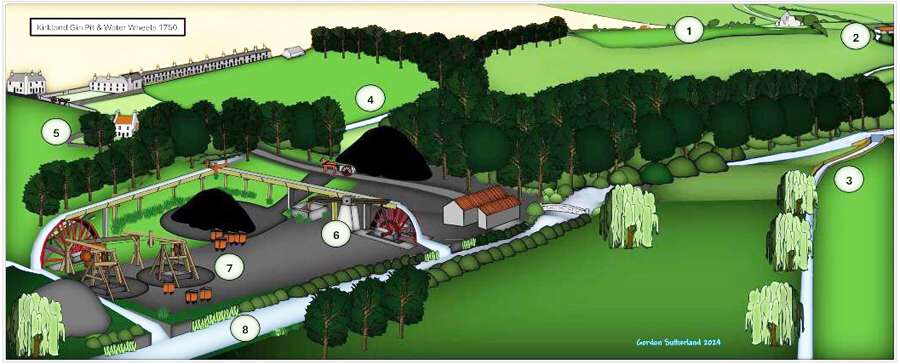
1. Methil Mill Cemetery
2. The Methil Mill
3. Burnmill Lade
4. Kirkland Lade which comes from beyond Methil Mill Cemetery
5. The Colliery Manager's house - built 17th century
6. Water Pump Drive Linkage
7. Dual Gin Pit
8. River Leven
------------------------------------------------
Extract from A. S. Cunningham
RAMBLES IN THE PARISHES OF SCOONIE AND WEMYSS
One of the chains
and bucket-engines was displaced by a pump-engine in 1730,
and the wooden pumps introduced proved such a success
that a second pump-engine was erected in the days of
William of Wemyss. The wheel for the bucket engines
was about forty feet in diameter, while that for the first
pump-engine was twenty-eight feet. For over a year, coals
were raised from one of the pits by waterpower, but the
horse-gin system seems to have been more satisfactory, and
the water-power winding engine was abandoned and the
gin again introduced.
One of the witnesses in the action
thus describes the pits and machinery:
"The new engine pit was 62 fathoms deep, and the pumps
discharged
their water about seven fathoms below the pit mouth. The
engine wrought four sets of pumps, two upon each beam. The
pumps consisted of two bottom pumps, a middle pump, and an
upper pump. One of the bottom pumps discharged its water into a
stone mine about nineteen fathoms from the bottom of the pit,
which mine had a communication with the old engine pit, and the
water run into the mine was raised by the two sets of pumps,
wrought by the old engine. The working-barrels of the two bottoms
sets of pumps in the new engine-pit were ten inches in diameter,
and the middle and top sets were nine and a half inches. The new
engine went six strokes a minute."
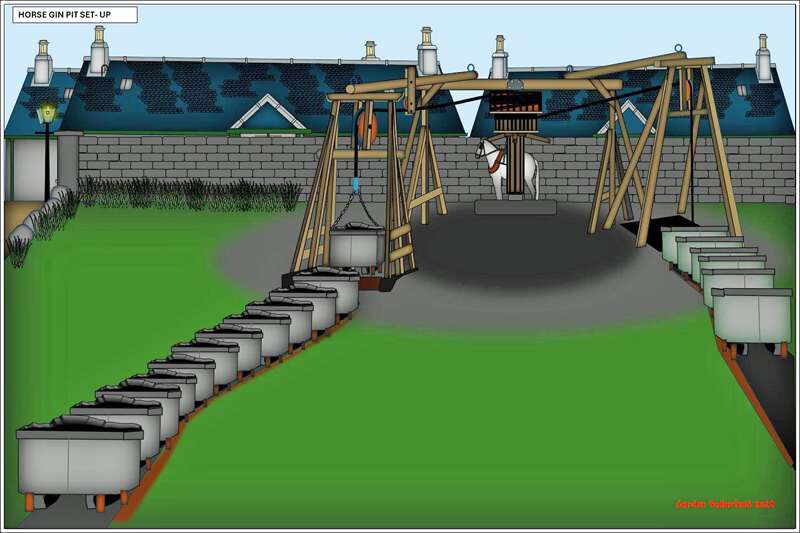
Horse Gin Set-Up
------------------------------------------------
PLEASE NOTE THAT THESE DRAWINGS ARE © GORDON SUTHERLAND
*** An abandonment plan section also supplied by Gordon, in December 2024, indicated that the coal seams from the Kirkland pit workings were all worked out by 1787.
------------------------------------------------
