Owners: not known
| Much of East Fife's rural landscape masks its industrial past. Many quiet pastures in our lovely Kingdom were once scenes of coalmining activity in the eighteenth and early nineteenth centuries. Although little now survives of these coalmining activities which were on a very much smaller scale than modern pits, the fresh ploughing of a field will often reveal some evidence in the appearance of patches of dark pit waste from former workings. Examination of aerial photographs of these areas can reveal a landscape covered with small indents and markings suggesting the sites of many unnamed old shafts and shallow workings. Often a brief mention in an old document is the only evidence that they once existed. Nevertheless, they too deserve to be recognised in our record of the coalmines and pits of Fife. |
 |
Extract from Statistical Account of Fife
Dunino Parish - 1795
" ... Coal seams, from the vast number of old pits
in various places of the parish, to have, some time ago, been
a very plentiful article here. There is still, it is said,
plenty of it in several estates of this district, but it is
uncertain when any of its proprietors will open these mines,
or rather, whether their future gains would compensate the
expenditure necessary for that purpose.
... The leading subject of complaint, with the inferior
classes of our parishioners, is the scarcity of coals, (the
only article of the parish fuel), even in the land of
coal. By the selfishness of individuals, the people here
seem to be, in a great measure, excluded from those
inestimable and necessary favours, so liberally poured around
them, by the benignity and wisdom of the Almighty. For,
notwithstanding the great quantity of coals formerly raised
in our immediate neighbourhood, the spirit of monopoly has
for many years past deprived us of this bounty of Providence;
and it is hard to say how long the same spirit may continue
to afflict the poor of this parish; the principal proprietor
of the coal-mines here having entered into an agreement with
the proprietor of an adjoining colliery, to keep his own
coal-works shut till those of the other shall be completely
exhausted; in return for which the other has bound himself,
and his heirs, & c. to pay him an annuity of £20
a-year!
Thus the poor of this parish, as well as the adjacent
country, are deprived of a blessing evidently intended for
them by Providence; and obliged to purchase fuel from a
considerable distance, at a higher price, and of a worse
quality. ..."
Extract from Statistical Account of Fife
Dunino Parish - 1837
" ... The parish of Dunino is situated on the north-east part of the great coal basin of Scotland, supposed to be 90 miles long, and 33 miles broad. It is believed that a square mile of this space will answer the demand yearly. ... On every estate in the parish, are vestiges of coal-working at some former period; and very frequently at the surface, appears bituminous schistus or blaes, denoting the presence of this mineral. No coal is at present wrought in the parish, from a belief it would not pay the expense; and nothing is more difficult to calculate than the profits of coal-working. ... "
Information of coals worked near Kinaldy
(based on a 1900 report)
Although seams of coal were not infrequent in the
Carboniferous system of Fife below the Hurlet Limestone, they
were for the most part too thin and poor to be of use.
However, some of them became thick enough in the inland
district between Balcormo, near Carnbee, and Brigton, near
Dunino, to have been once largely worked.
It was revealed in these old workings that the coal seams
maintained a greater regularity and persistence of outcrop
than the coals that lay above the Hurlet Limestone in this
part of Fife but they did not escape the dislocations and
invasions by igneous rocks which played havoc among the
coal-bearing strata. Most of the workings are of old date and
were probably shallow, nothing being known of the condition
of the seams to the dip of the pits.
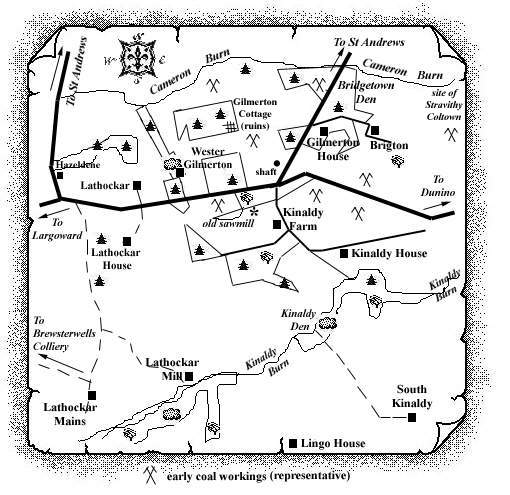
Several shallow workings are known to have worked the Fore and Back Coals at Kinaldy (formerly Kinaldie) and northwards over the ground on the south side of the Cameron Burn.
A thin coal seam cropped out in the ravine to the south of Kinaldy House and a cherry coal was exposed in the ditch west from Kinaldy saw-mill.
