Ironstone and coalmining operations, on a small scale,
were carried out at Kilmux, about a mile and a quarter
north-east of Kennoway, from the latter part of the
eighteenth century, if not from an earlier date, the last
coal-venture featuring a surface-mine in Whally Den having
been abandoned in 1922.
The grounds to the south and south-east of Kilmux Colliery
also appear to have worked by a small colliery (Drummaird?)
but few details are available other than a record of a No. 33
Pit, owned by the Glasgow Iron Company in 1873 (exact
location not known).
[On a light note, we are wondering where the other 32
pits were located??]
| See Early Mining Link for Drummaird/Kilmux ironstone mining records. |
|---|
 |

|
|
 |
| Source Date of Information (Owner) |
|---|
| Pit or Mine / Manager / Under-Manager / Men underground / Men above ground / Coal seams worked / Shaft Details |
| 1845-57 (J. B. Fernie, Esq.) |
| 1860 (John Lister) |
| 1873 (William Lister) |
| Nos. 1, 3
W. Forrester / ---------- / -- / -- / 6 feet / D/cast 420 ft. : U/cast 342 ft. |
| No. 33
W. Forrester / ---------- / -- / -- / 6 feet / D/cast 300 ft. : U/cast 300 ft. |
| 1874 (Robert Christie) |
| No. 1 /
Robert Forrester / ---------- / 33 / 7 / Six feet
|
| No. 3 Stopped |
| 1875 (Robert Christie) |
| No. 1 /
Robert Forrester / ---------- / 25 / 7 / Six feet
|
| 1876 (Robert Christie) |
| No. 1 /
Robert Forrester / ---------- / 19 / 6 / Six feet
|
| 1877 (Robert Christie) |
| No. 1 /
Robert Forrester / ---------- / 20 / -- / Six feet
|
| 1878 (Robert Christie) |
| No. 1 /
Robert Forrester / ---------- / 17 / 6 / Six feet
|
| 1879 (Robert Christie) |
| No. 1 /
Robert Forrester / ---------- / 14 / 6 / Six feet
|
| 1880 (Robert Christie) |
| No. 1 /
Robert Forrester / ---------- / 9 / 6 / Six feet, 9'
|
| 1881 (Robert Christie) |
| No. 1 /
Robert Forrester / ---------- / 9 / 5 / Six feet, 9'
|
| 1882 (Robert Christie) |
| No. 1 /
William Forrester / ---------- / 8 / 6 / Six feet
|
| No record of Kilmux Colliery in 1896 list. |
Extract from Statistical Account of Scotland (1795)
Parish of Kennoway
"There are appearances of coal in several parts. some of it was lately wrought; but as the quality was not very good, nor the seam thick, and as there is great plenty of excellent coal in several of the neighbouring parishes, the mines that had been opened, were soon abandoned. After this it is unnecessary to add, that the only fuel used in the parish is coal, and that the great plenty of this most necessary article, with which the neighbourhood abounds, is one of those advantages which it enjoys in common with all the south coast of Fife."
Extract from Statistical Account of Scotland (1845)
Parish of Kennoway
"On the western boundary of the parish, there is a patch of peat-moss; and towards the eastern boundary, beds of coal at various depths are found, some of which have been wrought, with scarcely any intermission, for nearly fifty years past. The line of dip of the strata lies in the form of a crescent. Towards the east of the coal-field, it dips to the south-east, and towards the west, it approaches to south-west. The dip of the strata is about one foot in twelve. Slips or fissures, generally running in a straight direction from east to west, are found frequently to interrupt the seams of coal, throwing them up or down to a distance, varying from a few inches to eight feet.
The following journal shows the metals with their depths respectively, which have been gone through to reach the seams of coal at present wrought, lying upwards of fifty-four fathoms from the surface."
| Description | Fath. Feet. In. |
| Surface and clay | 1 5 0 |
| Bands | 1 4 0 |
| Freestone | 0 3 0 |
| Bands | 0 3 0 |
| Blaes with coal | 1 5 0 |
| Dark stone | 1 0 0 |
| Coal I | 0 0 6 |
| Bands | 0 2 6 |
| Coal II | 0 2 2 |
| Bands | 0 2 4 |
| Freestone | 3 0 0 |
| Coal III | 0 0 6 |
| Blackstone | 0 0 8 |
| Coal IV | 0 1 4 |
| Bands | 1 0 6 |
| Coal V | 0 0 5 |
| White bands | 0 1 0 |
| White freestone | 0 3 9 |
| Blaes | 0 1 0 |
| Dark freestone | 2 0 8 |
| White freestone | 1 1 1 |
| Bands | 0 4 1 |
| Blaes with bands | 0 4 0 |
| Dark blaes | 0 2 6 |
| Bands | 1 1 4 |
| Freestone | 1 0 4 |
| Bands | 0 2 1 |
| Blaes | 0 1 0 |
| White freestone | 3 0 0 |
| Coal VI | 0 1 4 |
| Blaes | 0 1 2 |
| Bands | 0 2 2 |
| Grey freestone | 2 0 0 |
| Hard bands | 0 2 11 |
| Dark blaes | 1 0 5 |
| Bands | 0 0 6 |
| Hard grey freestone | 0 3 10 |
| White freestone | 0 2 8 |
| Black bands | 0 0 4 |
| White bands | 3 0 5 |
| Blue bands | 0 3 5 |
| Blaes and bands | 2 2 4 |
| Blaes | 1 1 2 |
| Bands | 0 5 3 |
| Hard white bands | 0 0 3 |
| Dark bands | 0 2 1 |
| Soft blaes | 0 2 6 |
| Dark bands | 0 1 2 |
| White bands | 1 1 5 |
| Grey bands | 0 1 9 |
| Soft blaes with coal | 0 1 10 |
| Freestone | 2 3 10 |
| Bands | 0 2 5 |
| Hard blaes | 0 1 6 |
| Coal VII | 0 4 2 |
| Grey stone | 0 0 9 |
| Coal VIII | 0 1 0 |
"... It has been mentioned, that, in the eastern
part of the parish, coal at different depths is found, and
that it has been wrought with little intermission, for nearly
fifty years past. The seams which have hitherto been chiefly
dug are those marked No. III. and IV. in the journal before
given. These seams were latterly wrought on what is called
the long-wall method. After leaving sufficient pillars at the
pit-bottom, every inch of coal, with the interjacent bed of
black stone, was cut out progressively forward, and the whole
superincumbent strata allowed to crush towards the stone or
rubbish taken from the coal, which was used for gobbing the
excavation. This coal was laid dry by a day-level of 350
fathoms in length.
The seams above-specified having been nearly wrought out,
the proprietor of the mine, J. B. Fernie, Esq. of Kilmux, a
gentleman of great enterprise, well known, especially, as an
eminent agriculturalist, and to whom the writer of this
account is indebted for the information he supplies, both in
regard to coal and agricultural matter, - has lately sunk a
pit to a depth of more than 54 fathoms, where coal, marked
VII. and VIII. in the journal, is found to the thickness of 5
feet 2 inches, with an interjacent bed of greystone 9 inches
thick. To draw water from this pit, an engine of forty-seven
horse power has been erected. The coal, which has now been
wrought for several months, is found to be of good quality,
and it is believed that the field is extensive. There are at
present between 40 and 50 colliers employed."
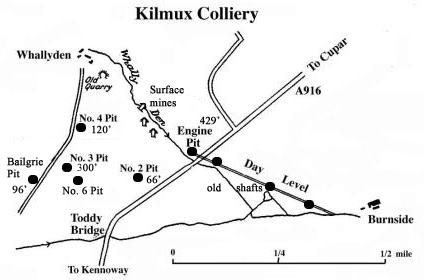
The total extent of coal working in this area was not large and was based around a day-level, the Kilmux Engine Pit, Pits No. 2, 3 and 4 (and another of uncertain location) and a small number of surface-mines. There is little doubt that there are considerable reserves of coal both to the south and east of Kilmux. The coals which were worked at Kilmux Colliery lie in the upper part of the Limestone Coal Group and the lower part of the Upper Limestone Group.
The main pit was of Victorian design and had a traditional rectangular shaft, as was common for Scottish pits. In 1857, it was owned by J. B. Fernie, but possibly the Glasgow Iron Company could also have owned earlier ironstone works.
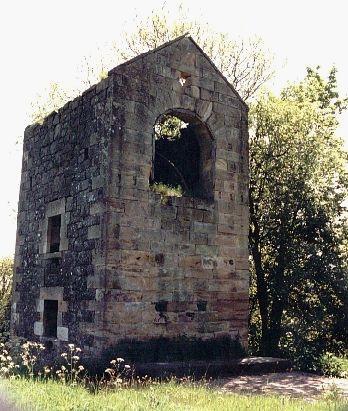
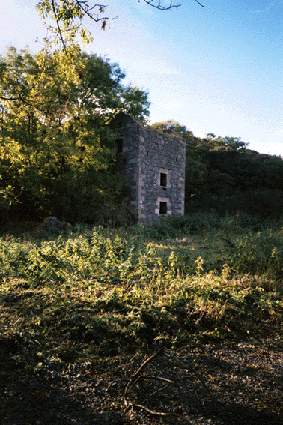
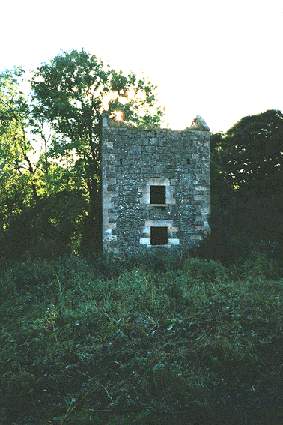
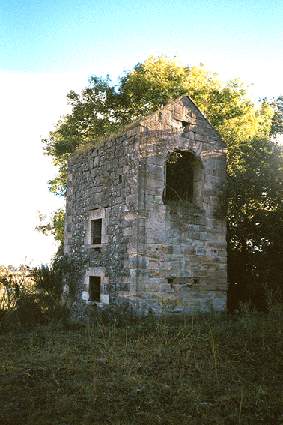
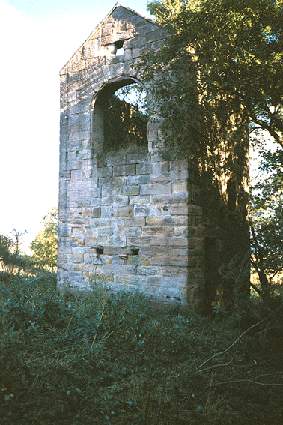
The remains of the Victorian engine house which had the pumping beam engine were photographed by Harry Adamson, Cowdenbeath, who has also supplied the following description of beam engine operation.
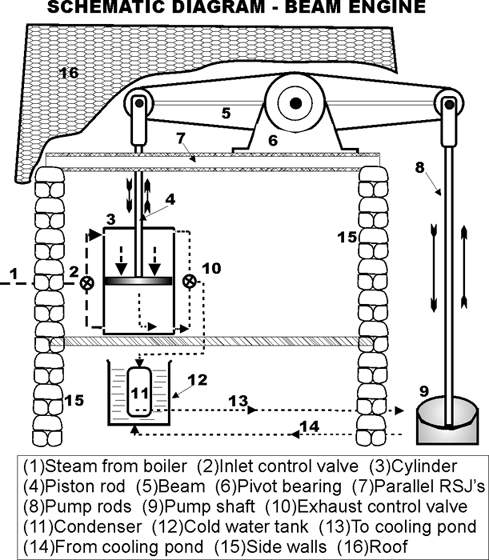
BASIC OPERATION OF BEAM ENGINE
High pressure steam from the boiler (1) passes through a directional control valve (2) into the top or bottom of the cylinder (3) and this forces the piston to move up or down in the cylinder.
The diagram shows the piston at the middle of the down stroke.
A rod (4) is attached to the piston, passes through the cylinder, and is linked to the cast iron beam (5), which pivots on bearings (6) bolted to parallel RSJ's (7).
The motion of the piston causes the beam to rock in a see-saw fashion.
The pump rod (8), linked to the opposite end of the beam, extends vertically through the centre of a pipe column (9) to the bottom of the shaft. The bottom of the pump rod is attached to a bucket pump which raises water to the surface by the up and down motion of the rods.
To improve the efficiency of the system, the exhaust steam flows through the control valve (10) and into the condenser (11). The exhaust steam is condensed by the cold water in tank (12) thus creating a partial vacuum in the cylinder. The mixture of condensed water and steam is piped (13) to a cooling pond and this water may be piped back (14) to replenish the cold-water tank or boiler feed. The machinery is usually housed in a stone or brick built engine house (15) and protected from the elements by a pitched roof (16).
Working examples of beam engines in Scotland may be seen at the Newtongrange Site of the Scottish Mining Museum and the Wanlockhead Lead Mining Museum.
 |
 |
 |
 |
Information on coals worked at, or near, Kilmux Colliery
A thick seam of coal considered to be Rough Coal, or
perhaps Rough Coal and Lochgelly Splint Coal, was the lowest
coal in the Limestone Coal Group that was worked in the
district.
It was wrought to a small extent at Kilmux under the name of
Stranger Coal and was reached by cross-cut mines from the
overlying Six Foot Coal. A small amount was taken out by a
longwall system, but it was found to be too expensive a
proposition as the seam was only 1 ft. 11 in. thick,
including a stone parting, while its quality was no better
than that of the higher seams.
Lochgelly Blackband Ironstone was the first seam above the
Lochgelly Splint Coal which could be recognised with
certainty and consequently it provided a valuable index to
the strata both above and below it. The seam had its best
development at Kilmux Colliery where it was worked to a very
small extent from 1870 to 1872.
Operations were conducted from the No. 3 Pit by the Glasgow
Iron Company who raised a few thousand tons. However, the
seam was found to be of poor quality and the workings were
abandoned in 1874. Prior to this, the ironstone seam had been
tested by the Lochgelly Iron Company but they also found it
to be too poor in quality to be a workable proposition.
A plan of the workings of Kilmux Colliery (Plan No. 418)
deposited at the Home Office recorded the seam as: free coal
(6 in.), shale (4 in.), Parrot Coal (7 in.) and Blackband
Ironstone (10in.).
From a report by D. Landale on the Colliery, dated July
1863, we find a description of a seam as: Common Coal (1
in.), Rum Coal (2 in.), Good Cherry Coal (6 in.), Parrot
Feruginous Coal (3 in.), Coarse Gas Coal (6 in.), Blackband
Ironstone (1 ft. 3 in.) and Coal, holing (2 in.).
Above the Lochgelly Blackband Ironstone, and separated
from it by 4 ft. to 12 ft. of fakes and sandstone, was a
thick, though somewhat variable seam which correlated with
the Cardenden Smithy Coal. This seam was wrought at Kilmux
Colliery under the name of Six Foot Coal more or less
continuously from the early years of the nineteenth century
until 1881 when the Colliery was abandoned.
From a report on the colliery by D. Landale, dated 1882, the
coal was found to be quite suitable for burning in furnaces,
but he describes it as a coarse coal with a deal of white ash
and of little value as a household coal. Despite its high ash
content, however, he considered it to be the best of the
seams worked at the colliery. The workings were on the room
and rance system*, with rooms 30 ft. wide and rances
averaging 15 ft. thick, cut every 14 fathoms or thereby for
ventilation.
*[A system of working with long narrow pillars; less usually
a system of working with extra large pillars and narrow
rooms.]
The depth to the Six Foot Coal in the Engine Pit was 69
fathoms and in No. 3 and No. 4 Pits was 50 fathoms and 20
fathoms, respectively. The section below, illustrating the
development of the Six Foot Coal at Kilmux, has been compiled
from a number of sections measured at various points in the
workings of the Kilmux pits:
UPPER LEAF:
Coal ( 1 ft. 2 in. - 1 ft. 6 in.),
Black rib (2 in. - 5 in.),
Coal (1 ft. 11 in. - 2 ft. 6 in.),
Brown stone (2 in. - 4 in.),
Coal (3 in. - 6 in.),
Rum Coal (4 in. - 6 in.),
Coal ( 4 in. - 7 in.),
Fireclay (1 ft. 2 in. - 1 ft. 10 in.).
LOWER LEAF:
Coal (1 ft. 6 in. - 2 ft. 1 in.).
The Blairhall Main Coal was the topmost seam of any
consequence in the Limestone Coal Group and it was worked
intermittently at the Kilmux Colliery during the nineteenth
century until the colliery was abandoned in 1881.
It was known locally as the Four Foot Coal and appears to
have been divided into four leaves, amounting in all to some
4 ft. 6 in. to 5 ft. of coal, with hard stony partings
totalling about 1 ft. 6 in.
In his 1882 colliery report, Landale describes the Four Foot
Coal as coarse in quality and as being entirely worked out to
the depth at which it was cut in the Kilmux Engine Pit, i.e.
about 54 fathoms.
As a general rule, the coals that occurred in the Upper
Limestone Group in this area were too thin and inconstant to
be of economic value but the Three Foot Coal and an unnamed
seam close above it at Kilmux were known to have been worked
during the early part of the nineteenth century.
The Three Foot Coal lay at a depth of 12 fathoms in the
Engine Pit and at 11 fathoms in No. 2 Pit.
In the Engine Pit it had the following section: coal (6
in.), on black stone (8 in.), on coal (1 ft. 4 in.).
In a third pit, whose site is not definitely known, but
which was probably about 50 yds. south-west of Shepherd's
Neuk, the Three Foot Coal was recorded at 16 fathoms from the
surface. The seam was described as a soft cherry coal and was
worked out (longwall system) down to the level at which it
was cut in the Engine Pit.
A coal, probably the Three Foot Coal, was worked from a
surface-mine (about 400 yds. upstream from the main Cupar
A916 road) driven into the east bank of Whally Den on the
outcrop of the seam below a thick, coarse sandstone which
dipped to the south-east at about 30°. The workings were
of a very limited extent and were abandoned in 1922.
The section of the seam at the mine-mouth was:
Dirt (1 ft. 3 in.),
Coal (8 in.),
Dirt (8 in.)
Coal (1 ft. 1in.).
Three other disused mines in this coal seam can be seen a little further downstream. In his parish report of 1845, the Rev. David Bell referred to the working of the Three Foot Coal in the Kilmux Engine Pit. He wrote, "The seams which have hitherto been chiefly dug are those marked No. III and IV ... " i.e. the coals No. III and IV taken together being the Three Foot Coal of Kilmux.
He further remarked that the coal was laid dry by a
day-level of 350 fathoms in length. This day-level, made in
1829, is without doubt the one that runs in an
east-south-east direction from a depth of 13 fathoms in the
Engine Pit to the stream about 150 yds. west of Burnside (see
map).
About 4 fathoms above the Three Foot Coal in the Engine Pit
lay a second seam 2 ft. 2 in. thick. It was wrought to a
small extent during the early years of the nineteenth
century, but only 1 ft. 3 in. of it was workable and it was
soon abandoned. The coal cropped out in Whally Den about 190
yds. upstream from the A916 Cupar road where it was 1 ft. 3
in. thick and rested on sandstone.
Plans of Abandoned Seams & DatesNote: abandonment dates do not relate to individual pit closures but to the abandonment of seams which had ceased to be worked. Not worked for a period of time, it was quite normal for some coal seams to be re-opened for working at a later date or at a different location. |
|---|
| Plans of Abandoned Seams
(with dates where available |
Pits or Mines designated
in Abandonment Plans |
|---|---|
| IRONSTONE; Blackband (February, 1874) | Kilmux |
| COAL; Kilmux Six Feet | Kilmux, Nos. 2, 3, 4; Engine |
| COAL; Three Feet (November, 1922) | Kilmux |
------------------------------------
"Fifeshire Journal"
9 December, 1841
The marriage of Mr J. B. Fernie, Esq., of Kilmux, took place on Tuesday with much celebrating by the men of the colliery.
------------------------------------
"Fifeshire Journal"
1 September, 1842
COLLIERS STRIKE
Yesterday afternoon we received information that the whole of the collieries at Durie and Kilmux works had struck on Tuesday morning. Three emissaries from Wemyss came to Durie on Monday night, and demanded, in name of the "general movement", that the workmen should strike. They foolishly yielded; and, in turn, sent three of their number to Kilmux, where they prevailed upon the men there to follow their example. Durie colliers, we understand, are all bound to give a month's notice previous to their quitting the work; and are consequently, under act Geo. IV. cap. 34, liable to be apprehended and committed to jail for breach of engagement.
[Kilmux miners were not out for long - they reportedly returned to work the following day!]
------------------------------------
"The Scotsman"
18 May, 1859
ESTATE OF KILMUX FOR SALE
... THE VALUABLE ESTATE of KILMUX, situated in the Parishes of
Scoonie and Kennoway, Fifeshire. ... There is also Coal in the Lands, which
has been wrought to profit for several years back, the engine-pit being placed
at the south-west corner of the property, and not interfering with the amenity
of the property as a residence. ...
Cupar, 31st March 1859.
------------------------------------
"Dunfermline Saturday Press"
5 September, 1874
KENNOWAY
The Kilmux miners are working four days per week, the lessee having nothing to do with unions.
------------------------------------
"Dunfermline Saturday Press"
23 October, 1886
KENNOWAY - MAN SUFFOCATED
On Saturday afternoon John Dowie, residing at Kilmux, went for a walk in Kilmux Den, accompanied by his little girl. In the plantation there is a disused mine which Dowie entered, and when about thirty yards from the mouth he was overcome by damp or foul air. Hearing moaning proceeding from the mine the little girl at once ran home and informed her sister, who procured the assistance of a man named Birrell, and after much difficulty Dowie was removed from the mine. Life was extinct. Dr. Crole, Leven, who was sent for, stated that death was caused by suffocation.
------------------------------------
"Fifeshire Advertiser"
Saturday, 23 October, 1886
KENNOWAY.
On the afternoon of Saturday last John Dowie, a labourer, residing at Kilmux, Kennoway, was taking a walk through Kilmux Den, accompanied by his daughter, a girl about 10 years of age, and curiosity seems to have led him to examine the mouth of a disused coal mine in the den. By the directions of her father the girl remained at some distance from the mine, but thinking her father was remaining too long, she called to him. She was answered by a moan, and calling again with the same result she got alarmed. She ran to the house which was two or three hundred yards distant and informed her older sister, who hastened to the mine and found her father a short distance into the mine still moaning. She made a strong effort to reach him, but on account of the foul air which was issuing from the mine, she was forced to beat a retreat, leaving the poor man. She, however, got the assistance of two men near by, and returning with them to the mine they succeeded in reaching Dowie and dragging him out, but by that time life had fled. Dr Croll of Leven was sent for, but only to pronounce life to be extinct. There can be little doubt that deceased, unaware of his danger, ventured too far into the mine, and was overcome by the foul air in the mine. Deceased, who was about 40 years of age, leaves a family to mourn his untimely end.
------------------------------------
We were delighted to hear from Lindsay Trim, a great granddaughter
of John Dowie, who found this website through a link with the Fife Family
History Society, and who kindly gave us permission to add her own words to
the sad tale above. We are also grateful to Lindsay for the 'Fifeshire Advertiser' report
which has been added to complement the 'Dunfermline Press' report.
M. Martin & Webmasters.
"October, 2006
I looked up Kilmux Colliery, Kennoway. I already knew that my great grandfather,
John Dowie, had died there in 1886, aged only 42. In fact, there is a fuller account
of the tragedy in the Fifeshire Advertiser of Saturday, 23 October, 1886, under Kennoway.
I have a copy of it from Kirkcaldy Central Library. However, the Dunfermline paper mentions
that a man Birrell helped pull him out, I did not know this. John Dowie's wife was a
Mary Birrell so perhaps a brother, who knows. The little girl mentioned in the article as left
outside, and who goes for help, was my grandmother, Isabella Dowie. She was not quite nine
at the time of her father's death. She was the youngest of their five children. My mother
is still alive, aged almost 88, and she can remember her mother recounting the sad story. Her
mother, Isabella, never told my mother, Agnes, that she had been the sister left outside the mine.
Perhaps she always felt guilty that she did not go for help sooner. Who knows?
They all lived just 200 yards from the disused pit. John Dowie was out of work as a miner and
doing casual labouring jobs. It was a terrible day of rain and high winds, ships were standing
out in the harbour of Kirkcaldy, they could not dock. The family story is that they had no
coal for the fire. John Dowie had gone into the mine, leaving Isabella on guard so to speak.
He had done this many times before; he used to work in the pit. But his luck ran out that day.
How very sad it all is.
Thank you for having the story of John Dowie, my great grandfather, on your website. I feel it is
fitting that all these sad stories are recorded for the future.
If I can be of any further help,
please let me know."
Best wishes
Lindsay Trim
------------------------------------
"The Scotsman"
8 June, 1889
THE COAL, FIRE-CLAY, and IRONSTONE on the ESTATE of KILMUX, FIFESHIRE. The
Ground has been proved, and there is a Shaft already sunk to one of the six feet seams.
DAVID RITCHIE, 53 Cockburn Street.
------------------------------------
