Owners: pre 1872 (not known)
Mr. Torrance (1872/3)
| We were very
excited by the uncovering of the two newspaper reports
during our research [December 2002] and hope eventually
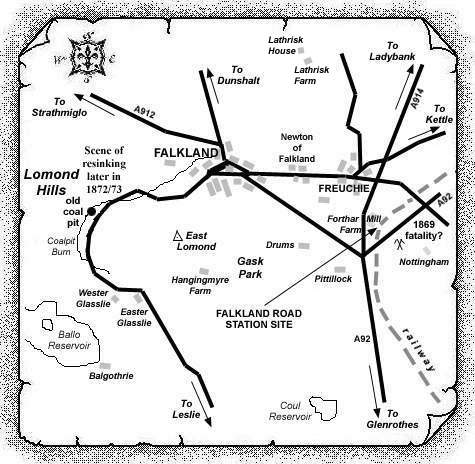
to identify the locations of the pit where the fatality
occurred and of where the shaft was sunk to the rich coal
seam at the north base of East Lomond Hill. It has always
been thought that no coals were worked beyond a major
fault to the south of Falkland.
Thanks are also due to 'eagle-eyed' Pete McKenna who observed the 'old coal pit' on the OS map of 1856. This early coal pit was located by the appropriately named Coalpit Burn not far north of the present day car park used by walkers using the tracks to the nearby summits of the West and East Lomond Hills. During January, 2003, our research uncovered some information on the nature of the Falkland coal seams in the region of Coalpit Burn where earlier coalworks were being re-examined during 1872/73. M. Martin & Webmasters |
 |
Extract from the Statistical Account of Scotland - Falkland Parish (1795)
"... On the eastern Lomond [Hill] is plenty of limestone rock, a few feet below, and in some places very near the surface, and easily wrought. There are also strata of coal of very good quality, but not yet discovered in such quantity as to be thought worth the digging, especially in a country where there is an abundance of fine coal, at a reasonable rate, in the neighbouring parishes of Leslie and Markinch. ... "
-------------------------------------------------
"Fifeshire Journal"
7 February, 1839
FALKLAND
We have much pleasure in stating that William Johnstone, Esq., of Lathrisk, has sent the Rev. William Thomson the handsome sum of £20 sterling - £10 as a subscription for the assembly's schemes; the other £10 to be laid out in the purchase of coals or other necessities for the most destitute poor of the parish of Falkland. At the suggestion of Mr Johnstone, his tenants in the parish have kindly agreed to drive the coals, which greatly enhances this very reasonable donation.
-------------------------------------------------
Extract from the Statistical Account of Scotland - Falkland Parish (1845)
"... The superincumbent materials all belong to the under coal formation, and consist of the usual beds of sandstone, shale, ironstone, coal, and limestone. ... There are three thin beds of coal, which are little sought after, of inferior quality, and do not pay the expense of working. They vary from a few inches to about a foot and a half in thickness. ... There is a great abundance of coal in the neighbourhood. It is brought in carts from the adjoining parish of Markinch, and also in considerable quantities from Lochgelly. The Balbirnie and Lochgelly coals are of excellent quality, and if we include the carriage, cost 9s. or 10s. a ton."
-------------------------------------------------

"Dunfermline Saturday Press"
25 December, 1869
FALKLAND
FATAL ACCIDENT NEAR FALKLAND ROAD STATION
On Monday night, a miner, named James Wilson, was instantaneously killed at a coal-pit near Falkland Road Station. Wilson had been shunting a coal bogie, and, the rails being slippery, in attempting to stop its progress, he was carried with the bogie to the mouth of the pit, and was precipitated to the bottom.
"Dunfermline Saturday Press"
14 September, 1872
FALKLAND - NEW COAL SEAM
A new coal seam of considerable thickness, and of excellent quality, has been discovered on the estate of Falkland, near the north base of the East Lomond Hill. The sinking of a shaft for the working of the seam is about to be proceeded with.
"Dunfermline Saturday Press"
12 October, 1872
FALKLAND - BORING FOR COAL
The work of boring for coal at points near the highest level of the Leslie Road is still persevered in, but as yet without success. The workings which were carried on a number of years ago have been opened up and the water taken off so as to admit of the state of the old workings being examined. The seam of coal is stated to be about fourteen inches thick, which is said to be a workable seam. It is below this seam several fathoms that the present boring is in progress. Above the seam which has been worked there is another seam cropping out not far from the surface. It is about eight or nine inches thick - too thin, of course, to be worth working.
---------------------------
"Dunfermline Saturday Press"
11 January, 1873
FALKLAND - COAL
We understand that a 14-inch seam of good burning coal has been struck by the workmen employed by Mr. Torrance, and operations to work the seam are to commence immediately.
