Owners: Wemyss Coal Company Ltd.
NCB
The Wemyss Coal Company
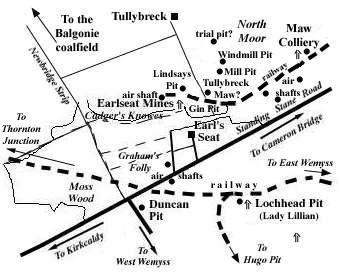
began the development of the Earlseat Mines to the north of
the old Duncan Pit, off the Standing Stane Road, in early
1903. It is thought that the old shaft of the Tullybreck Maw,
to the east of the mines (see sketch) was in operation
during the 1830s working ironstone and coal.
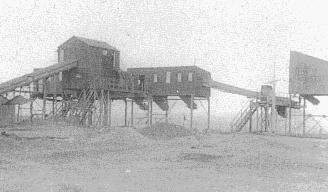
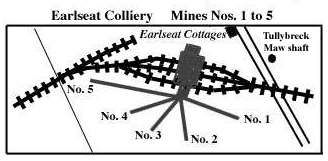
The five Earlseat mines were arranged in a distinctive
radial layout from a central loading point (see sketch) but
only four are recorded as 'working gainfully'. In 1911,
the Earlseat Mines were employing 604 men below ground and 69
surface workers - a not inconsiderable workforce! It is recorded
that the mine pumps were seriously damaged as a consequence of
pumping waters with highly-corrosive content. The Earlseat
Nos. 1-5 Mines had closed by late 1927.
After Nationalisation, the Coal Board developed a drift mine on the
site in 1950; this Earlseat mine had a life of
around 8 years.
 |
 |
 |
---------------------------------------------
We are always grateful when website visitors pass on contributions to enhance our content and we wish to thank Gordon Sutherland, Methil, Fife, for giving permission to display his unique colourful projects based on photographs of bygone collieries.
Colin Martin & Chris Sparling, Webmasters.
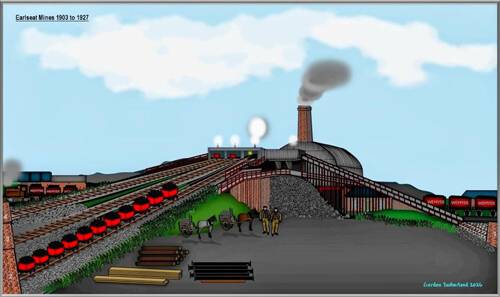
PLEASE NOTE THAT THE ABOVE IMAGE IS © GORDON SUTHERLAND
---------------------------------------------------------
| Pit opened: Mines Nos. 1-5: May, 1903
Drift mine opened: 1950 |
Pit closed: Mines Nos. 1-5: September, 1927
Drift mine closed: December, 1958 |
|---|---|
| Source Date of Information Supplied | |
| Manager / Under-Manager / Men underground / Men above ground / Coals seams worked | |
| 1904 | |
| James Burgess / ------------ / 9 / 7 / Household, manufacturing and steam coals. | |
| 1905 | |
| James Burgess / ------------ / 244 / 21 | |
| 1908 | |
| James Burgess / ------------ / 550 / 55 | |
| 1911 | |
| James Burgess / ------------ / 604 / 69 | |
| 1918 | |
| James Burgess / Albert Scarlet : Henry Dewar / 313 / 82 | |
| 1920 | |
| Manpower: 502 / 100 | |
| * * * | |
| 1951 (NCB) | |
| F. T. Kennedy / ------------ / 16 / 14 / Coal (seam not specified) | |
| 1958 (NCB) | |
| F. T. Kennedy / ------------ / 132 / 14 / Steam coal. Lower Dysart. | |
| Plans of Abandoned Seams for Earlseat | Pits or Mines designated in Plans |
|---|---|
| COAL; Dysart Main. IRONSTONE. | EARLSEAT: Tullybreck Maw |
| COAL; probably Dysart Main | Earlseat |
| COAL; Dysart Lower; Dysart Main (September, 1926) | Earlseat Nos. 1 - 5, Duncan |
--------------------------------------------
"Dunfermline Press"
20 June, 1903
A FIND OF COAL AT DYSART
On the north part of the Wemyss estate, in the
centre of Thornton, Dysart, and Wemyss coal areas, a line of the
Dysart seam has been found, the outcrop running to within three
feet of the surface. Such finds are not unknown in shale districts,
but Fife has never yielded such a good thing. Wemyss Collieries
Company only tapped the seam the other day, and already two
inclines have been opened, and mining has been started. The
foundations for a permanent engine are being put in, and two
vertical engines are temporarily in use.
The Dysart seam, from 16 to 18 feet thick,
radiates in five directions from the apex, and the length of the
seams will be nearly a mile each. Close at hand runs the railway,
and the Collieries Company are preparing to develop the pit to the
fullest extent.
--------------------------------------------
"Dunfermline Press"
14 January, 1905
DEVELOPMENT OF FIFE COALFIELD
UNIQUE UNDERTAKING AT WEMYSS
It is wonderful how history repeats itself. The
mine which was run by Earl David of Wemyss through the strata from
Methil to Kirkland was a unique undertaking in the history of
mining in the seventeenth century.
At Earlseat (which is about four miles to the
north of the site of the "Happy Mine" as the crow flies)
- the Wemyss Coal Company are carrying on a series of mining
operations which are unique among the great and improved colliery
works of these advanced days.
It is the site which makes the Earlseat Colliery
unique in the history of mining. Earlseat may be said to be the
apex of the Wemyss, Dysart, and Balgonie collieries, and five seams
of coal converge and crop out within a small area. The colliery
fittings have been pitched on the apex, and as many as five day
mines, or "ingoing-eyes" are being run into the great
Dysart Main seam, which is from fifteen to twenty feet in
thickness.
The seams stretch away into the Dysart, Wemyss,
and Balgonie fields for distances ranging from a mile to a mile and
a half, and the mines are being run to the south, the east, and the
west.
No. 3 mine has been run into the solid coal for
a distance of 320 yards, and it is the intention of the management
to follow up with the other mines, running such chambers as will
make them all practically one mine with five eyes looking to the
surface. The stoop-and-room system of working is being followed
while the work of development goes on; but when the march has been
reached on the different slopes and a great area of coal has been
opened up, the management will start to come surfacewards on the
longwall system.
In the 320 yards which have been run in the
Dysart seam in No. 3 mine, the dip has varied - now one foot in six
feet, then comparatively flat, and afterwards one in three. One in
three is pretty steep, but it is evident from the lie of the strata
that this steepness will not last long. It must be kept in mind,
however, that a steep gradient at a point when the mine is not more
than a fifth or a sixth of the distance it is expected to run is a
good feature.
It means that the Dysart Main seam and the seams
which lie above it have ample covering in the whole of the area
being operated on, and it is computed that the field of Earlseat
will yield from 15,000,000 to 20,000,000 tons of coal.
In the centre of the horse-shoe into which the
mines are being driven, a huge platform has been erected on the
surface, and by an ingenious arrangement the whole of the coals
drawn from the mines are to be wheeled on to the one platform and
dealt with by a big cleaning and screening plant, which is already
in operation, and is pouring the different classes of coal into the
waggons in the best of condition.
The winding engines are powerful enough to meet
all demands, and will easily deal with from 2000 to 3000 tons of
coal a day when the underground workings have been developed.
Because of the manner the field dips into the other coalfields of
the district, there is comparatively little water. An occasional
box of water is brought up with the races of loaded hutches from
the face of No. 3 mine; but as the workings advance the water will
vanish.
The mines have been brought into direct railway
communication with Methil dock. Thornton is the nearest village to
Earlseat; but feeling that it would be impossible to get enough
miners there to equip such a large colliery, Mr Wemyss hit upon the
idea of building the village of Denbeath, which is situated on the
sandy slopes which overlook the Burgh of Methil.
Work was only commenced with Denbeath village in
March last, and with such lightning rapidity was the work of
building proceeded with that something like 100 of the 220 houses
contemplated were ready for occupancy by mid-summer. Now all the
220 houses are nearly finished, and squads of men are engaged daily
in the work of fencing, road-making, &c.
All the houses are of three rooms, scullery, and
sanitary conveniences. Mr Wemyss had adhered to the plans adopted
by the Wemyss Company at East Wemyss - two-storey buildings with
red roofs and crow-stepped gables.
A plentiful supply of the Wemyss water has been
introduced, and the drainage promises to be perfect. With a light,
sandy soil, and a view extending far up and down the Forth and to
the Lothians, the site is an ideal one.
Good housing and a lovely situation are not by
any means the only recommendation attached to Denbeath as a
village. Feeling that the walk from Denbeath to Earlseat, some five
miles, would be out of the question for hard-wrought men and boys,
Mr Wemyss hit upon the idea of running trains to and from Denbeath
to the colliery in connection with the various shifts.
And so the village, as a colliery village, is as
unique as the Earlseat mines. The miners step out of their doors in
the mornings and afternoons into the carriages of the train. The
whistle blows, the train starts, and in ten minutes the men are at
the mines.
As much care is exhibited in the starting of the
trains for the return journeys. So in all weathers the men
accomplish the journey with more comfort than men who live only a
few hundred yards from the scenes of their labours.
The idea is a splendid one. It is a departure
which might well be adopted in connection with more collieries than
Earlseat.
A considerable number of men are now employed at
Earlseat, but there is room for an additional hundred hands. There
is plenty of housing at Denbeath, with all its railway and other
advantages, and the Wemyss Coal Company have intimated that they
will pay the moving expenses of men who care to make a
change.
Men who pitch their tabernacle at Denbeath must
not for a moment run away with the idea that their choice of work
will long be confined to the mines at Earlseat. The Wemyss Coal
Company are about to sink a new shaft at Denbeath, and there one of
the largest collieries in the "Kingdom" is destined to
spring up.
A coal washer, guaranteed to handle 1,000 tons
of coal in eight hours, is being put up within sight of the new
village. The washer gives an idea of the magnitude of the
undertakings which have been and are about to be
launched.
And then, to crown all, the Tramway Scheme is
coming. The tramway line is to run through Denbeath, or the
"Garden City" as it is called. So the good wives of the
village are to be brought into as close touch with the outer world
as their husbands are with the busy mines of Earlseat.
Who says we are not making progress?
Houses which are positive palaces when compared
with the mining villages of the old world; trains puffing at the
doors to take men to work, and electric cars flying through the
streets!
Time brings wonderful changes. Methil once had a
mine which was called "The Happy Mine". Why should
Denbeath not then be "The Happy Village?"
-Leven Advertiser and Wemyss Gazette.
--------------------------------------------
"Dunfermline Press"
26 August, 1905
On Monday forenoon one of the mines at Earlseat,
belonging to the Wemyss Coal Company, was the scene of an alarming
accident. A considerable fall of coal from the roof completely
buried one miner, George Smith, and caught another, John Gray, by
the lower part of the body. Workmen gathered to help them, and one
of these, Matthew Dewar, fell and severely strained his back. Gray
was the first extricated, and it was found that he had sustained
internal injuries. Smith was then got out in a state of collapse
and was badly bruised. About the same time J. McAndrew had his leg
broken by a piece of coal bursting from the face.
Gray and Smith belonged to the Garden City.
Rumours of a big fall had reached there, and the whole population
was in a state of great anxiety. The ambulance waggon bore the
injured men home, and much relief was felt when it was known that
the reports of the accident had been exaggerated. Gray's
condition is the most serious.
--------------------------------------------
"Dunfermline Press"
9 September, 1905
For some days workmen have been grappling with a
fire in the coal bing at Earlseat. Two squads, day and night, are
cutting the bing through so as to save at least half the stock,
which amounts to fully 30,000 tons.
At Wellsgreen Pit, which, like the Earlseat
mines, belongs to the Wemyss Coal Company, fire has also broken
out, and as this is parrot coal, the danger of the whole stock
being destroyed is great.
An idle day was observed at the mines on
Wednesday, as binging is not practicable, and part of the gangway
has been removed, so as to save the huge pithead frame which is so
designed as to serve the five mines.
--------------------------------------------
"Dunfermline Press"
16 September, 1905
The fire which broke out in a coal heap at Earlseat Mine, near Thornton, about a fortnight ago, is still burning fiercely, and there is little prospect of its being extinguished till it burns itself out. ... It is not expected that much of the coal in half of the heap will be saved, and probably the best part of 10,000 tons will be destroyed.
--------------------------------------------
"Dunfermline Press"
25 November, 1905
Thirteen weeks have passed since the bing of steam coal at Earlseat, Wemyss, went on fire, but the flames still hold sway. Each strong breeze fans the mass into a red glow, but in quiet weather it lies a grey pile crowned by little flames. The bing is only half the original height, but there are thousands of tons of coal beneath, which, it is expected, will have to burn out ere the fire ceases. Work at Earlseat now goes on smoothly. The acute danger to the great pithead frame, with its gangways to the five pits, is past, and work at the boilers is possible without the discomfort of the fumes or smoke. Only two of the mines are being worked at present, but machinery to cope with the others is being installed. One of the most successful experiments in local mining has been the substitution of under haulage in place of by overhead ropes, and this is to be introduced at Earlseat.
--------------------------------------------

H. M. Inspector of Mines Report 1907
Mr. Robert McLaren's Report
Fatal Accident at Earlseat, Fife
Owner: Wemyss Coal Co., Ltd.
25 March, 1907
George Hutchison, 44, Miner. Deceased was lying holing under the head coal, when it suddenly burst and fell upon him. The head coal was "ranced" but the "burst" threw the rance out.
Rance: See Glossary of mining terms in Coalfields link.
-----------------------------------------------------
"The Scotsman"
13 August, 1907
ACCIDENT ON A FIFE MINERAL RAILWAY. - Yesterday forenoon fifty men travelling from Denbeath, Methil, to Earlseat Mines, on the Wemyss mineral railway, had a narrow escape with their lives. At the junction of the lines to Earlseat and the Michael pits their train shunted on to a branch line to let a coal train pass. The latter engine was scarcely past the points when a warning whistle ahead on the branch line made all turn. Quickly the miners realised that this was a train beyond control dashing into their train, and in frantic haste they leaped out. Some of the doors on one side were locked, but the men scrambled through the windows. A second later the mineral train crashed into the carriages, and drove them back upon the other mineral train. The carriages were smashed. Had the driver not whistled many men must have been killed. A few were injured slightly. Great damage was done to rolling stock.
-----------------------------------------------------
"Dunfermline Press"
31 August, 1907
Fire broke out on Tuesday in Earlseat Mines, near Thornton, belonging to the Wemyss Colliery Company, and did considerable damage to the workings. Over seventy miners in consequence are temporarily thrown out of employment.
-----------------------------------------------------
"Dunfermline Press"
14 September, 1907
Shortly after starting work on Monday morning at Earlseat Mines, near Thornton, belonging to the Wemyss Coal Company, Richard Hazzard, miner sustained severe injuries. He had been removing his sprags when a large quantity of coal and stone came away, and partly fell upon him, breaking his left leg between the knee and ankle. He was conveyed to Kirkcaldy Cottage Hospital.
-----------------------------------------------------
"West Fife Echo"
Wednesday, 31 January, 1912
A DENBEATH MINER KILLED
Late on Friday night a great fall of blae and coal in the Earlseat Mine buried two of the workers - Hugh Muir and his son, Hugh. Muir and three sons were working at the face, and two of them drew out a hutch while the father and son were engaged in repairing the roof. Suddenly the mass came away, overwhelming the father and son. On a rescue party reaching the spot, they found the son pinned to the side by a post and partially sheltered by a lump of rock which lay across the top. His father was killed on the spot. Some hours elapsed before the body could be extricated. Muir was about 48 years of age, and resided at Denbeath.
-----------------------------------------------------
"Fifeshire Advertiser"
24 February, 1912
The death roll from the pit was augmented on
Thursday evening by a terrible accident in No. 4 Earlseat Mine,
belonging to the Wemyss Coal Company.
David Heggie, Coaltown of Wemyss, was overtaken in the haulage road
by a race of hutchies and struck dead by an avalanche of wheels.
Deceased was an inspector and was well-known and highly-respected
by all the employees. He resided at Coaltown of Wemyss. About 10
years ago he took a leading part in football and was a member of
Buckhaven F.C.
--------------------------------
"Fifeshire Advertiser"
2 March, 1912
Deaths
HEGGIE, accidentally killed at Earlseat Mine on
22nd ult. David S. Heggie. Dearly beloved husband of
Jeannie Wallace age 32.
-----------------------------------------------------
"Leven Advertiser & Wemyss Gazette"
2 January, 1919
DENBEATH
MINER KILLED. - We regret to record the tragic fate that has befallen Mr Charles Addison, junr., Denbeath. While at work in the Earlseat Mines on Saturday morning last, a stone weighing fully a ton fell on him, inflicting terrible injuries to his head, and also his back. He was taken to the Wemyss Memorial Hospital, where everything possible was done for him, but he gradually sank and passed away on the morning of the 23rd. He has left a young wife and two children to mourn his loss. He was a fine violinist, of a very quiet disposition, and a general favourite with all who knew him. The funeral took place last Thursday afternoon, when a large company of friends and companions followed his remains to East Wemyss cemetery. The Revs. Alex. Robertson and D. R. Hume conducted the service at the house, and Mr M. M. Boyd took the service at the grave.
---------------------------
Deaths
ADDISON. - At the Wemyss Memorial Hospital, on the 23rd ultimately., the result of an accident, CHARLES ADDISON, junr., aged 26 years, beloved husband of ISABELLA ROBERTSON, 14 Cowley Street, Denbeath, and younger son of Mr and Mrs CHARLES ADDISON, 9 Cowley Street, Denbeath. Deeply regretted.
---------------------------
Acknowledgements
Mrs CHARLES ADDISON, junr., begs to return sincere thanks to all neighbours and friends for their kind expressions of sympathy and floral tributes in her recent sad and sudden bereavement. - 14 Cowley Street, Denbeath.
---------------------------
Mr and Mrs CHARLES ADDISON, senr., and Family return sincere thanks to each and all for the great sympathy shown to them in their sore trial and sudden bereavement. - 9 Cowley Street, Denbeath.
-----------------------------------------------------
"Dunfermline Press"
19 April, 1919
FATALITY TO DENBEATH MINER
Thomas Spence (44), Denbeath, working at the face in Earlseat Mines, near Thornton, was caught in a fall and killed. He leaves a widow and large family.
-----------------------------------------------------
"Dunfermline Press"
4 January, 1936
FIFE COLLIERY OFFICIAL'S DEATH.
The death occurred on Thursday of Mr Alexander Raeburn Grieve (64), a well-known Fife colliery official, who resided at the Rescue Station, East Wemyss. Mr Grieve had been employed by the Wemyss Coal Company, Limited, as superintendent of the mines rescue station during the last twenty-three years, and previously was underground manager at the Company's Earlseat Colliery.
-----------------------------------------------------
"The Courier"
28 April, 2011
An ambitious project to extend an open-cast coal mine on the outskirts of
Kirkcaldy is set to take a step forward this summer after councillors agreed to
amend an important planning condition.
English firm Hall Construction Services says around 30 to 40 jobs will be
created at Earlseat Colliery, which is just off the Standing Stane Road,
over the next few years as it pursues plans to extract material from an
adjacent site at Mackie's Mill. ...
-----------------------------------------------------
