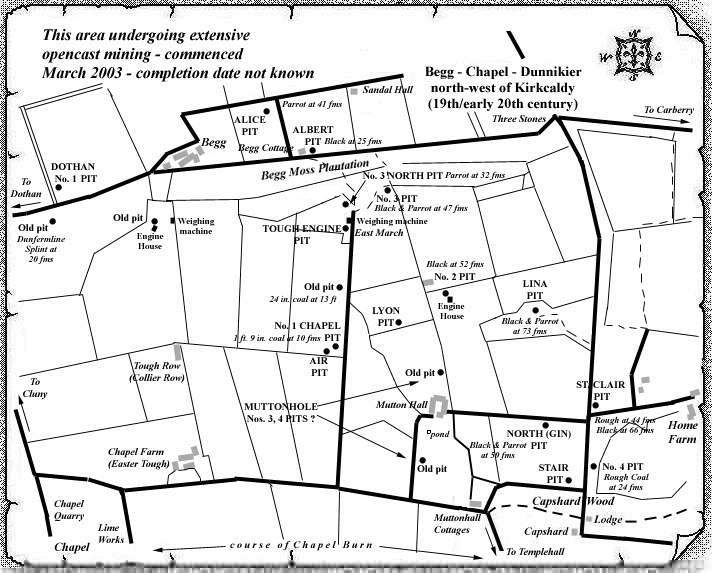
The Dunnikier Colliery wrought the ground between the Begg
Colliery, to the west, and Dysart Colliery, to the east, an area
known to have supplied coals for several centuries through early
crop workings and shallow pits, a great many located in the fields
immediately to the south of Dunnikier House (now Dunnikier Hotel).
[See 'Coalpitts' on map section from 17th century.]
 |
 |
 |
 |
| We are always pleased when site visitors
contribute their knowledge, experience and information to
the development of any aspect of this website. In this
respect, we are very grateful to William H. MacLeod,
Guardbridge, nr St Andrews, for his many interesting
contributions on the history and coalworks of Dunnikier
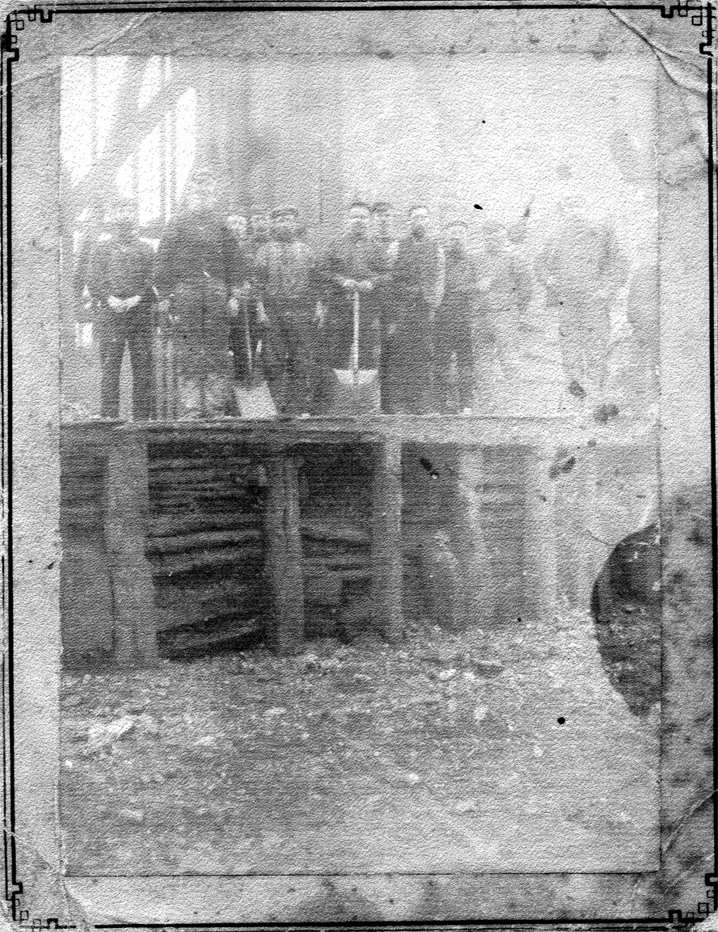
Colliery. The image below is believed to be an early scene
at a Dunnikier Pit, perhaps the Lena. It is believed that the tall man, second from the
left of the group, may even be a relative of William MacLeod.
M. Martin & Webmasters. |
 |
---------------------------------------------------------
A. S. Cunningham provides us with a fascinating
description of the early Dunnikier Collieries:-
'On the western fringes of Dysart parish, mining has
been carried on by the proprietors of Dunnikier or by lessees
for more than 400 years. As far back as 1659, the Town
Council of Kirkcaldy ordained that all
"coalholes" should be filled up. At that
time the miners operated upon a thin seam of coal which lay
near the surface, and landslips must have been common through
the "coal heugh" wastes falling in. In
"Kirkcaldy Burgh Records", Mr Macbean has the
following entry:-
"11th October 1731 - The
Council, considering the coal heugh is so near the town, and
the way so good and easy, the present price of threepence for
the cartload of coals is extravagant, and three halfpennies
for the sack; therefore, they reduce the price of the
cartload to twopence, and of the sack load to two
halfpennies, and ordains the carriers to serve at that price,
and discharges any of the burgesses to pay a greater sum, and
ordains intimation to be made on Saturday next by the
drum."
What would the coal carters of the present day say if the
Town Councils of Kirkcaldy and Dysart were to fix carting
rates? .... '
Kirkcaldy also had a number of early, small pits sunk in
the vicinity of Kirkcaldy Harbour, and right through Smeaton to
the Muttonhall, Capshard and Chapel Level districts in the
north-west of modern-day Kirkcaldy.
Probably its most well-known pits were the 'Panny
Pits', located in the Pathhead district approaching
Dysart, but some Kirkcaldy pits, such as the Isabella and the
Spitheads, were located closer to old Kirkcaldy town in the
Bennochy Road district, north-east of the railway station.
Early Dunnikier coal-works were under the ownership of Sir
John Oswald but most of the successful pits were worked under
lease by Goodall, Goodall & Herd, Walter Herd and then by
the Company involving several of his sons. After a brief
period of ownership under the Bowhill Coal Co., the Dunnikier
Colliery was taken over by the Fife Coal Co. Ltd.
The Dunnikier or Panny Nos. 1, 2 Pits, north of Pathhead,
finally ceased coaling in 1927.
----------------------------------
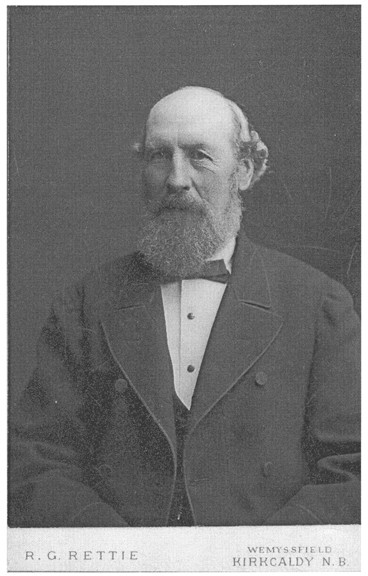
Mr Walter Herd
 |
----------------------------------
Pits or mines of the Dunnikier Colliery so far identified include:
Bye North (possibly the No. 3 North); Dunnikier Nos. 2, 3, 4; Engine; Isabella; Level; Lina (also Lena); Lyon; Muttonhole Nos. 3, 4; North (or Gin); Panny Nos. 1, 2; Smeaton; Spithead; St. Clair; Stair; Tough Engine; Townsend
----------------------------------
Extract: Statistical Account of Fife
Parish of Kirkcaldy - 1792
"Minerals. - Besides the produce of
the surface of the ground, this parish yields free-stone,
iron-stone, and pit-coal. At present, however, there is little or
no increase of value derived from these sources. ... The iron
stone is found in the coal-pits, and the working of it depends
on that of the coal. Different seams of coal from 2¼ to
4½ feet thick were formerly wrought; but they have for some
time been exhausted above the draining level. They continue, and
are supposed to be more valuable, below the level; but the expence
of machinery for draining, has hitherto prevented the working of
them. - At present, the inhabitants are supplied from the coaleries
of Dysart, belonging to Sir James St. Clair Erskine, or of Cluny,
belonging to Mr Ferguson of Raith. The former is distant from
Kirkcaldy about 2 miles, the latter about 4. At the former 2
metes, about 9½ cwt of small coals or chews, the
kind generally used for home consumption, are sold for 2s. 1d. and
the expence of carriage to Kirkcaldy is 1s.
At the latter, 3 loads, weighing about
9¾ cwt. are sold at 1s. 6d. and the expence of carriage is 2s.
There is a depot of Cluny coals kept at Kirkcaldy for exportation;
from which about 600 tons have been annually shipped during the
last 5 or 6 years, partly for Hamburgh, but chiefly for Middleburg,
where the Cluny splint is said to have the preference of
every other species of Scotch coal. As there is now a turnpike road
from Cluny to this place, it is probable that the quantity of coal
exported from it will increase. ..."
----------------------------------
Statistical Account of Fife (Abbotshall) 1836
"Upon it [carboniferous limestone], rest
the coal strata which run through the district, and which
contain valuable seams of coal. ... Coal being profitably
worked by some of the proprietors in the immediate
neighbourhood, there are no pits open at present in this
parish. The inhabitants, however, are well supplied with that
article of fuel, and at an easy rate. The nearest colliery is
that at the back of the town of Kirkcaldy, belonging to Sir
John Oswald, where the price of coal is 7s. 7d. per ton of 21
cwt. At the colliery of Dysart, belonging to the Earl of
Rosslyn, the price is 7s.; and at the colliery of Cluny,
belonging to Mr Ferguson of Raith, the price is 6s. 5d. The
Cluny coal, though the most distant, is generally preferred.
...
... Number of miners working in the parish =
21."
----------------------------------
Extract: Statistical Account of Fife
Parish of Kirkcaldy - 1845
"Minerals.- ... The general dip of
the strata, where their bearings are regular, and have not been
deranged by the convulsions which threw up the trap rocks, that
intersect this coalfield, are so troublesome in the working of the
coal, is south-south-east, from a ridge near the northern extremity
of the parish. The prevailing strata are sandstone, slate, clay,
and till, containing a number of seams of coal, varying in
thickness from 9 inches to 3½ feet. Above the coal, which is
now being wrought, there is a bed of whinstone 8 fathoms thick.
There is only one coal-pit in operation at present. It is 46
fathoms deep. The bed of coal is 5½ feet in thickness; but the
expense of turning out this coal is much increased, in consequence
of its being composed of two seams, separated by a stratum of clay
15 inches thick. This, however, only lessens the value of the
coal-field to the proprietor, and does not raise the price of coal
to the consumer;- for this is prevented by the competition of other
coal-works in the neighbourhood.
Considerable quantities of iron ore are also
found in this coal-field in globular masses. About thirty years
ago, when the iron trade was more profitable than it is now, this
ore was wrought along with the coal, and was sold at 10s. 6d. per
ton to the Carron Company. The working of it has been discontinued
for many years. The present tacksman of the Dunnikier colliery
could find buyers of the iron in England; but the prices offered
are not sufficiently remunerating to encourage him to embark in
this branch of trade. ...
Mines.- One coal-pit is
at present in operation. Forty (pick-men) colliers are
employed in it, besides labourers, and young persons to draw the
coals below ground. ..."
----------------------------------
| Individual EAST FIFE INDEX entries are currently in preparation but general information relating to facts and events of the Dunnikier Colliery which do not relate to a specific pit will be held in this entry. |
|---|
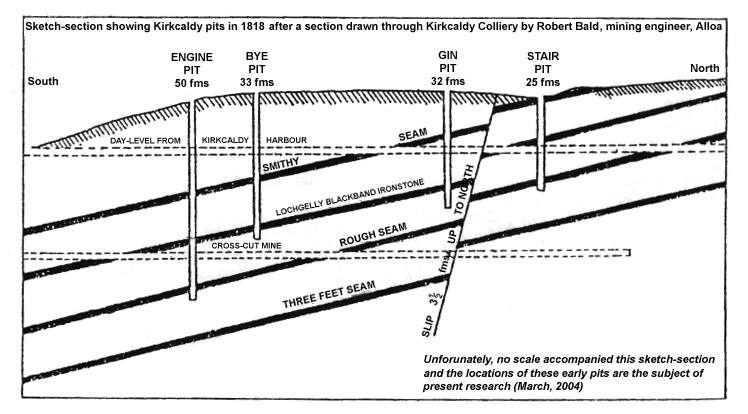
Some pits of the Kirkcaldy coalfield, to the south of Dunnikier estate and close to the harbour and promenade areas, were also operating in the late 18th and early 19th centuries. Pits so far identified include: Crop Pit; Bye Pit; Gin Pit and Stair Pit.
 |
------------------------------------
| Individual EAST FIFE INDEX entries for these Kirkcaldy pits are also currently in preparation but general information relating to facts and events of this southern Kirkcaldy coalfield will be held in the entry for the Crop Pit whose location has been identified from old map sections. The exact locations of the other pits are not known at this stage but information in abandonment plans suggests that the grounds wrought are in the area north-west of Kirkcaldy harbour. |
|---|
Dunnikier Colliery, Kirkcaldy
| Source Date of Information Supplied | |
|---|---|
| Manager / Under-Manager / Men underground / Men above ground / Coal seams worked | |
| 1833 (Sir John Oswald) | |
| Pit at Spithead Farm working the Smithy Coal and another at Dunnikier working with sales of Great and Small coals reported. Supplies at both pits described as considerable. Coal shipped at Kirkcaldy Harbour. | |
| 1835 (Sir John Oswald) | |
| Reports of colliery, salt pans and coals to be Let. | |
| 1840 (Mr Patrick Knight, Lessee) | |
| Source: A. S.
Cunningham account of Dunnikier Collieries.
[For Patrick read Park?] |
|
| 1842 (A. P. Knight, Lessee) | |
| Mr. Alexander
Park Knight, Lessee, Dunnikier Colliery, reported to the
1842 Commission.
A level to be driven from an engine pit of the colliery. |
|
| 1844 (A. P. Knight, Lessee) | |
| October -
roof fall reported causing an accumulation of "bad
air" and two-week-long suspension of coal
excavation.
Mr. Knight reported to be sinking a new pit in "another and more central quarter of this extensive coalfield." |
|
| 1845 | |
| Colliery let advertised in local press; engine pit sunk to about 20 fms. from the Smithy Coal/engine will be put in order. | |
| 1849 | |
| Local newspapers carry advertisements for engineers, wanted for further sinking and development of engine pit. | |
| 1850 | |
| Mr. A. P. Knight, Lessee, Dunnikier Colliery, died 30 January. | |
| 1851 | |
| 15 April -
death of Mr. Robert Pratt in scalding accident
May - Mr. T. Knox, Dunnikier Collieries - owner. "Coal Hill" - understood to be in the vicinity of St Mary's Road. David Dryburgh, Engineman, Coal Hill William Ramsay, Engine Keeper |
|
| 1854 | |
| Mr Thomas Knox, owner. | |
| 1856 | |
| * Adit from
engine pit redd out.
[* Subject of future research.] |
|
| 1857 (J. Goodall) | |
| 1860 (John and A. Goodall) | |
| * Old engine
house at St Mary's demolished.
[* Subject of future research.] |
|
| 1861 | |
|
* Final removal of engine at St Mary's.
[* Subject of future research.] |
|
| 1868 | |
| William
Goodall, Coalmaster, Dunnikier Colliery - died 17
February, 1868, aged 54 years.
Source: "West Fife Graveyards" |
|
| 1869 (Goodall & Herd) | |
| Messrs
Goodall & Herd worked the Begg Colliery in
conjunction with Dunnikier Colliery but the partnership was dissolved in January 1872. Source: A. S. Cunningham account of Dunnikier Collieries. |
|
| 1873 (Walter Herd) | |
| St Clair Pit; Isabella Pit (sinking) | |
| 1874 (Walter Herd) | |
| St Clair Pit; Isabella Pit; Lena Pit (just opening) | |
| 1875 (Walter Herd) | |
| St Clair, Isabella and Lena Pits | |
| 1876 (Walter Herd) | |
| Isabella and
Lena Pits
St. Clair listed as abandoned |
|
| 1877 (Walter Herd) | |
| St Clair, Lena, Smeaton and Spithead Pits | |
| 1878 (Walter Herd) | |
| St Clair,
Lena and Spithead Pits
Smeaton - stopped May, 1878 |
|
| 1879 (Walter Herd) | |
| St Clair, Lena and Spithead Pits | |
| 1880 (Walter Herd) | |
| St Clair,
Lena and Spithead Pits
St. Clair - abandoned 16 July, 1880 |
|
| 1881 (Walter Herd) | |
| Lena, Spithead and Panny Pits | |
| Panny:
Peter Herd / ---------- / 54 / 12 / Rough Coal
D'cast (16 x 7) 348 ft. : U'cast (12 x 5) 342 ft. Furnace ventilation. |
|
| 1882 (Walter Herd) | |
| Lena and Panny Nos. 1, 2 Pits | |
| Panny No.
1: Peter Herd / ---------- / 23 / 4 / 3 feet
D'cast (16 x 7) 516 ft. : U'cast (12 x 5) 504 ft. Furnace ventilation. Panny No. 2: Peter Herd / ---------- / 43 / 11 / Black and Parrot D'cast ---- : U'cast ----. Furnace ventilation. |
|
| 1886 | |
| Walter Herd,
Coalmaster, Dunnikier Colliery - died 11 November, 1886,
aged 63 years.
Source: "West Fife Graveyards" |
|
| 1890 (Walter Herd & Son) | |
| Lena and Panny Nos. 1, 2 Pits | |
| Thomas Herd / ------------ / 188 / 23 / Black, Parrot and Three Foot Coals. | |
| Panny No.
1: Thomas Herd / ---------- / 50 / 5 / Three Foot
D'cast (16 x 7) 348 ft. : U'cast (12 x 5) 336 ft. Fan (Waddle) 16' dia. Panny No. 2: Thomas Herd / ---------- / 79 / 11 / Black and Parrot D'cast 516 ft. : U'cast 504 ft. |
|
| 1893 (Walter Herd & Son) | |
| Thomas Herd,
manager. June - death of Major Oswald of Dunnikier. |
|
| 1896 (Walter Herd & Sons) | |
| Thomas Herd / ----------- / 158 / 41 | |
| 1898* (Walter Herd & Sons) | |
| Thomas Herd /
------------ / 258 / 32 / Gas, household, manufacturing
and steam coals. [*Another source lists this information for 1896.] |
|
| 1899 (Walter Herd & Sons Ltd.) | |
| ------------ / ------------ / 271 / 44 | |
| 1900 (Walter Herd & Sons Ltd.) | |
| ------------ / ------------ / 378 / 53 | |
| 1901 (Walter Herd & Sons Ltd.) | |
| ------------ / ------------ / 433 / 65 | |
| 1902 (Walter Herd & Sons Ltd.) | |
| John Henderson / D. Skinner / 436 / 66 / Gas, household, manufacturing and steam coals. | |
| 1903 (Walter Herd & Sons Ltd.) | |
| John Henderson / ------------ / 385 / 50 | |
| 1904 (Walter Herd & Sons Ltd.) | |
| John Henderson / ------------ / 381 / 48 / Gas, household, manufacturing and steam coals. | |
| 1905 (Walter Herd & Sons Ltd.) | |
| ---------- / ------------ / 387 / 52 | |
| 1906 (Walter Herd & Sons Ltd.) | |
| ---------- / ------------ / 395 / 53 | |
| 1907 (Bowhill Coal Co. Ltd.) | |
| ---------- / ---------- / 434 / 56 | |
| 1908 (Bowhill Coal Co. Ltd.) | |
| Archibald
Bowman Jr. / C. Mackay / 571 / 110 Electricity used. |
|
| Mr John M. Thomson, late of Dundonald Collieries, Cardenden, appointed general manager of Dunnikier Collieries, Kirkcaldy, lately purchased by Bowhill Coal Company. | |
| Thomas Herd, former Manager, Dunnikier Colliery - died 20 August, aged 48 years. | |
| 1909 - Fife Coal Company Ltd. purchase Dunnikier Colliery. | |
| ---------- /
------------ / 705 / 115 Coal cutters used. |
|
| 1910 (Fife Coal Co. Ltd.) | |
| ---------- / ------------ / 638 / 130 | |
| 1911 (Fife Coal Co. Ltd.) | |
| ---------- / ------------ / 633 / 134 | |
| 1912 (Fife Coal Co. Ltd.) | |
| Oct: Mr Robert Crawford (ex-Kirkford Colliery) appointed manager. | |
| 1913 (Fife Coal Co. Ltd.) | |
| David Jack / ------------ / 634 / 139 | |
| 1918 (Fife Coal Co. Ltd.) | |
| Panny
Pits: David Jack / William S. Brown / 395 / 115
Lena Pit: David Jack / W. T. Lyons / 60 / 18 |
|
| 1920 (Fife Coal Co. Ltd.) | |
| ---------- / ------------ / 614 / 173 | |
| 1922 (Fife Coal Co. Ltd.) | |
| ---------- / ------------ / 284 / 97 | |
| 1923 (Fife Coal Co. Ltd.) | |
| ---------- / ------------ / 296 / 96 | |
| Nov: Mr Thomas T. Thyne, ex-Bowhill Surveying Office, appointed manager. | |
| 1924 (Fife Coal Co. Ltd.) | |
| ---------- / ------------ / 274 / 99 | |
| 1926 (Fife Coal Co. Ltd.) | |
| ---------- / ------------ / 19 / 18 | |
| 1927 (Fife Coal Co. Ltd.) | |
| ---------- / ------------ / 40 / 14 | |
| Coaling in the Dunnikier field ceased 19 April, 1927. |
| Please see Stories Link: Bowman Story, for interesting tales of the relatives of Archibald Bowman Jr., one-time manager of this colliery. |
|---|
Dunnikier and Begg Collieries (19th century report)
| Coal seams worked | Thickness | Quality | Class |
|---|---|---|---|
| Rough Coal | 3 ft. 6 in. | 2nd class | Steam (cherry) |
| Black Coal (Lochgelly
Splint) |
3 ft. | 1st class | Steam and household |
| Parrot Coal | 2 ft. | 2nd class | Gas coal |
| Glassee Coal | 3 ft. 6 in. | 1st class | Steam (cherry) |
| Mynheer Coal | 2 ft. | 2nd class | Smithy Coal |
| By the early 1930s no coal was apparently being worked within the Kirkcaldy area although for a number of years before this, the Dunnikier Panny Pits and the Seafield Mines (do not confuse with the modern Seafield Colliery), to the south of Kirkcaldy, were in operation. |
|---|
----------------------------------
Coals in the Dunnikier coalfield
The total thickness of the Limestone Coal Group (excluding igneous intrusions) was close to 115 fathoms and contained a total thickness of coal of 44 ft. It has been calculated that there were 12 coal seams with 18 in. or more of coal, and 9 coal seams with 2 ft. or more coal present in the Dunnikier Colliery workings. The development of the Limestone Coal Group varied from bore to pit to bore in this area and information on the seams and coals worked is available in the individual pit entries.
However, the general succession of coal measures in the Kirkcaldy field is representative of the strata as passed through in the Panny Pits of the Dunnikier Colliery. The following table is from a 1900 report:
| Description | Thickness |
|---|---|
| Various strata | 180 ft. |
| UPPER SMITHY COAL | 2 ft. 9 in. |
| Strata | 150 ft. |
| COAL
(rough and parrot) and Shale
(= position of Lochgelly B. B. Ironstone) |
3 ft. 9 in. |
| Strata | 50 ft. |
| COAL | 2 ft. 2 in. |
| Strata | 38 ft. |
| COAL (coarse) | 3 ft. |
| Whinstone | 18 ft. |
| Freestone | 24 ft. |
| COAL | 10 in. |
| Strata | 9 ft. 10 in. |
| COAL | 1 ft. 4 in. |
| Strata | 17 ft. 8 in. |
| BLACK COAL } | 4 ft. |
| Strata } (Lochgelly Splint and Parrot) | 2 ft. 4 in. |
| PARROT COAL } | 2 ft. 6 in. |
| Strata (including some thin coals and 40 feet of whinstone | 200 ft. |
| CARDENDEN COAL ( ? Glassee Coal of western fields) | 4 ft. |
| Strata | 21 ft. |
| GIBBS HALL COAL (Mynheer) | 2 ft. 1 in. |
| Strata | 25 ft. |
| Compare this with table from 1934 report - see Coalfields Link |
|---|
More based on the 1900 report:
The outcrops of the lower Dunfermline seams of coal have
not been traced through the Kirkcaldy field. The lowest seams
that have been followed are the Gibbs Hall and Carden seams,
which, as they approach Kirkcaldy, are known as the Lower and
Upper Smithy seams. ... The Black Coal and Parrot run on
beyond the end of the basalt-sheet at Mutton Hall, and crop
out in the dell of the Chapel Burn a little below Smeaton
Row, in the old Dunnikier Colliery. The strata are traversed
immediately to the south of that section by a powerful fault
which, throwing them down to the south, strikes from the
middle of the Pathhead Sands north-westwards to beyond Bogie
Parks. The effect of this dislocation is to shift the
outcrops 600 yards to the west.
Another intercalated basalt ... has been exposed in the
railway cutting north of Kirkcaldy Station with the outcrops
of the two coal seams coming out from under it. ... The two
seams [Splint and Rough Coals] have their outcrop in the
ravine of the Dunnikier Colliery, a little further down than
those of the Black Coal and Parrot. ...
It is a curious fact that, notwithstanding the comparative regularity of the strata in this field, and the small number of serious dislocations, a number of sills have been injected into the coal-bearing measures on several horizons. Two of these are shown in the sections of the Panny Pit (see separate entry).
| Plans of Abandoned Seams for Dunnikier | Pits or mines designated in the abandonment plans |
|---|---|
| COAL; Glassee; Mynheer | DUNNIKIER |
| COAL; Three Feet; Four Feet; Five Feet | DUNNIKIER |
| Plan Custodians:
Landale, Frew, Gemmell & Arnot, Edinburgh.
Dated abandonment plans available in individual pit entries. |
|---|
------------------------------------
"Fifeshire Journal"
26 January, 1833
PRICE OF COAL REDUCED
THE SMITHY COAL on Dunnikier Estate, which is now working
a Pit on the Farm of SPITHEAD, near Kirkcaldy, is reduced in
price to One Shilling per Load.
This Coal (equal to English Coal) is found to be of superior
quality for the Forge and is also well suited for Family use
having the property of caking, when put on the fire a little
damped.
Great and small Coal continues for sale at a pit near
Dunnikier, the Great at 1s. per Load, in small quantities,
and 11d. per Load in Tons; and the Small for Furnaces at 6d.
per Load.
As the Quantities on hand at both Pits is considerable, the
Public may depend on a steady supply.
The Smithy Coal is shipped at Kirkcaldy Harbour on very
moderate terms.
Dunnikier Colliery, near Kirkcaldy.
24 January, 1833.
------------------------------------
"Fifeshire Journal"
Saturday, 25 April, 1835
TO LIME BURNERS
THE LIMEWORKS at EASTER BOGIE, will be Let, on very advantageous terms, for such period as may be agreed upon, with immediate entry. The Lime is of excellent quality, and the Rock of considerable thickness.
Offers will be received by Mr. ALEX. KNIGHT, overseer, of Dunnikier Colliery.
Kirkaldy, April 24, 1835.
------------------------------------
"Fifeshire Journal"
Saturday, 2 May, 1835
COLLIERY AND SALT PANS TO LET
To be Let, for such term of years as may be agreed upon, with entry at Whitsunday first, or as soon after as a bargain can be concluded.
THE COLLIERY as at present going on the ESTATE of DUNNIKIER, with the MACHINERY and UTENSILS, together with the SALT PANS and SAT GIRNAL, &c., at Kirkaldy.
Offers will be received by ANDREW INGLIS, Kirkaldy, Factor to Lieut.-General Sir John Oswald of Dunnikier.
Kirkaldy, May 1, 1835.
------------------------------------
"Fifeshire Journal"
Saturday, 18 July, 1835
COAL TO LET
IT is proposed to Win the SEAMS of COAL immediately behind KIRKALDY. The working Pit which is already sunk, is put down at the top of the large park. The coal will be let for such period of years as may be agreed upon, and information will be given by applying to Mr A. P. KNIGHT, Lessee of Dunnikier colliery; and offers received by MR ANDREW INGLIS, Kirkaldy, Factor to Lieutenant-General Sir John Oswald of Dunnikier.
------------------------------------
"Fifeshire Journal"
11 June, 1840
This issue announced the death of General Sir John Oswald of Dunnikier who was 69 years of age was described as one of the bravest soldiers of modern times. It was reported that he had seen much service and had been fifty-three years on full pay.
------------------------------------
Royal Commission, 1842
Dunnikier Colliery, parish of Kirkaldy
(Mr. Alexander Park Knight, Lessee.)
John Bowman, 16 years old, hewer :
"Been five years at coal - hewing; works 12 &
13 hours day about and 10 when on night work. was at school
before working and at writing, now cannot sign own name; did
not sign the big paper but a man at the pit mouth wrote it
for me. I work on step-fathers account with sister, who is 17
years of age, she is a little [?] and goes to Sabbath- school
to learn the Scripture. I live near Kirkaldy, which is in
Fife, can't say what country it is in, unless it is in
Edinburgh."
(Can answer many of the questions in the short Catechism;
reads very badly.)
------------------------------------
"The Scotsman"
12 November, 1842
KIRKCALDY - DISTRESSING OCCURRENCE
On the morning of Thursday last, a boy about eight or nine years of age was sent as usual with breakfast to his grandfather, who is fireman at Dunnikier engine pit. While the grandfather was taking his breakfast, the boy employed himself in drawing some coals from the heap towards the furnace, and got out of sight occasionally, owing to some part of the premises intervening. The old man thinking the boy rather long of returning, went to see what he was about. Not seeing him about the premises, he looked down one of the pits, in which there is a considerable depth of water, and seeing the coal hurley swimming on the top of the water, he thought that he had let it fall into the pit, and had run home from fear of his displeasure. The old man, however, feeling alarmed at the sudden disappearance of the boy, ran down to his house to see if he were there. Not finding him, he instantly returned with others, to assist in searching the pit in which he had seen the hurley, and in which he now believed the boy to be, as it was likely that, having to pass close by the pit, he had gone too far, and thus fallen in backward, dragging the hurley with him. The body has been searched for in the pit with grappling irons, but in vain. We understand the pit is not fenced round, which surely ought to be the case; and we are sorry to observe that too many, both of disused and of working pits, are in such an unfenced state as to look like traps for either man or beast, exhibiting a gross carelessness of the lives of those who may have occasion to pass that way. - Fife Herald.
------------------------------------
"Fifeshire Journal"
31 October, 1844
DUNNIKIER COLLIERY
In consequence of the roof of Dunnikier colliery having fallen down in several places, which has been the cause of the accumulation of a quantity of bad air in the working vaults, the excavation of coal in the mine has been for the last fortnight altogether suspended. It is, however, expected that the cessation of the work will be only temporary, as the tacksman, Mr Park Knight, has been for some time engaged in sinking a new pit in another and more central quarter of that extensive coal-field. The accident, however, in the meantime may be considered as untoward having occurred at a time when the supply of coals in general is not equal to the demand, and especially as the Dunnikier coal is considered by consumers as the best, especially when it is used for steam, to which it has been applied extensively by the owners of steam-boats as well as factory proprietors.
------------------------------------
"Fifeshire Journal"
9 October, 1845
EXTENSIVE COAL-FIELD IN FIFE.
To be Let, for such a number of years as may be agreed upon -
THE COLLIERY upon the Estate of Dunnikier,
consisting of a variety of Workable Seams, containing superior
Smithy Coal, Parrot or Gas Coal, as well as Coal adapted for
Household purposes, Steam-Boats, Engines, &c.
The Engine Pit is sunk to about 20 fathoms from
the Smithy Coal; and the Engine, Machinery, and Utensils, will be
put in good repair, and handed over to the Tenant at a
valuation.
This extensive Coalfield is situated in the
immediate vicinity of the thriving and populous Burgh of Kirkcaldy,
where a great Quantity of Coals are consumed for Steam, Gas, and
Household purposes - and besides, the Edinburgh and Northern
Railway intersects the Coalfield, passing within a few yards of the
Engine Pit; thus opening up facilities for supplying Perth, Dundee,
and other large Manufacturing Districts, as well as other parts of
the North-East Counties of Scotland.
For further particulars, application may be made
to Messrs Tosh & Gibson, Writers, Kirkaldy, or to Mr Paton,
Factor on the Estate.
Kirkaldy, October 8, 1845.
[This advertisement also appeared in the issue of 6 November, 1845.]
------------------------------------
"Fifeshire Journal"
11 January, 1849
ENGINEER WANTED
... An experienced working engineer for the further sinking of Dunnikier Engine Pit. Apply to Mr Alex. Paton, Kirkcaldy. ...
------------------------------------
"Fifeshire Journal"
1 November, 1849
TO ENGINEERS
... Wanted, an engineer accustomed to all kinds of pit work and well-acquainted with machinery. Apply to Mr Alex. Paton, Dunnikier Colliery Office. ...
------------------------------------
Information from the Edinburgh, Perth & Dundee Railway
Minute Books.
[Contributed by Ed McKenna, Edinburgh.]
At the Board Meeting of 23 October, 1850, a request was received from Captain Oswald of Dunnikier that the EPDR lay in a siding to his Dunnikier Coal Pit. The request was rejected but at a further meeting on 30 October, 1850, Captain Oswald stated that he would construct the siding at his own expense if the EPDR laid in the connection to the main line. This was agreed to. The 1st Edition OS 6" map does not show the connection although it does show a tramroad running up the west side of the Den from the Engine Pit.
------------------------------------

"Fifeshire Journal"
15 April, 1851
KIRKCALDY - ACCIDENT
On Thursday last, at 2 o'clock p. m., the boiler of the pumping engine at one of the Dunnikier coal pits burst, by which Robert Pratt, banksman, was so severely scalded that he died at 11 o'clock the same evening. He has left a widow and five children to deplore his loss.
------------------------------------
"Fifeshire Advertiser"
9 May, 1851
The Lessee of KIRKCALDY COLLIERY has now opened up the
Black and Parrot Seam of Household Coal and is prepared to
deliver at the following rates:-
Best Household Coal -------------- 7s. per ton (including
Cartage) from the Engine Pit
Household Coal ------------------- 7s. 6d. per ton (including
Cartage) from the Old Pit
Orders will be received by:
Mr P Marshall, Jeweller
Mr H. Ross, Post Master, Pathhead
Mr J. Henderson, Tinsmith, Links
or at the Colliery Office, Coal Wynd.
------------------------------------
Information from the Edinburgh, Perth & Dundee Railway
Minute Books.
[Contributed by Ed McKenna, Edinburgh.]
The railway siding connection agreed to in October, 1850, must have been constructed, for later, on 7 December, 1854, Robert Douglas asked the EPDR for access to his proposed works at Dunnikier by means of the siding to the colliery there. Douglas's proposed works was what became known as The Dunnikier Foundry, later owned by Douglas & Grant.
------------------------------------
"The Scotsman"
3 October, 1860
ENGINE, PUMPING MACHINERY, &c.,
FOR SALE.
FOR SALE, an 80 Horse-power CONDENSING ENGINE, having Two
BOILERS, the one 45 feet by 7½ feet, and the other 40 feet by 7 feet,
with about 30 Fathoms of 15-Inch PUMPS, with Spear-Rods, Buckets, and
everything complete; and also a 10-Inch SET of PUMPS, with the usual
accompanying Gear. Also, GRABS, ROPES, and a great many MISCELLANEOUS
ARTICLES used in COLLIERY operations. The Machinery is in perfect order, and
quite recently stopped. The whole will be sold separately, or together, as offerers
come forward.
For terms and particulars, apply to Mr W. GOODALL, Dunnikier Colliery, Kirkcaldy.
Dunnikier Colliery,
September 28, 1860.
------------------------------------
"Dunfermline Saturday Press"
2 February, 1867
ACCIDENT
On Tuesday, while a man named John White, a miner, was engaged in Dunnikier coal-pit, a large block of loose stone fell from the roof and injured him severely on the back or other parts of the body. The unfortunate man is under medical treatment, and is making favourable progress.
------------------------------------
"Dunfermline Journal"
3 March, 1877
KIRKCALDY
A new coal pit has been opened at Smeaton, and will now be worked instead of Dunnikier Colliery which is exhausted. ...
------------------------------------
"Fife Free Press"
9 July, 1881
"THE PANNIE COAL PIT- SUCCESSFUL ISSUE OF SINKING OPERATIONS - A few days ago the sinking operations at the new coal pit at the Pannie came to a very successful issue. A seam of black coal, four feet four inches in thickness, and of splendid quality, was struck and thus a rich reward is promised to the costly mining operations so long carried on by Mr Herd."
------------------------------------
"Fifeshire Advertiser"
11 March, 1882
"THE EAST BURN CASE - On Wednesday, in the Second Division
of the Court of Session, their Lordships disposed of an appeal from the Sheriff
Court of Fifeshire in reference to the Denburn at Kirkcaldy. The action was
originally brought at the instance of James Heggie, Auchtermuchty, against
Mrs Catherine Ingram or Nairn, residing in Kirkcaldy; Robert Nairn, floorcloth
manufacturer, and Michael Barker Nairn, floorcloth manufacturer.
The pursuer [Heggie] is owner of a property on the east bank of the Denburn,
and is entitled to the use for dyeworks belonging to him of the water of the Burn
as it flows past his property. This burn is a little way above the pursuer's
property, augmented by the water which is discharged from an artificial mine or
level constructed more than forty years ago, and which now drains the mineral
workings of the estates of Dunnikier and Raith. The greater part of this water
is pumped up by the mineral tenants, from workings at a lower level. In 1874
the defenders [Nairn] who are proprietors of manufactories in the neighbourhood,
enlarged a previous existing hole in the level, and have since withdrawn from the
mine for the purposes of their works, a large quantity of the water flowing through it.
The pursuer objected to this, and maintained that he had a right to all the water
which flowed into the Denburn before it passed his property.
Their Lordships dismissed the appeal on the grounds that the appellant [Heggie]
had not proved any right to the water in the artificial conduit from the mine, but
that the respondents, who had obtained permission from the colliery tenants
were in the same position as if they had got the permission from the proprietor. ..."
[We are very grateful to Alan Simpson, Kirkcaldy, for supplying this information
and other data on some early pits and manpower figures at Dunnikier Colliery. Alan confirms
that Denburn is synonymous with the East Burn in Kirkcaldy which flows into the
sea at the side of the wall of the present day harbour.
M. Martin & Webmasters.]
------------------------------------
"Dunfermline Saturday Press"
17 March, 1883
KIRKCALDY - COLLIERY ACCIDENT
A serious accident occurred on Friday last week, at Dunnikier Colliery. Two miners were engaged propping up a roof of the pit when a large fall of rock took place, literally burying them. Both men were injured, one named Simpson severely. Nearly an hour elapsed before he could be extricated.
------------------------------------
"Dunfermline Saturday Press"
29 September, 1888
KIRKCALDY - COLLIERY ACCIDENT
On Wednesday morning, a lad named George Skinner met with an accident at Dunnikier Colliery. He was conducting some hutches along one of the passages when, owing to some obstruction, they were overturned, and Skinner had his leg and foot severely crushed, some of the bones being broken.
------------------------------------
"Dunfermline Saturday Press"
4 February, 1893
READING ROOM FOR DUNNIKIER MINERS
On Thursday night, a handsomely fitted up reading-room for the miners connected with Dunnikier Colliery - the gift of Major Oswald - was formally opened.
The reading-room, which is situated at Dunnikier Row, is equipped with all the modern requirements of a first-class reading-room. The opening ceremony was performed by the donor. Mr John Leitch, on behalf of the miners, thanked Major Oswald for the splendid hall he had placed at their disposal.
------------------------------------
"Dunfermline Saturday Press"
10 June, 1893
This issue announced the death of Major Oswald of Dunnikier. He died in London where he had been living during the last two months.
------------------------------------
"The Scotsman"
26 August, 1893
Last night a meeting of the Dunnikier miners was held in Kirkcaldy for the purpose of considering the present situation. The masters' threat to hold out was regarded with indifference, the fact that some of the smaller collieries in the district had got 25 per cent. seemingly giving the men great hope of an early settlement. A resolution agreeing to insist on their original demand was unanimously adopted, and delegates to the miners' conference at Dunfermline today were instructed to support nothing short of this. Coals have gone up in price 5s. per ton. Most of the coals have been taken from the pit heads for domestic consumption only.
------------------------------------
"The Scotsman"
3 September, 1896
COLLIERY clerk wanted. Apply with references, Dunnikier Colliery, Kirkcaldy.
------------------------------------
"Dunfermline Saturday Press"
5 September, 1896
AN ENTERPRISING MINING FIRM
Messrs Walter Herd & Son, Dunnikier Colliery, have just arranged with Mr Munro Ferguson of Raith, for a lease of a large portion of Raith coalfield. The firm have also acquired Begg Colliery from Messrs Goodall Brothers. There is every probability that in the near future coal will be wrought more extensively than ever in the immediate neighbourhood of Kirkcaldy.
------------------------------------
"Dunfermline Press"
19 May, 1900
KIRKCALDY
ANCIENT COAL WORKINGS
In connection with the construction of Kirkcaldy Victoria Bridge and the formation of the connecting road, considerable interruption has lately been experienced owing to the discovery of some old coal workings at a point about 30 feet from the surface. These workings seem of ancient type, consisting of long passages, which are in some cases 12 feet in height, the entrance having been from the Den. The contractor found it necessary to build brick walls in these passages to support the ground above.
------------------------------------
H. M. Inspector of Mines Report 1907
Mr. Robert McLaren's Report
Fatal Accident at Dunnikier, Fife
Owner: Walter Herd & Son, Ltd.
14 February, 1907
Andrew Galloway, 24, Miner. Deceased was travelling up an incline towards his working place, when he was met by an empty runaway tub which injured him and he died 22 days later. His drawer, in turning an empty tub on the plates at the incline, allowed it to go over to the rails, and it ran down.
H. M. Inspector of Mines Report 1907
Mr. Robert McLaren's Report
Fatal Accident at Dunnikier, Fife
Owner: Walter Herd & Son, Ltd.
22 February, 1907
James Griffiths, 47, Pumping Engineman. Deceased was walking up a dook, and was overtaken by a loaded rake of tubs being drawn up, and seriously injured, the injuries terminating fatally on 21st May, 1907. He apparently did not think the rake was so close upon him, as he had plenty of room to step aside and allow it to pass.
H. M. Inspector of Mines Report 1907
Mr. Robert McLaren's Report
Fatal Accident at Dunnikier, Fife
Owner: Walter Herd & Son, Ltd.
28 March, 1907
Lewis Park, 30, Wheeler. The tubs on a self-acting incline, became derailed, and deceased and the hanger-on at the foot re-railed them. Owing to some obstruction on the rails the tubs did not at first move, and afterwards they went away, just as deceased was leaning over them, and he was crushed against the roof which was low at the part.
H. M. Inspector of Mines Report 1907
Mr. Robert McLaren's Report
Fatal Accident at Dunnikier, Fife
Owner: Walter Herd & Son, Ltd.
21 October, 1907
William Bowman, 55, Repairer. A room was being made for a motor, in an old roadway, which had fallen a considerable height, and while deceased was filling a tub with debris, a small stone fell off the side and struck him. The injuries were considered very slight, but he succumbed from the effects 16 days later.
-------------------------------------------------
"The Scotsman"
15 February, 1908
IMPORTANT FIFE COLLIERY AMALGAMATION. - An arrangement of much importance to all concerned in the Fife coal trade has been arrived at whereby the Bowhill Coal Company (Limited) have acquired the collieries and minerals at present worked by Messrs Walter Herd & Sons, Dunnikier Colliery, Kirkcaldy. The coalfields of the two companies adjoin each other, and the combination will give the amalgamated company control over those seams of coal extending from Bowhill to the shore, and also coal under the sea. The Dunnikier Collieries have been many years in existence, and include the seams of Begg and Dunnikier, and also the seams on Dysart estate underlying the Dysart main. The coalfields will extend over several miles, and very extensive developments of the industry are anticipated at an early date. Borings have already been made near the village of Thornton, and extensive work is likely to be undertaken between Kirkcaldy and Markinch.
-------------------------------------------------
"Dunfermline Press"
20 May, 1908
Mr John M. Thomson, late of Dundonald Collieries, Cardenden, leaving to take up the more important duties of general manager of Dunnikier Collieries, Kirkcaldy, lately purchased by Bowhill Coal Company.
-------------------------------------------------
"Dunfermline Press"
19 February, 1910
COAL CUTTING MACHINERY
Mr J. M. Thomson, general manager of the Fife Coal Company's works at Dunnikier, is the patentee of an apparatus for reducing the risk of accidents associated with bar coal-cutting machines. The invention has been adopted by a well-known Glasgow firm, Mavor & Coulson, Limited, and fitted to their coal-cutters.
-------------------------------------------------
"Dunfermline Press"
12 March, 1910
John Muir Thomson, colliery manager, Denend House, Kirkcaldy, was examined in Kirkcaldy Bankruptcy Court on Wednesday before Sheriff Shennan.
-------------------------------------------------
"Dunfermline Press"
30 July, 1910
Mr J. M. Thomson, the Fife Coal Company's manager at Dunnikier Colliery, Kirkcaldy, has introduced a patent cable suspender for use in collieries, which, it is believed, will supply a much-felt want in mining circles. The suspenders have been approved of by mining experts, and will probably be introduced to most up-to-date collieries. Mr Thomson, who has a high reputation as a mining engineer, has already other engineering inventions to his credit.
-------------------------------------------------
"Dunfermline Press"
15 July, 1911
FIFE COLLIERY MANAGER'S INVENTION
Mr Thomson, the talented Fife Coal Company's manager at Dunnikier, has added
to his inventive reputation by his recent device with coal-cutting machines. In the report just
issued by the Mines Inspector for Scotland, it is given a flattering reference, and the invention
has created a favourable impression in mining circles. It will probably be an effective medium in
reducing the death and accident roll in Scotland.
One of the most prominent firms in Britain has secured from Mr Thomson the selling rights of
the machine at a satisfactory royalty to the inventor.
The device consists of an apparatus for throwing the bar of a coal-cutting machine out of gear
while the machine is travelling, and has already worked in a very satisfactory manner in
Dunnikier and other collieries.
-------------------------------------------------
"Dunfermline Press"
24 May, 1913
MINERS AND SUNDAY LABOUR.
At the monthly meeting of the miners of Dunnikier Colliery, Kirkcaldy (Fife Coal Company) on Tuesday, it was reported that a large amount of unnecessary Sunday labour is at present being carried on at this colliery. After discussion, it was unanimously agreed that a determined effort be made to stop this practice, and the General Secretary, Mr Wm. Adamson, M.P., is to be asked to confer with the management with a view to obtaining this end. A strong desire was expressed that if this proceeding prove abortive Sunday picketing should be at once resorted to.
-------------------------------------------------
"The Scotsman"
28 February, 1921
DISMISSAL AT FIFE PITS.
LEVY ON WORKERS.
At a special meeting at Dunfermline on Saturday of the Executive Board of the Fife, Kinross,
and Clackmannan Miners' Association, a discussion took place with regard to the large
amount of unemployment in the pits of the counties. At Dunnikier Colliery, Kirkcaldy, it was
reported, 200 men had been dismissed, and at Dysart Colliery the services of 100 men had
been dispensed with. There had also been dismissals at other collieries.
With a view to alleviating the prevalent distress, the Executive recommended to the favourable
consideration of the members the imposition of a voluntary levy. The suggestion was that each
man should contribute a sum of sixpence per shift, and the hope was expressed that it would be
possible to collect the contributions at the colliery offices.
-------------------------------------------------
"Dunfermline Press"
2 July, 1921
... With the exception of the Wellesley Pit, in the Wemyss area, and Dunnikier Pit in the Kirkcaldy district, all the pits in the East of Fife will be in full working order within a few days. At each of these pits, the full working complement in normal times is about eight hundred men.
-------------------------------------------------
"Dunfermline Press"
24 September, 1921
DUNNIKIER COLLIERY.
TO BE CLOSED DOWN IF OUTPUT IS
NOT INCREASED.
The Fife Coal Company has given notice to the men employed at their Dunnikier
Colliery that the pit will be closed at the end of this week. As the colliery normally
employs about 500 men the officials of the Fife, Kinross, and Clackmannan Miners'
Association feel that they cannot allow such a large addition to the ranks of the
unemployed to be made without making some effort to avert the calamity. Mr
William Adamson, M.P., had a meeting with Mr C. Augustus Carlow, joint managing
director of the Fife Coal Company. Mr Carlow explained the reasons for the Company's
decision. He pointed out that the output from the colliery only averages 15 cwts per
person per day, as against a pre-war output of 35 cwts per person per day.
Mr Adamson, who recognises the importance of output, pleaded that the pit should
be kept open, and referred to the distress which would inevitably follow its closing.
Mr Carlow stated that the Company had no desire to close the pit if it could pay its way.
At present, however, the coal raised cost the Company from 28s to 30s per ton, and
they had to sell it at £1 per ton. An output of 30 cwts per person per day -
less than the pre-war rate - would enable them to keep the pit open.
Mr Adamson said he would place the facts before the men and strongly
advise them to do all they could to increase output.
-------------------------------------------------
"The Scotsman"
26 September, 1921
THE THREATENED CLOSURE
OF A FIFE PIT.
MEN AGREE TO MONTH'S TRIAL OF
OWNERS' CONDITIONS.
At the monthly meeting of the Executive Board of the Fife, Kinross, and Clackmannan Miners'
Association at Dunfermline on Saturday, a report was submitted of the negotiations which had taken
place with regard to the threatened stoppage of the Fife Coal Company's Dunnikier Colliery,
Kirkcaldy. Three interviews, it was stated, had been held during the week between the heads of the
Company and representatives of the men. The result of these was that certain rates of wages had
been proposed by the Company and accepted temporarily for one month by the men, in order to avert
the danger of a stoppage at the colliery, where 800 persons are normally employed.
Mr William Adamson, M.P., the general secretary, reported an interview he had had with the
umpire under the National Unemployment Insurance Act with regard to the question of men who
had not yet been able to resume work. The report showed that the umpire had favourably decided
the claim of the men still unemployed at the Mary Pit, Lochore, the settlement, so far as these men
were concerned, representing a lump sum payment of £9 per adult member.
-------------------------------------------------
"Cowdenbeath & Lochgelly Times"
15 February, 1922
That many miners at Dunnikier Colliery, near
Kirkcaldy, are now unable to earn wages was reported at
Saturday's meeting at Dunfermline of the Executive Board of
Fife, Kinross, and Clackmannan Miners' Association. Much
dissatisfaction prevailed at this colliery as a result of the
drastic reductions which had taken place there in the tonnage rates
allowed to miners.
It was stated that the working faces had
recently been examined on behalf of the men, and that a meeting had
taken place with the management, at which claims for
reconsideration of the rates were put forward. The management have
agreed to consider the claims, and have promised an early reply.
-------------------------------------------------
"Dunfermline Press"
24 November, 1923
Mr Thomas T. Thyne, who has been in charge of the surveying office at Bowhill Colliery for a considerable number of years, has been appointed manager at Dunnikier Colliery. Mr Thyne has been at Bowhill Colliery for about eighteen years, having served his apprenticeship there. For some time he was in charge of the evening continuation classes in connection with mining, and was successful a few months ago in gaining a first-class manager's certificate.
-------------------------------------------------
"Fife Free Press"
9 October, 1926
"A good deal of water has risen in the Dunnikier pit during the strike, and it is not expected to open for some time. ..."
-------------------------------------------------
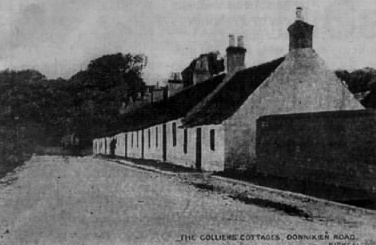
Colliers' Cottages, Dunnikier Road
"Fife Free Press"
10 January, 2003
The Dunnikier Colliery open in 1885 when Walter Herd feued
the rights to mine coal from James Oswald of Dunnikier.
This was an extension to the Pannie Pit which had been
started in 1881. Dunnikier Colliery was entered from
Dunnikier Road where the Fire Station is now. The little lane
on the side, leading to garages, is where the colliery
cottages were for the miners. These were mostly simple
two-roomed cottages with an attic.
Large families lived in these little houses and it was not
unusual for a miner and his wife to rear 10 or more children.
Dunnikier Colliery closed after the General Strike of
1926.
 |
-------------------------------------------------
"The bing of the Pannie Pit."
"This was removed during the mid 1960s and as a pupil
at Pathhead Primary School during that era, I can remember a steady
stream of tipper trucks belonging to a Windygates-based haulage
contractor passing by the playground at break-time and full of the
bing material. I understand that this spoil was used as road bottoming
on the Standing Stane Road (this last point may have been anecdotal).
"
Alan Simpson, Kirkcaldy.
-------------------------------------------------
