Owners: not known
This small nineteenth century pit, thought to be still
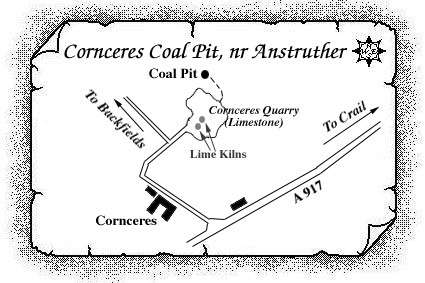
working around the 1850s, was situated just yards north of
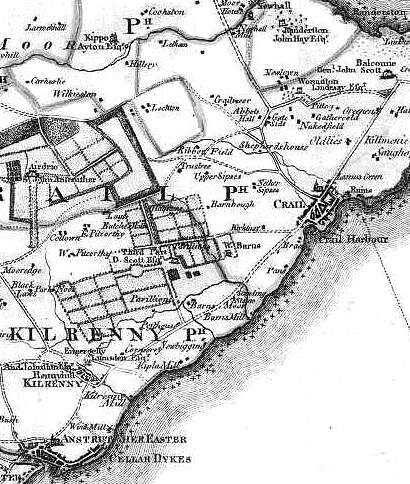
Cornceres limestone quarry, over a mile north-east of
Anstruther, and by Kilrenny. Coalworks associated
with lime quarries were on a very small scale and bore
little comparison to other old east Fife collieries of this
period which were operated on a more commercial basis
for coal sales. Coals from this Cornceres pit would have been
used for the burning of the local limestone.
Cornceres is
slightly over two miles south-west of Crail, probably the most
eastern part of the Kingdom, along with nearby Kingsbarns, to
have worked Fife coals.
 |
 |
Kingsbarns
"Coal also appears to exist largely underneath the greater part of the parish ... Where it peeps out, it is at times quarried by the poor people."
Statistical Account of Fife 1836
Kilrenny
"...It [bituminous limestone] is wrought inland ... at Cornceres ... Here it lies in small trough-shaped basins, and is much disturbed by underlying dykes, which traverse in every direction the whole of the district. Along the shore the deposit is about six feet thick, and dips to the south-east at an angle of 20o. It rests upon a thin bed of coal about one foot and a half in thickness. ... The coal which is found in the parish is of inferior quality, and used only for burning limestone. ..."
Statistical Account of Fife 1843
Crail
"There are many indications of coals having been dug here at an early period ... at present, coals are raised for burning lime."
Statistical Account of Fife 1845
---------------------------------------
Coals worked at, or near, Cornceres Coal Pit, nr Anstruther
(based on a report from 1900)
A limestone was formerly worked in a long line of quarries
extending from Cornceres quarry (filled up by 1900)
south-westwards to the church of Upper Kilrenny and it is
likely that coaling ceased when the
limeworks were closed (two kilns on site) some time before the quarry
was filled up.
Several limestones, quarried in the vicinity of
Cornceres, were associated with an underlying coal (2 ft. 6
in. thick) and a thin coal above it. A number of other thin
coal seams were also laid open during quarrying operations
although correlation of these coals with any known seams is
not possible at this time.
Lime, CaO, is produced by heating lumps of limestone to a high temperature to drive off CO2 from the CaCO3 present in the limestone. In the eighteenth century, lime became widely used as an agricultural fertiliser and this led to the building of lime kilns wherever there were available supplies of limestone and coal to burn it. The coming of the railways in the 1850s led to the decline of most local limestone industries since it was often easier and cheaper to import supplies from larger quarries elsewhere.
