It is not known when the first pits of Begg Colliery were sunk but it
was worked in conjunction with Dunnikier Colliery,
by Goodall & Herd, from around 1869 until 1872.
The Alice Pit of the Begg Colliery just to the east of the
Dothan Pits, south of Cluny, is believed to have been the
re-named Ronald Pit of the Begg Colliery, the new name
appearing around 1879/80.
The Black and Parrot Coals of the district had been worked
from the Goodall's named Ronald Pit at this same location
- identical shaft dimensions - for a number of years
previous.
The final closure date of the Alice Pit is not known but it
had probably ceased coaling before the start of the First
World War.
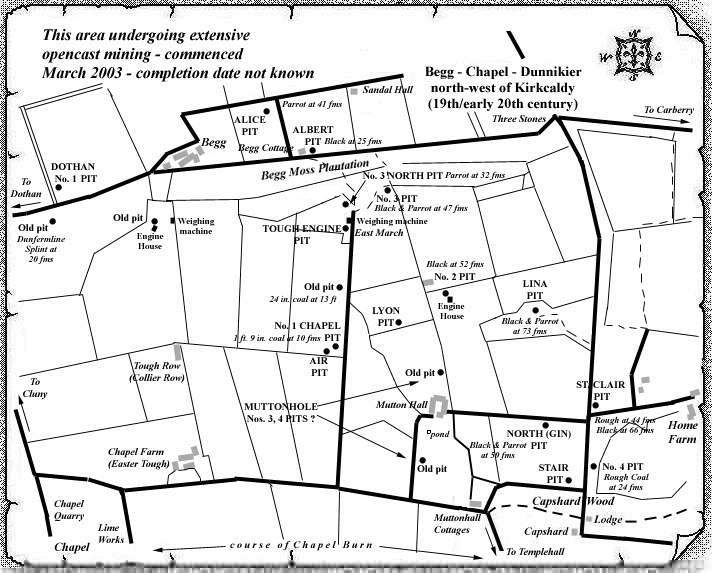
The Begg district embraced the portion of the Kirkcaldy
Coalfield around the Begg Farm, the Chapel area to the
north-west of Kirkcaldy and had its eastern limit at Carberry
which is just north of the present-day, large shopping
complex close to the Dunnikier Way/Overton Road roundabout.
It was separated from the district of Kirkcaldy and
Dunnikier by a north-easterly line passing through Dunnikier
House (now Dunnikier Hotel), and from the district of
Redford, Strathore and Pitteuchar, in the north, by an
east-south-easterly line drawn through Fosterton, one mile
east of Cluny Bridge.
 |
 |
 |
 |
| Alice Pit shaft | Fault | Drift Mine,
north-west of Alice Pit |
 |
 |
 |
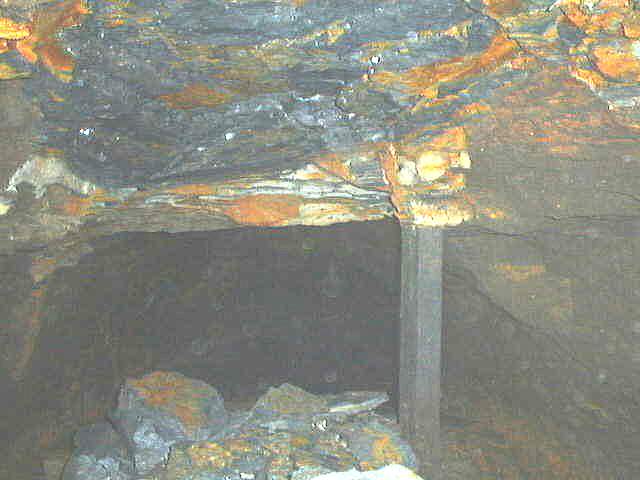 |
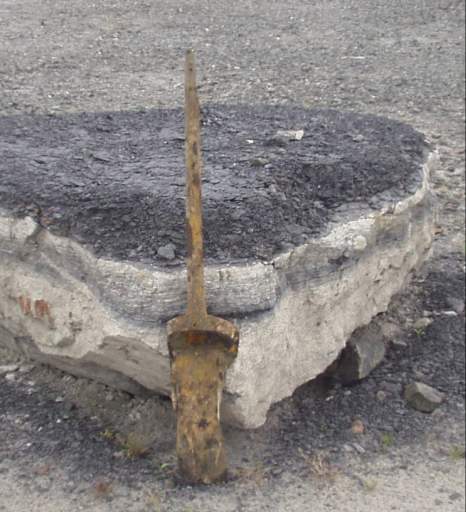
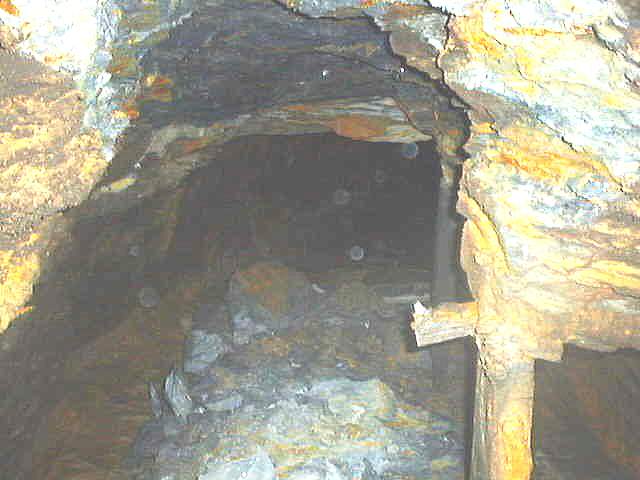
| Wooden Shovel | Wooden Shovel | One of the Alice Tunnels |
Another of the Alice Tunnels |
------------------------------------
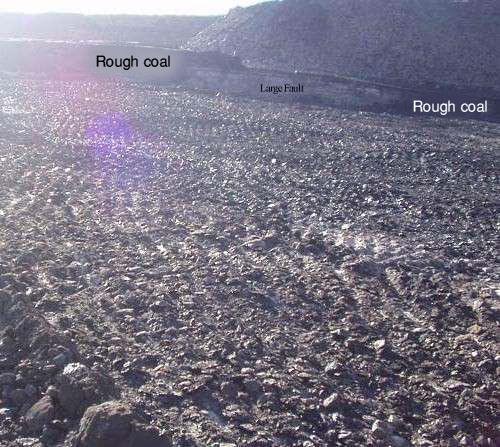
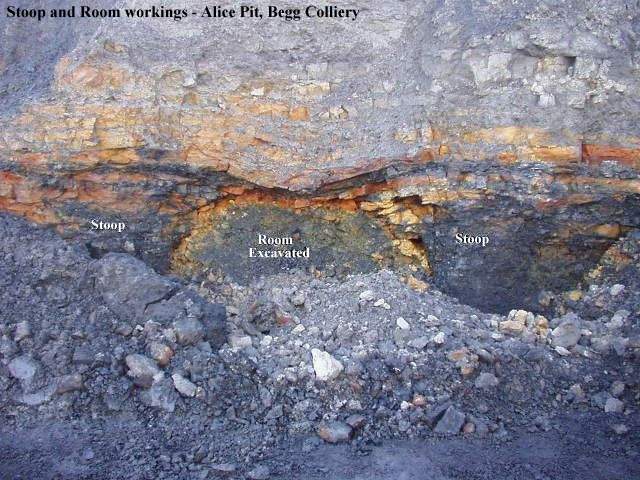
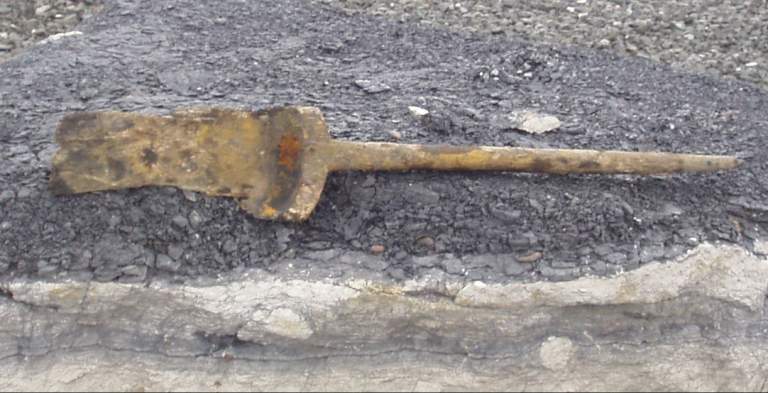
The images, from March, 2003, kindly sent in by Ian Terris, Glenrothes, are from the opencast workings now underway in the lands of the old Begg Colliery just north of the large Kirkcaldy shopping complex by the Chapel Level. Also found late August, 2003 a wooden shovel in the Splint coal.
| Source Date of Information (Owner) |
|---|
| Manager / Under-Manager / Men underground / Men above ground [Pit/Mine] / Coal seams worked / Shaft Details |
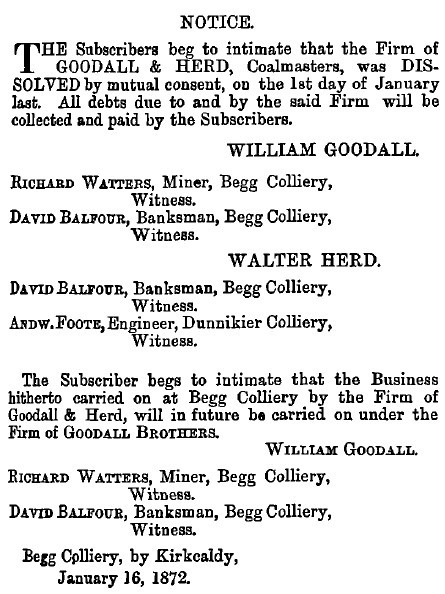
| 1869?-1872 (Goodall & Herd |
| Partnership dissolved January 1872. | 1873 |
| Wm. Arnott, Manager |
| 1879/80 (Goodall Bros.) |
| Wm. Goodall, Manager : Alice Pit listed in Begg Colliery - Black and Parrot seams (same as Ronald Pit) |
| 1881 (Goodall Bros.) |
| Wm. Goodall /
------------ / 65 / 8 / Black, 2' 4"; Parrot,
2' / D'cast (9 x 5) 246 ft. : U'cast (9 x 5)
150 ft.
Manpower shared with Ronald Pit. Furnace ventilation. |
| 1882 (Goodall Bros.) |
| Wm. Goodall /
------------ / 63 / 7 / Black and Parrot / D'cast (9
x 5) 246 ft. : U'cast (9 x 5) 150 ft.
Ronald Pit no longer listed. |
| 1890 (Goodall Bros.) |
| Alex. Danskine /
------------ / 56 / 7 / Black; Parrot; Smithy
D'cast (9 x 5) 246 ft. : U'cast (9 x 5) 150 ft. Furnace ventilation. |
| 1893 (Goodall Bros.) |
| Alex. Danskine, manager, Begg Colliery. |
| 1896 (Walter Herd & Son.) |
| Alex. Danskine /
------------ / 57 / 9 / Household, manufacturing and
steam coals.
Listed as Begg Colliery. |
| 1902 (Walter Herd & Son, Ltd.) |
| Wm. Clark /
------------ / 13 / 1 / Household, manufacturing and
steam coals.
Begg Colliery listed as abandoned. |
| 1904 (Walter Herd & Son, Ltd.) |
| J. Henderson /
------------ / 103 / 16 / Gas, household, manufacturing
and steam coals.
Begg Colliery operating. |
| 1905 (Walter Herd & Sons, Ltd.) |
| ---------- / ------------ / 65 / 14 / as Begg Colliery |
| 1908 (Bowhill Coal Co. Ltd.) |
| Archibald Bowman, jr. / William Lyon / 84 / 18 / |
| 1911 (Fife Coal Co. Ltd.) |
| ---------- / ---------- / 96 / 24 / |
 |
| Please see Stories Link: Bowman Story, for interesting tales of the relatives of Archibald Bowman, jr., one-time manager of this colliery. |
|---|
Coal seams worked in the Begg District
The thickness of the Limestone Coal Group was fairly
constant throughout the district and was comparatively small,
ranging from around 650 ft. in the west to about 700 ft. near
Carberry. The total content of coal was correspondingly low,
falling to as little as 30 ft. at Carberry. There were six or
seven separate seams averaging 2 ft. or more in thickness, so
that, in this respect, the district did not compare
unfavourably with that of Dunnikier and Kirkcaldy where the
group as a whole was more fully developed.
The strata were inclined to the north and north-east at an
average angle of about 15o, but between Begg and
Muttonhall, steeper dips up to 25o and
30o were encountered.
Stink or Sulphur Coal was proved in a bore put down half a
mile NNW of Carberry where it reached a thickness of 2 ft. 4
in., including a 1 in. rib of coaly fireclay.
In a boring, in the north-eastern corner of the district, a
thin coal with parrot, believed to be the Dunfermline Splint,
lay 12½ fathoms below the Five Foot Coal, the
intervening layers consisting largely of coarse sandstone. No
records are known of workings in the Five Foot Coal, although
its average thickness in bores was about 2 ft. 9 in. It was,
however, known at several localities to be associated with a
thin whinstone intrusion, which, despite its small thickness,
was likely to have caused fairly extensive damage to the
coal.
An outcrop of Five Foot could be seen on the footpath, 300
yds. north of Tough Row, north of Chapel, where its thickness
was 2 ft. 6 in.
The Rough and Little Splint coals have been worked in the
past from old pits in the vicinity of Begg, where the former
seam was known alternatively as the 'Rough' or
'Cluny Coal' and the latter as the 'Cluny
Splint'. Both seams showed considerable variation not
only in thickness, but also in position relative to one
another and to the underlying Main group.
The distance from the Rough Coal to the Cardenden Smithy was
fairly constant over the whole district, averaging a little
less than 18 fathoms. The intervening layers consisted mainly
of sandstone and faky beds and, besides the Little Splint
Coal, usually included a rib of coal 6 to 9 fathoms above the
Rough, which probably represented the Lochgelly Blackband
Ironstone.
The lower leaf of the Cardenden Smithy was little more than
a rib of coal, separated from the upper leaf by less than a
fathom of sandy strata.
The Blairhall Main Coal was recognised at one point only, in
the bore half a mile north of Carberry.
 |
Dunnikier and Begg Collieries (19th century report)
| Coal seams worked | Thickness | Quality | Class |
|---|---|---|---|
| Rough Coal | 3 ft. 6 in. | 2nd class | Steam (cherry) |
| Black Coal
(Lochgelly Splint) |
3 ft. | 1st class | Steam and household |
| Parrot Coal | 2 ft. | 2nd class | Gas coal |
| Glassee Coal | 3 ft. 6 in. | 1st class | Steam (cherry) |
| Mynheer Coal | 2 ft. | 2nd class | Smithy Coal |
Information on coals worked at, or near, the Alice Pit
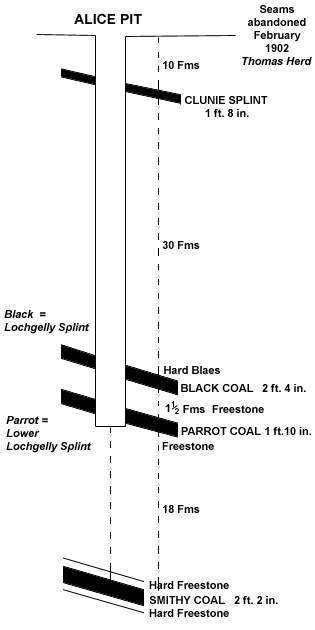
The pit was sunk to a 2ft. 2 in. coal, below freestone, at
a depth of 61 fathoms. The coal was worked as a
'smithy' coal and was almost certainly the
Dunfermline Splint. A level mine was driven southwards from
the pit from the pavement of the Lochgelly Parrot Coal for
nearly 250 yds., at which point a coal, called the Five Feet,
was encountered dipping to the north at 11o. There
is no record of the thickness of this seam, but it is
believed to be the Dunfermline Splint and not the Five Feet
Coal, as a 3 ft. coal was passed in the mine about 4 fathoms
higher up in the sequence.
The strata between the Five Feet and the Lochgelly Parrot,
the lowest seam in the Main group, consisted largely of faky
beds and sandstone and normally measured from 21 to nearly 28
fathoms in thickness.
In the Alice Pit, however, the distance between the seams
appeared to be no more than 14 or 15 fathoms. (This reduction
in thickness may have been due to faulting.)
The Lochgelly Splint and Parrot Coals were generally
separated by about 2 fathoms of fakes and sandstone. They
have been worked as the Black and Parrot Coals from this pit.
The Little Splint Coal was recorded in the Alice Pit as 1
ft. 8 in. thick at a level of about 30 fathoms above the
Lochgelly Splint Coal.
Plans of Abandoned Seams & Dates |
|---|
| Plans of Abandoned Seams for Alice Pit, Begg Colliery | Pits or Mines designated in Plans |
|---|---|
| COAL; Black; Parrot (February, 1902) | BEGG, Albert; Alice (including portion of workings probably from Dothan Nos. 1, 2) |
| COAL; Black; Parrot; Smithy; Clunie Splint (February, 1912) | BEGG, Albert; Alice |
| COAL; Glassee | BEGG, Alice |
------------------------------------

"The Scotsman"
18 January, 1888
FATAL ACCIDENT AT KIRKCALDY. - Yesterday morning, James Nicholson, a miner residing in Gallatown, met his death under painful circumstances. Deceased had been engaged at the coal face in the underground workings of Begg Colliery when a huge piece of stone of almost three tons weight fell from the roof and crushed him to the ground. Death was instantaneous. Nicholson was 26 years of age and leaves a widow and four of a family.
----------------------
"Dunfermline Saturday Press"
21 January, 1888
KIRKCALDY - MINER KILLED
On Tuesday, James Nicholson, a miner, was crushed to death while at work in Begg Colliery, Kirkcaldy. The unfortunate man was engaged at the coal face of the pit when a huge piece of stone about three tons in weight fell from the roof, and crushed him to the ground. Death was instantaneous. Nicholson was 26 years of age, and leaves a widow and four of a family.
------------------------------------
"Cowdenbeath & Lochgelly Times & Advertiser"
27 February, 1895
BEGG COLLIERY. - It is currently reported that an extensive addition is being negotiated for the Begg Colliery, Cluny. We hope the rumour's true.
---------------------------------------------
"Dunfermline Saturday Press"
15 August, 1896
PIT ACCIDENT NEAR KIRKCALDY
On Tuesday morning, two men, named Alexander
Clark, weighman, residing at Clunie Bridge, and Joseph Wyse,
check-weighman, residing at Redford, were injured while employed at
Begg Colliery, which is about three miles from
Kirkcaldy.
Both men were employed on the pithead when the
accident occurred. It appears that while a quantity of coal was
being raised in one of the cages, the winding rope became detached
from the drum, and was drawn right over the winding pulley, and
fell with great force on the pithead, knocking the two men down. Dr
Mackay found that Clark had both his arms broken, besides being
injured internally. He was taken to the Kirkcaldy Cottage Hospital.
Wyse, although injured, was able to walk home.
------------------------------------------------
"Dunfermline Saturday Press"
5 September, 1896
AN ENTERPRISING MINING FIRM
Messrs Walter Herd & Son, Dunnikier Colliery, have just arranged with Mr Munro Ferguson of Raith, for a lease of a large portion of Raith coalfield. The firm have also acquired Begg Colliery from Messrs Goodall Brothers. There is every probability that in the near future coal will be wrought more extensively than ever in the immediate neighbourhood of Kirkcaldy.
-------------------------------------------------
"Dunfermline Press"
25 August, 1906
DEATH OF A COALMASTER
The death of Mr Thomas Herd, coalmaster, occurred at his residence, Parkhill, Dunnikier Road, Kirkcaldy, on Monday. Mr Herd, who was a native of Kirkcaldy, was only forty-seven years of age. He had been ailing for the last two months, and his death was not unexpected. Mr Herd and his brother, Mr Peter Herd, succeeded their father as partners of Dunnikier Colliery, Kirkcaldy, and the Begg Colliery. Mr Herd was well known throughout the district, and was highly esteemed by a large circle of friends. He was of a quiet, retiring disposition, and took no active part in public affairs, although his business aptitude did much to promote the success of the collieries. In politics he was a staunch Unionist. He was a warm-hearted member of Bethelfield U. F. Church, and was one of its highly respected managers. He was unmarried.
-------------------------------------------------
"Dunfermline Press"
1 October, 1910
William Mackie (39) was admitted to Kirkcaldy Hospital on Saturday suffering from injuries to his back, caused by a fall of coal in Begg Pit.
-------------------------------------------------
