Owners: Fordell Colliery
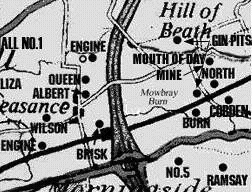
This Ramsay Pit was probably sinking around 1850, as part of the Prathouse Colliery coalworks operated by Fordell Colliery, just a short distance to the west of the 'Big Mine'. Named after John Ramsay, lessee, Crossgates Colliery, in the 1840s, this pit is a different working from 'Mr Ramsay's Pit', an earlier working some distance to the north-east, and probably closed at the time of sinking of this new shaft.
 |
 |
 |
Information on coals worked at, or near, Ramsay's Pit, Crossgates
(based on a report from 1934)
The Dunfermline Splint Coal outcropped about 500 yds. south of Ramsay's Pit. In Cuttlehill Colliery, and south of Hill of Beath, the Dunfermline Splint seam contained alternate bands of splint and cherry coal and was, on average, 4 ft. thick. The Glassee Coal was worked from Ramsay's Pit under the name Blawlowan Coal and little was left in the Cuttlehill field approaching the 1930s. Blawlowan Coal, was 2 ft. 2 in. to 3 ft. thick, in two leaves with a thin fake parting. The roof of this seam was irony blaes and the pavement was a sandy fireclay.
| Plan of Abandoned Seams for Ramsay's Pit, Crossgates | Pits or Mines designated in Plan |
|---|---|
| COAL; Five Feet; Blawlowan; Mynheer; Splint (February, 1877) | No. 3 or Prathouse; No. 4 or Roadside; No. 5; Ramsay's |
| Please refer to Crossgates and Cuttlehill Collieries (Central Index entries) for more information. |
|---|
