Owners:
Earl of Moray
Beath and Blairadam Colliery Company
Fife Coal Company
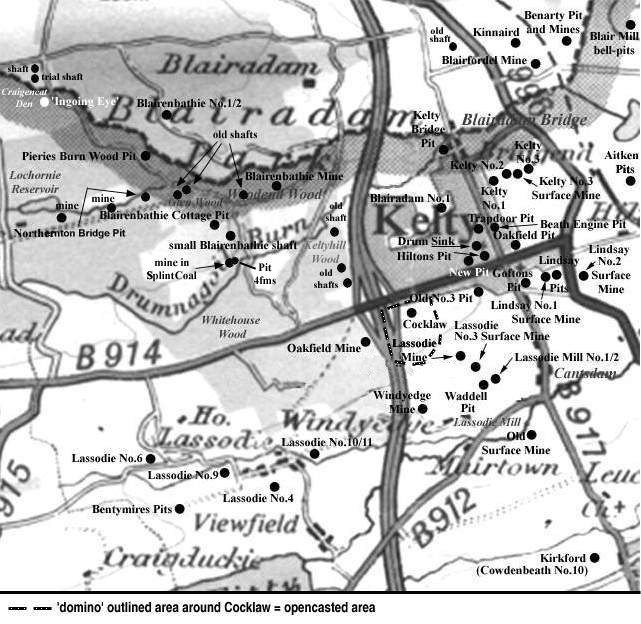
Oakfield Pit, situated just to the east at Kelty crossroads and only a few hundred yards west of the site of the future Lindsay Pits, was probably sunk by the Earl of Moray in the 1840s as part of the early Beath Colliery, taken over by the B&BCC, and finally acquired by the FCC in 1872. Mention is made that a roadway was driven from the Lindsay Pit, during sinking, to connect with the Oakfield shaft, probably for access, ventilation or to prove the area of coal. The closure date of Oakfield Pit is not known but this may have been the first example of land restoration in Fife as, on the site of the old colliery, the Gothenburg Public House was built in 1900. From the profit generated by the 'Goth', the rest of the site and bing was reclaimed for the construction of Kelty Bowling Club and the green opened for play in 1902.
|
 |
After 1856, into the later decades of the nineteenth century, the number of pits in and around Kelty mushroomed at an amazing rate.

|
------------------------------------
Kelty Colliery (19th century report)
| Name of Coal | Thickness | Quality | Class | |||
|---|---|---|---|---|---|---|
| Main Coal | Roof Coal | > | 1 ft. 10 in. | > | Good | Bunker Coal |
| Good Coal | > | 4 ft. 8 in. | > | |||
| Jersey Coal | Coal | > | 2 ft. 6 in. | > | Good | Steam |
| Stone | > | 2 ft. 4 in. | > | |||
| Coal | > | 3 ft. 8 in. | > | |||
| Bank Coal (Lochgelly Splint) | 4 ft. 5 in. | Good | Steam and 2nd class
Household |
|||
| Dunfermline Splint Coal | 4 ft. 7 in. | Good | Best Household | |||
------------------------------------
Information on coals worked at, or near, Oakfield Pit, Kelty
(based on reports from 1900 & 1934)
Several feet of sandstone split the Dunfermline Splint Coal
here into an upper 1 ft. 8 in. and a lower 2 ft. leaf. Wee or Two
Foot Coal measuring 1 ft. 4 in. was recorded at the pit but
generally in the area it was found to be too thin for systematic
working. The Five Foot Coal normally lay about 7 to 11 fathoms
above the Dunfermline Splint. It was a fair household and a good
steam coal, always of workable thickness with an occasional
development of a midstone, and was raised from this pit. Mynheer
Coal 3 ft. 9 in. thick, resting on sandstone and overlain by faky
blaes, was wrought here and by the early 1930s, little of the
Mynheer Coal was left between Oakfield and the Ochil fault. From
the journal of the strata in Oakfield Pit, the Lochgelly Parrot
Coal was about 3 ft. 9 in. and separated from a 3 ft. Lochgelly
Splint Coal by 13 fathoms of coarse sandstone.
Here, too, a trial pit was sunk to the Kelty Blackband Ironstone
recording a blaes roof, ironstone (1 ft.), freestone (2 ft. 6
in.), coal (1 ft.) on a pavement of fakes. In the Oakfield area,
a thick coal (Gorman’s or Rough Coal) with a fireclay
pavement, underlain by coarse sandstone, was recorded about 20
fathoms above the Kelty Main Coal.
----------------------------------------

"Fifeshire Journal"
26 November, 1846
BEATH - FATAL ACCIDENT
On the morning of the 18th inst., two young lads of the name of Martin, brothers, were at their usual employment at the Beath Colliery, when a mass of coal of about two tons weight, which they were undermining, suddenly gave way, and fell upon one of them, and instantaneously deprived him of life. The other one was also severely injured from the falling of rubbish. Dr Neil, from Lochgelly, who was promptly in attendance, entertains hopes of his recovery. The feelings of the parents may be easily imagined. We understand that P. B. Ainslie, Esq. of St Colme House, has with his usual goodness and liberality, directed the superintendent of the colliery to defray the expenses of the funeral of the one, and to continue the wages of the other until he shall be able to resume his employment.
------------------------------------
"Dunfermline Saturday Press"
19 November, 1864
KELTY - FATAL ACCIDENT
On Friday morning, Helen Campbell, a widow woman,
residing in Oakfield, employed by the Coal Company here in filling
trucks, unfortunately lost her life. She appears to have been applying
the brake to a full truck in front, whilst the other two were
following, and having fallen, the two trucks passed over her
body.
Dr. Malcolm, who was immediately on the spot,
pronounced her quite dead. This sad event has cast a sudden gloom over
the village. An accident of so serious a nature has not occurred here
for a great number of years. We understand that she left four of a
family, all of them daughters, one of whom was also engaged on the
pit-head. Her wailing and that of the other female workers, on seeing
the mangled body, can be better imagined than described.
