Owners: Lochgelly Iron and Coal Co. Ltd.
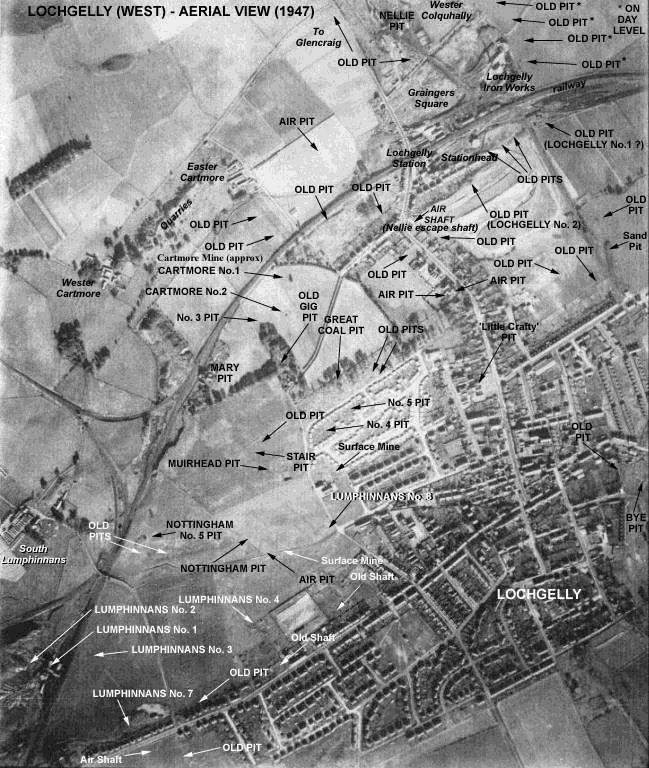
The "Wee Mary" Nos. 1, 2 Pits were located between Lumphinnans No. 7 Pit and the site of the Old Gig Pit, at the north side of the golf course in Lochgelly, close to the main railway line.
 |
 |
 |
A Personal Note
My wife and I walked all round this area many years ago when looking for
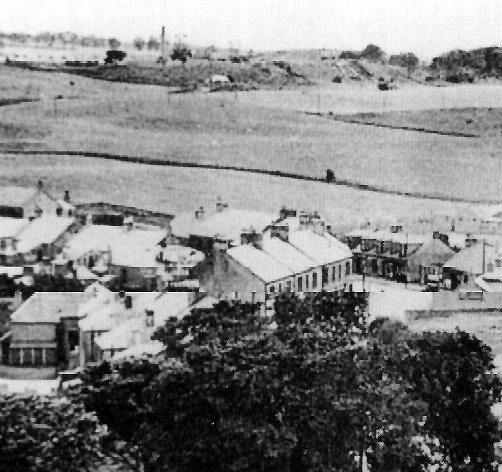
traces of old mine-workings. The photograph (above, left) shows a view taken from a Glencraig
Pit bing looking towards Lochgelly. In the foreground is the south side of Glencraig Village,
with the bing and surface buildings of the Wee Mary Pit showing faintly in the top half of
the photo. The town of Lochgelly itself appears just beyond this in the top left background.
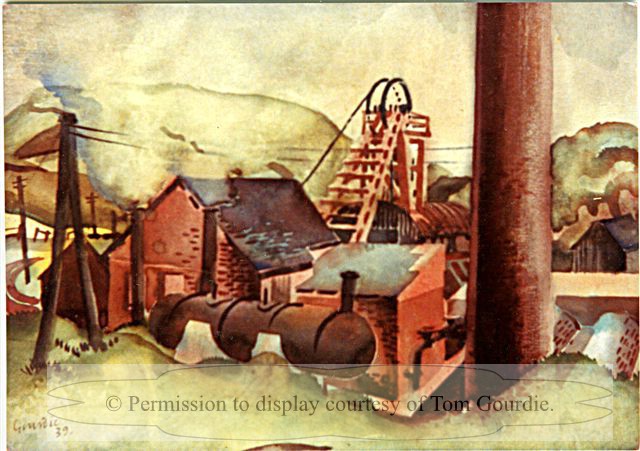
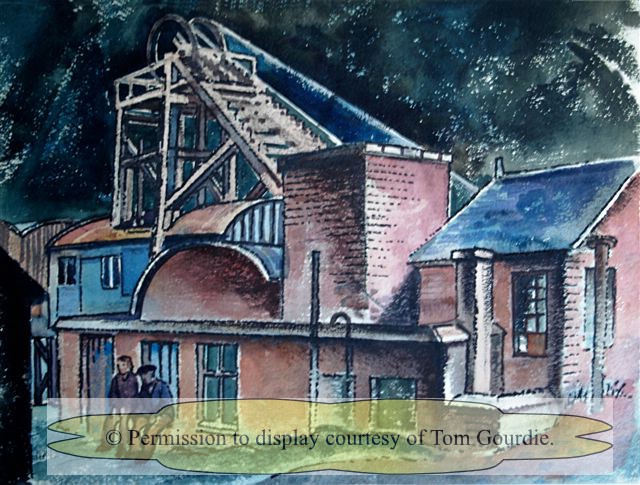
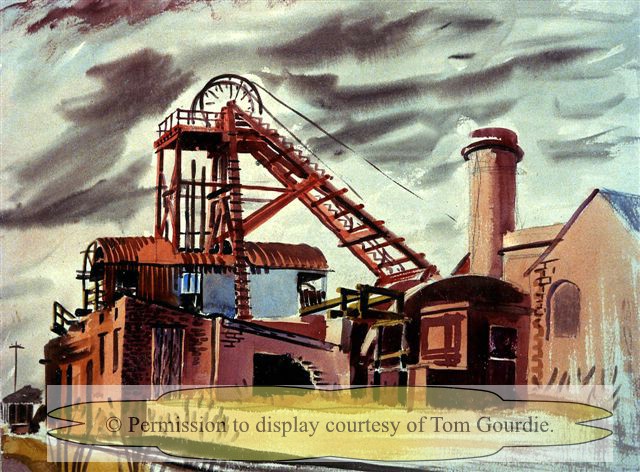
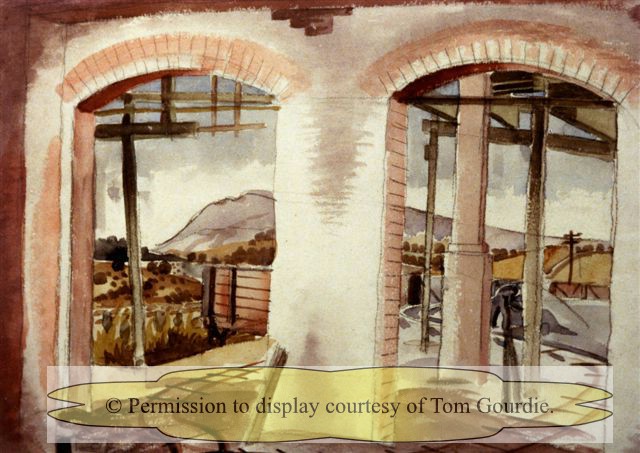
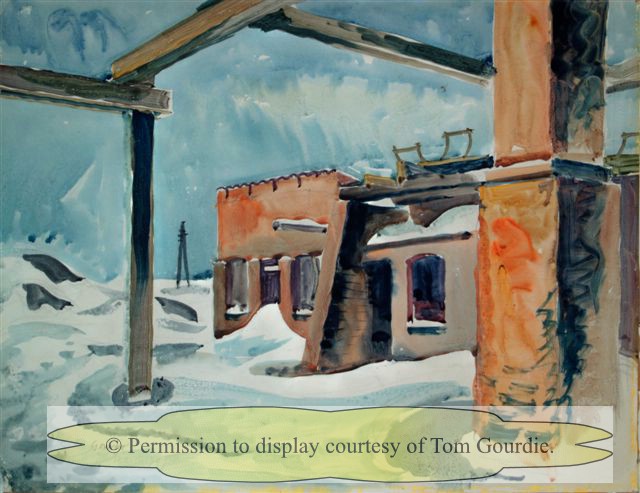
My search for a detailed photograph of the Mary Pit, Lochgelly, has been unsuccessful
as I don't think one exists. However, I am absolutely delighted to have been given
permission by Tom Gourdie, the son of the late Fife artist Tom Gourdie, to display images
of some of his father's paintings of the coal mines of Fife. These lovely works give a
clear impression of the pithead buildings and headgear of the "Wee Mary".
M. Martin
 |
 |
 |
 |
 |
-------------------------------
| Pit opened:1850s(?) | Pit closed: 1949 (?) |
|---|
| Source Date of Information Supplied |
|---|
| Manager / Under-Manager / Men underground / Men above ground / Coal seams worked / Shaft Details |
| 1873 (Lochgelly Iron & Coal Company, Ltd.) |
| David Thomson /
---------- / --- / --- / Splint and Parrot / D'cast
150 ft. : U'cast 180 ft.
(One fatality recorded. Exhaust from "Special" pump.) |
| 1874 |
| David Thomson / ---------- / 88 / 11 / Splint, 5' 6"; Parrot, 4' / D'cast 150 ft. : U'cast 180 ft. |
| 1875 |
| David Thomson / ---------- / 70 / 12 / Splint, 5' 6"; Parrot, 4' / D'cast 150 ft. : U'cast 180 ft. |
| 1876 |
| David Thomson / ---------- / 50 / 12 / Splint, 5' 6"; Parrot, 4' / D'cast 150 ft. : U'cast 180 ft. |
| 1877 - 80
S. Macdonald, Manager |
| Listed in colliery record but no details provided. |
| 1881/82
S. Macdonald, Manager |
| Not listed in colliery records. |
| 1886 |
| Mr. George Thomson, oversman, Mary and Melgund Pits, Lochgelly, left to fill a similar appointment at Little Raith Colliery. |
| 1890 |
| John Anderson /
---------- / 182 / 26 / Lochgelly Splint and Parrot;
Mynheer; Five Foot; Dunfermline Splint
D'cast (10 x 10) 516 ft. : U'cast (12 x 8) 516 ft. Fan (Guibal), 30' x 10'. |
| 1900 |
| Mr Nisbet / ---- /
--- / --- June: serious fire at Mary pithead. |
| 1903 - 05 |
| Mr Arthur King, Manager |
| 1909 |
| Mr William Barclay, Manager |
| 1911 |
| Oct: Mr William Barclay, manager,
moves to manage Minto Colliery. Mr Robert Stewart, appointed manager [from Jenny Gray]. |
| 1918 |
| James Dawson / Andrew
Anderson / 687* / 139*
(* numbers include workers at the Nellie Pit) |
| 1920 |
| ------------ / Andrew
Anderson / 654* / 348*
(* numbers include workers at the Nellie Pit) |
| 1928 |
| Frank Forsyth / Andrew
Anderson / 385* / 273
**
(* number includes workers at the Nellie Pit; ** includes 163 employed at Central Workshops and Offices) |
| Gas, household, steam
coal and blaes.
Upper Five Foot, Diamond, Little Splint, Dunfermline Splint, Mynheer, Lochgelly Splint, Lochgelly Parrot, Glassee and Fourteen Foot. |
| 1938 |
| Robert Bauld / G. Penman
/ 253* / 111*
(* numbers include workers at the Nellie Pit) |
| 1945 |
| George Marshall / G.
Penman / 242* / 233*
(* numbers include workers at the Nellie Pit) |
| Household coal and blaes.
Lochgelly Splint, Jersey, Lochgelly Parrot and Kelty Main. |
| 1948 (NCB) |
| W. Forbes / William
Harris / 232* / 132*
(* numbers include workers at the Nellie Pit) |
| Household coal and blaes.
Kelty Main, Jersey, Lochgelly Splint and Lochgelly Parrot. |
-------------------------------
Information on coals worked at the Mary Pits, Lochgelly
Lochgelly Colliery (19th century report)
| Name of coal | Thickness | Quality | Class |
|---|---|---|---|
| Little Splint | 3 ft. | Good | 2nd. class Steam |
| Fourteen Foot | 10 ft. | Good | 2nd. class Steam |
| Duddie Davie | 3 ft. | Good | 2nd. class Steam |
| Lochgelly Splint | 5 ft. | Good | 1st. class Steam |
| Lochgelly Parrot | 3 ft. 3 in. | Good | 2nd. class Gas |
| Glassee Coal | 3 ft. | Good | 2nd. class Steam |
| Mynheer Coal | 3 ft. 3 in. | Good | 1st. class Household |
| Five Foot Coal | 4 ft. | Good | 1st. class Steam |
| Dunfermline Splint | 4 ft. | Good | 1st. class Household |
The only available section of Sulphur Coal in the district
was at the Wee Mary where a 2 ft. coal was recorded resting
on several feet of fireclay and overlain by a thick bed of
blaes.
Dunfermline Splint Coal, 3 ft. 9 in. thick, lay 11 fathoms
above the Sulphur Coal and 88 fathoms from the surface. At
the pit, the dip is to the west-north-west at 40o
but just before Wester Cartmore, the seam was folded over a
small anticline.
To the east of the pit, the Five Foot Coal varied from 3 ft.
3 in. to about 5 ft. including a few inches of soft, foul
coal at the base. A section of Jewel Coal or Upper Five Foot
had two leaves: upper 6 in., lower 2 ft., separated by 2 ft.
fireclay.
The Mynheer Coal here reached 3 ft. 3 in. but it thinned out
eastwards.
The Lochgelly Splint and Parrot Coals worked to the west of
the Wee Mary were very similar in development to the seams
found in the Lumphinnans No. 7 Pit. Here though, the hard
fireclay found between the seams at the No. 7 Pit was partly
replaced by fakes and the distance between the coals reached
around 12 ft.
Near the Mary Pit, the sandy layers above the Swallowdrum
Coal were replaced by finer-grained sediments and the seam
was closer to the Jersey Coals. It was in thin leaves, with
thick partings, and was not a workable proposition.
A boring put down in the plantation east of the Wee Mary
gave the Kelty Main Coal as 1 ft. 6 in. coal above 2 ft. 1
in. coal with a 1 in. soft parting.
------------------------------------
| Plans of Abandoned Seams for Mary | Pits or Mines designated in Plans |
|---|---|
| Splint; Parrot (1851) | Little Dean, Mary, Nottingham, Sawmill |
| COAL; Upper Leaf Fourteen Feet or Little Splint (Abandoned 10th October, 1929); Fourteen Feet (Abandoned 17th April, 1930); Diamond (Abandoned 13th May, 1930). | LOCHGELLY; Mary |
------------------------------------
"Dunfermline Journal"
22 March, 1873
LOCHGELLY - A MISADVENTURE
A good deal of excitement was created here on Monday, on a report being raised that two men had lost their way while engaged on an exploring expedition through the waste of old workings in the vicinity of the Mary Pit. It appears that before leaving they had expressed their intention of being back by twelve o'clock, but as the afternoon wore on and they had not returned considerable anxiety was felt for their safety. About for o'clock, at which time a large crowd had collected at the pit mouth, several of the workmen volunteered their services for the purpose of making a search through that part of the old workings in which the two men were supposed to be left, and in which we are glad to say they were successful. The whole of the party reached the pit bank about six o'clock.
------------------------------------

"Dunfermline Saturday Press"
31 May, 1873
A fatal accident occurred on Thursday forenoon at the Mary Pit, Lochgelly, belonging to the Lochgelly Iron and Coal Company, a young lad named Angus Low being instantaneously killed by being crushed between a number of empty coal tubs and the wall at the bottom of an incline, up which the tubs were being drawn by the impetus of the loaded ones coming down, when the chain broke.
------------------------------------
"Dunfermline Saturday Press"
7 November, 1874
An accident occurred at Lochgelly on Wednesday at the Mary Pit, belonging to the Lochgelly Iron Company, by which a married man named Alexander Brown was very seriously injured. He was about to descend to his work, and he had just taken his place on the cage along with three others, when a part of the rope slid off the "drum", causing the cage to descend with fearful velocity about half-way down the pit. As the rope tightened, the cage came to a stop so suddenly as to throw Brown off, the other three retaining their hold. The poor man caught the side of the cage with his hands as he was falling and held on for some time, but his strength failed, and he fell to the bottom from a considerable height, sustaining severe internal injuries. On being brought to the pit-head, he was conveyed by some of his fellow-workmen to his home on a stretcher, where he now lies in a very precarious condition.
------------------------------------
"Dunfermline Saturday Press"
11 December, 1886
This edition carried the news that Mr. George Thomson, oversman, Mary and Melgund Pits, Lochgelly, was leaving to fill a similar appointment at Raith Colliery.
------------------------------------
"Dunfermline Saturday Press"
25 December, 1886
While a miner named Alexander McLean was working at his usual employment in the Mary Pit, belonging to the Lochgelly Iron and Coal Company, on Friday last, a large quantity of coal fell upon him from the roof of the working, by which he sustained severe internal injuries. He was conveyed home, and attended to by Dr. Stiell.
------------------------------------
"Dunfermline Saturday Press"
16 June, 1888
A sad accident occurred in the Mary Pit, belonging to the Lochgelly Iron Company, on Thursday morning, by which a miner named William Scobie was instantaneously killed. The unfortunate man, who is about 50 years of age, was working at the coal face along with his son, when a large mass of the coal fell upon him. By the time his fellow-workmen got him extricated life was extinct. The son had a marvellous escape, having sustained only a slight injury on the head. His remains were removed to Lochore, where his family reside, and for whom much sympathy is felt.
------------------------------------
"Dunfermline Saturday Press"
12 January, 1889
John Folley, a drawer in the employment of the Lochgelly Coal Co., was seriously injured while at work in the Mary Pit on Monday. He had been standing at the foot of a wheel brae when a large stone fell from the roof, knocking him down, crushing his head and back severely, and bruising him internally.
------------------------------------
"Dunfermline Saturday Press"
24 May, 1890
A miner named Laird, while working at his usual employment in the Mary Pit, Lochgelly, on Tuesday, had one of his legs broken by a fall from the roof. He was conveyed home, and medical assistance obtained.
--------------------------------------------
"Dunfermline Saturday Press"
6 August, 1892
While a miner named James Walkingshaw was engaged at his usual occupation in the Mary Pit, belonging to the Lochgelly Iron and Coal Co., on Thursday forenoon, a large mass of coal fell upon him from the roof, by which he sustained very serious injuries about the breast and other parts of the body. The unfortunate man was conveyed home by some of his fellow-workmen on a stretcher and attended to by Dr. Dendle, who did all in his power to alleviate his sufferings.
[As a result of his serious injuries, James Walkingshaw died soon after the accident.]
--------------------------------------------
"Cowdenbeath & Lochgelly Times & Advertiser"
16 December, 1896
SERIOUS ACCIDENT. - On Saturday forenoon in the Mary Pit an accident of a serious nature happened to a miner named William Sharp. It appears that by some cause or other a hutch broke away on an incline, with the result that Sharp was severely crushed on the lower part of the body. Dr Dendle was in immediate attendance, and had the unfortunate fellow conveyed home, where he is progressing as favourably as could be expected.
--------------------------------------------
"Dunfermline Press"
25 December, 1897
Robert Reid, son of William Reid, fireman, Lochgelly, met with an accident while employed as a brakesman on the top of the wheel brae in the Mary Pit, Lochgelly, on Thursday. A full hutch had been sent away before the empty hutch was coupled on at the foot of the brae. The chain caught Reid by the left leg, breaking the limb at the ankle.
--------------------------------------------
"Dunfermline Press"
10 December, 1898
Early on Saturday morning, Owen Payne met with a serious accident in the Mary Pit. He was in the act of removing a piece of coal that had fallen down the shaft, when the cage came down upon one of his legs and fractured it. He was removed to the Dunfermline Cottage Hospital.
--------------------------------------------
"Dunfermline Press"
31 December, 1898
A start has now been made with the new railway, which is to connect the Thornton and Perth lines to the east of Cowdenbeath. The line will be cut from the Mary Pit, belonging to the Lochgelly Coal Company, on the Thornton branch, to a point on the Perth line at the north side of the railway bridge on the Lochgelly road. Besides the cutting of the line, the work will include the erection of two bridges and four culverts. One of the bridges will be erected at Lumphinnans Farm, and the other, half-way between that point and where the new line touches the Perth branch. Bailie Wilson, builder, Cowdenbeath, has been successful in receiving the contract for the work.
--------------------------------------------
"Dunfermline Press"
25 November, 1899
Angus Falconer, miner, Grainger Street, Lochgelly, has had his right foot bruised and his right hand cut, through a stone falling from the roof while he was at work in the Mary Pit, Lochgelly Iron and Coal Company, on Tuesday.
--------------------------------------------
"Dunfermline Press"
30 June, 1900
ALARMING FIRE AT A LOCHGELLY PIT
EXCITING RESCUES
A PLUCKY INSPECTOR
On Thursday evening an alarming outbreak of fire
occurred at the pithead of the Mary Pit, Lochgelly, belonging to
the Lochgelly Iron and Coal Company, Limited.
In respect that there are two shafts, designated
No. 1 and No. 2, which are situated at a distance of some fifteen
feet from each other, the framework and roofing, which consisted to
a large extent of wood, formed a structure of fairly large
dimensions. Only one of the two shafts, No. 2, is in daily use, the
other being kept as a reserve in cases of emergency. On Thursday
afternoon the miners stopped work at the usual hour. Some time
afterwards another shift consisting of twenty-two men, descended
No. 2 Pit, with the intention of working during the
night.
It was close upon six o'clock when the
outbreak of fire was discovered. At that hour a North British
Railway signalman, whose cabin is situated on the north side of the
Dunfermline and Thornton railway, which is quite close to the pit
bank, observed smoke and flames issuing from the roof at the
north-west corner of the pithead of No. 2 Pit. Conjecturing that
something was wrong, he quickly raised the alarm.
Mr Nisbet, the pit manager, happened to be in
the office at the time, and he was early apprised of the outbreak.
On reaching the pithead, the manager, whose first thought naturally
was for the safety of the men underground, ascertained that the
engineman had signalled to the Inspector, Hugh Thomson, to come up
the shaft as soon as the outbreak was observed. Thomson requested
to be lowered again with a view to having the miners warned of
their danger, and brought to the surface before communication was
cut off, because, by this time the conflagration had assumed
alarming proportions, and it was apparent that only a few minutes
must elapse before approach to No. 2 shaft would be rendered
impossible. The Inspector was fortunate in meeting at the bottom of
the shaft, a miner named James Stewart, whom he instructed to take
one road, he himself taking another road, in order that the men
might be more expeditiously summoned to the bottom of the
shaft.
Meantime, under the superintendence of the
manager, the engine was set in motion and the first batch of men
were not long in being raised to the surface. This was done by
means of No. 1 shaft, the woodwork in the vicinity of No. 2 shaft
having already become ignited. What added to the difficulty of the
work of rescue was the fact that the signal wires between the shaft
and the pit bottom suddenly gave way. In the circumstances, the
cage was lowered and raised continuously, the manager directing the
engineman when to "start" and when to "stop".
In this way the men were gradually brought to the
pithead.
It was close upon seven o'clock when the
cage containing the last four men, including Thomson, the
Inspector, and a miner named William Foote, were brought up the
shaft. By this time the flames had extended to No. 1 shaft, and so
fiercely was the woodwork burning that fears were entertained that
the pulley rope attached to the cage might snap and prevent further
all further possibility of rescuing the remainder of the
men.
While, happily, these fears were not realised,
the last of the men brought to the pit bank had a very trying
experience. When the cage arrived, the whole of the woodwork was
ablaze, and the men had to make their exit in the midst of the
flames and blinding smoke.
Thomson was severely burned about the arms,
while Foote, a man of sixty-four years of age, had his face, hands,
and arms badly scorched. Both men were so severely injured that
they had to be conveyed home in a cab, after being attended to by
Dr Elliot Dickson, Lochgelly.
Ten minutes or so after the rescuing operation
had been completed, the whole of the framework collapsed. A large
crowd of anxious spectators had taken up their position in the
vicinity of the pit, and when it became known that the whole of the
men had been rescued, a loud cheer was raised. From the first it
was evident that it would be a difficult matter to subdue the
flames, but, unfortunately, although the necessary hose was
obtained, it was found that the pressure was totally inadequate to
carry the water any distance. A considerable quantity of water was,
however, directed on the burning pile by means of pails and other
vessels, there being quite an army of miners who voluntarily lent
assistance.
The entire framework of the two pits was
destroyed. Happily the engine-room was untouched, and it is another
fortunate circumstance that the winding engine and boilers were not
in any way damaged.
Considerable damage, however, was done to the
pumping engine, as well as to one of the haulage engines in
connection with No. 2 Pit. In addition, four large pulley wheels,
with their gearing, were irreparably destroyed. The total damage,
which is covered by insurance, amounts to between £1000 and
£1200.
A quantity of burning material fell down the
shafts, and it was deemed advisable to close up the mouths of both
of the pits. Although temporarily out of order, it is not expected
that any serious results will accrue from the suspension of pumping
operations, as the water does not rise very rapidly in either of
the pits. Yesterday the Company's engineer visited the scene
and took measurements with a view to fitting up new framework, and
replacing the damaged machinery. It is expected that work will be
resumed within a fortnight. Fortunately the men employed in the
Mary Pit, numbering upwards of 160, are not to be allowed to suffer
in consequence of the fire. Arrangements were made yesterday for
finding temporary employment for the whole of them at other pits
belonging to the Company.
--------------------------------------------
"Dunfermline Press"
14 July, 1900
A committee has been formed to collect subscriptions to present Hugh Thomson with a suitable testimonial in recognition of his gallantry at the recent fire at the Mary Pit.
--------------------------------------------
"Dunfermline Press"
21 July, 1900
The Lochgelly Iron and Coal Company have granted the following honorariums for assistance rendered at the recent Mary pithead fire:- To Hugh Thomson, £25; to James Stewart, £12; and to Thomson, the engineman, £3.
--------------------------------------------
"Dunfermline Press"
18 August, 1900
THE RECENT PITHEAD FIRE
The Mary Pit was re-opened for work on Wednesday. It is fully six weeks since the fire, so that the rebuilding and remounting has been expeditiously carried forward.
--------------------------------------------
"Dunfermline Press"
25 August, 1900
John Nicol, pit inspector, Main Street, Lochgelly, had both his legs broken while he was at work on Wednesday in the Mary Pit, Lochgelly Colliery, belonging to the Lochgelly Iron and Coal Company. He had been assisting to put a loaded hutch on the rails on a wheel brae, and after this had been accomplished he stepped out of the way to let the hutch pass. Unfortunately, he walked right in front of a race of empty hutches which were going in an opposite direction. He was knocked down, and dragged up the brae for a distance of eight yards. Both his legs were broken between the knees and ankles. He was attended to by Dr Dickson, Lochgelly.
--------------------------------------------
"Dunfermline Press"
15 September, 1900
PRESENTATION TO A BRAVE MINER
In the Co-operative Hall, Lochgelly, on
Wednesday night, Hugh Thomson, the hero of the Mary pithead fire,
was made the recipient of a testimonial subscribed for by the
public of Lochgelly. It may be remembered that at the fire which
occurred at the Mary Pit-head in July last, Thomson volunteered to
warn over 20 men who were working below ground. He was the last man
to come up the pit, and received terrible injuries in making his
way through the flames. The chair was occupied by Mr William
Stewart, oversman. Mr McQuillan made the presentation. He said few
would have had the pluck to do what Thomson did, and his example
would go a long way to make them all braver and more courageous
men. (Applause.)
He then handed Thomson a gold watch and albert,
with appendage bearing a suitable inscription. Mr Thomson, in
accepting, said he had done no more than his duty towards his
fellow-workmen. He asked all subscribers to accept his hearty
thanks for the generosity shown him. (Applause.)
Michael Tunnicliffe and James Stewart, who
rendered assistance in the work of rescue, were each presented with
a gold badge bearing an inscription. The meeting was afterwards
addressed by the Rev. James Brown, Rev. Thomas Dewar, and the Rev.
Duncan Brown.
--------------------------------------------
"Dunfermline Press"
22 September, 1900
THE PRESENTATION TO A BRAVE MINER
The Hugh Thomson Testimonial Committee having laid the circumstances relating to the heroism of Thomson at the Mary Pit fire before Mr John D. Hope, the Liberal candidate for West Fife, that gentleman was good enough to write the Home Secretary with a view to Thomson being granted the Albert Medal. The following reply has been received:-
Whitehall, 10thSeptember 1900.
SIR, - With reference to your letter of the
17th ult., furnishing particulars of the work of rescue
effected by Hugh Thomson, on the occasion of the pithead fire at
Lochgelly Colliery on 28th June last, with a view to the
award of an Albert Medal, I am directed by Secretary Sir Matthew
Ridley to acquaint you that he has carefully considered
the
circumstances of this case, and that while fully
recognising Thomson's devotion to duty, and desiring me to
express his high appreciation of his gallant conduct, he regrets
that the case is not one which satisfies the extremely high
standard of qualification which alone would warrant a
recommendation being made to the Queen for the award of the
decoration in question. - I am, Sir, your obedient
servant,
HENRY CUNNINGHAME
J. D. Hope, Esq.,
Inchmartine, Inchture, Perthshire.
--------------------------------------------
"Dunfermline Press"
3 November, 1900
John Adamson, miner, Station Road, Lochgelly, was severely injured on Tuesday while at work in the five-feet seam of the Mary Pit, Lochgelly Colliery, belonging to the Lochgelly Iron and Coal Company, Limited. A quantity of coal came away suddenly from the roof, and falling upon him broke four or five of his ribs. He was attended to by Drs Dickson and McDonald, Lochgelly.
-----------
"Dunfermline Press"
17 November, 1900
FATAL RESULT OF AN ACCIDENT
John Adamson, miner, Station Road, Lochgelly, has succumbed to the injuries he received while he was at work, on 30th October, in the five-feet seam of the Mary Pit. ... Deceased was fifty-one years of age.
-----------
"Dunfermline Press"
24 November, 1900
This issue carried the Report of the Fatal
Accident Inquiry into the death of John Adamson, on the
30th October, at the Mary Pit, Lochgelly, as the result
of a coal fall.
Among those giving evidence were: Dr John
Malcolm Jefferies, assistant to Dr Dickson; John Adamson, son of
deceased; and, John Maine, fireman, Station Road, Lochgelly. The
Jury returned a formal verdict.
