Owners: Lochgelly Iron and Coal Co. Ltd.
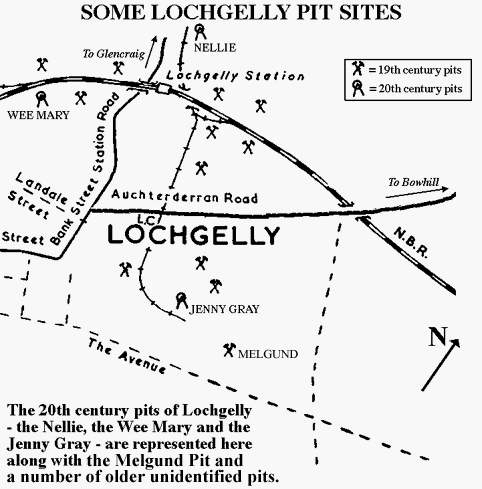
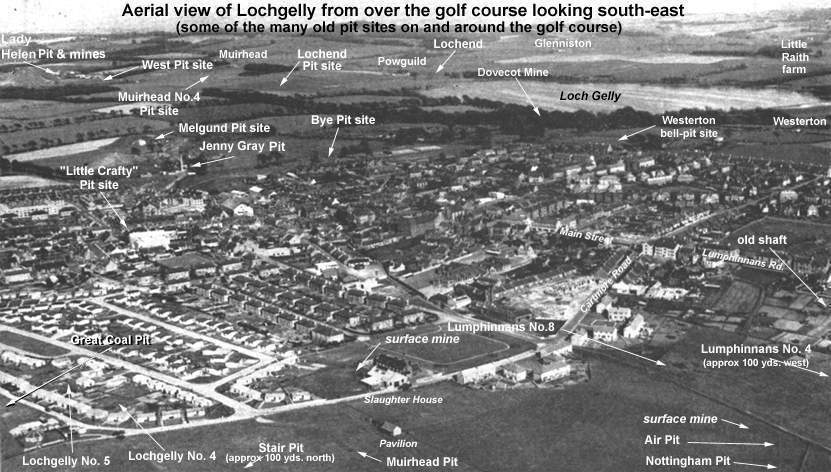
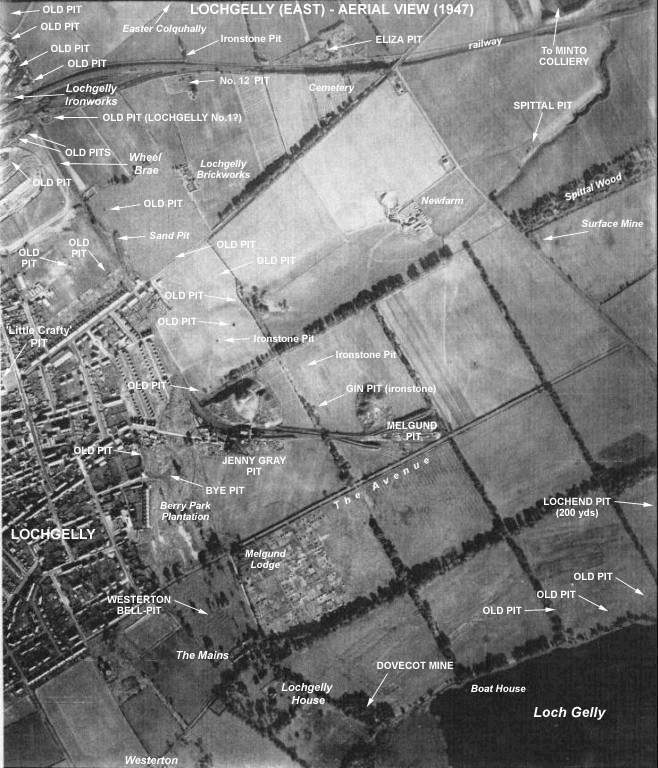
The location of the Melgund Pit, Lochgelly, was about ¼ mile east of the Jenny Gray Pit which lay on the eastern boundary of Lochgelly, just north of the Avenue. The Melgund Pit, believed to have opened in 1886, was sunk to a depth of 65 fathoms and in its later working years was nominally associated with the Jenny Gray. It is reported to have closed in 1908 (see newspaper article below) but a mine record from 1911 lists combined manpower figures with the nearby Jenny Gray Colliery.
 |
 |
 |
| Pit opened: 1886 | Pit closed: 1908 |
| Source Date of Information Supplied | |
|---|---|
| Manager / Under-Manager / Men underground / Men above ground / Coal seams worked / Shaft Details | |
| 1886 | |
| Mr George Thomson,
oversman, Mary and Melgund Collieries, moves to Little Raith Colliery as oversman. |
|
| 1890 | |
| John Anderson / ------------ / 170 / 33 / Lochgelly Splint and Parrot / D'cast (15 x 10) 336 ft. : U'cast (12 x 5) 254 ft. | |
| 1896 | |
| Lochgelly Colliery | |
| (individual pits not specified in figures below which must have included the Melgund Pit) | |
| Andrew Nisbet / ------------ / 783 / 122 | |
| Gas, household, manufacturing and steam coals. | |
| 1904 | |
| (as Jenny Gray and Melgund) | |
| Andrew Ramsay / ------------ / 378 / 61 / Gas, household, manufacturing and steam coals. | |
| 1905 | |
| (as Jenny Gray and Melgund) | |
| Andrew Ramsay / ------------ / 419 / 60 | |
| 1906 | |
| (as Jenny Gray and Melgund) | |
|
Dec: Colliery manager, Mr Andrew Ramsay, leaving for South Africa.
Mr William Barclay, oversman at Minto Pit, appointed manager. | |
| 1908 | |
| (as Jenny Gray and Melgund) | |
| W. Barclay / ------------ / 320 / 44 | |
| 1911 | |
| (as Jenny Gray and Melgund) | |
| ---------- / ------------ / 380 / 44 | |
Lochgelly Colliery (19th century report)
| Name of coal | Thickness | Quality | Class |
|---|---|---|---|
| Little Splint | 3 ft. | Good | 2nd class Steam |
| Fourteen Foot | 10 ft. | Good | 2nd class Steam |
| Duddie Davie | 3 ft. | Good | 2nd class Steam |
| Lochgelly Splint | 5 ft. | Good | 1st class Steam |
| Lochgelly Parrot | 3 ft. 3 in. | Good | 2nd class Gas |
| Glassee Coal | 3 ft. | Good | 2nd class Steam |
| Mynheer Coal | 3 ft. 3 in. | Good | 1st class Household |
| Five Foot Coal | 4 ft. | Good | 1st class Steam |
| Dunfermline Splint | 4 ft. | Good | 1st class Household |
Information on coals worked at, or near, Melgund Pit, Lochgelly
(based on reports from 1934)
A small east-west fault, not exceeding 8 fathoms, crossed
the Lochgelly Coalfield near the Melgund Pit. Around the pit,
and eastwards, towards Powguild Plantation (just east of Loch
Gelly), the Lochgelly Parrot Coal was almost entirely
destroyed by a thin dolerite sill.
The Lochgelly Splint Coal measured 4 ft. to 6 ft. thick,
with an overlying 9 in. of Craw Coal, at the Melgund.
The Splint Coal was partly burnt in the ground between the
pit and Powguild Plantation, and there was some evidence that
the seam thinned out eastwards towards Cluny Colliery, where
partings in the coal rendered its working less profitable.
A bore at Lillielees Park, 600 yds. south-east from the
Melgund Pit revealed the average composition of the Lochgelly
Blackband Ironstone seam which lay 2 to 6 fathoms above the
Little Splint Coal and was recognised throughout the
district. Records indicate that ironstone was worked at the
Melgund in its early years. A typical section had the
following composition:
| Sandstone and fakes | - |
| Blaes | 1 ft. 8 in. |
| Blackband ironstone | 1 ft. 7 in. |
| "Brown band" ironstone | 2½ in. |
| Coal | 1½ in. |
| Fireclay | 1 ft. 1 in. |
| Fireclay and coal | 1 ft. |
| Fireclay | - |
-----------------------------------------------------
| Plans of Abandoned Seams & Dates for Melgund | Pits or Mines designated in Plans |
|---|---|
| Upper (1859); Five Feet
(1862); Mynheer (1863);
Glassee (1866); IRONSTONE (1875); Lochgelly Splint; Lochgelly Parrot (1884); Little Splint (1886) |
Lochgelly Nos. 1, 2, 3, 4, 5, 6, 7, 8, 9, 10, 11, 12, 13, 15, 16, 17, 18, Eliza, Melgund, Nottingham No. 5, Spittal |
| IRONSTONE | Lochgelly No. 9, Foulford, Jenny Gray, Melgund |
| Lochgelly Splint;
Lochgelly Parrot; Little Splint;
Duddie Davie (1908) |
Lochend, Melgund |
-----------------------------------------------------
"Dunfermline Saturday Press"
11 December, 1886
This edition carried the news that Mr. George Thomson, oversman, Mary and Melgund Pits, Lochgelly, was leaving to fill a similar appointment at Raith Colliery.
----------------------------------------------------

"Dunfermline Saturday Press"
7 May, 1887
LOCHGELLY - FATAL RESULT OF AN ACCIDENT
On Friday afternoon last week, a miner, named William Galloway, while working at his usual employment in the Melgund Pit, belonging to the Lochgelly Iron Company, was seriously injured by a fall of coal from the roof. After being conveyed home by his fellow workmen, Dr. Stiell was shortly in attendance and did everything in his power to alleviate the man's sufferings. The unfortunate man after lingering in great suffering died on Monday forenoon. Deceased was greatly respected by all who knew him, and was about 48 years of age. He leaves a widow and three of a family to mourn his loss.
----------------------------------------------------
"Dunfermline Saturday Press"
2 January, 1892
LOCHGELLY - A FALL OF 390 FEET
A sad accident occurred in the Melgund Pit, belonging to the Lochgelly Iron and Coal Company, on Monday morning, by which a young man named Robert Watters lost his life. The unfortunate lad, who was seventeen years of age, was about to step on the cage, along with other workmen, as it was about to descend the pit, when through some cause he lost his balance, and fell to the bottom of the shaft, a distance of 65 fathoms, and was killed instantaneously. Much sympathy is felt for his parents in their sad and sudden bereavement.
---------------------------------------------------
"Cowdenbeath & Lochgelly Times"
2 March, 1898
Mary Baird, a pithead worker, fell over the stage at the Melgund Pit last Friday, with the result that her shoulder blade was dislocated. Drs Dendle and Dickson were promptly in attendance and had the injury put right.
---------------------------------------------------
"Dunfermline Press"
5 March, 1898
David Kirk, miner, South Street; Simon Cargill, miner, Mid Street; and Robert Lister, miner, also residing in Mid Street, all of Lochgelly, were slightly injured in the Arthur Pit, Lochgelly Coal Company, on Saturday last. A few cwts. of coal had come away from the roof, part of the coal striking Cargill and Lister about the legs. While Kirk was assisting them a stone fell from the roof upon his left leg. Lister had his left ankle dislocated; the other two men being bruised.
[This incident is reported elsewhere as having taken place in the Melgund Pit.]
---------------------------------------------------
"Dunfermline Press"
17 February, 1900
Alexander Taylor, wheeler, Hill Street, Lochgelly, met with an accident on Saturday. While he was lowering a race of seven hutches down the wheel brae in the Melgund Pit, the journals of the wheel gave way and caused the handle of the brake to spring back and strike him on the face, whereby his left jaw was fractured. He was attended by Dr Dickson.
----------------------------------------------------
"Dunfermline Press"
23 June, 1900
Henry Hannah, miner, Gardeners Street, Lochgelly, was injured on Wednesday in the Melgund Pit, Lochgelly Colliery. He was brushing a roadway, and was assisting to place a boring machine in position, when half a ton of blaes fell from the side of the road and knocked him down, breaking one of his ribs and injuring his face.
----------------------------------------------------
"Dunfermline Press"
30 June, 1900
On Saturday, a number of the workers at the Melgund Pit met in the Crown Tavern for the purpose of presenting Mr Thomas Thomson, engineman, with a testimonial, on the occasion of his leaving the district.
--------------------------------------------------
"Dunfermline Press"
24 November, 1900
William Dair, miner, School Lane, Lochgelly, was severely injured on Saturday in the Melgund Pit, belonging to the Lochgelly Iron and Coal Company. Dair was working the coal, when a mass of stone came away from the roof and fell on him. He was conveyed home, and on medical examination it was found that his ribs were badly crushed and his legs severely bruised.
---------------------------------------------------
"Dunfermline Press"
12 July, 1902
Richard Suttie, miner, Auchterderran Road, Lochgelly, met with an accident on Tuesday in the underground workings of the Melgund Pit, wrought by the Lochgelly Iron and Coal Company. He was working at the face when about a ton of coal came away unexpectedly. A quantity of coal struck him on the left leg, breaking the limb at the thigh. The fractured bone was set by Dr Halley, assistant to Dr Dickson, Lochgelly.
---------------------------------------------------
"Dunfermline Press"
6 December, 1902
William Dryburgh, pit bottomer, South Street, had his arm broken in the Melgund Pit on Friday. He was engaged at the bottom of the shaft, when a pit prop fell from a cage which was being lowered, and struck him on the arm, fracturing it at the elbow and wrist.
---------------------------------------------------
"Dunfermline Press"
21 February, 1903
Francis Ward, pit labourer, Grainger Street, Lochgelly, met with an accident on Friday last. He was employed at a hoist at the Melgund Pit, when the check of the hoist slipped and a loaded hutch fell off. On the gates descending, the hoist sprang back and Ward was struck with such force on the nose that it was fractured.
---------------------------------------------------
"Dunfermline Press"
12 March, 1904
Shortly before eight o'clock on Saturday morning, James Nasmyth, miner, residing at High Street, Lochgelly, was injured in the little splint seam of the Melgund Pit, of the Lochgelly Iron and Coal Co. Ltd. A piece of coal weighing about one cwt came away from the face and struck him on the right side, which was severely bruised. On being conveyed home, the injured man was attended by Dr Dickson.
----------------------------------------------------
"Dunfermline Press"
3 September, 1904
BLACK DAMP IN A LOCHGELLY PIT
Another thrilling story of accident and rescue
in a Fife pit falls to be recorded. On this occasion the occurrence
took place in the Melgund Pit, one of the oldest in the Lochgelly
district, belonging to the Lochgelly Iron and Coal
Company.
For the last few weeks the men in the Lochgelly
splint seam had been troubled with the presence of black damp, a
poisonous vapour of an extremely dangerous character. It was not
present, however, in great abundance, and while steps were taken to
keep it in check, the pit continued to be worked as
usual.
On Sunday afternoon two inspectors descended
about half-past six for the customary examination before the miners
started to their work. Their names were William Gray and David
Fowler, both married, and both residing in Landale Street,
Lochgelly. The nightshift men, who arrived to start work about ten
o'clock, were surprised at not getting the usual signal to
descend. After waiting for a short time, and aware of the presence
of black damp in the pit, they reckoned that something was wrong,
and some of them volunteered to descend the shaft.
On reaching the bottom they made their way into
the workings, and found the two men already mentioned lying
unconscious a considerable distance from the shaft.
This was at once communicated to those on the
surface, and Mr Paul, general manager, Mr Ramsay, pit manager, and
Dr Dickson were soon on the scene. The doctor descended with the
second relief party, and calling for one volunteer tried to reach
the men. He was, however, himself overpowered and rendered
unconscious. Ultimately all were raised to the surface, and
artificial respiration was applied.
The miners, assisted by the several medical
gentlemen in the district, who had now all arrived, and directed by
Mr Paul, worked in relays, and made strenuous efforts to
resuscitate the unfortunate inspectors.
Dr Dickson was first to be brought round, and
with assistance he was able to walk home. Fowler, after great
efforts had been made, showed signs of consciousness, but still lay
in a dangerous condition. Gray, however, was beyond aid. All three
ponies stabled in the section referred to succumbed to the
poisonous fumes of the black damp. Many of the first rescue party
were almost on the point of collapse before they were got on the
cage.
What would have occurred had the nightshift men
got started to work is not pleasant to contemplate.
The deceased and Fowler were inspectors, and it
was their duty on Sunday night to light a fire beneath the Loch
air-shaft, which is kept burning throughout the working week, to
regulate the current. Then, after their inspection, if everything
is in order, they signal down the backshift men about ten
o'clock.
On Sunday night, however, the miners on the pit
bank failed to receive the signal, and knowing something must be
amiss, several of them descended into the pit. They at once
proceeded along the main road, and, as they anticipated, came upon
Gray and Fowler.
The damp, however, was too much for them, and in
addition they were in total darkness, for the damp had put out
their lights and reluctantly they were forced to retrace their
steps to the bottom, where for long they sat in a dazed
condition.
Andrew Ramsay, the oversman, and Dan Clelland,
the "gaffer", came on the scene shortly after ten
o'clock, and realising the gravity of the situation, sent for
Dr Dickson, who arrived in all haste. These three, along with James
Forrester, Ballingry Lane; John Gibson, Main Street; John Mullan,
Grainger Square; and James Falconer, Grainger Street, then went
down.
The men wanted to separate, each going his own
way, but Dr Dickson knowing full well the deadly effects of black
damp, prevailed on them to keep together, and no doubt the wisdom
of the advice has been recognised by now. The company went straight
along the road, a few men who were previously at the bottom
following with hutches, which were kept continually on the move to
cause a draught, and which were intended to carry the bodies back.
When the party had proceeded along the road for some distance the
small lamps began to flicker, but kept alight until Gray and Fowler
were found, about half an mile from the shaft.
The rescuers perceived no difference in the air,
but they began to pant. Dr Dickson had just pronounced Gray dead,
when he was overcome, but soon recovered. He had been fatigued
through his invaluable work at the Lochore accident on Saturday
night and Sunday.
Gray's body was placed on the hutch, and the
men had got hold of Fowler when the big lamp went out, leaving the
willing but weak rescue party scrambling in the dark. The me, with
the hutches, rushed back to the pit bottom, and the others followed
as quickly as they could. All were more or less suffering from the
dazing effects of the poisonous gases, and it was necessary to hold
one another's hands to make sure that no one would lie
down.
A tired feeling crept over the men, and, as they
explained afterwards, each could have gone off in a pleasant sleep
- in fact, every few minutes one or other called for a rest, but
his companions pulled him on.
At last the bottom lights were observed
twinkling in the distance, and a supreme effort brought the brave
rescuers to the shaft. Here Clelland and the doctor collapsed, and
it was when the latter came round that he discovered that Fowler,
Gray's companion, was still alive.
On arriving at the pit brink, Dr Dickson again
collapsed, and it was an hour and a half before he could proceed
home. After a day's rest, he had fully recovered on Monday
night.
Dr Wallwork, Dr Dickson's assistant, was in
attendance at the pithead, and at once started artificial
respiration with Fowler. After some time Dr MacFarlane and Dr
Davies also put in an appearance, and after four hours'
constant work the medical gentlemen had the satisfaction of seeing
Fowler regain consciousness.
The rescuers were all feeling sick and upset
throughout Monday, but it is thought all have got over the worst
effects of their experience in the poisoned mine.
FOWLER'S STRUGGLE FOR LIFE
David Fowler, who is about 40 years of age,
stated to a newspaper representative on Monday, at his residence in
Landale Street, that he and Gray went down the shaft at six
o'clock on Sunday night. It was their custom to light the fire
at the Lochore [sic] shaft, which was kept burning during
the week to cause a current. They had not gone far along the main
road when their lamps went out. Black damp was occasionally met
with in this pit, and, not thinking much of it, they returned to
the pithead for a larger lamp. Once more they proceeded down the
shaft, and were working their way through the damp very well, but
it became so dense that it affected their breathing to such an
extent that they found it impossible to proceed, and at once they
retraced their steps. A few yards nearer the pit bottom Gray
collapsed with the remark, "I'm a goner."
Fowler, who was not so badly affected, implored
Gray to take hold of a hutch which was standing by, and he would
take his other hand and try his best to get him out of the
poisonous gas zone. The couple struggled hard to reach a place of
safety, but Gray completely collapsed, and Fowler was by this time
also becoming enfeebled.
However, he strove manfully on, but he became
unconscious a few yards from where Gray was lying, and he also
dropped. Of what took place after this Fowler knew
nothing.
---------------
"Dunfermline Press"
24 September, 1904
Under the Fatal Accidents Inquiry Act, an inquiry was held in the Sheriff Court, Dunfermline, on Thursday - before Sheriff Shennan and a jury - into the circumstances attending the death of William Gray, roadsman, Landale Street, Lochgelly, suffocated on 28 August by an accumulation of poisonous gas in the Melgund Pit, Lochgelly. Those giving evidence included:- John Paul, general manager; Thomas Thomson, engineman, South Street, Lochgelly; William Duncan, pit repairer, Melville Street, Lochgelly; Robert Watson, pit repairer, Melville Street, Lochgelly; and Andrew Ramsay, colliery manager, Auchterderran Road, Lochgelly. The Jury returned a formal verdict.
----------------------------------------------------
"Dunfermline Press"
24 September, 1904
FIRE DAMP IN A LOCHGELLY PIT
The Lochgelly district, which three weeks ago
was the scene of several mining accidents, was again thrown into a
state of excitement on Monday forenoon by an occurrence which took
place at Melgund Pit, belonging to Lochgelly Iron and Coal Company.
This is the pit where, the other week, one man lost his life
through black damp, and many others had narrow escapes. The pit has
been working daily since three days after that accident, but about
eleven o'clock on Monday forenoon. Michael Vail (20), a
wheeler, observed symptoms of fire damp, which is stated to be a
mixture of carbon monoxide and carbon bi-oxide. He at once notified
the other workmen in the section, and went himself to remove a
screen with the intention of creating a greater draught. He could
not reach the top of the brae, and on returning he was overcome by
the noxious gas. This was observed by the other miners, who with
difficulty carried him, now unconscious, to the pit bottom, where
artificial respiration was applied.
After a time he was brought to the surface, and
under the directions of Dr Dickson these efforts were continued. In
about two hours he was brought round, and by evening had almost
recovered.
A rumour that two men were entombed in the pit
proved groundless - these men being discovered at work in another
section of the pit unaware of anything having occurred.
----------------------------------------------------
"Dunfermline Press"
24 September, 1904
Enquiries were held before Sheriff Shennan at Dunfermline Sheriff Court into no fewer than six fatal pit accidents locally. One of the enquiries related to a somewhat alarming occurrence at the Melgund Pit at Lochgelly, where men were overcome by black damp. One man died and others were seriously injured. A second enquiry looked at the collapse of a shaft at the Mary Pit, Lochore, which killed one and injured several.
----------------------------------------------------
"Dunfermline Press"
1 October, 1904
MELGUND PIT
Owing to a certain part of the pit being troubled with black damp the Company have thought it advisable to discontinue working it for a time till they get new fanners erected. This will be the means of throwing upwards of 50 men out of work, but the Lochgelly Iron & Coal Company will endeavour to give the most of the men employment in some of the other pits.
----------------------------------------------------
"Dunfermline Press"
1 October, 1904
MORE BLACK DAMP AT LOCHGELLY
Another serious occurrence took place on
Wednesday night in the Melgund Pit, Lochgelly, belonging to the
Lochgelly Iron & Coal Company, where twice within the past
month men have been overcome by what is popularly known as black
damp. Since the last accident a particular section of the pit
affected by the poisonous gas has been cleared of men, about 75
being paid off only this week.
On Thursday five miners, David Clelland,
oversman; Adam Michie, Henry Anderson, William Kirk, and J.
Macfarlane, had occasion to traverse the road to repair some
apparatus which had been laid down with the intention of closing up
the source whence the black damp came. The men had just
accomplished their object and were returning when they found
themselves being overcome. Three of them were able to walk out with
difficulty and inform others working in a different portion of the
pit. A rescue party, conspicuous among whom was an ex-soldier,
William Falconer, whose services were so valuable at the first
accident, got Clelland out, and eventually reached the remaining
man, Anderson, who was removed on a hutch, he having completely
collapsed. Most of the men were able to walk home with assistance,
but Anderson, in a dangerous condition, had to be taken away on a
stretcher. He gradually came round.
Dr D. E. Dickson and Dr A. Dickson descended the
pit at the first alarm, and gave every attention to the men. Coming
as it did so soon after the previous occurrences, it occasioned
great excitement and alarm in the town, and several thousands of
men and women waited at the pit bank till all the men had been
brought to the surface.
----------------------------------------------------
"The Scotsman"
4 November, 1904
At the Dunfermline Sheriff Court yesterday, Andrew Ramsay, colliery manager, Lochgelly, pleaded guilty of having, on 27th and 28th August, allowed to die out a fire or furnace in the Melgund pit, worked by the Lochgelly Iron and Coal Company, the fire being maintained for the purpose of ventilation, and to dilute and render harmless noxious gases in the pit. Sheriff Shennan said that the value of the prosecution consisted in that it brought before the notice of mine managers and others the fact that the ventilation of a mine was their primary duty. As there was no evidence of gross carelessness he would impose the nominal penalty of £2.
----------------------------------------------------
"Dunfermline Press"
15 December, 1906
This issue carried news of the presentation to colliery manager, Mr Andrew Ramsay, Jenny Gray and Melgund Pits, belonging to the Lochgelly Iron and Coal Company on the occasion of his leaving for South Africa.
-----------------------------------------------
"Dunfermline Press"
29 December, 1906
In the Bay Horse Tavern, Mr William Barclay, late oversman at Minto Colliery, who has been appointed manager over the Jenny Gray and Melgund Pits, was met by a large company of workmen, and made the recipient of a handsome gold watch. Mrs Barclay received a silver tea service and tray. Mr Keirs, manager of the Minto, made the presentation.
-----------------------------------------------
"Cowdenbeath & Lochgelly Times"
Wednesday, 19 February, 1908
MELGUND PIT TO BE CLOSED
The Melgund Pit, Lochgelly, is to be permanently closed this week. This is one of the oldest pits worked by the Lochgelly Company, it having been sunk about a quarter of a century ago. For some time past the pit has not paid, and rather than continue working it at a loss the management decided to close it altogether. Sometime ago, it will be remembered, there was an outbreak of "white damp", with fatal consequences, but of late this has been entirely dissipated. It will throw about a hundred men temporarily out of employment, but it is expected that places will shortly be found for them in other pits belonging to the Company.
----------------------------------------
"Dunfermline Press"
22 February, 1908
CLOSING OF MELGUND PIT
The Lochgelly Iron and Coal Company (Limited) have intimated their intention of closing the Melgund Pit permanently. This will throw about 150 men out of employment, but places will shortly be found in the Company's other pits. The Melgund Pit, one of the smallest of the Company's pits, has been in operation about twenty-five years. Recently it has been worked at a loss.
----------------------------------------
"Dunfermline Press"
4 April, 1908
COLLIERY MANAGERIAL CHANGES
... Mr John Gray, oversman at Lochhead, has been promoted manager at the Newton Pit; and Mr Thomas Crichton, oversman at the Melgund Pit, which is now closed, takes the former's place at Lochhead.
----------------------------------------
