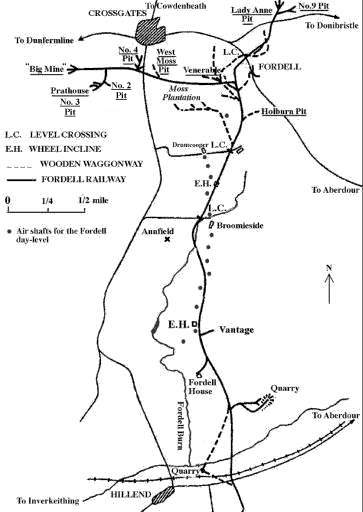
The Lady Anne (No. 4) Pit was located in the Cuttlehill Woods between the William and No. 9 Fordell Pits, about ¼ mile to the south-east of Cuttlehill farm, on the north side of the A907 Crossgates-Kirkcaldy road. Sunk in 1832, to a depth of 300 feet, her circular shaft ceased coaling early in 1950 although the pit remained open for maintenance of the Fordell Day Level and as an outlet shaft for miners working in other pits.

|
|
 |
| See Central Fife Index Entry 'Fordell Pits & Mines' for more information. |
|---|
| ‘Please
also see the Nationalisation Section of the website - Menu 4 -
for Fordell Colliery Information’ |
| Pit opened: 1832 | Pit closed: ceased coaling 1950 |
|---|
| Source Date of Information Supplied |
|---|
| Manager / Under-Manager / Men underground / Men above ground / Coal seams worked / Shaft Details |
| 1889 |
| Mr. James, oversman, departs Lady Anne and No. 4 Pit, Fordell. |
| 1890 (Fordell Trustees) |
| A. M. Morton / -------- /
61 / 8 / Lochgelly Splint; Blawlowan; Five foot
D'cast (circular 10 ft. dia.) 229 ft. : U'cast ------- |
| 1912 |
| Mr William King, manager. |
| 1918 (Countess of Buckinghamshire) |
| William King / William Johnstone / 331 / 110 (manpower figures include Alice and William Pits.) |
| 1928 (Countess of Buckinghamshire) |
| Wm. Simpson Lindsay / Wm. Johnstone / 271 / 106 (manpower figures include Alice and William Pits) |
| Gas, household and steam. Smithy, Lochgelly Parrot, Lochgelly Splint, Mynheer, Five Feet, Dunfermline Splint, Diamond, Glassee, Two Feet, Fourteen Feet. |
| 1938 (Mercer Henderson Trust) |
| James Kelly / Wm. Johnstone / 230 / 111 (manpower figures include Alice and William Pits) |
| Gas, household and steam. Smithy, Lochgelly Parrot, Lochgelly Splint, Mynheer, Five Feet, Dunfermline Splint, Diamond, Glassee, Two Feet, Fourteen Feet. |
| 1945 |
| James Kelly / Wm. Johnstone / 345 / 111 (manpower figures include Alice and William Pits) |
| Gas, household and steam. Two Feet, Smithy, Dunfermline Splint, Five Feet, Mynheer, Glassee, Lochgelly Splint, Diamond, Fourteen Feet. |
| 1948 (NCB) |
| James Kelly / Wm. Johnstone / 347 / 122 (manpower figures include Alice and William Pits) |
| Gas, household and steam. Fourteen Feet, Diamond, Smithy, Lochgelly Splint, Glassee, Mynheer, Five Feet, Two Feet, Dunfermline Splint. |
Information on coals worked at, or near, the Lady Anne Pit, Fordell
(based on a report from 1934)
The Crossgates Station fault, downthrowing to the south,
started west of the station in a disturbed area of workings
in the Dunfermline Splint seam and died out near the Lady
Anne Pit. Sadly, little information appears to have been
documented about the workings of this pit which was sunk to
145 feet and is now believed to be concrete-covered.
The outcrop of the Lochgelly Splint and Lochgelly Parrot
Coals seams passed just north of this pit and headed towards
the north of Donibristle village to the east.
------------------------------------------------

"Cowdenbeath Mail & West Fife Record"
10 August, 1912
A sad fatality occurred on Monday evening at Lady Anne Pit, Fordell Colliery. The pit is an old one, re-opened after some years disuse. John Pollock, Wemyss Square, Fordell, and Thomas Forman, Dunfermline Road, Crossgates, were at the bottom of the shaft waiting in the cage to be raised to the surface, when suddenly a mass of debris came crashing through the cage cover. Some of the bricks higher up the shaft had fallen loose. Borland was severely bruised about the shoulders and side, but Pollock was in a much worse plight; his scalp was fractured and his jaw broken. He was removed in an unconscious state and died that night in hospital. The deceased, who was about forty years of age, leaves a widow and two of a family. The funeral took place on Thursday at two o'clock to the Dunfermline Cemetery and was by public invitation.
-----------------------------
"Dunfermline Press"
7 September, 1912
Under the Fatal Accidents Inquiry Act, an inquiry was held in the Sheriff Court, Dunfermline, on Thursday - before Sheriff Umpherston and a Jury - into the circumstances attending the death of John Pollock, fireman, Wemyss Square, Fordell, who was fatally injured in the Lady Anne Pit, Fordell Colliery, on 5 August through a number of bricks coming away from the side of the shaft and falling on him while he was in the cage. Those giving evidence included:- William King, manager; George Foreman, miner, Dunfermline Road, Crossgates; Thomas Foreman, son of previous witness; and John Baxter, miner, Donibristle. The jury returned a formal verdict.
------------------------------------------------
"Dunfermline Press"
30 August, 1913
On Tuesday, while a casual labourer named Peter Kennedy was engaged among the waggons at Lady Anne Pit sidings he was knocked down by some waggons that were being shunted, and received severe bruises to both legs, besides a deep cut on the right thigh. Kennedy, after being attended to by Dr W. R. Nasmyth, was conveyed to the Dunfermline and West Fife Hospital, where he is making satisfactory progress.
------------------------------------------------
"Dunfermline Press"
17 August, 1929
DETONATORS AT COLLIERY BING.
A package containing 200 detonators was found at the bing at the Lady Ann(e) Pit, Fordell Colliery, on Wednesday. How the dangerous explosive material came to be there is a mystery, but it was evident from the appearance of the detonators that they had lain for some time. The police are making investigations with regard to the matter.
------------------------------------------------
"Dunfermline Press"
18 March, 1950
THE "LADY ANNE" RETIRES
WORK CEASES IN OLD PIT
The old "Lady Anne," one of Fordell Colliery's oldest pits, retired
from work on 16th January. Her history goes back to 1832, the year when a plan was
made for the relaying of the old Fordell railway's wooden line with a malleable iron
railway. Her shaft was then sunk to a depth of approximately 300 feet, and was built,
through an initial band of moss, in circular form and partially lined with masonry.
The circular shaft, which is a form being adopted in many of the modern pits, was probably
unique at the time the Lady Anne was constructed, and it gives those unaccustomed to
descending it a peculiarly light-headed feeling.
Throughout her long career, the Lady Anne, situated a mile to the east of Crossgates, has
stopped working at various times through the economies of the periods in which she lived.
During her lifetime the seams of Dunfermline Splint coal were worked out around the bottom
of the shaft, and when she commenced her final stretch of work in 1941 the shaft reached
bottom at 230 feet at the five feet coal.
Her function when she was re-employed was to "prove" a new area of coal for her
neighbour, the Alice Pit, and to work an isolated patch of coal available only to her, and
work this until it was exhausted, the coal being a house coal, three feet nine inches to four feet,
named Mynheer. These duties she carried out admirably, and she can retire with the
satisfaction of having greatly assisted the production of the country.
The Lady Anne was connected underground to the Alice in 1943, and the remainder of the
new "proved" area of coal will be brought up the recently constructed Henderson
mine, designed to take the complete output of the colliery and eliminate individual pit shafts.
This mine has maintained the output of the colliery which would otherwise have been
decreased by the cessation of work in the Lady Anne.
Some 40 men were employed in the Lady Anne in the closing stages of her career, and these
have been absorbed into other pits in the colliery, and two of the oldest miners employed in the
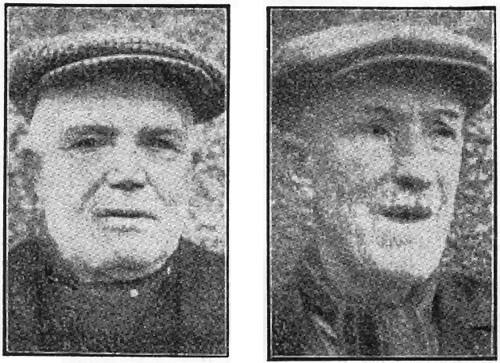
colliery and who worked in the Lady Anne in her old age are pictured here.
|
Mr Archibald McArthur (left) and Mr William Walker.
Mr Archibald McArthur, 11 Droverhall Place, Crossgates, is, at the age of 70, one of the
oldest miners employed at Fordell Colliery. He began work in 1890, when he was ten, in the
old Humbug pit, the site of which is now occupied by Crossgates football field, and since 1894,
when he commenced working underground, he has worked at the colliery ever since.
His grandfather, the late Mr A. L. McArthur, and his father, the late Mr John McArthur, worked
in the same colliery before him, and now his two sons, John and Joe, work in the same colliery.
His grandfather, in his day, was known as a great piper and Highland dancer, and in the days
when the Fordell Parade was held, and the whole village went en fete, a special stage was
always erected for Piper McArthur. Still vigorous, Mr McArthur recalls the time when no one
moved down the pits on Sundays, and when all workers refused to start work until midnight
had chimed on Sunday nights. A keen rose grower, he carried off the supreme award of the
National Rose Society last year at the Southport show.
Mr William Walker, Dunfermline Road, Crossgates, is another veteran miner who is still
employed at Fordell Colliery although he is 72. He has behind him almost sixty years'
service there, and his father before him, the late Mr Peter Walker, worked his lifetime in
the same colliery. His son, Peter, is a Crossgates District Councillor. Mr Walker commenced
work at one shilling per hour and worked an eight hours' day from 6 am until 2 pm.
He, like Mr McArthur, began work in the old Humbug pit, and until he received a foot injury
early this year he was still working as a stone miner. He has now been given a haulage job
to do, but remains underground. He is, however, not the oldest man down the pit. That
honour falls to Mr Jas. Rutherford (75), Fordell, whose son has followed in his footsteps.
When these veterans commenced working there was, of course, no mechanical haulage
underground, all haulage work being done by ponies, but it is only some twenty years since
ponies ceased to be employed at Fordell Colliery, which was one of the last collieries in Scotland
to do away with them.
The Lady Anne will not be closed up completely; she will remain as an additional outlet
for miners in the other pits, and she will remain open for the maintenance of the Fordell Day
Level, an underground water course carrying water from the pits, constructed by Sir John
Henderson, of Fordell, after whose daughter, Anne Isabella, the Lady Anne is named.
A new pithead gantry for the winding gear of the Lady Anne (pictured below) was constructed in
1940, but the winding engine is probably the oldest engine working in Fife, and is of a unique type
with a single cylinder.

|
It and the old lady of the pits will now have a well-earned rest; they represent a step on the way toward a better day for the mining industry with modern improvements, and they will take their place unlamented in the history of the Fife coalfield.
------------------------------------------------
