Owners: Thomas Spowart and Co. Ltd.
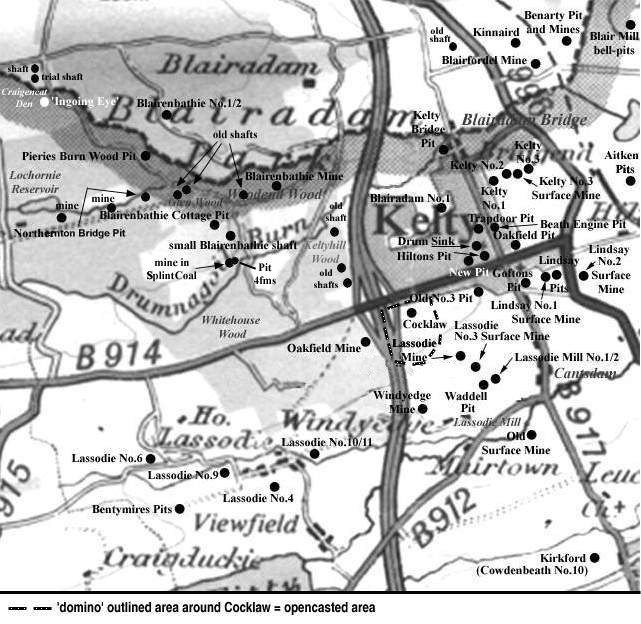
The Lassodie Nos. 10, 11 Pits were located in the
north-east corner of Lassodie village and just a few hundred
yards north-east of the No. 4 Pit.
Sinking during 1890/93, these were the last pits of the
Lassodie Colliery which had commenced operations in the green
fields to the north of Loch Fitty in 1859. The
"Dunfermline Journal" article included later gives
an excellent account of these pits which were working until
the closure of the Lassodie Colliery in 1931. It is also
obvious from the content of the article that 19th century
Fife had a flourishing heavy engineering industry supplying
winding, haulage and pumping machinery to the mining
industry.
 |
| Source Date of Information (Owner) |
|---|
| Manager / Under-Manager / Men underground / Men above ground |
| 1890 (Thomas Spowart & Co. Ltd.) |
| William Andrew / ------------ / 11 / 8 / No other details in colliery list. |
| 1906-09 (Thomas Spowart & Co. Ltd.) |
| Mr David Archibald, colliery manager. |
| 1911 (Thomas Spowart & Co. Ltd.) |
| Sep: Mr Andrew Steedman, under-manager. |
| See also Lassodie Colliery entry CENTRAL FIFE INDEX |
|---|
Information on coal seams worked at Lassodie Nos. 10, 11 Pits
(based on a report from 1934)
In the workings from Nos. 10, 11 Pits (in the northern
basin of the Lassodie coalfield) where the Dunfermline Splint
Coal seam was thinnest, burnt coal was encountered to the
north.
At No. 11 Pit, the Two Foot Coal was somewhat reedy and was
about 2 ft. 3 in. thick.
The Mynheer Coal wrought northwards from both pits was of
good quality - being, as a rule, a bright, hard, steam coal.
The Lochgelly Parrot Coal seam measured at Nos. 10 and 11
Pits was around 4 ft. 6 in. thick with a 2 in. midstone.
The Swallowdrum Coal, averaging 2 ft. 11 in. (but maybe
swelling out to more than 5 ft.) was worked from the No. 10
Pit.
The Jersey Coals were known at Lassodie as the Upper
and Lower Cairncubie Coals. They lay about 40 ft.
above the Swallowdrum Coal, and were separated from each
other by 4 to 6 ft. of sandy strata. At Nos. 10 and 11 Pits,
the Lower Jersey had the following section:
| Description | Thickness |
| Fakes and sandstone | - |
| Soft coal and fireclay | 6 in. |
| COAL | 2 ft. 9 in. |
| Fireclay | 4 in. |
| COAL | 2 in. |
| Fireclay | - |
The Upper Jersey Coal at Lassodie was a hard splint coal of very good quality, and was nearly exhausted in the northern part of the field. Near the outcrop, to the north of Lassodie Mains, the seam was 3 ft. 5 in. thick, including a rib of stone near the base. An average section in the workings of the No. 10 Pit had the following composition:
| Description | Thickness |
| Sandstone and fakes | - |
| COAL | 2 ft. 7 in. |
| Stone | 2 in. |
| COAL | 8 in. |
| Fireclay | - |
Kelty Main Coal (known at Lassodie as the Six Foot Coal) lay from 2 to 4 fathoms above the Upper Jersey Coal and was a light coal of fair quality with a sandstone roof and hard pavement. The coal was worked to the north and west of the No. 10 Pit and a mine, driven towards Fairfield from the pit, tapped the seam to the north-east of the village. The following section may be taken as typical:
| Description | Thickness |
| Sandstone | - |
| COAL | 3 ft. 6 in. |
| Faky fireclay | 2 in. |
| Sandstone | - |
North and west of the No. 10 Pit, a 2 ft. 3 in. coal lay 14 fathoms above the Rough Coal, locally named the Fourteen Foot Coal. It had a thick fireclay pavement and a coarse sandstone roof, and seemed to correspond in position with the Lower Three Foot Coal of Killiebone.
Plans of Abandoned Seams & Dates |
|---|
| Plans of Abandoned Seams for Lassodie Nos. 10, 11 | Pits or Mines designated in Plans |
|---|---|
| COAL; Glassee (April, 1926); Lochgelly Splint (November, 1926) | Lassodie Nos. 4, 10, 11 |
| COAL; Two
Feet (December 1930); Five Feet (March, 1931); Eight
Feet;
Mynheer; Dunfermline Splint (May, 1931); Cairncubie; Swallowdrum (May, 1931); Six Feet; Upper Eight Feet (May, 1931) |
Lassodie Nos. 1, 2, 3, 4, 6, 7, 9, 10, 11
(including old workings in the Lochgelly Splint; Swallowdrum and Top Cairncubie seams at Lochfitty (?) No. 1) |
-----------------------------------
"Dunfermline Journal"
22 April, 1893
THE VILLAGE OF LASSODIE - TWO NEW PITS IN OPERATION
 |
Despite the dullness which is being experienced in
connection with the great coal industry throughout the
country, there are not wanting signs in many of the West Fife
mining villages, and indeed burghs, which cannot fail to
impress one with the idea that there is little slackness in
the work of mineral development. Turn how one likes, he will
find that new pits are being sunk, and that the house
accommodation for workmen is being added to.
The village - the very much isolated village - of Lassodie
is no exception to the rule. It is now 34 years since the
Lassodie Coal Company, with Mr Brownlie as their general
manager, commenced operations at Lassodie. When the company
first started, they confined themselves to the western
boundary of the estate of Lassodie; but as the seams of coal
have got exhausted in the western division they have
gradually wore eastward, putting down pit after pit, and now
they have just sunk two pits which give them control of the
entire eastern boundary of the estate and the coalfield on
the adjoining estate of Thornton.
A very small space divides the pits which are known as
Nos. 10 and 11, and the former has been sunk to a depth of 60
fathoms through the upper seams - two of which, the Six Feet
and the Cairncubie, are at present being worked - while the
latter has touched the Dunfermline Splint, the lowest and
finest seam in the "Kingdom", at a depth of 124
fathoms.
All the seams are of a particularly fine quality. The Five
Feet and some of the other seams are likely to prove an
excellent steam coal, and the samples of the Dunfermline
Splint, the Cairncubie, and other household seams which are
today to be seen at the pits are quite equal to the best
household coals ever produced at Lassodie.
The machinery and gearing are constructed on a scale to
cope with a large output, and the work of opening up the
seams is being pressed forward with all possible speed.
In No. 11 Pit, the sinkers passed through a belt of whin
rock which proved to be 13 fathoms in thickness. An idea of
how much this retarded operations will be apparent when it is
stated that the piercing of a fathom of whin means an
expenditure of at least £100 in wages alone, while in
ordinary sandstone rock the outlay for wages will not be more
than from £15 to £20.
No. 11 shaft is the pumping shaft, and the management have
taken care to provide an engine which will meet all
requirements although the growth of water were to increase
enormously. The engine is a direct working Bull engine with a
72 inch cylinder and a 12 feet stroke.
There are two sets of pumps - the upper having a 22-inch
ram, and the lower a 20-inch ram. The great pump which raises
100 gallons of water per stroke, works smoothly and
noiselessly, and is a striking contrast to the huge metal
beamed engines which were common in the days when the
terrible Hartley disaster took place. The machine was
supplied by Messrs. Douglas & Grant, Kirkcaldy, and it is
a credit to the firm.
The winding is done at No. 11 Pit by a pair of handsome
coupled engines which have 24-inch cylinders and a five feet
stroke. The drum measures 12 feet in diameter, and, working
on the double cage system, the engines will be capable of
winding at least 500 tons a day of eight hours at a depth of
124 fathoms. The engines were turned out from the works of
Messrs. M. Todd & Son, engineers, Dunfermline.
The Dunfermline Foundry Company supplied the winding engines
for No. 10 Pit. They are of a lighter make than those of No.
11 - the cylinders being 18 inches.
With a well developed coalfield the engines of the two
pits should throw from 600 to 800 tons of coal per day. All
the gearing for working about the pumps is particularly
strong. Care is being taken to construct the coal loading
screens on a principle calculated in every way to expedite
the work. Meantime, steam is supplied to all the engines by
four egg-ended boilers, but these are being augmented by two
Lancashire boilers of the most approved type, which will work
at a pressure of 70 lbs. to a square inch. Mr. Brownlie has
still the assistance of his old and experienced manager, Mr.
Andrew, and for some years Mr. Andrew has had associated with
him in the work of manager below ground Mr. Archibald
Brownlie, Mr. Brownlie's eldest son.
The superintendence at the new pits was all that could be
desired while sinking operation were going on, and so
carefully was the whole work carried through that no accident
of any magnitude occurred involving loss of life, or yet the
slightest loss through damage to gearing.
With the opening up of the coalfields on the eastern
division of the estate, the village extends eastwards. It is
a good many years since a considerable number of houses were
built by the company at Fairfield, a slope on the north-east
banks of Loch Fitty. After the first batch of houses were
built, Fairfield stuck for a good many years, but the
development of the minerals in the immediate vicinity has
brought an air of greater activity about the hamlet, and such
a number of houses have been built and are about to be built
as to impress one with the idea that new Lassodie is destined
to become larger than old Lassodie.
We congratulate Mr. Brownlie and the managers under him on
the improved prospects which the new pits bring to the
village. Trade is not, it is true, particularly encouraging
at present; but it is to be hoped that the dullness, which
has played sad havoc with profits and wages during the last
18 months, will not continue long. In the hope that it has
not come to stay, the management are pressing forward the
work of opening up the different seams of coal, and we trust
that their hopes will be realised. Should trade not improve
in the immediate future, it will at least be a satisfaction
to the management and the company to know that the new pits
will put them in a favourable position to compete
successfully with the collieries which have been recently
opening up new seams. In those days of fierce competition
much depends on the appliances for bringing the coals to the
surface. It is impossible to take a peep at the fittings of
the two Lassodie pits without being impressed with the idea
that Messrs. Thomas Spowart & Co. (Limited) mean to keep
abreast of the times.
[We are indebted to the publishers of the People's Journal for the above drawing of the gearing of the pits.]
------------------------------------
"Dunfermline Saturday Press"
16 May, 1895
LASSODIE - PIT ACCIDENT
On Monday, while Tom Sanders, residing at Gask toll-house, was engaged in sinking operations at No. 11 Pit, Lassodie Colliery, one of the stays supporting the gibbet of a crane gave way, and a hutch containing about fifteen cwts. of clay, which was being raised, was precipitated to the bottom of the shaft. Sanders was knocked down, and rendered unconscious for a time. He was conveyed home, and attended by Dr. Morris, who found that although no bones had been broken, the unfortunate man was severely bruised about the head, chest, and other parts of his body.
------------------------------------

"Fife News Almanac"
30 November, 1896
William Campbell, miner, Beveridgewell, Dunfermline, was fatally injured in the underground workings of No. 10 Pit, Lassodie.
---------------
"Dunfermline Saturday Press"
5 December, 1896
William Campbell, miner, Beveridgewell, met his death in the underground workings of No. 10 Pit, Lassodie, on Monday forenoon. A large stone weighing between one and two tons fell from the roof upon him and inflicted such injuries that he died before he could be conveyed home. Deceased was 34 years of age, and was married.
[The Fatal Accident Inquiry into the death of William Campbell on 30 November, was held in the Dunfermline Sheriff Court on the 11th December.]
------------------------------------
"Dunfermline Saturday Press"
21 August, 1897
Alexander McCutchen, pony driver, son of Robert McCutchen, miner, Fairfield, Lassodie, was seriously injured in No. 10 Pit, Lassodie, on Thursday. He fell off the first of a race of hutches, and his face was so severely lacerated that Dr Macgregor found it necessary to put 15 stitches in the wounds.
------------------------------------
"Dunfermline Press"
27 November, 1897
Patrick Condron, a labourer, about sixty-five years of age, was fatally injured at Lassodie Colliery on Monday night. After finishing his work he had gone for his jacket, which was hanging on the buffer of a waggon. Another waggon was at this time shunted back upon him, and he was crushed between two buffers, with the result that he died almost immediately.
11 December, 1897
[This issue carried a Report of the Fatal Accident Inquiry into the death of Patrick Condron at sidings between the Lassodie Nos. 10, 11 pits, on 22nd November. The Inquiry was held on Monday, in Dunfermline Sheriff Court, and heard evidence from Peter Arnott, labourer; William Lithgow, dispatch clerk; Meldrum Beveridge, shunter; and, Thomas Strang, locomotive engine driver. The Jury found that the cause of death was that, after leaving his work, deceased was jammed between two waggons which were being shunted.
In the issue of 7 May, 1898, it was indicated that the family of the late Patrick Condron had instigated a claim for damages against Thomas Spowart & Co., the damages claimed being three years' wages - £117.]
------------------------------------
"Dunfermline Press"
26 March, 1898
Robert Smith, labourer, Lassodie, met with an accident at the pithead of No. 11 Pit, Lassodie Colliery, on Tuesday. He had been inside a waggon making preparations to lift a steel wire rope, when two men, who were removing a batten from the pithead floor, allowed the batten to slip through their hands in the direction of the waggon. The batten struck Smith between the shoulders, rendering him unconscious. He was conveyed home, where Dr Morris, Dunfermline, found that his spine was bruised.
------------------------------------
"Dunfermline Press"
25 June, 1898
Thomas Cook, miner, Fairfield, met with an accident on Monday in the underground workings of No. 11 Pit, Lassodie Colliery. Cook was drawing a hutch of coal from the face, to the main road. While passing the foot of the wheel brae, a runaway hutch came down upon him, and, jamming him against a wall, broke his right leg above the ankle.
------------------------------------
"Dunfermline Press"
9 July, 1898
While Thomas Caldwell, Fairfield of Lassodie, was engaged holing coal in the underground workings of No. 11 Pit, Lassodie Colliery, on Tuesday, the wooden prop supporting the face gave way, and a quantity of coal, weighing about two cwt., came away and fell upon him. Two of his ribs were broken, and his left shoulder was severely bruised. He was attended to by Dr Morris, Dunfermline.
------------------------------------
"Dunfermline Press"
1 October, 1898
Joseph Hunter, Jun., miner, Lassodie, met with an accident in No. 11 Pit, Lassodie Colliery, on Tuesday forenoon, which terminated fatally in the evening. He had fired a shot, and thinking it had not taken full effect, he applied a pinch to the coal, with the result that a large mass, weighing about two tons, fell upon him. He was conveyed home and attended to by Dr Macgregor, Dunfermline, who found him suffering from a broken leg and a broken arm. He had also sustained severe internal injuries, and from the first little hope was entertained of his recovery. The deceased, who was thirty-six years of age, leaves a widow and five children.
------------------------------------
"Dunfermline Press"
22 October, 1898
This issue contained the Report on the Fatal Accident Inquiry into the death of Joseph Hunter following an accident at Lassodie Colliery on the 27th September. It was held at Dunfermline Sheriff Court, on Monday, during which the following gave evidence: David Archibald, colliery manager; John Terris, miner, and John Masterton, jun., pit inspector. Joseph Hunter died in his house at Old Rows, Lassodie.
--------------------------------------------------
"Dunfermline Press"
9 December, 1899
James McGrouther, colliery labourer, Old Rows, Lassodie, while oiling the jigger machinery at No. 11 Pit, Lassodie Colliery, on Saturday, allowed his left leg to be drawn in between two pinion wheels. The leg was severely bruised, but no bones were broken. He was attended by Dr Tuke, Dunfermline.
-------------------------------------------------
"Dunfermline Press"
23 December, 1899
James Kelly, labourer, Fairfield of Lassodie, met with an accident on Monday afternoon while employed in the underground workings of No. 11 Pit, Lassodie Colliery. A stone fell from the roof upon him. He was attended to by Dr Dendle, Dunfermline, who found that his back was severely bruised, and ordered his removal to the Dunfermline Cottage Hospital.
---------------------------------------------------
"Dunfermline Press"
25 May, 1901
On Friday, last week, William Hugh Drysdale, pony driver, son of and residing with William Drysdale, Lassodie School House, met with an accident in the underground workings of No. 11 Pit, Lassodie Colliery, wrought by Messrs Thomas Spowart & Company, Limited. He was sitting on a race of hutches and got jammed between the race and a hutch which had been left on the rails by mistake. His legs were bruised, but Dr Tuke, who was called in, found that no bones were broken.
-----------------------------------------------------
"Dunfermline Press"
25 May, 1901
An accident occurred at Lassodie Colliery yesterday, by which one man was killed and another was injured. The colliery is worked by Messrs Thomas Spowart & Company, Limited, and the accident happened at the pit known as No. 11. In the course of the afternoon, two men - William Taylor and William Anderson - were employed at the brushing in the splint seam when a stone came away from the roof and fell upon Taylor, killing him instantaneously. The stone afterwards rolled down the brae, and in its decent struck Anderson. Dr Tuke, Dunfermline, who was speedily in attendance, found that Anderson's injuries were fortunately not of an alarming nature, and that he was suffering principally from shock to the system. Anderson is a married man, and resides in Fairfield of Lassodie. Taylor was also married, and a painful feature of the accident is that he was a stranger to the district and had only worked three shifts in the pit. His household furniture came from Sauchie in the afternoon, and his wife was expected to arrive at Lassodie in the evening.
------------------------------------
"Dunfermline Press"
15 June, 1901
This issue contains a Report of the Fatal Accident Inquiry into the death of William Springthorp, brusher, Lassodie. David Archibald, manager at Lassodie Colliery, belonging to Messrs Thomas Spowart & Co. Ltd., stated that on 24th May deceased was at work in No. 11 Pit. Witness visited the place half an hour after the accident was reported to him. He found that the accident had occurred from a fall from the roof. Deceased was found with the stone on top of him but Anderson, the contractor, was also injured. Other witnesses included:- John Potter, brusher, 45 Old Rows, Lassodie; John Campbell, pit inspector, Ploughman's Rows, Lassodie; and, William Schoolbred, brusher, 42 Fairfield, Lassodie. A formal verdict was returned by the jury.
Footnote
[We feel this one is related to the above story.]
------------------------------------------------
"Dunfermline Press"
15 February, 1902
Thomas Penman, residing at 46 Fairfield, Lassodie, met with an accident in No. 11 Pit, Lassodie Colliery, on Friday last. While he was working at the face a piece of coal came away unexpectedly and struck him on the right leg, causing a compound fracture. Dr Tuke ordered his removal to the Dunfermline Cottage Hospital.
------------------------------------------------
"Dunfermline Press"
22 March, 1902
The coal-washing machinery at Nos. 11 and 12 [sic] Pits, Lassodie Colliery, belonging to Messrs. T. Spowart & Company, Limited, was destroyed by fire on Saturday. ... The damage, which is partially covered by insurance, is estimated at £1500.
------------------------------------------------
"Dunfermline Press"
FROM OUR FILES
100 Years Ago
Lassodie man John Smith, a pithead labourer, was in charge of the steam hoist at No.11 Pit, Lassodie Colliery. He put a loaded hutch on the hoist but the weight was more than the machine could tolerate. He took off the hutch without shutting off steam and he was caught by the hoist on its ascent. He was carried up a distance of 18 feet and fell to the ground, breaking his arm above the elbow. Dr Tuke from Dunfermline attended to Smith at the scene.
-----------------------------------------------
"Dunfermline Press"
4 April, 1903
John Smith, pithead labourer, Fairfield, Lassodie, was in charge of the steam hoist at No. 1 [sic] Pit, Lassodie Colliery, on Tuesday. He put a hutch of redd on the hoist, but the weight was more than the machinery was able for. He took off the hutch without shutting off steam, and he was caught by the hoist in its ascent. He was carried a distance of eighteen feet when he fell to the ground, breaking his left arm, above the wrist. He was attended to by Dr Tuke, Dunfermline.
-----------------------------------------------
"Dunfermline Press"
18 June, 1904
James Malcolm, miner, Kingseat, was injured on Tuesday in the Dunfermline splint seam of No. 1 [sic] Pit, Lassodie Colliery. He was jammed between an empty hutch and the workings at the foot of a wheelbrae and had his right thigh severely bruised. He was attended to by Dr Drysdale, and conveyed to the Dunfermline Cottage Hospital.
-----------------------------------------------
"Dunfermline Press"
13 January, 1906
An accident which terminated fatally occurred at No. 10 pit, Lassodie Colliery, on Thursday. William Terris, miner, Old Rows, Lassodie, was engaged at work when a stone fell from the roof upon him. Several of his ribs were broken, and he was removed to the Dunfermline and West Fife Hospital. He died in the evening without regaining consciousness.
--------------
"Dunfermline Press"
17 February, 1906
Under the Fatal Accidents Inquiry Act, an inquiry was held in the Sheriff Court, Dunfermline, on Thursday - before Sheriff Shennan and a Jury - into the circumstances attending the death of a miner named William Terris, miner, Old Rows, Lassodie, who died in the Dunfermline and West Fife Hospital on 11th January as a result of injuries received in No. 10 pit, Lassodie Colliery, on 8th January. Those giving evidence included Nurse Mary Logan, Dunfermline and West Fife Hospital; Police Constable Wanlass, late of Lassodie Station; David Archibald, manager; William Allan, miner, Main Street, Kingseat; Thomas Malcolm, miner; and William Wallace, pit fireman, Fairfield, Lassodie. A formal verdict was returned by the Jury.
----------------------------------------------------
"Dunfermline Press"
3 March, 1906
Robert McNabb Curran, a Kelty miner, employed in No. 1 [sic] Pit, Lassodie Colliery, sustained burning injuries ob Friday which necessitated his removal to the Dunfermline and West Fife Hospital. A spark from his lamp ignited a quantity of gunpowder which he carried in his hands, and he was severely burned about the hands, arms, neck, and face.
----------------------------------------------------

H. M. Inspector of Mines Report 1907
Mr. Robert McLaren's Report
Fatal Accident at Lassodie, Fife
Owner: Thomas Spowart & Co., Ltd.
1 May, 1906
Thomas Haddow, 42, Brusher. Deceased was in the act of setting timber to the roof of a roadway which he had just brushed, when a stone fell and struck him between the shoulders. His injuries proved fatal on 23rd January, 1907.
----------------------------------------------------
"Dunfermline Press"
23 February, 1907
Under the Fatal Accidents Inquiry Act, an inquiry was held in the Sheriff Court, Dunfermline, on Thursday - before Sheriff Shennan and a Jury - into the circumstances attending the death of Thomas Haddow, brushing contractor, lately residing at 89 Fairfield, Lassodie, who was injured on 1st May, 1906, in No. 11 Pit, Lassodie Colliery, by a stone falling upon him from the roof, and who died in the Dunfermline Hospital on 23 January, 1907. Those giving evidence included:- David Archibald, manager; Agnes Murie or Haddow, widow of deceased; Drs Tuke and Dalgleish, Dunfermline; John Whitelaw, brusher, 59 Fairfield, Lassodie; and John Ryan, fireman, 9 Fairfield, Lassodie. A formal verdict was returned.
----------------------------------------------------
"Dunfermline Press"
Saturday, August 7, 1909
PIT FATALITY AT LASSODIE
On Tuesday morning, Thomas Anderson, miner, aged 24, residing at Terris's Buildings, Kelty, met with his death at No. 10 Lassodie Pit, belonging to Messrs. Thomas Spowart & Company. Anderson had been working at the coal face, and is supposed to have been in the act of cleaning a place to put up a tree, when a stone fell upon him. On his being extricated, it was found that the unfortunate man's neck was broken. Anderson was a prominent member of Kelty United Cricket Club.
----------------------------------------------------
"Dunfermline Press"
25 September, 1909
Under the Fatal Accidents Inquiry Act, an inquiry was held in the Sheriff Court, Dunfermline, on Thursday - before Sheriff Shennan and a Jury - into the circumstances attending the death of Thomas Strachan Cumming, miner, Fernie's Buildings, Lower Oakfield, who was killed on 3 August in No. 10 pit, Lassodie Colliery, by a fall of stone from the roof. Those giving evidence at the inquiry included:- David Archibald, colliery manager; Robert Taylor, miner; John Dobbie, drawer; and William Wallace, pit fireman. A verdict in accordance with the evidence was returned.
----------------------------------------------------
"Dunfermline Press"
14 May, 1910
Under the Fatal Accidents Inquiry Act, an inquiry was held in the Sheriff Court,
Dunfermline, on Thursday - before Sheriff Shennan and a Jury - into the circumstances
attending the death of miner James Robson, lately residing at Old Row, Lassodie, who
was killed by a fall of coal at No. 10 Pit, Lassodie, on 15th April. Those giving evidence
at the inquiry included:- John Reid, pit fireman; John Morrison (15), coal filler; and James
Arnott, miner, Old Row, Lassodie.
A formal verdict was returned and no blame was attached to any one by the jury.
----------------------------------------------------
"Dunfermline Press"
11 July, 1914
The workmen at Lassodie Colliery met in the Tavern on Saturday. Mr John Ryan, who presided, presented Mr Andrew Steedman, late colliery oversman, with a gold watch, suitably inscribed, as a token of respect from the workmen. ...
----------------------------------------------------
"Dunfermline Press"
21 November, 1914
On Tuesday, Thomas Ramsay, brusher, Muir Road, Townhill, was admitted to the Dunfermline and West Fife Hospital suffering from a dislocated ankle and bruises on one of his feet, which he received by a fall from the lip of the brushing in No. 2 (sic) Pit, Lassodie Colliery.
----------------------------------------------------
"Dunfermline Press"
4 May, 1918
While at work in No. 11 Pit, Lassodie, on Friday last week, George Hynd, Todd's Buildings, received an injury to one of his feet - two of his toes being taken off, and the foot being badly bruised - as the result of a stone falling from the roof. Hynd is the old Kelty Rangers and Lochgelly footballer.
----------------------------------------------------
"Dunfermline Press"
29 May, 1920
A miner named Shoolbred, about 42 years of age, while working in No. 11 Pit, Lassodie Colliery, was struck by a fall of stone from the roof, and was fatally injured.
---------------------------
"Dunfermline Press"
17 July, 1920
ROOF FALLS
Under the Fatal Accidents Inquiry Act, several inquiries were held in the Sheriff Court, Dunfermline, on Thursday - before Sheriff Umpherston and a Jury - into the circumstances attending the deaths of several miners from roof falls including William Donaldson Schoolbred, brushing contractor, lately residing at 37 Fairfield Rows, Lassodie (No. 11 Pit, Lassodie Colliery). ...
----------------------------------------------------
"The Scotsman"
22 September, 1924
FIFE PIT FATALITY. - Andrew Dobbie (54), residing at 26 Fairfield, Lassodie, was instantaneously killed in No. 10 Pit, Lassodie Colliery, near Dunfermline, on Saturday. He was engaged in the Swallowdrum seam, when a heavy roof fall took place, under which he was completely buried.
-----------------------
"Cowdenbeath & Lochgelly Times"
24 September, 1924
LASSODIE PIT FATALITY
SON SEES FATHER CRUSHED BY FALL FROM ROOF
Another fatality has occurred in the West Fife coalfield under tragic circumstances. The victim was Andrew Dobbie, a married man with a family, residing at 26 Fairfield, Lassodie, and a painful feature was the fact that his son, of the same name and 22 years of age, was working alongside his father when the accident took place. The two men were employed in No. 10 Pit, Lassodie, when a fall took place from the roof, killing Dobbie almost instantaneously.
----------------------------------------------------
"Dunfermline Press"
28 February, 1931
LASSODIE PIT FATALITY.
Thomas Woodrow, a pit repairer who resided at 71 Fairfield, Lassodie, met with a fatal accident in No. 10 Pit, Lassodie Colliery, on Monday night. Woodrow was working shortly after half-past nine o'clock, in the six-foot section of the pit when a stone, weighing about three tons, fell on him from the roof. He was killed instantaneously. Deceased, who was 56 years of age, leaves a widow and a family of seven children.
------------------------------
"Dunfermline Press"
9 May, 1931
Under the Fatal Accidents Inquiry Act, an inquiry was held in the Sheriff Court, Dunfermline, on Thursday - before Sheriff Umpherston and a Jury - into the circumstances attending the death of a miner named Thomas Henry Gilmour Woodrow, coal miner, 71 Fairfield, Lassodie, who was killed by a roof fall on 23 February in the underground workings of No. 10 Pit, Lassodie Colliery, belonging to Thomas Spowart & Company, Limited, in course of his employment as a repairer. Those giving evidence included:- John McLellan, machineman, Denbrae, Lower Oakfield, Kelty; Daniel Hills, stripper, 44 Henderson Street, Kingseat; and Alexander Waugh, underground fireman, 131 Golfdrum Street, Dunfermline. A formal verdict was returned by the jury.
----------------------------------------------------
