Owners: Lumphinnans Iron Co. Ltd
Lumphinnnans Iron and Coal Co. Ltd.
Fife Coal Co. Ltd.
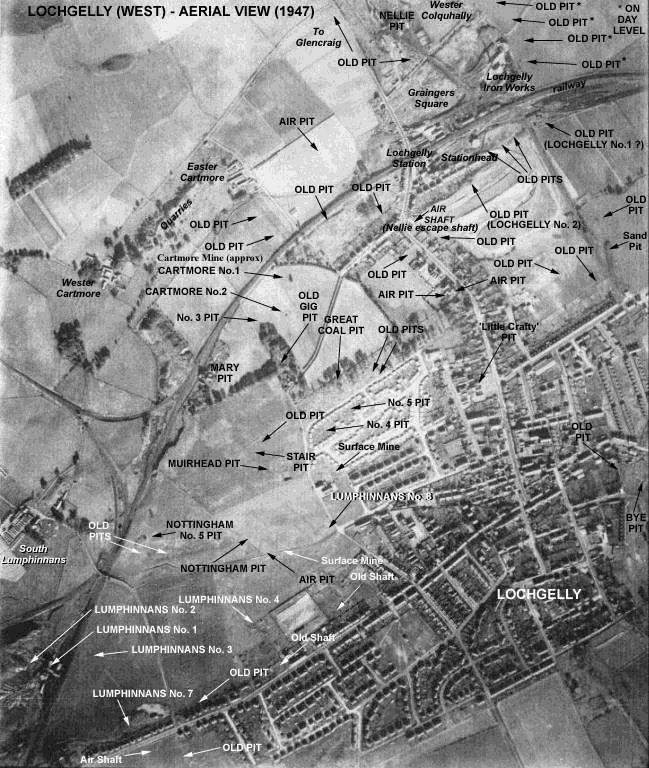
The Lumphinnans No. 7 Pit was sunk 350 yds. south-east of the No. 1 Pit on the north side of the main Lumphinnans-Lochgelly road. Records indicate that the shaft reached the Lochgelly Splint at 42 fathoms and the Five Feet seam at 75 fathoms.
 |
 |
| See Lumphinnans No. 1 Pit entry for general information on Lumphinnans Colliery. |
|---|
Lumphinnans No. 7 Pit
| Pit opened: 1860s | Pit closed: not known |
|---|
| Source Date of Information Supplied |
|---|
| Manager / Under-Manager / Men underground / Men above ground / [Pits denoted] / Coals and Seams worked / Shaft Details |
| 1873 (Lumphinnans Iron Co.) |
| Peter Cummings /
---------- / -- / -- / 5 feet
D'cast (15 x 5½) 612 ft. : U'cast (10 x 5½) 450 ft. Natural ventilation. |
| 1874 (Lumphinnans Iron Co.) |
| Peter Cummings /
---------- / 70 / 17 / 5 feet
D'cast (15 x 5½) 612 ft. : U'cast (10 x 5½) 450 ft. Natural ventilation. |
| 1875 (Lumphinnans Iron Co.) |
| Peter Cummings /
---------- / 61 / 17 / 5 feet
D'cast (15 x 5½) 612 ft. : U'cast (10 x 5½) 450 ft. Natural ventilation. |
| 1876 (Lumphinnans Iron Co.) |
| Peter Cummings /
---------- / 61 / 17 / 5 feet; Dunfermline Splint
D'cast (15 x 5½) 612 ft. : U'cast (10 x 5½) 450 ft. Natural ventilation. |
| 1877 (Lumphinnans Iron Co.) |
| Peter Cummings /
---------- / 63 / 18 / 5 feet; 4' 2" Dunfermline
Splint
D'cast (15 x 5½) 612 ft. : U'cast (10 x 5½) 450 ft. |
| 1878 (Lumphinnans Iron Co.) |
| Peter Cummings /
---------- / 67 / 16 / 5 feet; 4' 2",
Dunfermline Splint
D'cast (15 x 5½) 612 ft. : U'cast (10 x 5½) 450 ft. |
| 1879 (Lumphinnans Iron Co.) |
| Peter Cummings /
---------- / 95 / 20 / 5 feet; 4' 2",
Dunfermline Splint, Mynheer
D'cast ----- : U'cast (10 x 5½) 450 ft. (Fan 20' x 5' 6" at No. 7 Pit) |
| 1880 (Lumphinnans Iron Co.) |
| Peter Cummings /
---------- / 59 / 25 / 5 feet; 4' 2",
Dunfermline Splint, Mynheer
D'cast ----- : U'cast (10 x 5½) 450 ft. Fan 20' x 5' 6". 1 fatality recorded. |
| 1881 (Lumphinnans Iron Co.) |
| Peter Cummings /
---------- / 60 / 26 / 5 feet; Mynheer
D'cast ----- : U'cast (10 x 5½) 450 ft. |
| 1882 (Lumphinnans Iron and Coal Co.) |
| Peter Cummings /
---------- / 57 / 16 / Dunfermline Splint
D'cast ----- : U'cast ----- Air from No. 1 |
| 1890 (Cowdenbeath Coal Co.) |
| Peter Cummings / John
Thomson / 98 / 11 / Mynheer; Dunfermline Splint
D'cast ----- : U'cast (10 x 5½) 450 ft. Fan (Guibal), 21' x 6'. |
| Plans of Abandoned Seams for Lumphinnans No. 7 | Pits or Mines designated in Plans |
|---|---|
| COAL; Dunfermline Splint; Little Splint; Fourteen Feet; Mixed; Parrot. IRONSTONE (1851-1883). | Lumphinnans Nos. 1, 2, 3, 4, 5, 7, 8, 9; Little Gig; Nottingham; Stair |
| COAL; Dunfermline Splint (1856); Little Splint (1858); Diamond (1880); Five Feet (1921); Lochgelly Splint (1923); Fourteen Feet (1925). IRONSTONE (1875). | Lumphinnans Nos. 1, 2, 3, 4, 5, 7, 8, 9; Little Gig; Nottingham; Stair |
| COAL; Five Feet; Fourteen Feet; Glassee; Mynheer; Lochgelly Parrot; Lochgelly Splint; Dunfermline Splint (May, 1896) | Lumphinnans No. 7 |
| COAL;
Five Feet; Main; Lochgelly Splint; Lochgelly Parrot
(December, 1926)
Later workings in the Five Feet seam have been added to this plan. The amended abandonment date is January, 1932.) |
Lumphinnans Nos. 1, 2, 7, 8 |
Information on coals worked at, or near, Lumphinnans No. 7
The Dunfermline Splint Coal measuring 3 ft. 6 in. to 4 ft.
6 in. thick, with a blaes roof 1 ft. 2 in. thick, was worked
here. In higher workings of the pit, the Five Foot Coal was
recorded as 4 ft. 10 in. thick on average.
The Mynheer Coal seam in the Lumphinnans Pits supplied a
fair steam and good household coal with 3 ft. 2 in. to 4 ft.
coal overlain by a thin bed of coaly blaes separating the
ironstone from the top of the coal.
The Glassee Coal worked was around 4 ft. 8 in. thick.
The Lochgelly Splint Coal (6 ft. 6 in. to 7 ft.) and
Lochgelly Parrot Coal (3 ft. to 6 ft.) were wrought for years
and limited reserves were available approaching the 1930s.
Here too, the sandy layers above the Swallowdrum Coal were
replaced by finer-grained sediments and the seam was closer
to the Jersey Coals. It was in thin leaves with thick
partings and was not a workable proposition.
"Dunfermline Saturday Press"
14 May, 1864
ACCIDENT TO A BOY
On Monday a horse engaged at No. 7 Coal Pit, Lumphinnans,
ran off along the Lochgelly road to Cowdenbeath, running down
a boy named Thomas Brand.
Dr. Mungall, who was promptly in attendance, reports that
the boy has sustained a compound fracture of the skull.

"Dunfermline Saturday Press"
12 June, 1869
FATAL COLLIERY ACCIDENT
On Monday forenoon an accident of a fatal nature occurred in No. 7 Pit of the Lumphinnans Colliery, to a young lad named Thomas Beveridge. It appears that the unfortunate boy, who was about 14 years of age, had been busily engaged at his work as a drawer, and was in the act of filling his tub with coals, when a large stone fell upon him from the roof, which knocked him to the ground. He was immediately attended to, and the stone removed, but it was found that his head was so severely crushed that he never rallied. The lad resided with his mother in Lochgelly, and she is a widow. No blame can be attached to any one, owing to the circumstance being accidental.
"Dunfermline Saturday Press"
24 August, 1872
FATAL ACCIDENT
On Thursday, a man named John Macdonald, whilst working in No. 7 Lumphinnans coal pit, was killed instantaneously by a fall of stone from the roof of the pit. We are sorry to state that deceased leaves a widow and large family, who are not able to work for themselves yet.
------------------------------------
"Dunfermline Saturday Press"
29 January, 1876
PIT ACCIDENT
A young man named David Herd was somewhat seriously injured at Lumphinnans Colliery on Saturday last. At the time the accident happened he was engaged working at the coal face, when a mass of coal fell upon him from the roof, by which his collar bone was broken. On being conveyed home, he was attended to by Dr. Mungall, and is now progressing as favourably as can be expected.
------------------------------------
"Dunfermline Saturday Press"
17 March, 1877
LOCHGELLY - TWO MINERS KILLED
An accident occurred on Wednesday morning at No. 7 coalpit, belonging to the Lumphinnans Iron Company, Lochgelly, by which two miners, named James and Andrew Clark, (father and son), lost their lives. They were engaged working the coal, when suddenly a large piece of the roof fell upon them, causing almost instantaneous death. A considerable time elapsed ere the body of James could be recovered owing to the large quantities of material that had fallen. The father leaves a widow, and the son a widow and two children.
"Dunfermline Saturday Press"
4 September, 1880
FATAL ACCIDENT
On Saturday afternoon, a lad named David Ross, about 18 years of age, and residing at Launcherhead, met with his death at the Lumphinnans Coal Co.'s works, Lochgelly. It appears that Ross had been engaged "spragging" the wheels of some waggons which were in motion, and by some misadventure fell before the wheels, which passed over his left leg below the knee. He died while being conveyed to the Infirmary, Edinburgh.
"Dunfermline Saturday Press"
5 March, 1881
FATAL PIT ACCIDENT
On Wednesday forenoon, an accident happened in one of the pits belonging to the Lumphinnans Coal Company by which a youth named John Bowman, about 15 years of age, lost his life. He had been engaged filling a hutch at the coal face, when a large quantity of rubbish fell upon him from the roof, and before he could be extricated, life was found to be extinct.
------------------------------------
"Dunfermline Saturday Press"
21 November, 1885
ACCIDENT
On Monday, Peter Lessells, better known as John Pinder, the Lochgelly poet, was severely injured by a fall of coal while working in No. 7 Pit, Lumphinnans - his leg being broken above the knee. He is progressing as favourably as can be expected.
------------------------------------
------------------------------------
"Dunfermline Saturday Press"
19 October, 1889
PUBLIC MEETING
At a public meeting held in the Court-House on Wednesday evening, a Committee was appointed to collect subscriptions on behalf of Robert Simpson who had his back broken by an accident in No. 7 Pit, Lumphinnans, and is permanently disabled from earning a livelihood. This is a case well deserving public sympathy, and we trust the appeal will meet with a liberal response.
------------------------------------
"Dunfermline Saturday Press"
12 April, 1890
ALARMING ACCIDENT AT LUMPHINNANS COLLIERY
NARROW ESCAPE OF FOUR MINERS
At an early hour yesterday morning an accident of an
alarming nature occurred at No. 7 Pit, Lumphinnans Colliery,
belonging to the Cowdenbeath Coal Company.
The miners employed in the mine in question usually start
work at the face about six o'clock, and shortly after
five they begin to descend the shaft, down which they are
lowered in cages. Three double-decked cages - each containing
four men - two in the lower division and two in the upper -
had been lowered yesterday morning, and four miners had taken
their places in the fourth cage when the accident referred to
occurred. The engineman, it appears, had turned on the steam,
but for some reason or other he omitted to reverse the lever,
which had the effect of continuing the ascent of the cage
instead of lowering it, and before he discovered the mistake
the cage was rapidly approaching the pulley, which is almost
ten feet from the level of the platform at the pit-mouth.
With remarkable presence of mind, however, the engineman
succeeded in stopping the machinery, and the result was that,
the cage swerving over to the right, the occupants were
thrown on to the platform instead of being as, but for the
engineman's timely action, they would have been
precipitated to the bottom of the shaft. The miners who
occupied the cage at the time of the accident were Hugh
Jamieson, Andrew Nasmyth, John McLean, and Abraham Moffat.
Fortunately, none of them sustained injuries of a serious
nature, although the last named received a somewhat severe
shock to his nervous system.
------------------------------------
"Dunfermline Press"
3 May, 1902
John Armit, seventy years of age, a labourer, of no fixed residence, died suddenly in the donkey engine-house at No. 7 Pit, Lumphinnans Colliery, on Monday morning. He was lodging at the pithead, and was last seen alive by the foreman half an hour previous to his death. The cause of death was failure of the heart's action.
------------------------------------
"Dunfermline Press"
19 September, 1903
DEATH OF A COLLIERY MANAGER
Mr Peter Cummings, late colliery manager, Lumphinnans, died at Wilcum Terrace, Cowdenbeath. The deceased gentleman, who was a native of Prestonpans and came to Fife when a young man, was for many years connected with the mining industry at Lumphinnans. He obtained charge of No. 7 Pit, and in 1872, when a new Mines Act came in force, he was promoted to manage the whole colliery. About three years ago he retired on a pension from the Fife Coal Company.
------------------------------------
"Dunfermline Press"
19 March, 1904
About three o'clock on Wednesday afternoon, Laurence Page, pit fireman, residing at 82 Albany Street, Dunfermline, met with serious injuries while removing a waggon of coals from a coal bing to the fireholes at No. 7 Pit, Lumphinnans Colliery. By some means or other his body was caught between the waggon and a wall below the old engine, and on being removed to the weigh-house he was found by Dr Drysdale, Dunfermline, and Dr Craig, Cowdenbeath, to be suffering severe internal injuries. The doctors ordered his removal to the Dunfermline Cottage Hospital.
------------------------------------
