A number of coal workings are known to have operated from the early 19th century in the Hill of Beath district, to the west of Cowdenbeath, as Hill of Beath Colliery. To date, we have identified the following Hill of Beath coal-works:
Loan Pit; 'Minister's Pit'; West Pit; Engine Pit; Dalbeath Nos. 1, 2 Pits
Near the beginning of the 20th century, however, individual records begin to appear for two separate collieries - Hill of Beath and Dalbeath (see records below). By 1911, very little coaling was taking place at the old Hill of Beath Colliery, but the Dalbeath pits continued to be productive into the 1930s.

|
 |
| Source Date of Information (Owner) |
|---|
| Manager / Under-Manager / Men underground / Men above ground / Coal seams worked / Shaft Details |
| 1830s (Robert Wilson) |
| 1840s (Robert
Wilson)
Lessee: T. Landers |
| 1842 (Robert Wilson) |
| [From Dunfermline Register] |
| 1851 (K. Mathieson, Sen.) |
| [From Dunfermline Register] |
| 1852-1856 (Messrs K. Mathieson) |
| [From Dunfermline Registers] |
| 1857-1859 (Messrs Nasmyth) |
| As Hill of Beath Coal and Firebrick Works [From Dunfermline Registers] |
| 1859-82 (Ord Adams)
[Mr. Ord Adams - died 20 April, 1882, aged 75 years.] |
| 1886/87
Sinking of Dalbeath pits. |
| 1889 February: Fife Coal Co. Ltd. purchase West, Engine and Dalbeath pits from Mr David Adams. |
| 1893 (Fife Coal Co., Ltd.) |
| Henry Rowan, manager. |
| 1896 (Fife Coal Co., Ltd.) |
| Henry Rowan / ------------ / 521 / 163 [Hill of Beath] |
| Gas, household, manufacturing and steam coals. Ironstone. |
| 1902 (Fife Coal Co., Ltd.) |
| Mr David Adams, former colliery owner - died April, 1902. |
| 1904 (Fife Coal Co., Ltd.) |
| William Riddell / ------------ / 165 / 44 [Hill of Beath] |
| Gas, household, manufacturing and steam coals. Ironstone. |
| William Riddell / ------------ / 280 / 86 [Dalbeath] |
| Gas, household, manufacturing and steam coals. |
| 1905 (Fife Coal Co., Ltd.) |
| Wm. Riddell / ------------ / 229 / 108 [Hill of Beath] |
| Wm. Riddell / ------------ / 307 / 65 [Dalbeath] |
| 1907 (Fife Coal Co., Ltd.) |
| Jan: Mr Wm. Riddell, manager, leaving to take up position in Grangemouth |
| 1908 (Fife Coal Co., Ltd.) |
| Thomas Borland / ------------ / 306 / 49 [Hill of Beath] |
| Thomas Borland / ------------ / 413 / 191 [Dalbeath] |
| 1909 (Fife Coal Co., Ltd.) |
| March: Mr Borland appointed manager at Valleyfield |
| 1911 (Fife Coal Co., Ltd.) |
| ---------- / ------------ / 13 / 4 [Hill of Beath] |
| ---------- / ------------ / 372 / 123 [Dalbeath] |
| 1918 (Fife Coal Co., Ltd.) |
| James Erskine / Charles Seaman / 422 / 152 [Dalbeath] |
| 1919 (Fife Coal Co., Ltd.) |
| May: James Erskine, manager, moves to Townhill Colliery. |
| 1926 (Fife Coal Co., Ltd.) |
| William Paterson, manager. |
| 1928 (Fife Coal Co., Ltd.) |
| William Paterson / Charles Seaman / 208 / 97 [Dalbeath] |
| Household and steam
coals and blaes.
Lochgelly Splint, Glassee and Kinglassie Splint. |
| 1930 (Fife Coal Co., Ltd.) |
| March: Mr Dewar, manager, appointed
to Valleyfield Colliery. Mr J. Fleming, Valleyfield, appointed manager, Hill of Beath Colliery. |
| Dalbeath pits were probably closed in the early 1930s. |
Hill of Beath Colliery (19th century report)
| Name of coal | Thickness | Quality | Class | ||||
|---|---|---|---|---|---|---|---|
| Fourteen Foot Coal | 4 ft. 8 in. | not stated | Steam | ||||
| Duddie Davie Coal | 5 ft. 5 in. | not stated | Steam | ||||
| Lochgelly
Splint Coal |
Coal
Stone Coal |
>
> > |
4 ft. 2 in.
1 ft. to 3 ft. 3 ft. 9 in. |
>
> > |
not stated | >
> > |
Steam |
| Glassee Coal | 5 ft. 5 in. | not stated | Steam | ||||
| Five
Foot Coal |
Ironstone
and Coal |
>
> > |
8 in.
and 5 ft. |
>
> > |
not stated | >
> > |
Steam |
| Dunfermline Splint Coal | 4 ft. 6 in. | not stated | Household | ||||
| Plans of Abandoned Seams for Hill of Beath & Dalbeath | Pits or Mines designated in Plans |
|---|---|
| COAL; Splint | Hill of Beath |
| COAL; Duddie Davie (1872) | Hill of Beath |
| COAL; Splint; Seam unnamed (1872) | West |
| COAL; Lochgelly Splint (1872); Splint; Dunfermline Splint; Swallowdrum (1904); Five Feet; Kinglassie Splint (1908); Glassee; Fourteen Feet; Diamond (1910). | Loan; West; |
| COAL; Lochgelly Splint; Dunfermline Splint; Swallowdrum; Five Feet; Glassee; Fourteen Feet; Diamond (November, 1910). |
Engine; West;
Dalbeath Nos. 1, 2 |
| COAL;
Five Feet (April, 1912); Dunfermline Splint
or Lower Splint (January, 1919) |
DALBEATH,
Nos. 1, 2; Engine |
| COAL; Little Splint; Gorman (July, 1927) | Dalbeath |
| COAL; Little Splint (October, 1930) | Dalbeath |
| COAL;
Main (April, 1926); Diamond (April, 1928);
Swallowdrum (October, 1928); Lochgelly Splint (April, 1931). |
Dalbeath
(including workings from Engine and West Pits) |
--------------------------------------------
EVIDENCE ON THE EMPLOYMENT OF CHILDREN
Mr. Robert Wilson, Esq.
ROYAL COMMISSION - 1842 REPORT
"Colliers in this part work their children at
eight and nine years of age, and it would be a prudent step
not to allow male nor female to enter a pit until the age of
12 years, that by keeping them at school they may have a
little more knowledge of the right and wrong.
As miners find use for young persons of nine, or even
younger than nine years of age, it will be a difficult task
to induce them to educate their children; nothing but
compulsory steps will effect it."
--------------------------------------------
"Fifeshire Journal"
11 August, 1842
GOING COLLIERY IN FIFE TO LET.
To be Let for Nineteen, or such other terms of
years as may be agreed on -
THE HILL OF BEATH COLLIERY, situated in the
Parish of Beath, and Western District of Fifeshire, within about
four miles of the Harbour of Inverkeithing, and a few hundred yards
of the Great North Road, and of a contemplated junction with the
Halbeath Railway.
The Colliery is presently won to a depth of 22
fathoms, by a pumping and winding Engine, to a seam of good
Household and Furnace Coal, of about 5½ feet thick; and a
bore, put down about 30 fathoms further, has passed through five
seams of coal, varying from 3 to 5½ feet thick. One of these
seams is 14 fathoms from the present working; it is 5½ feet
thick, is hard and splinty, and is conjectured to be the Lochgelly
splint seam. It is supposed that the whole of the old Fife seams
are below those bored to. A powerful new High Pressure three-valved
Pumping Engine has been recently erected, and all ready to sink to
this seam.
Every encouragement will be given to an eligible
and enterprising Tenant, and immediate entry may be obtained. The
Engines and other fittings will be delivered over to the Tenant at
a valuation.
The terms of Lease, with any farther
information, may be learned by applying to the Proprietor at the
Colliery, or to JAMES McFARLANE, Writer, Dunfermline.
Dunfermline, August 3, 1842.
[This advert also appeared in the issue of 27 October, 1842.]
--------------------------------------------
"The Scotsman"
26 April, 1843
GOING COLLIERY IN FIFE TO LET.
To be LET, for such term of years as may be agreed on, with Immediate Entry,
THE VALUABLE GOING COLLIERY & COALFIELD of HILL of BEATH, situated in
the Western District of Fifeshire, distant about four miles from the Harbour of Inverkeithing,
and within a few hundred yards of the Great North Road, and of a contemplated junction
with the Halbeath Railway, which terminates at Inverkeithing Harbour.
This Coalfield has been partially wrought for some years - the Workings being restricted,
however, to a 5½ feet seam of good Household and Furnace Coal. Recently, the
Going Pit has been sunk through other four seams, varying in thickness from 3 to 5½ feet.
The principal seam presently sunk to is 35 fathoms from the surface; 5½ feet thick,
and is understood to be the Lochgelly Splint, the superior excellence of which is well known;
and five feet below it there is a 3 feet Coal, supposed to be the Lochgelly Parrot Seam.
The Coalfield is believed to contain the whole of the Old Fife Seams. The operations of the
present Fitting are carried on by means of two Engines, both in excellent going order. The
Winding Engine is about 16 horses' power, and the other is a powerful new high-pressure
three-valved Pumping Engine, likely to prove efficient for the drainage of the field for many
years.
The Engines and other Fittings will be given over at prices to be fixed by valuators
to be mutually named, and a suitable tenant will receive every encouragement.
The terms of lease, with any farther information, may be learned by applying to the Proprietor
at the Colliery, or to James McFarlane, writer, Dunfermline.
Dunfermline, 18th April 1843.
--------------------------------------------

"Fifeshire Journal"
15 October, 1846
CROSSGATES - MELANCHOLY ACCIDENT
On Monday afternoon last a very melancholy accident happened at Hill of Beath Colliery in this vicinity. The pumps had been requiring repair. While the men were withdrawing the spears, Mr Landales [Landers?], the master and lessee, had gone to the top of the shear-legs, immediately over and considerably higher than the pit-mouth, for the purpose of guiding the spears past this obstacle, when, it is supposed, a sudden jerk caused him to lose his balance, when he fell down the shaft, and was instantaneously killed. He fell above thirty fathoms. He was much respected by all who knew him, and has left a widow and two children to mourn over his melancholy end.
------------------------------------
"Supplement: Dunfermline Press"
17 May, 1862
DISASTROUS COAL-PIT ACCIDENT AT HILL OF BEATH
A melancholy accident occurred at Hill of Beath Colliery on Saturday morning, in a pit in process of being sunk there, by which one man was killed and others more or less injured.
Two men, named respectively William Hamilton, aged 29, and Gavin Hamilton, aged 25, sinkers, were employed in the pit, about eight o'clock, in guiding down the shaft a quantity of pipes, which were being lowered from the surface, for the purpose, it is said, of getting a few more lengths of pipe attached to the top. The two men were standing on a "bunting", a beam of wood, four inches square, crossing the shaft. When within a short distance of this "bunting", some of the bindings of the pipes gave way, and the heap crashed down the pit, carrying off the beam on which the two men stood, with other debris.
William Hamilton seized hold of one of the side bars of the shaft, by which he held until rescued from the top, but his brother, less fortunate, was borne down by the falling mass to the pit bottom into 30 fathoms of water.
David Adams, the son of Mr. Ord Adams, the proprietor, was also employed in the shaft at the time, but escaped by the exercise of the same presence of mind which saved William Hamilton. The two survivors were at once relieved from their perilous position by the men at the pit-head, and the drag was applied, if possible to recover the body of Gavin Hamilton, but without success - it is being supposed that his body has been buried under the pipes and rubbish. If this supposition be correct, the body will not soon be recovered. At least one month is necessary before the vast quantity of water in the pit can be drained off - perhaps three or four months may be required. Till this be done, the cause of the accident will remain a mystery, only vaguely guessed at. There were in the mass twenty-seven fathoms of cast-iron pipe, of twelve inches diameter weighing eleven tons - a very heavy weight - but it was thought that the bindings were quite sufficient.
They were fastened by means of two chains, one an inch, the other seven-eighths of an inch, in thickness. These were passed through strong fiddle-blocks, and attached to two ropes - one three and a-half, the other seven inches in diameter - and thus let down the pit by means of three cranes at the pit head.
The fastenings were made by the men themselves, and so confident were they of their security that when, about ten minutes before the accident occurred, they were enjoined by the proprietor, Mr. Adams, "That if they had any fear of danger they should come up the pit." They replied "That there was no fear," and gave the signal to the men at the pit-head to lower away.
William Hamilton was bruised about the head, right leg, and back, but cannot tell how he received the injuries. One of the men at the pit-head was slightly injured by the jerking of the crane, caused by the parting of the bindings, and consequent relaxing of the strain on the ropes.
The injured men were attended by Dr. Mungall, and it is expected will soon again be able to work. The Hamiltons are steady and industrious workers, and looked upon as skilled in their profession. They had come from Hamilton in Lanarkshire, to Hill of Beath colliery, only about three weeks ago. It is so far satisfactory to know that, in this matter, no blame can be charged upon any party. The accident is just one of those unfortunate contingencies which can never be fully provided against in an occupation so fraught with danger as mining.
------------------------------------
"The Scotsman"
31 May, 1862
DUNFERMLINE - THE LATE COAL-PIT ACCIDENT
AT HILL OF BEATH
The body of the miner, Hamilton, who, three weeks ago, was thrown down the shaft of a pit at Hill of Beath Colliery, by the fall of a quantity of pipes, and drowned in several fathoms of water at the bottom, was recovered on Monday.
--------------------------------------------------------
" Dunfermline Press"
21 July, 1866
On Thursday last week, William Erskine, a boy of about 13 years of age, met with a rather serious accident at the Hill of Beath, which unfortunately resulted in his death. It appears the boy was working at Hill of Beath coal-pit, and standing at a place called the top of the Wheel Brae, when two hutches were, by some means or other, pushed on to the incline, and having run to the bottom, came in contact with some empty ones that were attached to a rope wound round the wheel at the top of the incline. This drew the rope quite tight, and by the concussion, the hutches at the top were drawn against the wheel, and Erskine was jammed between them, and received such injuries about the stomach that he expired a short time afterwards. Dr Mungall was immediately in attendance, but could do nothing for the poor boy.
--------------------------------------------------------------
"Dunfermline Press"
19 January, 1867
On Wednesday, a man named George Kinnell, a wright, aged 50, met with his death under very distressing circumstances. It appears that the poor man was working in the shaft of one of the Hill of Beath coal pits, the property of Ord Adams, Esq., repairing slides, when the engineman let the cage, on which Kinnell was standing, down the pit, which caused him to fall out. He fell down the shaft a depth of 30 fathoms, and alighted on a cage that had stuck fast at a part of the shaft about 15 fathoms from the bottom of the pit, and was killed instantaneously - his head being severely bruised.
--------------------------------------------------------------
"The Scotsman"
26 June, 1867
PERTH AND FIFESHIRE
EXTENSIVE MINERAL FIELDS.
To be LET, for such period and in such Divisions as may be agreed on, the
IRONSTONE and GAS and COMMON COAL in the following ESTATES:-
1. WEST GRANGE and BALGOWNIE, containing, exclusive of a portion to be
reserved, 1600 Acres, lying in the Parish and within a mile of the Shipping Port of Culross,
and intersected for nearly two miles by the Stirling and Dunfermline Railway. An Ironstone
Pit is in course of being sunk for Ironstone and Coal in the Valleyfield and Blairhall Estates,
which last marches with Balgownie. Parrot Coal of the best quality has long been worked
in part of Valleyfield, and the Oakley and Comrie Mineral Fields are in the immediate vicinity.
2. DALBEATH and MEIKLEBEATH, in the Parish of Beath, and County of Fife,
extending to upwards of 500 Acres, nearly surrounded by Coalworks in active operation. Conditional
arrangements have been made for connecting this field with the Dunfermline Branch of the N.
B. and the West of Fife Mineral Railways.
Apply to Messrs GEDDES, M. E., Melville Crescent; or the Proprietor, No. 8 Atholl Crescent,
Edinburgh.
--------------------------------------------------------------
"Dunfermline Press"
8 February, 1868
An accident of a most melancholy nature, resulting in the
loss of life of a man named Robert Campbell, occurred in the
Hill of Beath coal-pit, belonging to Mr. Ord Adams, yesterday
morning. Campbell is a young man, and resides in Crossgates.
He was engaged as a brusher, and was, at the time of the
accident, working along with other three men in a seam of the
said pit. About one o'clock in the morning the men were
blasting, and a shot was fired to endeavour to remove a
stone. Campbell, thinking that the stone, which was about two
tons in weight, was not going to give way, went and knocked
it underneath, when it suddenly came away and fell above him.
There was at the time, as already stated, only other three
men beside deceased working in that seam, and there was no
communication to the men in other seams. The men obtained
props, rails, and pinches, and endeavoured to the utmost to
ease the stone to get the unfortunate man out. In this,
however, they failed but they observed that he was dead.
Unfortunately they could not obtain any assistance, and
strange enough surely, there was no gigman at the pithead.
The men down the pit alternately used the signal hammers,
with the hope of attracting attention and receiving aid. The
night, however, was windy, and it was only about five
o'clock in the morning that a man who was working at a
neighbouring pithead heard the sound of hammers. He
immediately ran to the pit, and having learned the cause of
the alarm, went and got the regular gigman.
Assistance was then obtained, and the body removed. Other
men came to their work in the morning, but as usual when
accidents occur they returned to their homes, and no work was
done in the pit all day. Much sympathy exists in the
neighbourhood for the relatives of the deceased, and a strong
feeling is entertained among the miners that there ought to
be a gigman at the pithead if men are working in it, for had
there been one on this occasion these men would not have
required to remain in the pit till six o'clock in the
morning, and more assistance would have been rendered them.
This matter will be looked into, and is being investigated by
the authorities.
--------------------------------------------------------------
"Dunfermline Press"
8 October, 1870
The treasurer of the Edinburgh Royal Infirmary, has received through Mr. J. B. Erskine, Cowdenbeath, the sum of £7, being the amount collected for behalf of that Institution by the men of Hill of Beath Coal and Fire-Clay Works.
-------------------------------------------------
"The Scotsman"
7 December, 1870
DUNFERMLINE. - Boiler Explosion. - About mid-day on Monday the boiler of the engine used at the Hill of Beath Brick and Tile Works, Dunfermline, belonging to Mr Ord Adams, suddenly exploded with great violence, completely destroying its shed, the engine, and several neighbouring buildings. A large piece of the boiler, measuring about five feet long, was hurled a distance of several hundred yards, and alighted in an adjoining field, where it sank to the depth of two feet in the soil. The office of the works was much injured, and the chair usually occupied by Mr Adams entirely destroyed. No personal injury was sustained by any one.
-------------------------------------------------
"The Scotsman"
20 December, 1871
ACTION FOR DAMAGES AGAINST A PIT OWNER
Lord Gifford was occupied during the greater part of yesterday in hearing proof in an action for £3750 damages for injury done to the estate of the Earl of Beith, Fifeshire, by the working of the mineral on the estate. The pursuer in the action is Mr John Ross, judicial factor on the estate, which is under trust, and the defender is Mr Ord Adams, a gentleman who has acquired the mineral on the estate. For the better working of the mineral, the defender has built certain works and constructed certain railways, which the pursuer alleges to have materially damaged some fields on the estate. The pursuer further asserts that the defender is not entitled to occupy a portion of the estate, on which he has built brickworks, except for building colliers' houses thereon; and also that the defender is bound by agreement to submit any matter in dispute to arbitration. ...
-------------------------------------------------
"Dunfermline Press"
22 March, 1873
HILL OF BEATH - STRANGE SPECTACLE
On Friday last, an old man named John Robertson, who had
died the previous morning from the effects of drink and
exposure, was buried under peculiar circumstances. He had
been employed at one of the pits belonging to Mr. Ord Adams,
for the purpose of examining the quality of the coals sent to
the pit-head by the miners.
In this position, he was not likely to be very popular
with "Billy", and as he had often to condemn tubs
of coal on account of the large stones, or
"doggers" as they are called, which the men had
filled along with the coals, he got the title of "Dogger
Jock". He was of rather dissolute habits, and had to be
buried at the expense of the Parochial Board. At paupers'
funerals there are seldom many to witness the sad duty
described by the poet -
"Rattle his bones over the stones."
"He's only a pauper whom nobody owns."
But on this occasion, whether out of respect for their departed "friend", or from opposite or various feelings, about a score of colliers in their pit robes, with lamps and black faces, followed the hearse to the churchyard, and saw "Dogger Jock" safely lowered, as they said, into a new shank or pit, in which no coal had been found.
-------------------------------------------
"Dunfermline Press"
1 November, 1873
BEATH - NEW MINERAL FIELD
Mr. Ord Adams, proprietor of the Hill of Beath minerals and colliery, has just leased the whole minerals on the estates of Dalbeath and Meiklebeath, in this parish, belonging to Mr. Laurence Dalgleish. Mr. Adams intends at once to begin mining operations in the southern portion of the lands, and if the northern and western portions thereof should turn out well after the contemplated boring trials are made, the minerals will be worked to some extent.
----------------------------------------------
"Dunfermline Press"
5 October, 1878
A notice has been posted up at the Hill of Beath Colliery, intimating a reduction of wages to the extent of 7½ per cent. This course has been adopted, it is said, in consequence of the very depressed state of trade which has prevailed in the district for a long time. At various other collieries it has been found necessary to disperse with the services of a good many of the "oncost" workmen, and it is feared that still further reduction of the working power will have to be resorted to.
------------------------------------
ORD ADAMS
Hill of Beath Coal and Fire-Clay Works
Wages Slips from 1885
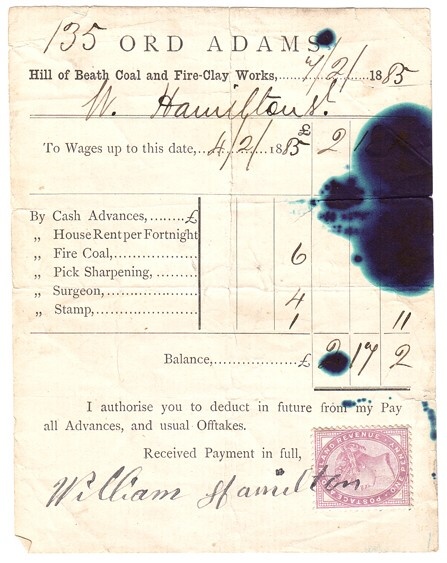
|
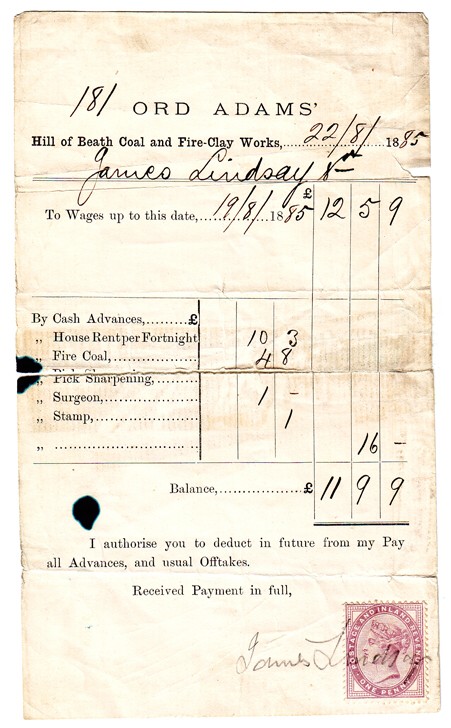 |
These items are displayed courtesy of George Hunter, Crossgates.
----------------------------------------------
"Dunfermline Press"
20 November, 1886
At Hill of Beath and Rosewell Collieries, the miners are now working on an increased rate of wages - an advance of 10 per cent., having been granted in each instance. The proprietors of the collieries in question are not members of the Fife and Clackmannan Coalowners' Association. The Association has not yet met to consider the application made last week for an advance of ten per cent.
------------------------------------
"Dunfermline Press"
12 March, 1887
On Thursday afternoon, James Beveridge, fourteen years of age, a hanger-on at Halbeath Colliery, met his death in a very sudden manner. He had been engaged on a wheel brae in one of the pits, when a quantity of material fell from the roof, crushing him so severely that he died shortly afterwards.
------------------------------------
"Dunfermline Press"
23 February, 1889
THE HILL OF BEATH ESTATE SOLD FOR £60,000
We understand that the estate of Hill of Beath, Dunfermline, with lands and minerals, collieries and fireclay works, belonging to Mr. David Adams, has been purchased by Mr. Charles Carlow, Leven, the managing partner of the Fife Coal Company. The purchase includes a new colliery just opened by Mr. Adams on the estate adjoining Hill of Beath. The sum paid for the whole subjects is £60,000.
------------------------------------
A Few Notes on the Early Days
by
CHARLES AUGUSTUS CARLOW
1889 In this year the Company purchased Hill of Beath Collieries and lands, and acquired the lease of Dalbeath. Mr. Henry Rowan came at that time to the Company, to manage this part of the undertaking. Mr. Rowan also was in charge of the sinking of Kirkford, Cowdenbeath No. 10, which at the time was an immense task, very successfully accomplished. Everybody who knew Mr. Rowan liked him, and the friendship between us was fast and firm. It is interesting to note that a grandson of Mr. Rowan, in the person of Mr. Henry King, now occupies an important position with the Company and lives at Foulford House, Cowdenbeath, which the Company originally bought as a residence for Mr. Rowan.
------------------------------------
"Dunfermline Press"
17 August, 1889
On Thursday evening, the dead body of John Ross Kay (19), a pit-bottomer, son of a Crossgates blacksmith, was found at the bottom of a pit belonging to the Hill of Beath Colliery Company. It is supposed that the poor lad had been struck on the back of the head by a descending cage.
------------------------------------
"Dunfermline Press"
16 July, 1892
A serious accident happened on Tuesday night to a young lad named David Smith, who was employed as a shunter on a locomotive at Hill of Beath Colliery. The poor fellow had, it is stated, slipped while running in front of his engine for the purpose of shifting points, with the result that a waggon passed over one of his feet. The injury was so serious that it was found necessary to amputate the injured limb.
------------------------------------
"Dunfermline Press"
22 October, 1892
John McEwan, an old man residing at Crossgates, and employed by the Fife Coal Company at Hill of Beath Colliery, met with a fatal accident at the Raith sidings on Thursday morning. McEwan had been greasing the waggon wheels when the 10 a.m. express from Dunfermline came along. He did not see the train, and crossed the line in front of it. He was knocked down by the engine and immediately killed.
------------------------------------
"Dunfermline Press"
13 May, 1893
Andrew Peebles, a young man residing in Dunfermline, met with an accident on the railway at Hill of Beath Colliery yesterday. While engaged in shunting operations, the wheels of a waggon passed over his left foot, inflicting such injuries that Drs Nairne Lee, Dunfermline; and Nasmyth, Crossgates; found it necessary to amputate the foot.
------------------------------------
"Dunfermline Press"
25 November, 1893
John Nicol, 35 years of age, a brusher, residing at Crossgates, died from the effects of injuries sustained while working in one of the Fife Coal Company's pits at Hill of Beath Colliery on Tuesday morning. A stone had fallen from the roof, and, striking Nicol on the head, injured him so severely that the poor fellow never regained consciousness, but succumbed to his injuries on Tuesday evening.
------------------------------------
"Dunfermline Press"
17 August, 1895
James Erskine (50), mining contractor, Hill of Beath, sustained a fracture of the right leg near the ankle in No. 3 Pit, Hill of Beath Colliery, on Thursday. The accident was caused through a stone which he was endeavouring to remove from the roof coming away unexpectedly and falling upon his leg.
------------------------------------
"Dunfermline Press"
28 November, 1896
On Saturday last, a man named Hugh McGill, while unloading wood from a waggon, had a few of his ribs broken, besides sustaining some other serious injuries to his body. McGill was standing on the top of the wood in the waggon, when the stanchions and part of the waggon suddenly gave way, precipitating him violently to the ground. Dr Nasmyth attended to his injuries.
------------------------------------
"Dunfermline Press"
2 January, 1897
Hugh McGill, miner, Hill of Beath, who had three of his ribs broken on the 21 November last through the stanchions of a waggon, which he was unloading, giving way and precipitating several heavy beams of wood on him, has been awarded £9 as compensation in full from the Highland Railway Company, to whom the waggons belonged.
------------------------------------
"Dunfermline Press"
16 April, 1898
John Frew, 67 years of age, employed as a waggon greaser, and residing at Hill of Beath, met with a serious accident at the Hill of Beath Colliery siding on Thursday morning. While shunting operations were being carried on, he was knocked down by a mineral train, and several waggons passed over the lower parts of his legs, almost cutting off both feet. The unfortunate man was removed to the Dunfermline Cottage Hospital, where both limbs had to be amputated between the knee and ankle.
[John Frew died on the 14th April as a result of injuries received in this accident. A Report of the Fatal Accident Inquiry was contained in the issue dated 28 May, the Inquiry being held in Dunfermline Sheriff Court.]
------------------------------------
"Dunfermline Press"
3 December, 1898
Mr Wm. Simpson, for the last nine years Chief Engineer at the Hill of Beath Works of the Fife Coal Company, Limited, has been appointed to a similar situation in the service of the Bowhill Coal Company, Fife, Limited, Cardenden.
----------------------------------------------
"Dunfermline Press"
28 January, 1899
Mr William Simpson, chief engineer at the Hill of Beath Works of the Fife Coal Company for the last eight years, has been presented with a pair of gold-mounted eye-glasses, a silver-mounted walking-stick, and a gold brooch for Mrs Simpson, on the occasion of his leaving to fill the position of chief engineer at Bowhill Collieries, Cardenden.
---------------------------------------------
"Times and Advertiser"
27 December, 1899
The Fife Coal Company, after a claim in the Sheriff Court, agreed to pay £50 in damages to Alex. Brown, Hill of Beath, in respect of an accident. He had accepted three week's compensation under the Workmen's Compensation Act, and the question at issue was his right to sue under the Employers' Liability Act.
---------------------------------------------
"Dunfermline Press"
19 October, 1901
William Wallace, twenty-nine years of age, a waggon shunter, residing at Morningside, Halbeath, was fatally injured at Hill of Beath Colliery on Monday afternoon. He was engaged in shunting operations, and while leaping off the first of a race of seven waggons he slipped and fell. The wheels passed over both his legs above the knees, crushing them severely and almost severing them. The injured man was attended to by Dr Nasmyth, Crossgates, and Dr Craig, Cowdenbeath. He expired while being conveyed to the Dunfermline Cottage Hospital.
-----------------
"Dunfermline Press"
2 November, 1901
At the Fatal Accident Inquiry in Dunfermline Sheriff Court, on Thursday, under Sheriff Gillespie, the jury returned a formal verdict on the death of William Wallace, waggon shunter, Hill of Beath, following an accident on the 14th October. Among those giving evidence at the inquiry were:- Thos. Simpson, engine driver, West Row, Hill of Beath; Thomas Hughes, waggon shunter, 17 West Row, Hill of Beath; and Richard Simpson, surface foreman.
-------------------------------------------------
"Dunfermline Press"
5 April, 1902
DEATH OF MR DAVID ADAMS, OF MUIRCAMBUS
We regret to announce the death of Mr David Adams, of Muircambus, which occurred suddenly at his residence on Sunday. ... The connection of the deceased gentleman with the West of Fife dates back forty years, when his father, Mr Ord Adams, then resident in the Hamilton district, acquired the estate of Hill of Beath. With his two sons - Mr James, and the late David - he commenced mining operations of an extensive character. These were carried on with success until within several years ago, when the concern was acquired by the Fife Coal Company. ...
-------------------------------------------------
"Dunfermline Press"
3 December, 1904
James Bowman, an engineer in the employment of the Fife Coal co., at Hill of Beath, met with an unfortunate accident on Monday morning. He had been working at some of the machines in the brickwork when he was drawn in among the machinery and had his left arm torn off by the shoulder and his head severely injured. He was attended to by Dr Nasmyth, who had him conveyed in the ambulance to the Dunfermline Cottage Hospital, where he is lying in a critical condition.
-------------------------------------------------
"Dunfermline Press"
18 February, 1905
COAL-CUTTING MACHINES
The Fife Miners' Secretary, along with his assistant, had an interview with the general manager of the Fife Coal Company for the western district, and the Hill of Beath manager. The meeting was asked on behalf of the Hill of Beath men, who were complaining of long hours being worked in connection with the coal-cutting machines, six of which are now in operation at Dalbeath and Hill of Beath Collieries. Both managers agreed to remove the cause of the complaint as far as possible.
--------------------------------------------------
"Dunfermline Press"
5 January, 1907
This issue carried news that Mr William Riddle, seven years manager of the Hill of Beath and Dalbeath Collieries, was leaving to take up an important position in Grangemouth.
--------------------------------------------------
"Dunfermline Press"
6 March, 1909
This issue carried the news of the appointment of Mr Thomas Borland, jun., Hill of Beath Colliery, as manager of the Fife Coal Company's two new pits at Lowvalleyfield. Mr Borland was previously manager at Townhill, Saline, Kincardine, and Lumphinnans.
--------------------------------------------------
"Dunfermline Press"
13 March, 1909
This issue carried the news that Mr Robert Brown, former under-manager, who had left the Hill of Beath Colliery about three years ago, was to manage the Borehole Collieries, Teralba Pit, Boolaroo, Newcastle, N.S.W., Australia.
--------------------------------------------------
"Dunfermline Press"
25 June, 1910
Mr William Paterson, who left Hill of Beath early in the year for Natal, has gained a first-class certificate in mining, having passed an examination held in May at Dundee, Natal.
--------------------------------------------------
"Dunfermline Press"
22 August, 1914
Among the successful candidates for under-managers certificates (second class) at the recent examination held in Edinburgh was Mr Charles Seaman, Hill of Beath. Mr Seaman was coached by Mr James Robertson, Woodend, Cowdenbeath, who has coached a great many pupils for these examinations, and who also has the unique record of never having had a failure.
--------------------------------------------------
"Dunfermline Press"
1 April, 1916
James Bruce McLaren, a pit drawer, was accidentally killed while proceeding home from his work late on Thursday night. His journey took him over the railway crossing at Hill of Beath sidings. He was in the act of passing between a couple of stationary waggons, when the vehicles were unexpectedly set in motion by a waggon which was being shunted. The man was knocked down. The wheels of the waggon passed over his body, and he was killed almost instantaneously. A miner, named Alexander Broadfoot, who was accompanying McLaren at the time of the accident, had a narrow escape. Deceased resided in lodgings at Broad Street, Cowdenbeath. His widow and three children live in Dundee.
--------------------------------------------------
"Dunfermline Press"
31 May, 1919
The workmen of Hill of Beath Colliery have presented handsome gifts to Mr James Erskine, who has had charge of the Fife Coal Company's colliery, brickwork, washery, and sawmills for the last five years, and who has now received a mining appointment with Townhill Coal Company. ...
--------------------------------------------------
"Cowdenbeath & Lochgelly Times & Advertiser"
4 August, 1920
Thomas Hope, sawmiller, residing at Mossgreen, Crossgates, while working at the Central Sawmills, Hill of Beath Colliery, on Tuesday, had his left hand lacerated by a circular saw. After receiving medical attention, he was taken home.
--------------------------------------------------
"Dunfermline Press"
26 February, 1921
HILL OF BEATH
MINING. - At the recent examination held in Edinburgh, Mr John Mitchell, son of Mr Peter Mitchell, J.P., was successful in obtaining his colliery manager's certificate. Mr Mitchell was coached by Mr James Robertson, Woodend Place, Cowdenbeath, who has a large number of successful pupils to his credit.
--------------------------------------------------
Workers from Hill of Beath Brickworks in the 1920s
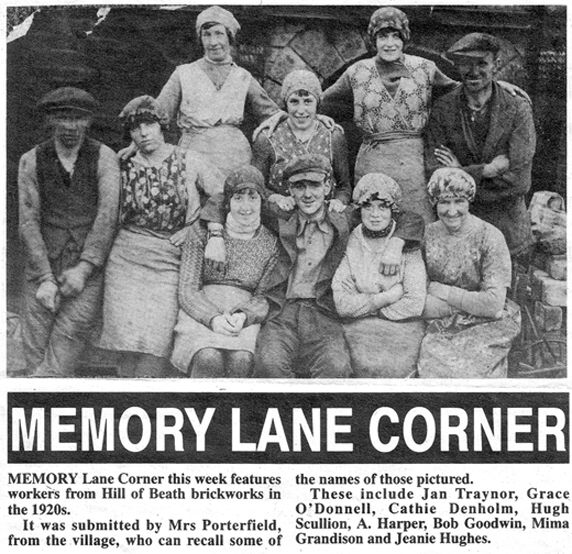
|
This item was kindly supplied by George Hunter, Crossgates.
--------------------------------------------------
"Cowdenbeath & Lochgelly Times and Advertiser"
4 June, 1924
THE PROPOSED SURFACE MINES AT HILL OF BEATH
A start has been made with the erection of the plant for transporting the coal from the proposed surface mines at Hill of Beath. All the output will be carried to the present coaling depot at Dalbeath.
--------------------------------------------------
"Cowdenbeath & Lochgelly Times and Advertiser"
9 July, 1924
RUNAWAY ENGINE
A peculiar incident took place at Hill of Beath on Friday, when an engine, belonging to the Fife Coal Company, started off from the shed at Hill of Beath on its own account. It ran right down the decline, gathering speed as it went, and its headlong career was only stopped when it reached the siding near the coal washer, fully a quarter of a mile from its starting point. Although it left the rails at this point it did not overturn.
It is very fortunate that no one was injured, as many people often walk by the line to Hill of Beath, and the engine crossed the main road where the car rails run almost perpendicular to the engine rails.
--------------------------------------------------
"Cowdenbeath & Lochgelly Times and Advertiser"
13 August, 1924
NEW COAL HOUSES
The Fife Coal Company, Ltd., are preparing for the erection of twenty three-roomed houses for their workers in connection with Hill of Beath Colliery. The Company will obtain a subsidy of £100 per house, and the total cost of erection will be about £11,000.
--------------------------------------------------
"Cowdenbeath Advertiser"
4 November, 1927
HILL OF BEATH
ACCIDENT
Arthur Steedman, pithead worker, met with a rather serious accident while attending a "creeper" on the pithead. It seems that the unfortunate lad slipped, and his leg was caught in one of the claws that convey the tubs. After being attended to in the ambulance room, Steedman was conveyed to Dunfermline Hospital, where on examination it was found that the muscles of his right leg were lacerated.
[This accident may have taken place at Dalbeath Colliery.
M. Martin & Webmasters.]
--------------------------------------------------
"Dunfermline Press"
12 January, 1929
The death took place at his residence, Craigenhall, Falkirk, on Saturday, of Mr William Riddell, who was well-known throughout Stirlingshire as a colliery owner. ... For a number of years he served as manager of Earnock Colliery in Hamilton, and afterwards held a similar post in Fife with the Fife Coal Company. ... Aged 63, he is survived by three sons and two daughters.
--------------------------------------------------
"Dunfermline Press"
8 March, 1930
COLLIERY OFFICIALS
A change of officials has taken place at the Valleyfield and Hill of Beath Collieries, the managers exchanging positions. Mr J. Fleming, Valleyfield, goes to Hill of Beath and Mr Dewar to Valleyfield.
--------------------------------------------------
