Owners: Goodall (?)
Lochgelly Iron & Coal Company
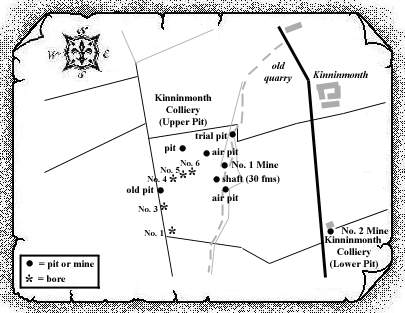
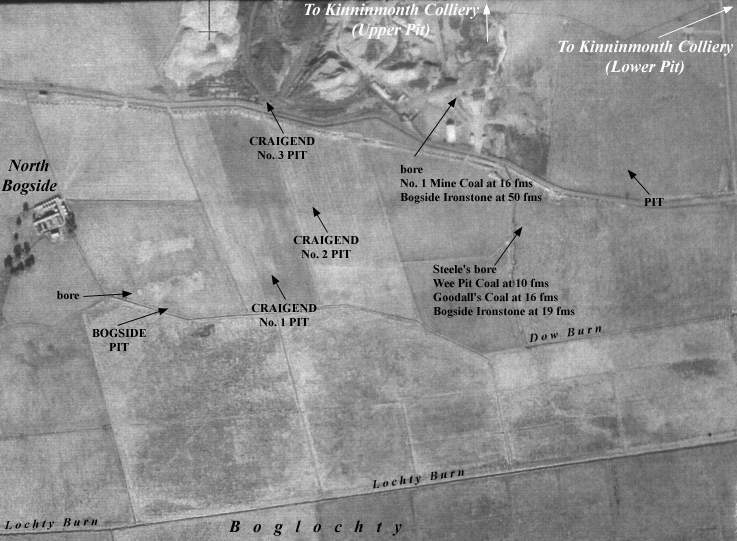
Goodall's Pit (exact location not known) is reported as being just east of the Kinninmonth Upper Pit. It was taken over by the Lochgelly Iron and Coal Company somewhere around 1850-55 and sunk to the Bogside Ironstone.
 |
 |
Extract: Statistical Account of Kinglassie Parish, Fife - 1791
"... There are many stone quarries and coal mines. Coal is the only fuel. The mine presently worked is esteemed the best burning coal in Fife. The coals are sold on the hill at 6d. the load, each load weighing 22 stone Dutch weight. ... "
Extract: Statistical Account of Kinglassie Parish, Fife - 1845
" ... Mineralogy.- Although, at no very remote period, coal-works were in operation, yet during several preceding years that occupation has been entirely suspended within this parish. There is reason to believe, however, that were coal pits less numerous in the neighbourhood, a copious supply of this fossil could be obtained. In various parts, ironstone, the constant companion of coal, is found. ... "
Information on coals worked at, or near, Goodall's Pit
(based on a report from 1934)
The structure of the coalfield to the west and north-west of Kinglassie was difficult to understand in the nineteenth century. The coals in it did not seem to fall into any recognisable association with those of any other part of Fife, though there can be no doubt that they must be classed in the true Coal Measures.
Kinglassie Colliery (19th century report)
| Coal seams worked | Thickness | Quality | Class |
| No. 1 Coal | 3 ft. | - | - |
| No. 2 Coal (Leven 6 ft.) | 5 ft. 5 in | Good | Household |
| No. 3 Coal | 4 ft. 9 in. | Good | Household |
| No. 4 Coal | 5 ft. | - | - |
| No. 5 Coal | 2 ft. 8 in. | - | - |
| No. 6 Coal (Muiredge 4 ft.) | 4 ft. 4 in. | Good | Household |
| No. 7 Coal | 4 ft. 9 in. | Good | Good Household |
| No. 8 Coal | 3 ft. 9 in. | - | - |
| No. 9 Coal
(Ironstone* & coal |
Ironstone * 1 ft. 8 in.
Coal 2 ft. 2 in. |
-
- |
Blackband
- |
| No. 10 Coal | 4 ft. | - | - |
| No. 11 Coal (Dysart Main) | 18 ft. | Soft | Inferior Steam |
| No. 12 Coal | 4 ft. | - | - |
| * this was last worked in the northern part of the coalfield around 1870 | |||
These coals were disposed in a synclinal trough which was truncated on the north by the great Ochil fault. Its western lip began about 500 yards to the west of Kinninmonth Farm, where it struck from the fault-boundary in a south-westerly direction to near North Bogside Farm, then it turned round under Boglochty and bent northwards on the west side of Whinnyhall.
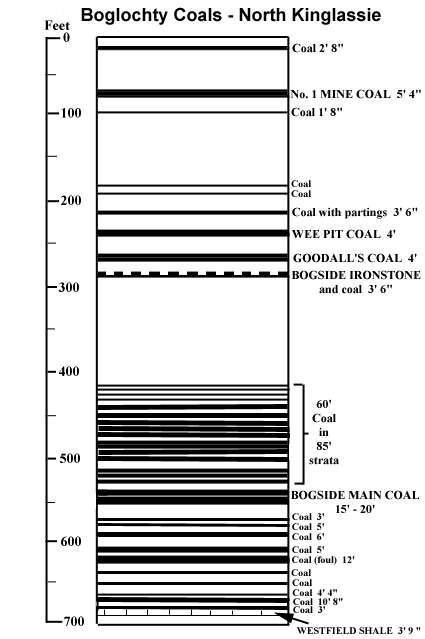 |
Bogside Ironstone: The Bogside Ironstone worked at Goodall's Pit was separated from the top of the thick coals by 21 to 25 fathoms of sandstones and fakes, with one or two thin coals and beds of fireclay. The Ironstone was known only on the west side of the basin and even there it was not constant. It outcropped in a semi-circular fashion from west of Kinninmonth Upper Pit by way of North Bogside Farm, to the north side of Boglochty.
 |
The Ironstone was wrought at Goodall's Pit for some time, the yield being carted to be smelted at Lochgelly.
Reports on the progress of the work, made towards the end of 1857, show that it was of doubtful success and that the ironstone was not of first class grade. Three pits had been sunk to the ironstone seam, two to the south and one to the north of a 7 fathom fault. In the pits to the south the ironstone was 1 ft. 6 in. thick; in the other pit it was described as 'worthless'. Operations at these pits do not seem to have been carried on much later than the end of 1857.
Goodall's Coal: This coal, so-named from this pit where it was worked, was separated from the Bogside Ironstone by about 3 fathoms of sandstones and fakes. It was a fairly uniform seam, 3 ft. to 4 ft. thick, which was proved over most of the western part of the coalfield, north of Boglochty. Near Goodall's Pit, where the seam had a soft parting, 3 ft. 8 in. of coal was recorded, while at the side of the Lochty Burn, near the corner of the Westfield march, 3 ft. 9 in. of hard coal was cut, 13 fathoms from the surface.
Separated from Goodall's Coal by 4 to 6 fathoms of fakes and fireclay, lay a thick composite seam that persisted throughout the western half of the syncline - the Wee Pit Coal. An average section at Kinninmonth Colliery had:
| Fireclay | - |
| COAL | 3 ft. 8 in. |
| Stone | 1 in. |
| COAL | 1 ft. 2 in. |
| Fireclay | - |
Note: In the late 1890s, it was recognised that there may possibly be another smaller basin of coal in the same field, somewhere to the south of Kinglassie, but the mineral capabilities of the ground could only be determined by further boring exploration. This, of course, proved to be the case and coals in the southern part of the Kinglassie coalfield were mined at Kinglassie Pit and Mine (see separate entry).
