Owners: Lochgelly Iron and Coal Co.
The Gordon Pit was one of the pits of the Little Raith Colliery to the south-east of Cowdenbeath. Sunk in the late 19th century it was worked into the 1930s.
 |
| Pit opened: ca 1893 | Pit closed: 1939 |
|---|
| Source Date of Information Supplied |
|---|
| Manager / Under-Manager / Men underground / Men above ground / Coal seams worked |
| 1904 (Lochgelly Iron & Coal Company) |
| James Hendrie, manager. |
| 1907 (Lochgelly Iron & Coal Company) |
| June: Mr Archibald Speedie, oversman, appointed to Leven Colliery. |
| 1908/09 (Lochgelly Iron & Coal Company) |
| Mr Duncan Livingstone, manager. |
| 1912 (Lochgelly Iron & Coal Company) |
| June: Mr William Gray appointed manager at Arthur (Newton) Colliery. |
| 1913 (Lochgelly Iron & Coal Company) |
| May: Mr Nisbet, colliery oversman. |
| 1921 (Lochgelly Iron & Coal Company) |
| April: Mr Frank Forsyth, manager. |
| 1928 (Lochgelly Iron & Coal Company) |
| William Gray* /
------------ / 188* / 69* * Management and number of workers probably applied to the Dora and Lochhead Pits and Lochhead Mine. |
| Household, steam and blaes. Mynheer, Duddie Davie, Fourteen Foot, Glassee, Lochgelly Splint, Parrot, Five Foot, Jewel, Dunfermline Splint, Rough, Upper Five Foot. |
| 1935 (Lochgelly Iron & Coal Company) |
| Feb: Gordon Pit to be re-opened after lengthy closure. |
| 1939 (Lochgelly Iron & Coal Company) |
| Notices issued to the men terminating their employment on 16th October. |
--------------------------------------------
Information on coals worked at, or near, Gordon Pit
Just east of Cowdenbeath town, this pit had a good seam of
Two Foot Coal measuring 3 ft. 2 in. at 99 fathoms.
In the
workings of the Gordon Pit, the Five Foot Coal, 5 ft. to 5 ft. 4
in. thick, rested on a sandy fireclay and was overlain by
blaes and sandstone.
The Jewel Coal reached a thickness of 2
ft. 6 in. to 3 ft. 3 in. and the Glassee Coal was 5 ft. 7 in.
including a 7 in. band of parrot coal. It rested on a
fireclay pavement and had a roof of blaes with two ironstone
ribs close to the coal.
The Lochgelly Splint Coal was from 8
ft. to 9 ft. thick and separated from a 5 ft. Parrot Coal by
some 2 ft. of fireclay.
Swallowdrum Coal measuring 3 ft. 6
in. to 5 ft. was also wrought from this pit and Upper Jersey
Coal was recorded here as a 2 ft. leaf and two lower leaves
with an 8 in. fireclay parting identified the Lower Jersey
Coal seam.
The Fourteen Foot seam was wrought to its outcrop
from this pit. Here too it was in leaves (3 ft. and 4 ft.
with a 5 in. parting of fireclay) and although variable in
quality, it was a good steam coal.
Rough Coal was
inconsistent in quality and thickness and where best
developed was in several leaves containing about 6 ft. 9 in.
of coal which was nowhere more than 30 fathoms from the
surface. Little Splint Coal was not present in the Gordon
workings.
--------------------------------------------
| Plan of Abandoned Seams for Little Raith | Pits or Mines designated in Plan |
|---|---|
| COAL;
Little Splint; Rough; Lochgelly Splint and Parrot; Mynheer, Upper
Five Feet; Five Feet; Dunfermline Splint; Stinking.
IRONSTONE; Lochgelly Blackband (Abandoned 13th February, 1932). |
LITTLE RAITH; Dora; Gordon; Lady; Lochhead; Lochhead, No. 2 |
--------------------------------------------
"Dunfermline Saturday Press"
16 February, 1895
On Saturday, Robert Hunter (28), miner, Cowdenbeath, while at work in the underground workings of the Gordon Pit, Little Raith Colliery, a mass of stone fell from the roof, striking him on the right shoulder and leg, breaking his leg between the knee and ankle. James Torley, who was working along with Hunter, was slightly bruised.
--------------------------------------------
"Dunfermline Saturday Press"
22 June, 1895
David Anderson (44), miner, Bridge Street, Cowdenbeath, met with an accident on Monday, while working at the Gordon Pit, Lochgelly Colliery. He had fired a shot at the coal face and returned before the smoke cleared away, with the result that a large stone fell from the roof and struck him on the head, shoulders, and back. His head was severely cut. Anderson is a brother of the man who was killed at Townhill Colliery on Tuesday.
--------------------------------------------
"Cowdenbeath & Lochgelly Times & Advertiser"
11 September, 1895
THE BURGH OF LOCHGELLY
THE LOCHGELLY IRON AND COAL COMPANY.
Despite the dull trade which has been experienced for the past three years, the work of developing the minerals of the western district of the county is being carried on a much more extensive scale than has been the case at any period of the "Kingdom."
At most of the collieries, where there is still a considerable extent of the minerals to work, new shafts are being sunk, while here and there new collieries are being established.
A period of prosperous trade is all that is required to give the Fife miners abundance of work, and to bring a very considerable influx of miners from other counties.
While Cowdenbeath has gone on in recent years increasing by leaps and bounds, the house accommodation in the neighbouring burgh of Lochgelly has been added to but slowly.
There is every prospect, however, of things taking a much faster turn in Lochgelly.
Messrs John Wilson & Coy., have made a bold start with their new works on the estate of Glencraig - two pits are being sunk - and the Bowhill Coal Coy. are pushing on with their operations at a point little more than a mile to the east of the burgh.
The Lochgelly Coal Coy. have also recently added two more pits to their numerous pits - one on the estate of Little Raith and the other on the estate of Lord Minto (a quarter-of-a-mile to the west of the famous Birnie Braes.)
The Lochgelly Company's output of coal amounts to at least 2000 tons-a-day, and when the minerals in the new shafts have been fully developed, this great total will be added to considerably.
Coal was got in the early days of the Lochgelly Coy. - some 50 years ago - to the west of the burgh, but the operations of the olden times were confined entirely to the Lochgelly splint, a seam which was not more than 30 fathoms from the surface. ...
LITTLE RAITH NEW PIT.
The principal pit at Little Raith Colliery is the Gordon Pit. The shaft is sunk to the Dunfermline Splint Seam, and the seams at present worked are the Dunfermline Splint, 5 ft. thick; the Five Foot, 5½ ft. ; and Mynheer, 4¾ ft.
The shaft is 110 fathoms in depth, and crosscut mines are driven from the splint to the Five Foot and Mynheer seams.
The pumping plant consists of a direct acting engine with 66 in. cylinder and 12 ft. stroke.
The pumps are in three lifts, namely two forcing lifts of 45 fathoms each, and one bucket lift of 19 fathoms.
The delivery pipes for the forcing lifts are 17 in. and the plungers 20 in. diameter.
The diameter of the bucket is 20 in., and of delivery pipes 21 in. The winding engines consist of one pair 24 in. cylinder by 5 ft. stroke coupled horizontal engines, with 12 ft. drums, by M. Todd & Son, Dunfermline.
There is also a crab winch capable of lifting 30 tons.
Screening arrangements - Those are by Kesson & Campbell, Hamilton, and comprise two tipplers, two shaking screens, with two picking tables 30 ft. long each.
The whole is driven by an engine, 9 in. cylinder, with 18 in. stroke.
The engine-houses, pithead, and screens are lighted by electricity, fitted up by Mavor & Coulson, Glasgow.
The dynamo is compound wound, of 100 volts, 30 amperes, and runs at 970 revolutions per minute.
It is driven by a Westinghouse automatic engine, supplied by Alley & MacLellan, Glasgow.
The steam-power for the pumping and winding engines is supplied by four Lancashire boilers, 24 ft. by 7 ft. 6 in., built by Penman & Co., Glasgow.
Mr Thomson is the general manager at Raith Colliery, and he carries on his work with marked ability. ...
THE HOUSE ACCOMMODATION.
In anticipation of the further development of the minerals the house accommodation of the burgh is being added to. A block of three-roomed houses has been erected by the Lochgelly company and a second block will be commenced at no distant date.
Water has been introduced into the houses, and the other conveniences are a great improvement on the institutions of the old mining burgh or village. - Dunfermline Journal.
--------------------------------------------
"Dunfermline Saturday Press"
12 October, 1895
Wm. Connelly (52), labourer, Cowdenbeath, met with a serious accident on Tuesday night. He was walking on a plank at the Gordon Pit, Little Raith Colliery, when he lost his balance and fell into a waggon partly filled with coals. Three of his ribs were fractured and he also sustained serious injury to one of his lungs. Dr Thomson, who was called, attended to his injuries and had him removed to the Royal Infirmary.
[Sadly, it appears that this miner would be killed at the Little Raith Colliery, several years later, in 1902 - see memorial book entry.]
--------------------------------------------

"Cowdenbeath & Lochgelly Times & Advertiser"
11 March, 1896
In Little Raith Colliery on Thursday forenoon, a miner, named Mark Brown, was pretty severely crushed by a fall of coal. It seems that Brown had been taking down the props from the coal face when the coal gave way and crushed the poor fellow in the lower parts of his body.
He was removed to his home in Arthur Street, where he was promptly attended by Dr Thomson.
------------------------
"Dunfermline Saturday Press"
21 March, 1896
COWDENBEATH - FATAL RESULT OF AN ACCIDENT
John Brown (22), miner, Arthur Street, Cowdenbeath, has died from the effects of injuries received in the Gordon Pit, Little Raith Colliery, on the 5th inst. While deceased was working at the face, a prop gave way with the result that about a ton of coal fell upon him, causing severe internal injuries.
------------------------
"Dunfermline Saturday Press"
28 March, 1896
This issue reported details of the fatal accident inquiry into the death of John Brown. It was held in Dunfermline, on Thursday, where his father, Richard Brown, described his son as being 21 years of age. John Brown had been taken home following the accident at the Gordon Pit, and was being attended by Dr Thomson. John died later at home on 15th March.
--------------------------------------------
"Dunfermline Saturday Press"
27 March, 1897
A number of the workmen employed at the Gordon Pit, met in Brunton's Hall, on Saturday evening; and presented Mr Wm. Johnstone, oversman, with a handsome gold albert and appendage, on the occasion of his leaving the district. ...
--------------------------------------------
"Cowdenbeath & Lochgelly Times"
12 May, 1897
On Wednesday night, a brusher named George Arrol met with a serious accident in the Gordon Pit, Raith Collieries, by a fall of stone from the roof. One of his legs was fractured, and he was otherwise injured about the body. After the accident, the unfortunate man was speedily conveyed to Lochgelly where he resides.
--------------------------------------------
"Dunfermline Saturday Press"
31 July, 1897
James Hunter, miner, Union Street, Cowdenbeath, met with a serious accident on Monday, in the underground workings of the Gordon Pit, Lochgelly Iron and Coal Company. He had sent away a loaded hutch from the top of the wheel-brae. The hutch came in contact with an empty one, and, while he was endeavouring to set them free, the wheel-brae rope broke. He was forced down the wheel-brae by the empty hutch, a distance of fifteen yards, with the result that his left arm was fractured between the elbow and wrist.
--------------------------------------------
"Dunfermline Press"
25 September, 1897
On Thursday morning, William Pringle, roadman, Minto Street, while working in the Gordon Pit, Little Raith Colliery, was struck by a race of runaway empty waggons. His back was severely bruised.
--------------------------------------------
"Dunfermline Press"
20 November, 1897
While Peter Bowman, 14 years of age, son of Lawrence Bowman, miner, Thistle Street, Cowdenbeath, was working in the Gordon Pit, Little Raith Colliery, on Wednesday morning, a large stone weighing about two tons fell from the roof at the spot where he was employed. The stone partly fell upon a hutch standing close by and partly upon the boy Bowman, knocking him to the ground. He was conveyed home and attended to by Dr Alexander Selkirk, assistant to Dr Craig. Although no bones were broken, the boy was seriously injured internally.
--------------------------------------------
"Dunfermline Press"
12 November, 1898
THE GORDON PIT DISPUTE
The Little Raith Colliery weighing difficulty may be said to have been got over amicably. The Company, it is stated, have shown a commendable desire to deal with the grievance in a fair spirit.
--------------------------------------------
"Dunfermline Press"
3 December, 1898
A young man named William Dryburgh had his leg broken in the Gordon Pit on Tuesday by a piece of coal falling upon him.
--------------------------------------------
"Dunfermline Press"
4 February, 1899
A pithead worker named Marian Campbell (15), residing at Cowdenbeath, narrowly escaped with her life on Saturday at the pithead of the Gordon Pit, belonging to the Lochgelly Iron and Coal Company. Her clothes were caught by a revolving shaft, and she was carried several times round the shaft. Her clothes had to be cut before she could be set free. The girl did not seem to have sustained much injury, as she was able to walk home.
--------------------------------------------
"Dunfermline Press"
27 January, 1900
The seam of coal in Fife known as the Lochgelly
splint and parrot has often proved a troublesome seam, both to the
management of the colliers and the miners. In Dysart, Wemyss,
Lochgelly, Lumphinnans, Cowdenbeath, and Raith this seam has
frequently shown that it is susceptible to take fire, and, in
consequence, large sections of it have had to be abandoned for
good.
On Monday morning it was discovered that this
seam had taken fire in the shaft of the Gordon Pit, Raith Colliery.
All the men employed there have been thrown idle, but efforts are
being made to shut off this part of the workings.
--------------------------------------------------
"Dunfermline Press"
30 March, 1901
ACCIDENT AT
COWDENBEATH
Lizzie Sharp, a pithead worker, residing at Cowdenbeath, was admitted to the Dunfermline Cottage Hospital, yesterday, suffering from a fractured skull. It seems that while she was employed at the pithead, a hutch fell from the platform, and in its descent struck her on the head. Dr Sturrock found it necessary to remove a piece of the skull.
--------------------------------------------
"Dunfermline Press"
13 September, 1902
Arthur Sheldon, waggon shunter, Foulford Street, Cowdenbeath, received a compound fracture to his right leg on Friday last, while engaged in shunting operations on the railway lye near the coal-washer at the Gordon Pit, Little Raith Colliery. While he was braking a waggon he was caught between the vehicle and the wall, and was thrown to the ground.
--------------------------------------------
"Dunfermline Press"
23 January, 1904
William Hunter, pit drawer, West Park Street, Cowdenbeath, met with an accident in the Gordon Pit, Lochgelly Colliery, on Monday forenoon. About two tons of stone and other material fell from the roof, and a portion struck him on the face and left foot. Three stitches had to be put in a wound on his face.
--------------------------------------------
"Dunfermline Press"
9 July, 1904
James Traill [sic], roadsman, 35 Arthur Street, Cowdenbeath, met with his death in the Gordon Pit, Lochgelly Iron and Coal Company, on Saturday morning. He was at work in the Mynheer section, when a bar dropped from the roof, releasing a large stone, which fell on the unfortunate man. The stone weighed about four tons and on its being removed it was found that Traill had succumbed. The body was examined by Dr Selkirk. Deceased, who was fifty-four years of age, was connected with the Baptist Church, a number of the members of which attended his funeral to Beath Cemetery on Monday.
-------------
"Dunfermline Press"
30 July, 1904
Under the Fatal Accidents Inquiry Act, an inquiry was held in the Sheriff Court, Dunfermline, on Thursday - before Sheriff Shennan and a Jury - into the circumstances attending the death of James Gullard Frail, pit roadsman, lately residing at 35 Arthur Street, Cowdenbeath. Frail was killed on 2nd July in the Gordon Pit of the Lochgelly Iron & Coal Company, Ltd., by a fall of material from the roof, consequent upon the roofing timber having given way. Those giving evidence included:- James Hendrie, colliery manager; Linus Gordon, miner, 43 Arthur Street, Cowdenbeath; James Morgan, drawer, 38 Beveridge Place, Lumphinnans; and William Blyth, pit inspector, Norwood Place, Cowdenbeath. A formal verdict was returned by the Jury.
--------------------------------------------
"Dunfermline Press"
22 April, 1905
Hugh Muirhead, pit inspector, Bridge Street, Cowdenbeath, sustained severe internal injuries at the Gordon Pit, Little Raith Colliery, on Wednesday. He was caught by a fall of coal and stone, weighing about ten cwts.
--------------------------------------------
"Dunfermline Press"
17 June, 1905
On Monday, Howard Watkins, a drawer, residing in Union Street, Cowdenbeath, had his left leg fractured by a stone falling upon it in the Gordon Pit, Little Raith Colliery.
--------------------------------------------
"Dunfermline Press"
16 September, 1905
On Friday last week Peter Flynn, pithead worker, residing at Raith Colliery houses, had his face fearfully lacerated by being caught with a rising cage at a steam hoist at the Gordon Pit. After being attended to by Dr Selkirk, he was conveyed to the West Fife Hospital.
--------------------------------------------
"Dunfermline Press"
30 December, 1905
While engaged at the Gordon Pit, Cowdenbeath Colliery, on Tuesday forenoon, Michael McGovern, waggon shunter, 40 Raith Colliery Houses, was crushed between a running loaded waggon and a brick wall. His right collar bone was fractured, and his left arm was bruised. Dr Selkirk attended the injured man.
--------------------------------------------
"Dunfermline Press"
22 June, 1907
This edition carried news of a fire at the Gordon Pit, Little Raith Colliery, with damage estimated at £900 - only two-thirds of which is covered by insurance. Nearly 200 men employed at the pit were out of work, with the Company hoping to provide labour for some of the miners in their other pits.
--------------------------------------------
"Dunfermline Press"
22 June, 1907
Mr Arch. Speedie, pit oversman, Leven, received on Saturday the present of a handsome roll-top writing desk, along with a chest of drawers for his wife, from the workers of the Gordon Pit, Little Raith Colliery - a pit which he till recently supervised. ...
--------------------------------------------
"Dunfermline Press"
30 November, 1907
On Tuesday Thomas McLeod, Bridge Street, lost the sight of one of his eyes. He had been working at the face in the Gordon Pit when a piece of coal in falling struck the pick he was using, knocking the point of it forward into his eye.
--------------------------------------------
"Dunfermline Press"
18 January, 1908
On Tuesday, Patrick O'Brien, High Street, was severely crushed between two waggons at the Gordon Pit washer. The injuries were mostly on the chest.
--------------------------------------------
"The Scotsman"
8 February, 1908
FIFE MINING TEST CASE. - In the Dunfermline Sheriff Court yesterday, Sheriff
Shennan gave judgement in a test case which will affect the whole of the collieries in Fife.
From time to time complaints have been made as to miners being detained in the pits
after their work was finished, and compensation has been obtained ex gratia, but
this is the first legal decision that has been given.
In October last it was found that blackdamp existed in a part of the workings of the
Lochgelly Iron and Coal Company's Gordon Pit, and as drawers and others
withdrew, the work of the men at the face was stopped from want of hutches. They
were, however, prevented from ascending the shaft until the end of the shift. On the
question being taken up by the Fife and Kinross Miners' Association, an action
was raised in the name of James Henderson, Cowdenbeath, for whom 10s. damages
was claimed.
The Sheriff grants decree for the sum sued for, with expenses. The evidence, he says, is
overwhelming that black damp was present in such quantity as to render it dangerous
for men working there to continue at work, and the men ought to have been at once
taken up the shaft.
--------------------------------------------
"Dunfermline Press"
18 April, 1908
Peter McTernan, an engineman, met with his death in a strange manner on Monday at the Gordon Pit coal-washer, Little Raith Colliery. His fellow-workers had missed him for a time, and while looking about they were surprised to see a leg hanging through a grating of one of the hoppers. The man was quickly lifted out in an apparently lifeless condition from the coal dross, and Dr Craig and Mr Livingstone, the colliery manager, did everything in their power to restore animation, but their efforts proved unavailing. McTernan was married, and lived in Landale Terrace. He leaves a widow and two of a family.
--------------------------------------------
"Dunfermline Press"
2 May, 1908
Robert McQuire, Thistle Street, employed in the Gordon Pit, fell off the cage on Monday as it was being lifted from the bottom and sustained a bad cut on the head by falling on the plates.
--------------------------------------------
"Dunfermline Press"
9 May, 1908
Peter McPherson, labourer, lodging at 34 Broad Street, was crushed at the Gordon Pit washer, Little Raith Colliery, on Thursday. So badly bruised was his body, that it was thought advisable to have him conveyed to the Dunfermline and West Fife Hospital for treatment.
--------------------------------------------
"Dunfermline Press"
6 June, 1908
Under the Fatal Accidents Inquiry Act, an inquiry was held in the Sheriff Court, Dunfermline, on Thursday - before Sheriff Shennan and a Jury - into the circumstances attending the death of Peter McTernan, coal washer attendant, lately residing at 41 Landale Terrace, Auchtertool, who was suffocated at the Lochgelly Iron & Coal Company's Gordon Pit in a hopper filled with small coal. Those giving evidence at the inquiry included:- Dr Selkirk, Cowdenbeath; John Anderson, labourer, Morayfield; Duncan Livingston, colliery manager; Roderick McMillan, waggon shunter, 61 Arthur Street, Cowdenbeath; and David Anderson, surface foreman, Gordon Cottages, Auchtertool. The jury returned a verdict in accordance with the evidence, the Sheriff remarking that the accident was an absolute mystery.
--------------------------------------------
"Dunfermline Press"
27 June, 1908
On Friday afternoon last, Francis Howery, 9 Landale Terrace, had his collar bone broken in the Glassee Seam of the Gordon Pit, Raith Colliery, by a fall from the roof.
--------------------------------------------
"Dunfermline Press"
21 November, 1908
Robert Thomson (16), residing at 31 Chapel Street, Cowdenbeath, was engaged in the Dry Dook splint seam, Gordon Pit, Little Raith Colliery, yesterday, drawing on a level, when the hutch struck a prop and a large quantity of material fell. While he was clearing it away a stone struck him, breaking his right shoulder bone. He was attended to by Dr Selkirk.
--------------------------------------------
"Dunfermline Press"
21 November, 1908
A sad accident occurred at the Gordon Pit, Little Raith Colliery, Cowdenbeath, on Saturday night. A fireman's assistant, named Hugh Morran, lodging with a married sister at 51 Thistle Street, had gone into the stokehold attached to the boilers to get the coal dross down to the shovelling benches. The engineman and fireman being alarmed at Morran's long absence went in search of him. They noticed that a large quantity of the coal had slipped forward, and suspecting that the man had been buried underneath they set to work, and in a short time they found him in a doubled-up position. On getting the body out they tried all they could to restore animation, but their efforts were unavailing. Deceased, who was a widower, of about forty years of age, was the chief support of his mother, who lives in Airdrie.
----------------------------
"Dunfermline Press"
5 December, 1908
Under the Fatal Accidents Inquiry Act, an inquiry was held in the Sheriff Court, Dunfermline, on Thursday - before Sheriff Shennan and a Jury - into the circumstances attending the death of Hugh Moran, labourer, Cowdenbeath, who was suffocated by duff at the furnaces of the Lochgelly Iron & Coal Company's Gordon Pit. Those giving evidence at the inquiry included:- Dr Selkirk, Cowdenbeath; David Guthrie, furnaceman; Daniel Robertson, engineman; James McKerral, surface foreman. A formal verdict was returned.
--------------------------------------------
"Dunfermline Press"
27 February, 1909
On Thursday, Robert Smith, 18, miner, son of Nicol Smith, Hall Street, Cowdenbeath, injured himself while lifting a hutch on the rails in the Gordon Pit. The lad's condition was not considered dangerous at first, but yesterday he grew worse as the result of an internal injury, and died in the forenoon.
--------------------------
"Dunfermline Press"
27 March, 1909
Under the Fatal Accidents Inquiry Act, an inquiry was held in the Sheriff Court, Dunfermline, on Thursday - before Sheriff Shennan and a Jury - into the circumstances attending the death of Robert Peden Smith, a haulage clipper, lately residing at 40 Hall Street, Cowdenbeath, who took suddenly ill after replacing a derailed loaded hutch in the Lochgelly Iron and Coal Company's Gordon Pit. Those giving evidence at the inquiry included:- Dr Alexander Selkirk, Cowdenbeath; Duncan Livingston, colliery manager; Richard Nicol, a haulage clipper; and Andrew Sneddon, contractor, Beveridge Buildings, Cowdenbeath. The jury adopted the Sheriff's suggestion as to the verdict, to which was added that "death was due to perforation of the stomach by an ulcer, the perforation being probably accelerated by the exertion required to replace the hutch."
--------------------------------------------
"Dunfermline Press"
20 March, 1909
Thomas Hedley, nineteen years of age, residing at 107 Broad Street, Cowdenbeath, was accidentally killed yesterday by falling down the shaft of the Gordon Pit, Little Raith Colliery. Hedley had been acting as bottomer and hanger-on for the day in the 14 feet seam, which is 44 fathoms from the pit bottom. He was on the point of finishing his work, and was waiting the arrival of the cage with the gate standing open, when a hutch ran against him and knocked him down the shaft. Death was instantaneous.
--------------------
"Dunfermline Press"
24 April, 1909
Under the Fatal Accidents Inquiry Act, an inquiry was held in the Sheriff Court, Dunfermline, on Tuesday - before Sheriff Shennan and a Jury - into the circumstances attending the death of a miner named Thomas Headley, jun., lately residing at 107 Broad Street, Cowdenbeath, who was killed in the Lochgelly Iron and Coal Company's Gordon Pit on 19 March, by falling from the Duddy Davie mid-working to the bottom of the shaft. Those giving evidence included:- Duncan Livingstone, colliery manager; David Mitchell, winding engineman; and Thomas Bissett, pit bottomer. The Sheriff, addressing the jury, said that the accident took place through the gate being opened before the cage stopped, contrary to the rules of the pit. It seemed a very deplorable thing that the rules should be ignored in this way. There was in operation an excellent system of rules, but if they were not observed, they were of no use. A verdict in accordance with the Sheriff's suggestion was returned.
--------------------------------------------
"Dunfermline Press"
9 July, 1910
John Bissett (31), residing at West Broad Street, Cowdenbeath, died on Sunday evening in the Dunfermline and West Fife Hospital, from injuries received in the Gordon Pit, Little Raith Colliery, on Tuesday last week. Deceased leaves a widow and three of a family.
-----------------------
"Dunfermline Press"
30 July, 1910
Under the Fatal Accidents Inquiry Act, an inquiry was held in the Sheriff Court, Dunfermline, on Thursday - before Sheriff Shennan and a Jury - into the circumstances attending the death of a miner named John Bissett, Broad Street, Cowdenbeath, who was injured on 28 June in the Gordon Pit, Lochgelly, by a fall of material from the roof and died on 3 July in the Dunfermline and West Fife Hospital. Those giving evidence included:- Thos. Morrison, pit fireman; and James Thomson, miner, Thistle Street, Cowdenbeath. The jury returned a formal verdict no blame being attached to any one.
--------------------------------------------
"Dunfermline Press"
15 October, 1910
Francis Nowery (35), residing at 9 Landale Terrace, Cowdenbeath, was seriously injured on Thursday by an explosion in his working place in the Gordon Pit, Little Raith Colliery, belonging to the Lochgelly Iron and Coal Co. He had charged a shot, which hung fire, and after waiting a considerable time, he returned, when the explosive ignited. His right arm was fractured and his face badly injured.
--------------------------------------------
"Dunfermline Press"
1 July, 1911
This week several pit accidents have occurred. ... Albert Adams, residing at Elgin Road, had his right leg fractured and his head badly cut while following his employment in the Gordon Pit, Little Raith Colliery. ...
--------------------------------------------
"Dunfermline Press"
29 June, 1912
Mr Wm. Gray, of the Gordon Pit, who has been promoted to managership of the Newton Colliery, Lochgelly, was met by a number of his fellow-workers in the Arcade Temperance Hotel on Saturday evening and presented with gifts.
--------------------------------------------
"Cowdenbeath Mail & West Fife Record"
Saturday, 7 September, 1912
On Friday, John Stevens (34), pithead worker, met with a serious accident while working at the Lochgelly Iron and Coal Company's Gordon Pit. He was caught between a waggon and the wall of one of the pit buildings and was so severely crushed as to necessitate his removal to the West of Fife Hospital.
--------------------------------------------
"The Scotsman"
11 April, 1913
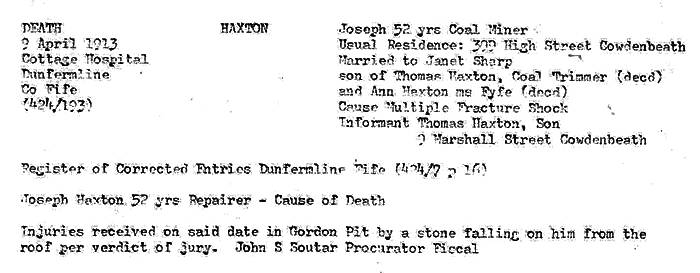
FATAL PIT ACCIDENT. - Joseph Haxton (52), a pit repairer, who resided in Cowdenbeath, died in the Wes Fife Hospital yesterday afternoon from injuries received earlier in the day by a large stone falling upon him in the Dunfermline Splint Seam of the Gordon Pit, Little Raith Colliery, belonging to the Lochgelly Iron and Coal Company. Haxton leaves a widow and grown-up family.
-----------------------------
"Dunfermline Press"
12 April, 1913
Joseph Haxton (52), pit repairer, Kenny's Buildings, Cowdenbeath, died in the Dunfermline and West Fife Hospital on Thursday afternoon from injuries received earlier in the day in the Gordon Pit, Raith Colliery. While engaged widening a roadway in the Dunfermline Splint seam, he had occasion to take away a stone from the side. This released a larger stone, weighing 12 cwts., which falling upon him inflicted severe internal injuries. Deceased leaves a widow and grown-up family, who reside at Arthur's Place, Cowdenbeath.
-----------------------------
A family connection
Joseph Haxton's daughter, Janet Cowan Haxton, went on to marry John McWilliam, a great uncle of webmaster Chris Sparling. They settled in Canada and when Chris eventually made contact with the McWilliam family, he was sent a copy of the information by Ivan McWilliam, a son of John and Janet McWilliam.
-----------------------------
"Dunfermline Press"
3 May, 1913
Under the Fatal Accidents Inquiry Act, an inquiry was held in the Sheriff Court, Dunfermline, on Thursday - before Sheriff Umpherston and a Jury - into the circumstances attending the death of Joseph Haxton, repairer, lately residing at 399 High Street, Cowdenbeath, who died in the Dunfermline and West Fife Hospital on 9 April as a result of injuries received that day in the Lochgelly Iron and Coal Company's Gordon Pit, by a stone falling upon him. Those giving evidence included:- William Davidson, colliery fireman; and Mr Nisbet, colliery oversman. A formal verdict was returned.
--------------------------------------------
"Dunfermline Press"
19 May, 1917
... James Bonnar, miner, 63 Thistle Street, Cowdenbeath, met with his death in the Duddy Davie seam of the Gordon Pit, Raith Colliery, on Monday afternoon. He was struck by a fall of coal, chiefly about the head, and died soon afterwards from the injuries. Deceased was forty-four years of age, and leaves a widow and ten children. ...
--------------------------------------------
"Dunfermline Press"
26 May, 1917
James Guthrie, brusher, 291 Broad Street, Cowdenbeath, while at work in the Gordon Pit, Raith Colliery, on Wednesday night, was buried by a fall of stone from the roof. The fall was so heavy that it took a number of his fellow-workers a considerable time to get him out. He was conveyed home and attended by Dr Primmer, who found him to be suffering from severe bruises on the left leg and arm and the right shoulder.
--------------------------------------------
"Dunfermline Press"
26 May, 1917
Robert Turnbull, Church Street, was injured about the body while working in the shaft of the Gordon Pit, Raith Colliery, on Saturday. He is progressing favourably.
--------------------------------------------
"Dunfermline Press"
11 January, 1919
PITHEAD FIRE AT COWDENBEATH
Between four and five o'clock on Monday afternoon, an outbreak of fire occurred in premises used as a store at the Lochgelly Iron and Coal Company's Gordon Pit, Cowdenbeath. Shortly after some barrels of oil had been put into the store, the colliery joiner observed flames issuing from the building. With assistance water was poured on the burning building, and, in order to prevent the fire spreading to adjoining buildings, the precaution was taken of cutting through the roof of the store. The store, together with a quantity of oil and colliery furnishings, was destroyed. The damage is estimated at about £300.
--------------------------------------------
"Dunfermline Press"
14 June, 1919
PIT SHAFT ACCIDENT.
While coal was being drawn at the Gordon Pit, Raith Colliery, on Monday, one of the cages caught in the shaft with the result that it tilted and the two hutches on it fell to the bottom. A link of the chain connecting the cage with the winding rope snapped. The miners had to get to the surface by way of the Dora Pit, and it was Tuesday night before repairs had been completed, work being resumed on Wednesday.
--------------------------------------------
"Dunfermline Press"
20 September, 1919
William Milne, labourer, Burnside House, Cowdenbeath, had his left leg severed below the knee by being run over by waggons at the Gordon Pit washer on Thursday.
------------------------
"Cowdenbeath & Lochgelly Times & Advertiser"
8 October, 1919
DIED FROM INJURIES
Wm. Milne, labourer, who lived at Burnside House, has died in the Dunfermline and West Fife Hospital, from injuries sustained at the Gordon Pit, Raith Colliery, through being run over by waggons.
------------------------
"Dunfermline Press"
18 October, 1919
... Formal verdicts were returned in the case of William Wheeler Milne, labourer, Burnside Lodging-house, Cowdenbeath, who was killed during shunting operations at the Gordon Pit, Lochgelly, on 18th September; ...
--------------------------------------------
"Dunfermline Press"
21 February, 1920
George K. Park, who was employed as head washerman at the Gordon Pit, Raith Colliery, was fatally injured at the pithead on Wednesday by being run over by a number of waggons. He was conveyed to the Dunfermline and West Fife Hospital, where he died the same evening. Deceased resided at Broad Street, Cowdenbeath. He leaves a widow and two children.
------------------------
"Dunfermline Press"
6 March, 1920
Under the Fatal Accidents Inquiry Act, an inquiry was held in the Sheriff Court, Dunfermline, on Thursday - before Sheriff Umpherston and a Jury - into the circumstances attending the death of George Park, coal washer attendant, residing at 348 Broad Street, Cowdenbeath, who died in the Dunfermline and West Fife Hospital on 19th February from injuries received that day on the railway near the coal washer at the Gordon Pit, Lochgelly Iron and Coal Company Ltd., by being knocked down and run over by an engine and waggons. ...
--------------------------------------------
"West Fife Echo"
25 December, 1920
PIT FATALITIES
... At the Gordon Pit, Cowdenbeath, Thos. Forbes (39), pit shunter, met an untimely death. Forbes, who resided at 159 Bridge Street, Cowdenbeath, is supposed to have been sitting on an empty waggon when it was run into accidentally by several loaded waggons. Forbes was thrown to the ground and an overturned waggon fell upon him, causing instantaneous death.
---------------------
"Dunfermline Press"
1 January, 1921
... On the same day [Friday last week] Thomas Forbes, 39, shunter, 159 Broad Street, met with his death at the Gordon Pit, Raith Colliery, through being crushed beneath a waggon which had overturned on running against another.
---------------------
"Dunfermline Press"
15 January, 1921
Under the Fatal Accidents Inquiry Act, an inquiry was held in the Sheriff Court, Dunfermline, on Thursday - before Sheriff Umpherston and a Jury - into the circumstances attending the death of shunter Thomas Blyth Forbes, lately residing at 95 Broad Street, Cowdenbeath, who, on 24th December, died at the Gordon pit sidings, Lochgelly Iron and Coal Company Limited, by being run over by a waggon during shunting operations. Those giving evidence included John Gray, the colliery manager. The jury adopted a suggestion by the Sheriff, which was added as a rider to their formal verdict.
--------------------------------------------
"Dunfermline Press"
26 February, 1921
Alex. Walls, son of David Walls, 44 Landale Terrace, Cowdenbeath, was instantaneously killed at the Gordon Pit, Raith Colliery, on Saturday. He had been pushing a waggon, when another ran forward and crushed him between the buffers. Deceased was deaf and dumb.
----------------------
"Dunfermline Press"
2 April, 1921
Under the Fatal Accidents Inquiry Act, an inquiry was held in the Sheriff
Court, Dunfermline, on Thursday - before Sheriff Umpherston and a Jury - into the
circumstances attending the death of Alexander Walls, a deaf mute employed as
a pithead labourer, and lately residing at 44 Landale Terrace, Auchtertool, who
was killed by being caught between the buffers of two waggons, one of which
he was pushing at the sidings at the Gordon Pit, Lochgelly Iron and Coal Company,
Ltd. Those giving evidence included:- Frank Forsyth, manager; David Arthur,
pitheadman, Randolph Street, Cowdenbeath; and John Robertson, pithead
labourer, 46 Bowling Green Street, Cowdenbeath.
The jury returned a verdict in accordance with the Sheriff's suggestion that they
should find that the accident was due to deceased pushing the buffer of the
waggon, contrary to the regulations under the Coal Mines Act.
--------------------------------------------
"Cowdenbeath & Lochgelly Times"
8 March, 1922
John Cairns, apprentice engineer, Broad Street, Cowdenbeath, by falling into the hopper at the Gordon Pit Washer on Friday, sustained a fractured arm. He was removed to the Dunfermline and West Fife Hospital.
--------------------------------------------
"Cowdenbeath & Lochgelly Times"
4 February, 1925
A water supply has been granted for the Gordon and Dora Pits by the Kirkcaldy District Committee. It will be paid by meter. The Company are to pay for the extra expenses involved in laying the pipes nearer to the pits than the engineers considered necessary, and to provide for a three-inch pipe if the Company desired a larger pipe to be laid.
--------------------------------------------
"Cowdenbeath & Lochgelly Times"
6 May, 1925
Workers at the Gordon Pit, Raith Colliery, Cowdenbeath, belonging to the Lochgelly Iron and Coal Co., have received their notices, and as the result 200 workers will be thrown idle.
--------------------------------------------
"Cowdenbeath Advertiser"
11 May, 1934
Richard Ketchen, boiler fireman, 50 years of age, who resided with his married daughter, Mrs Thomson, Gray Park, Cowdenbeath, died in a tragic manner on Wednesday. He was employed at the Gordon Colliery and was working on Tuesday night. While resting in the house on Wednesday forenoon he collapsed and expired before the arrival of a doctor.
--------------------------------------------
"Cowdenbeath Advertiser"
15 February, 1935
LOCHGELLY COAL COMPANY TO EMPLOY OTHER 200 MEN
The Gordon Colliery, Cowdenbeath, belonging to the Lochgelly Iron and Coal Company, which has been closed since 1928, is to be re-opened in the course of the next few months.
It is expected that this step will give employment to fully 200 men. Official intimation of the decision to re-open the pit was given at the weekend, and since then the Raith offices of the Company have been besieged with men offering their services.
Boring operations have been taking place for some time, and the success which attended these operations have influenced the Company in making their decision.
Meanwhile a staff of men are engaged in carrying through the preliminary repair work rendered necessary through the pit standing so long idle, and a new winding cage is also being installed.
--------------------------------------------
"Dunfermline Press"
16 February, 1935
MINE TO BE RE-OPENED AT KELTY.
Following the intimation last week of the re-opening of the Gordon Colliery at Cowdenbeath, belonging to the Fife Coal Company, Limited, comes the announcement that the Company have decided to re-open the No. 3 Surface Mine at Kelty. Preparation work for the re-opening of the mine, which was closed in 1920, is at present going ahead, and it is confidently expected that a large number of men will find employment in a few months time.
--------------------------------------------
"Dunfermline Press"
24 August, 1935
RE-OPENING OF GORDON PIT.
Work for a considerable number of local miners will probably be found within the next two months in the Gordon Colliery, which was recently re-opened by the Lochgelly Iron and Coal Company. The work of driving mines has now been completed, and the seams of coal are being opened up this week.
--------------------------------------------
"Dunfermline Press"
7 October, 1939
LOCHGELLY PIT TO BE CLOSED.
The Lochgelly Iron and Coal Company announce that their Gordon Colliery, Cowdenbeath, is to be closed. Notices have been received by the men terminating their employment on 16th October, but the Company states it is hoped that the men displaced, numbering approximately 160, will be absorbed in the other pits belonging to the Company. The Gordon Colliery was only re-opened about two years ago, after having been closed for some time.
--------------------------------------------
"Cowdenbeath Advertiser"
28 February, 1941
COWDENBEATH MAN INJURED
GORDON PIT ACCIDENT
Henry Erskine, Union Street, Cowdenbeath, employed at the Gordon Pit washer, Cowdenbeath, had his right hand badly injured on Saturday, when it was caught in the machinery.
For many years, a well-known junior football player, he played for Denbeath Star at outside-left, and had trials for Cowdenbeath, St Bernard's, and Dunfermline.
--------------------------------------------
"Lochgelly Times"
5 June, 1952
From the early hours of Wednesday morning well
into the day, units of Cowdenbeath, Dunfermline and Kirkcaldy Fire
Brigades fought a fire which broke out at the disused Gordon Pit
between Lochgelly and Cowdenbeath. The situation of the pit is such
that four major pumps and 4000 feet of hose had to be employed to
link up with the nearest water supply at Thistle Street and High
Street, Cowdenbeath. The fire originated on the pithead and spread
to the shaft when one of the cages broke away from its moorings and
crashed down the shaft carrying burning material with
it.
The Gordon Pit, which originally belonged to the
Lochgelly Iron & Coal Company, stopped production of coal many
years ago but the shaft was maintained as an emergency escape route
for the adjoining Dora Colliery.
--------------------------------------------
