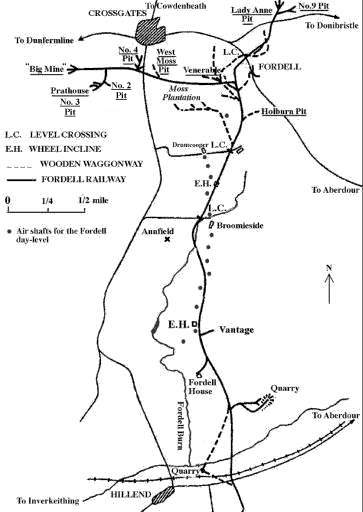
A very large number of coal workings are known to have operated from the sixteenth century in, and around, the village of Fordel (later Fordell), east of Crossgates. A number of small pits were later worked close to Crossgates village and even towards the Cuttlehill estates to the north, north-east and north-west of the site of the future village of Fordell, but the original small bell-pits and mines of this ancient colliery were sunk to the south of here, in the lands around Fordel Castle and Fordel House, in the parish of Dalgety.
 |
|
 |
 |
 |
|
Please note that, apart from maps and aerial views,
this entry presently contains only the information
gathered from early Parish records and the Statistical Accounts of
Dalgety Parish, Fife.
|
|---|
----------------------------------------
| Please refer to the Fordell Pits and Mines
entry
for more information on this famous colliery. |
|---|
----------------------------------------
Old Parish records are a great source of information in spite of the many variations in spellings of names, etc., laid down in these documents. The names of some early miners, and the dates when they were working the early, small coalworks, are revealed in records of births, deaths, and marriages, the first of these records often accompanied by colourful descriptions of what they had been up to, and with whom!
9 Nov 1634, George Penman, collier in Fordall heugh, and Marjory Wilson, his coalbearer, had Margaret (in adultery); witnesses, Andrew Gaw, Duncan Tailyeour, David Stevenson. Presented by William Penman, brother of said George.
----------------------------------------
Statistical Accounts of Fife: Parish of Dalgety - 1791
"... There is no particular branch of trade in the parish, except what arises from the coal and salt works, carried on to a considerable extent on the property of Sir John Henderson. The various branches of these works afford maintenance to several hundred people of one description or other. The greatest part of the coal and salt is exported from St Davids, a spacious harbour situated at the Western extremity of the parish in Inverkeithing bay, where vessels of any burthen, not exceeding 500 or 600 tons, can load in safety. The distance from the pits to the shore is near 4 miles, along which the coals are carried in waggons that contain 48 cwt. It is well ascertained, that this coal has been known and wrought for upwards of 200 years, and a considerable field of it still remains. The surrounding district, lying in the parishes of Dunfermline and Aberdour, contains also many seams of coal of an excellent quality, sufficient it is thought, to supply the usual demand for centuries to come."
----------------------------------------
Statistical Accounts of Fife: Parish of Dalgety - 1836
"... There is a picturesque situated waterfall on the
adjoining grounds of Fordel. The stream which forms it winds
its course for a considerable way through a darkly wooded
glen, where it meets with the outlet of water from the great
drainage level of the Fordel colliery, and then rushes over a
broken rocky precipice of about fifty feet in height. ...
Limestone, which constitutes the basis of the coal formation,
extends regularly throughout the parish, under the coal. It
is found about 50 fathoms underneath the lower bed of coal,
and from the basin shape of the minerals, the lime seldom or
ever makes its appearance at the surface; but it is to be
found in considerable quantities, both to the east and west,
in the adjoining parishes of Aberdour and Inverkeithing.
Fordel coal-works. - Coal, the mineral of the
greatest importance, abounds in considerable quantities in
this parish. The extensive coal-works on the estate of
Fordel, the property of Admiral Sir P.C.H. Durham, G.C.B.
form the principal feature of this parish, and the great
source of its trade and revenue. The coal on the lands of
Fordel has been wrought for nearly 240 years. This has been a
valuable property; but its value is now much diminished, in
consequence of the great extent of coal which has been
wrought out of it. As Sir Philip Durham, however, has in
lease the adjoining coal-fields on the estate of Cuttlehill,
it is certain that coal will be conveyed through the parish
for upwards of 150 years to come. And even when it is
exhausted, the extensive minerals to the north, in the
neighbouring parish, will, in all probability, be brought
through this parish to the shipping port of St David's.
From a recent inspection of the strata throughout this
parish, and, particularly, from a minute examination of that
part of it connected with the mining operations, it is found
that the coal-field is much intersected with dikes and
dislocations, which very much elevate and depress the strata
forming this extensive coal country.
From the harbour of St David's, the southern boundary of
the parish, as far north as the drainage level of the Fordel
colliery operations, - a distance of about two miles, - the
strata appear somewhat regular, dipping to the north-east.
They cannot, however, be correctly ascertained in many
places, as they have a considerable cover of earth upon them.
From the latter point, northwards, they can be most
accurately traced.
The outlet of water from the drainage level of the Fordel
colliery is 120 feet above the level of the sea, and it is
continued northwards nearly three miles through the solid
rock. During its course ten dikes are met with of various
magnitudes; in some places they do not alter the strata many
feet; in others, they are found 100 feet thick, and elevating
the strata sixty fathoms. Their direction often varies as
well as their angle of inclination from nearly a horizontal
to a vertical position. The materials of which these dikes
are composed are generally sandstone, more or less indurated
with quartz and limestone.
From the point at which coal is first found, the surface
rises gently northwards, till it reaches the height of 436
feet above the level of the sea; this forms the northern
boundary, and the highest part of the parish.
It is found as we proceed northwards, that the strata
assumes a greater dip in some places, varying from 1 in 8 to
1 in 3. In very few instances, however, do these dikes
deteriorate the coal in quality, but the reverse; for as the
miner approaches these dikes, the coal becomes harder, and
more difficult to work, and in many cases an extra expense is
paid for labour.
The coal mines in this parish were not wrought to any
considerable extent until within the last thirty years, when
the consumption of coal has been very much increased,
particularly for steam navigation. And as this coal-field
produces the finest coal for that purpose, the working of it
has been much more extensively carried on.
The depth of the mining operations at the northern boundary
of the parish is 300 feet from the surface, and that of the
main drainage level is only about 250 feet; consequently
machinery is required to raise the water from the mines, a
distance of about 50 feet, instead of which, had the level
been carried duly horizontal, the whole of the coal now
drained by machinery would have been level free. And thus had
due regard been paid at first to the drainage level, the
expensive machinery now erected on the works would, in great
measure, have been unnecessary.
The coal-field of this parish extends two miles north and
south, and one mile east and west, and forms the basin or
trough of the coal-fields in the neighbourhood. For, upon
drawing a line in a north-eastern direction from the point at
which coal is first found to the extremity of the parish, it
appears that the coal and its accompanying strata uniformly
rise to the east as well as to the west of that line. To the
east it rises rapidly, and throws out the crop of the upper
coals before it goes out of the parish; the under ones are
found on the verge of the Aberdour parish. At every dike or
dislocation of the strata northwards, the coals are thrown
further east, until the same coals in quality, though not the
same in number, or in thickness, are found to extend into
Lochgelly parish, and so on eastwards, throughout the whole
of that coal country.
To the westward of this line, the same takes place, but not
so rapidly, and this forms the most interesting and valuable
coal-field in the western district of Fife. The same dikes
and coals can be traced with great regularity from the east
of this, to the west of the parish of Dunfermline, with
little or no variation in the line of bearing, although they
are more or less depressed by the intersection of diagonal
dikes changing the direction of the strata.
In order more fully to shew the metals passed through in the
progress of sinking for coal, we shall here annex a correct
section of the strata as taken from actual measurement.
Section of a pit at Fordel Colliery.
| Fathoms | Feet | Inches | |
| Surface sand and clay | 4 | 2 | 6 |
| White freestone | 1 | 2 | 0 |
| Dark yellow freestone | 0 | 2 | 3½ |
| Soft blae and bands | 1 | 4 | 0 |
| Blue blae | 1 | 1 | 2 |
| Dark grey freestone | 2 | 1 | 8½ |
| Dark grey freestone with bands | 0 | 4 | 3 |
| Yellow freestone | 1 | 3 | 5 |
| Dark-grey freestone | 2 | 1 | 8 |
| Soft light freestone | 2 | 0 | 9 |
| Blae | 0 | 2 | 10 |
| Blawlowan coal | 1 | 0 | 3 |
| Grey freestone bands | 0 | 1 | 10 |
| Light yellow freestone | 1 | 2 | 6½ |
| Dark-yellow freestone | 0 | 2 | 8 |
| Dark-yellow freeestone mixed with blae | 0 | 3 | 3¼ |
| Lighter mixed with blae | 0 | 1 | 10½ |
| Very hard freestone | 0 | 5 | 4½ |
| Blae and bands | 0 | 1 | 8 |
| Mynheer coal | 0 | 4 | 0 |
| Hard grey freestone | 0 | 2 | 4 |
| Light grey freestone | 1 | 5 | 7½ |
| Blae | 1 | 2 | 4½ |
| Grey freestone | 1 | 5 | 6 |
| Do. | 0 | 2 | 5 |
| Very hard freestone | 1 | 1 | 8 |
| Softer freestone | 0 | 2 | 7 |
| Blae | 0 | 3 | 9 |
| Black blae | 1 | 0 | 5 |
| Very hard black blae bands | 0 | 5 | 2 |
| Blae and freestone | 2 | 3 | 7 |
| Dark-grey bands | 0 | 2 | 8 |
| Yellow freestone | 1 | 2 | 9 |
| Blae | 0 | 4 | 6 |
| Coalthief coal | 0 | 5 | 8 |
| Freestone post | 1 | 4 | 9 |
| Grey bands | 0 | 3 | 0 |
| White freestone | 0 | 3 | 0 |
| Very hard white freestone | 0 | 0 | 5 |
| Coal | 0 | 1 | 3 |
| Blae | 0 | 4 | 0 |
| White freestone | 1 | 3 | 6 |
| Ironstone bands | 0 | 0 | 5 |
| Freestone | 2 | 4 | 7 |
| Blae and bands | 1 | 0 | 2 |
| Main splint coal | 0 | 4 | 9 |
| Total depth | 49 | 2 | 0½ |
|---|
There are thus only four workable seams of coal, named the
Blawlowan, Coalthief, Mynheer, and Splint. - The Blawlowan is
a soft cubical coal, it is generally used in lime-works,
burns slowly, and produces white ashes. - The Mynheer is an
excellent splint coal, burns with little ashes, is used for
steam-machinery, but it is best adapted for household
purposes. - The Coalthief is a strong cubical coal, free of
all iron pyrites, burns clean, works large, and is
principally used by distillers and manufacturers. - The Main
Splint is a very superior coal to the other three. It burns
free of ashes, leaves a small cinder, is very bituminous,
works large, and has an exceedingly strong flame when
burning, and from its durability and superior quality, is
considered the best in Scotland for steam navigation and
household purposes, for which immense shipments are made all
over the continent.
Having given a short account of the coal-field of this
parish, and its connection with those of the adjoining
parishes, we shall shortly state the quantity of coal still
remaining to be wrought. This, we are sorry to say, is
reduced to a comparatively small extent, as may be easily
conceived from the length of time during which it has been
wrought. There is, it is generally believed, coal to work on
the Fordel estate for thirty years at a moderate rate, as
there still remains one or two coal-fields untouched, but the
mining apparatus not being directed in that quarter, it may
be some time before they are explored. I am also inclined to
think that there are several great coal seams throughout the
parish, particularly in the southern division, and which may
soon be examined, especially those lying in the direction of
the strath, in front of Fordel House, where evident proofs of
a coal formation have been traced. It may be sufficient at
present to mention, that in the parishes of Aberdour,
Dalgety, Inverkething, and Dunfermline, there are coal-fields
which will last many centuries at the present extent of
sales, which may be estimated at nearly 230,000 tons.
The average annual sales from Fordel colliery may be
estimated at nearly 70,000 tons. The mode by which the coals
are conveyed to the shipping harbour is by a wooden railway
laid with beech and fir, having wooden-sleepers every two
feet apart. The road is laid double, having one fir rail
below, and a beech rail above. Waggons containing three tons
are drawn by one and sometimes by two horses, to the shipping
port of St David's, and emptied into the vessels by
machines erected for that purpose. This waggon way is upheld
at a very great expense; but extensive operations have been
going on for some time, preparing a new line of road for an
iron railway, which, when finished, will be an immense saving
annually, independently of the greater facility and
expedition with which shipments may then be made. The
superior quality of the Fordel coal is now known over the
whole of Europe, and being particularly adapted for steam
navigation, it has gained an ascendancy over most of the
Scotch and English coal for that purpose. Besides being so
well adapted for all household uses, it is also much in
request by bakers, brewers, manufacturers; and large exports
are made to the continent and to America, which is in a great
measure to be attributed to the exertions of the spirited
proprietor of the works, Admiral Sir Philip Durham, G. C. B.
who has used every means, and has spared no expense, in
proving the superior qualities of the Fordel coal, especially
for the purpose of raising steam.
In the present state of the coal trade in the river Forth,
there is little encouragement to make any extensive
improvements. It has undergone a complete change within the
last twenty-five years. And this has been particularly the
case since 1820, when a more extensive sale of English coal
was introduced into the Scotch market. In 1824, the prices
revived a little, which gave a new stimulus to the coal
proprietors, but at present they are again much reduced.
The following are the prices at which coals are put on board
vessels at the harbour of St David's from the Fordel
colliery: Best splint great coal, 9s. per ton; chew coal, 6s.
6d.; mixed household coal, 6s. 6d.; small coal, 3s. 10d. And
even at these very reduced prices it is difficult to effect
the ordinary sales; and in many cases coals are sold at the
cost price.
Salt-works. - In connection with the colliery and
railway for the exportation of coal at St David's, there
are very extensive salt-works upon the best principles. There
is a steam-engine for drawing the salt water at flood tides
into a large reservoir, which contains as much water as is
necessary for a week's consumption. This completely
secures the deposition of all mud and sand, so that the water
becomes quite pure before it is used for making salt. There
are large salt pans, which make annually about 30,000
bushels, the sales of which amount to about £1600. ...
All that is now wanting is the finishing of the new railway
to make Fordel colliery, with the harbour of St David's,
one of the most complete coal-works in Scotland. The annual
circulation of money at the Fordel and Cuttlehill collieries,
and at the salt-works at St David's may be estimated at
nearly £22,000. The number of men, women, and children
who derive their support from the above works exceeds 800, or
nearly two-thirds of the whole parish. When we consider the
various advantages of which such works are productive to the
parish, and to the neighbourhood, they reflect the highest
honour on their benevolent proprietor, who for many years has
received little emolument from them. The number of houses
occupied by the families of work-people belonging to the
colliery is about 130. The number of men employed is 100;
unmarried men and boys, 186; women and girls, 120; making a
total of 536, actually employed. This number is independent
of those who are engaged in the shipping of coals, in the
salt-works, and in driving waggons, which require upwards of
50 horses.
These people are paid every fourteen days. Their wages are
very good; a collier, when the work is going well, can earn
about 3s. per day. They have likewise very comfortable houses
and gardens, which are kept up at the expense of the
proprietor."
------------------------------------
