Owners: Ord Adams
Fife Coal Co. Ltd.
The Engine Pit of the Hill of Beath Colliery lay ¼
mile to the west of the village of Hill of Beath. It was
probably sinking in the early 1860s around the same time as
the 'Minister's Pit' was being
redeveloped/deepened to the larger West Pit.
(Clarification of this will, of course, be part of our
on-going research.)
Information from abandonment plans suggests that the Engine
Pit may have closed around 1912 as the Dalbeath pits to the
north became more productive, although coals from its
underground workings continued to be wrought via the Dalbeath
pits until 1930/31 when the latter closed down.

|
|
|
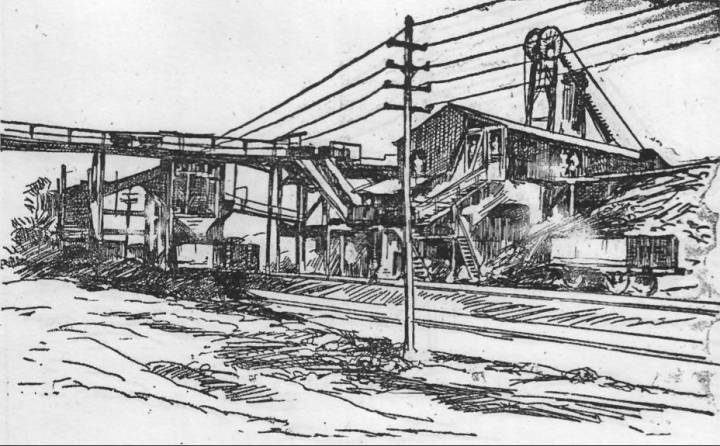
SKETCH OF THE PITHEAD [From a Photo by Mr Norval. ] |
| See also Hill of Beath Colliery entry. |
|---|
| Pit opened: 1860? | Pit closed: 1912? |
|---|---|
| Source Date of Information Supplied | |
| Manager / Under-Manager / Men underground / Men above ground / Coal seams worked / Shaft Details | |
| 1873 (Ord Adams) | |
| David Adams /
Robert Mathieson / -- / -- / Dunfermline Splint; Lochgelly
Splint
D'cast (6 x 6) 726 ft./ (9 x 5) 240 ft. : U'cast (12 x 6) 726 ft. Ventilation by furnace & steam jet. Upcast pit for the West Pit. |
|
| 1874 (Ord Adams) | |
| David Adams /
------------ / 144 / 34 / 5 feet, 5' 6"
Dunfermline Splint; Lochgelly Splint
D'cast (6 x 6) 726 ft./ (9 x 5) 240 ft. : U'cast (12 x 6) 726 ft. Ventilation by furnace & steam jet. |
|
| 1875 (Ord Adams) | |
| David Adams /
------------ / 173 / 37 / 5 feet 5' 6"
Dunfermline Splint; Lochgelly Splint
D'cast (12 x 6) 726 ft./ ----- 240 ft. : U'cast (6 x 5) 726 ft. Fan ventilation - fan 20' x 5'. |
|
| 1876 (Ord Adams) | |
| David Adams /
------------ / 160 / 37 / 5 feet 5' 6"
Dunfermline Splint; Lochgelly Splint. 6'
D'cast (12 x 6) 780 ft./ ----- 240 ft. : U'cast (6 x 5) 249 ft. / ----- 726 ft. Fan ventilation - fan 20' x 5'. |
|
| 1877 (Ord Adams) | |
| David Adams /
------------ / 245 / 50 / 5 feet. 5' 6"
Dunfermline Splint, Lochgelly Splint. 6'
D'cast (12 x 6) 780 ft. : U'cast (6 x 5) 249 ft. Fan ventilation - 20' x 5'. |
|
| 1878 (Ord Adams) | |
| David Adams /
------------ / 203 / 32 / 14 ft., 5 feet. 5' 6"
Dunfermline Splint, 4' 6". Lochgelly Splint.
6'
D'cast (12 x 6) 780 ft. : U'cast (6 x 5) 249 ft. Fan - 20' x 5'. |
|
| 1879 (Ord Adams) | |
| David Adams /
------------ / 202 / 45 / 14 ft., 5 feet. 5' 6"
Dunfermline Splint, 4' 6". Lochgelly Splint.
6'
D'cast (12 x 6) 780 ft. : U'cast (11 x 5½) 510 ft. Fan 20' x 5' at West Pit. |
|
| 1880 (Ord Adams) | |
| David Adams /
------------ / 221 / 49 / 14 ft., 5 feet. 5' 6"
Dunfermline Splint, 4' 6". Lochgelly Splint.
6'
D'cast (18 x 6) 780 ft. : U'cast (11 x 5½) 510 ft. Fan 20' x 5' at West Pit. |
|
| 1881 (Ord Adams) | |
| David Adams /
------------ / 143 / 46 / 14 ft., Lochgelly Splint,
6', 5 ft. Dunfermline Splint 4' 6"
D'cast (18 x 6) 780 ft. : U'cast (11 x 5½) 510 ft. Fan 20' dia. x 4'. Manpower figures shared with West Pit. |
|
| 1882 (Ord Adams) | |
| Engine
Pit: David Adams / ------------ / 184 / 49 /
Dunfermline Splint 4' 6", five feet, Lochgelly
Splint, 6' Fourteen Feet
D'cast (18 x 6) 780 ft. : U'cast (11 x 5½) 510 ft. Fan 20' x 4' at separate pit. |
|
| 1886/87
Sinking of Dalbeath pits. Fife Coal Co. Ltd. purchase the West, Engine and Dalbeath pits - February, 1887 |
|
| 1890 (Fife Coal Co. Ltd.) | |
| Engine
& West Pits: Henry Rowan / ------------ / 190 /
40 / Fourteen feet; Lochgelly Splint; Dunfermline Splint;
Five feet
D'cast ----- : U'cast (11 x 5½) 504 ft./ (18 x 6) 780 ft. Fan ventilation - 27' dia. (Waddle). |
|
| 1896 (Fife Coal Co. Ltd.) | |
| Henry Rowan /
------------ / 521 / 163 / As Hill of Beath
Colliery
Gas, household, manufacturing and steam coals. Ironstone. |
|
| 1900 (Fife Coal Co. Ltd.) | |
| Henry Rowan / Alexander Kelso / --- / --- | |
| 1902 (Fife Coal Co. Ltd.) | |
| William
Riddell / ------------ / 447 / 124 / As Hill of Beath
Colliery
Gas, household, manufacturing and steam coals. Ironstone. |
|
| 1904 (Fife Coal Co. Ltd.) | |
| William Riddell / ------------ / 165 / 44 [Hill of Beath] | |
| Gas, household, manufacturing and steam coals. Ironstone. | |
| 1905 (Fife Coal Co. Ltd.) | |
| ---------- / ------------ / 229 / 108 [Hill of Beath] | |
| 1908 (Fife Coal Co. Ltd.) | |
| Thomas Borland / ------------ / 306 / 49 [Hill of Beath] | |
| 1911 (Fife Coal Co. Ltd.) | |
| ---------- / ------------ / 13 / 4 [Hill of Beath] | |
| The Engine Pit probably closed around 1912. | |
Information on coals worked at, or near, Engine Pit
The Dunfermline Splint Coal was raised from this pit but
numerous faults were encountered. The coal, around 4 ft. 3
in. thick, was broken and burnt.
A Five Feet Coal section in workings from this pit had the
following composition:
| Blaes | 4 ft. |
| COAL | 1 ft. |
| Ironstone | 3 in. |
| COAL | 3 ft. 3 in. |
| Fireclay | 2 in. |
A parting of fireclay and blaes, reaching 12 ft. in
thickness, separated the Lochgelly Splint and Parrot Coals in
the Engine Pit.
Swallowdrum Coal measuring 3 ft. thick, with two variable
stone partings, and lying some 5 fathoms from the Lochgelly
Splint, was worked here as were the Jersey Coals at a depth
of 72 fathoms.
The Fourteen Foot seam measured 4 ft. thick and included a
thin midstone. The top of the coal was soft and foul and was
overlain by a thin bed of blaes.
Little Splint Coal was around 2 ft. 7 in. thick at a depth
of 55 fathoms, and the Cardenden Smithy Coal, in two leaves
of 2 ft. 7 in. and 2 ft. 2 in., were both worked at this
pit.
| Plans of Abandoned Seams for Engine Pit | Pits or Mines designated in Plans |
|---|---|
| COAL; Lochgelly Splint; Dunfermline Splint; Swallowdrum; Five Feet; Glassee; Fourteen Feet; Diamond (21 November, 1910) | HILL
OF BEATH
Engine; West; Dalbeath Nos. 1, 2 |
| COAL;
Five Feet (23 April, 1912); Dunfermline Splint
or Lower Splint (15 January, 1919) |
DALBEATH
Nos. 1, 2; Engine |
| COAL;
Main (April, 1926); Diamond (April, 1928);
Swallowdrum (October, 1928); Lochgelly Splint (April, 1931). |
DALBEATH
(including workings from Engine and West Pits) |
-----------------------------------------------------
"The Scotsman"
26 May, 1870
A case of assault and breach of the peace was tried before Sheriff Lamond at Dunfermline on Tuesday, arising out of a dispute between William Paterson, miner, Engine Pit, Hill of Beath Colliery, and John Robertson, inspector of coal at that pit. Paterson had sent up a hutch of coal on the 18th May, which the inspector condemned as being composed of other materials than coal. On Paterson coming up he admitted that the coal was not what it should be, but wished Robertson to give him the same credit for the hutch as if the coal had been good. On the latter declining to do so, it came out in evidence that Paterson struck him, causing to fall, and afterwards kicked him. The Sheriff said it was an attempt on the part of the prisoner to cause a servant to defraud his employer, and was not done in the heat of passion, but had been deliberately gone about. The prisoner was sentenced to sixty days' imprisonment with hard labour.
-----------------------------------------------------
"Dunfermline Press"
12 August, 1871
ACCIDENT
On Wednesday forenoon, George Horne, was engaged in removing an empty hutch in the engine pit, at Hill of Beath Colliery, when a piece of coal fell down the shafts, and injured one of his hands greatly, several of the bones of it being broken. Horne was attended to by Dr. Laing, Crossgates.
-----------------------------------------------------
"Dunfermline Journal"
8 March, 1873
DRAWING of the FIVE FEET COAL in ENGINE PIT to LET, in Two or Three Sections. For particulars apply to Mr ROBERT MATHIESON, Underground Manager. Offers to be Lodged on or before TUESDAY First.
HILL OF BEATH COAL & FIRE-
CLAY WORKS, 7th March 1873.
---------------------------------------------------

"Dunfermline Press"
9 May, 1874
On Wednesday morning, while Duncan Morgan, drawer, was employed in the Engine Pit, Hill of Beath Colliery, a quantity of blaes fell from the roof and knocked him down. He thereby sustained several cuts on the head, while the bridge of his nose was broken. He was quickly attended by Dr. Lemon Lane.
-------------------------------------
"Dunfermline Press"
16 May, 1874
Duncan Morgan, drawer, who met with serious injuries while working in a pit at Hill of Beath Colliery, on the 7th inst., (as reported in last week's Press) expired on Monday, in consequence of the accident.
Footnote
Recorded in Mines Report as having occurred 6.5.1874 - first newspaper report gives date of accident as 6.5.1874 but second newspaper report states that the accident occurred on 7.5.1874 and that Morgan died on the following Monday. Under these circumstances, it has been decided not to alter the record in the Memorial Book.
-------------------------------------
"Dunfermline Press"
5 December, 1874
On Saturday forenoon, a lad named John Morris, a pony-driver, was instantaneously killed in the Engine Pit, Hill of Beath Colliery. He was proceeding with a number of empty hutches from the bottom of the shaft to the working face, and on reaching a curve in the rails, the pony suddenly drew the front hutch - on which Morris was sitting - into contact with a prop, which at once gave way, bringing down from the roof an immense lump of blae, beneath which the lad was completely crushed. Deceased was about 16 years of age, and lived with his step-father, James Muir, at Hill of Beath.
Footnote
The Mines Report identifies this man as John Morris Muir. The man's stepfather was named Muir and it appears that he used his adoptive father's name.
-------------------------------------
"Dunfermline Press"
21 July, 1877
About seven o' clock on Thursday night, a man named David Innes met his death by accident while employed in the Engine Pit, Hill of Beath Colliery. He was engaged in filling a hutch, when a mass of stone came down upon him from the roof - causing his death instantaneously. He was 25 years of age.
------------------------------------
"Dunfermline Press"
8 September, 1877
On Saturday, John Bentley, a bottomer, was considerably injured while engaged in the Engine Pit, Hill of Beath Colliery. He was attended by Dr. Mungall, Cowdenbeath.
------------------------------------
"Dunfermline Press"
8 December, 1877
While a miner, named John Downie, was employed on Wednesday, in the Engine Pit, Hill of Beath Colliery, a lump of coal came down upon him from the roof, and injured his head badly. He was attended by Dr. Mungall, Cowdenbeath.
------------------------------------
"Dunfermline Press"
19 July, 1879
On Saturday morning, while Peter Beveridge was engaged in holing coal at the face in the underground working of the Engine Pit of the Hill of Beath Colliery, a large piece of coal fell upon him, injuring him severely. Dr. Thomson, Dunfermline, attended the man shortly afterwards, and, under his careful treatment, he is now progressing favourably.
------------------------------------
"Dunfermline Press"
3 July, 1880
On Saturday, a young man named John Beveridge, residing with his parents at Crossgates, near Dunfermline, met with a sad accident in one of the Hill of Beath coal pits. He was proceeding down steps leading from a higher seam to a lower, when, by some means or other, his feet slipped and he fell, it is supposed, a distance of about eight fathoms. The unfortunate young man was picked up and conveyed home in an unconscious state, when it was found his face was terribly disfigured, while the whole system had received a severe shock. He remained in a comatose state for several hours, and from the great distance he fell it is a wonder among miners how he has escaped with his life.
------------------------------------
"Dunfermline Press"
2 May, 1885
Still another addition has to be made to the list of mining fatalities in Fifeshire. Early on Tuesday morning, an accident occurred in the Engine Pit, Hill of Beath Colliery, whereby one man lost his life and another was injured. A quantity of coal gave way at the face, and before an escape could be effected, John Comrie was struck, and when he was extricated, a large piece of material was found resting on his neck, and his life extinct; while Birrell was knocked down, but only sustained some cuts and bruises. Comrie, who was thirty-eight years of age, leaves a widow and four of a family.
---------------------------------------------
"Dunfermline Press"
28 May, 1892
A number of men who had been employed as brushers had a narrow escape with their lives in the Engine Pit, Hill of Beath Colliery, on Monday. It appears that several men had sat down at one of the corners of one of the roads for the purpose of resting after their shift. They had not sat for many minutes when a large quantity of stones suddenly gave way and fell amongst them. Two of the men, George Hunter and William Muir, were struck by the falling material. Muir got off with some bruises about the back and shoulders, but Hunter was less fortunate. The poor fellow was almost covered by debris, and on being extricated it was found that his back was broken, and that he was much bruised internally. Hunter was conveyed to his house at Hill of Beath without delay, and Dr Nasmyth, who was called in with all possible speed, ordered his removal to the Royal Infirmary, Edinburgh.
---------------------------------------------
"Dunfermline Press"
17 September, 1892
Simon Dunn (50), miner, Hill of Beath, met with an accident while descending the Engine Pit, Hill of Beath Colliery, on Friday last week. His arm came in violent contact with a beam which crosses the pit shaft, with the result that the arm was fractured between the elbow and wrist.
---------------------------------------------
"Dunfermline Press"
2 November, 1895
Alexander Carr, brusher, Hill of Beath, had two of his ribs broken in the underground workings of the Engine Pit, Hill of Beath, on Monday. Carr was, along with other two men, replacing a cross-bar in one of the roads of the five feet seam. The old cross-bar broke, with the result that some stones fell from the roof on Carr. He was able to walk home, where he was attended to by Dr W. R. Nasmyth, Crossgates.
---------------------------------------------
"Dunfermline Press"
27 February, 1897
Thomas Walker (65), miner, Crossgates, was
killed on Saturday, by a fall from the roof in the underground
workings of the Engine Pit, Hill of Beath Colliery, wrought by the
Fife Coal Company, Limited. The poor fellow was buried beneath
three or four tons of top coal and debris. It is not known exactly
when the accident took place.
Walker was last seen alive at his working place
at half-past nine o'clock in the morning, and when a companion
went to inform him at one o'clock that it was finishing time
for the day, he was horrified to find that an accident had befallen
him. The alarm was at once raised and several men began to dig for
the deceased. It was fully three hours before the body could be got
out.
-----------------
"Dunfermline Press"
13 March, 1897
An Inquiry took place in the Sheriff Court, yesterday, relative to the death of Thomas Walker, miner, Crossgates, who was killed in the underground workings of the Engine Pit, Hill of Beath Colliery, on the 20th ult. The Jury found that the fatality was due to a fall from the roof of the deceased's working place.
--------------------------------------------
"Dunfermline Press"
15 January, 1898
Malcolm Condie, miner, Hill of Beath, was working at the coal face in the Engine Pit, Hill of Beath Colliery, on Thursday, when a piece of coal burst away from the face, and, striking him on the left side, broke one of his ribs and bruised his side severely. On being conveyed home, he was attended to by Dr Hamilton, assistant to Dr Nasmyth, Crossgates.
--------------------------------------------
"Dunfermline Press"
18 June, 1898
By the breaking of a pinion wheel on the pithead of the Engine Pit, Hill of Beath, on Tuesday morning, the rope attached to one of the cages snapped, precipitating the cage to the bottom of the shaft. Mr John Graham, undermanager, was in the other cage at the time, but escaped unhurt, the falling cage, which passed him in its descent, fortunately keeping in its slides.
--------------------------------------------
"Dunfermline Press"
24 September, 1898
One of the ventilating fans of the engine pit at Hill of Beath broke on Tuesday morning, and work had to be suspended for the day. The fan was repaired and work resumed on the following day.
--------------------------------------------
"Dunfermline Press"
11 February, 1899
... Another accident happened at Hill of Beath, yesterday, though, happily, unattended by fatal results. While Alexander Beveridge, miner, Woodend, was working at the Engine Pit, a quantity of stones and coal came down upon him unexpectedly from the roof, crushing him severely about the chest.
--------------------------------------------
"Dunfermline Press"
24 February, 1900
David Muir, 56 years of age, miner, 73 James Place, Dunfermline, met with his death on Wednesday, in the underground workings of the Engine Pit, Hill of Beath Colliery, Fife Coal Company, Ltd. Muir was working at the coal face when a large stone fell from the roof upon him, and caused instantaneous death. Deceased was married, and leaves a widow and grown-up family.
-------------------
"Dunfermline Press"
3 March, 1900
This issue carried the Report of the Fatal Accident Inquiry into the death of David Muir on the 21st February at the Engine Pit, Hill of Beath. Those giving evidence included:- Henry Rowan, colliery manager; Matthew Laird, fireman or pit inspector, Crossgates; Thomas Muir, miner, Dunfermline; and Alexander Kelso, underground manager of the Engine Pit. A formal verdict was returned.
----------------------------------------------------
"Dunfermline Press"
1 December, 1900
James Parker, miner, Back Row, Crossgates, was seriously injured this week in the Engine Pit, Hill of Beath Colliery. While returning from his working face to the pit-bottom he was riding on a hutch. He came in contact with the roof, and his head and breast were severely crushed. He was attended to by Dr W. R. Nasmyth.
----------------------------------------------------
"Dunfermline Press"
12 January, 1901
John Scott, miner, Main Street, Crossgates, has met with an accident. He was employed in the Engine Pit, Hill of Beath Colliery, Fife Coal Co., and while erecting a prop a quantity of stones fell from the roof upon him, breaking his left arm in two places between the elbow and wrist and slightly bruising him about the legs and back.
----------------------------------------------------
UNDERGROUND FIRE
Engine Pit, Hill of Beath Colliery
15th February, 1901
The Lochgelly Splint and Parrot seam in Fife is subject to spontaneous combustion, and gases from a fire of this nature in the East section of workings of the Engine Pit at Hill of Beath, belonging to the Fife Coal Company Limited, led to the loss of seven lives on the 15th February, 1901.
The seam is worked longwall in two carries; the bottom coal is worked first and the top coal is then taken out from the same roads. The inclination of the seam is about 1 in 7. The east section is separated from other sections of the colliery by a fault across which there are only two roads, one the intake and haulage road, and the other the return air way. The ventilation current passing along the intake when last measured before the accident amounted to 9.652 cubic feet per minute and passed in one current round the faces. The seam is free from firedamp and coal dust, and naked lights were used throughout.
In July, 1900, a fire broke out in the section and the miners were shortly afterwards removed nearer the shaft, and in September stoppings were built in both the intake and return air ways to isolate it. These stoppings appear to have damped the fire to some extent.
In December, 1900, a second fire, or possibly an extension of the first fire, broke out, and mining operations had to be again moved nearer the shaft. The second outbreak was isolated by a line of five stoppings built as follows: Next was 9 feet of stone and redd, then 1 foot of clay, and lastly 9 inches of brickwork. These stoppings were watched, and any cracks clayed up, and it was hoped that no air was reaching the fire, a hope which the sequel showed was not well founded.
On the 14th February, 1901, a smell as from a fire was felt in the section, and on the 15th, the oversman, Robert Birrell, reported this to the manager, Mr Richardson, who gave orders for Birrell and Alexander Nasmyth, the fireman of the section, to make a particular examination of the stoppings, and try and locate the issue of gases that day.
After work stopped about 2 p.m., Birrell and Nasmyth made their examination and then appear to have travelled to the shaft by the return air way. As they did not return to the surface, the alarm was raised, and a search party consisting of W. E. Richardson, manager; James Reid, miner; Alexander Carr, miner; Patrick Manson McRoberts, miner; James McFarlane, rope splicer; and Martin Rennie, miner, descended the shaft about 4 p.m. and proceeded into the section by the intake air way. They passed the stoppings, and then waited a few minutes in the air current. Mr. Richardson stated at the inquiry that there was no consultation as to danger from gases, but he suggested they should halt and see if their breathing was affected. After a few minutes halt, and feeling no difficulty as to breathing, they commenced to travel out by the return air way, and when Mr. Richardson, who led, had gone about 135 yards, he found his breathing affected and at once turned and told all the others to turn back. Mr. Richardson struggled back and managed to get into fresh air beyond the issue of gas when he became unconscious. Carr, McRoberts, Rennie and McFarlane did not get clear of the issue and were all lost.
Reid was found by a second search party as short distance in, lying utterly exhausted. The manager was carried home, and was dangerously ill for a few weeks after the accident. James Reid never regained consciousness, and died before reaching the shaft.
It is evident that air was reaching the fire, and that the products of combustion were entering the air current, and no doubt carbonic oxide was present. Dr. Nasmyth who examined the bodies, saw the affected survivor, and was of opinion that the cause of death and prostration was carbonic oxide.
The stoppings were not sufficiently tight to isolate the fire, or air was passing to it through cracks in the strata.
Names of the Deceased
| Name | Age | Occupation |
| Robert Birrell | 30 | Oversman |
| Alexander Nasmyth | 43 | Fireman |
| Alexander Carr | 43 | Oncostman |
| Patrick McRoberts | 30 | Oncostman |
| James McFarlane | 44 | Oncostman |
| Martin Rennie | 36 | Oncostman |
| James Reid | 35 | Miner |
| Foot Note
The disaster had made six widows and twenty-five fatherless children. |
|---|
-------------------------------------------------
"The Scotsman"
19 February, 1901
FIFE MINING DISASTER
At Hill of Beath yesterday the miners were quite unsettled and disinclined for work.
But for the ventilating fan humming. all was silent at the engine pit, and at the two other
pits connected with the colliery - the only coal that was got was by men who are non-resident.
The Lochgelly splint seam in the engine pit has been worked in two sections, and the eastern
section, in which fire has frequently given trouble, has now been built up and completely
shut off from the western part, in which work will be continued as usual.
The remains of Patrick McRoberts, the only unmarried man among the seven victims,
were interred yesterday. McRoberts, who was twenty-nine years of age, belonged to Wishaw,
and had been working at Hill of Beath for about two years. He was very popular among his
fellows, and as an evidence of this about two hundred men attended the funeral to pay him
their last mark of respect. A service was conducted in the house in which he had lodged in
Main Street by the Rev. Father McMahon, Lochgelly, the nearest resident priest, and as the
hearse, followed by the relatives and late fellow-workers, wended its way in the direction of
Kirkford up to Kirk of Beath burying-ground, the women and children of the village stood at
their doors and silently witnessed the mournful procession.
Mr J. B. Atkinson, His Majesty's Inspector of Mines for the eastern district of Scotland,
paid another visit to the engine pit yesterday, and made further inquiries as to the cause of
the disaster. Mr Charles Carlow, the managing director of the Fife Coal Company, who was in
London on Friday, arrived at the works yesterday, and one of his first acts was to make
arrangements for temporary relief being given in any necessitous case. On behalf of the Rev.
Thomas Mitchell, of the Guthrie United Free Church, Cowdenbeath, who had been entrusted
with the disbursement of a sum of money, inquiries were made by Mr Walker, the village
missionary, with the same object in view. Mr W. E. Richardson, the manager of the engine
pit, had so far recovered as to be able to attend the colliery office yesterday.
At considerable personal inconvenience, Mr John D. Hope, the new M.P. for West Fife, paid
a visit to Hill of Beath yesterday for the purpose of making inquiries. While there he learned that
McRoberts was to be buried in the afternoon, and he joined in the funeral procession, but was
unable to walk all the way to Kirk of Beath, having to hurry back to Dunfermline to get a train
for London.
On Saturday Mr Atkinson sent the following telegram to the Home Secretary:- "Regret to
report loss of seven lives yesterday at Hill of Beath Colliery, near Dunfermline. Suffocated by
gases from underground fire. Bodies all recovered." A reply in the following terms was
received:- "Secretary of State hears with much regret of the accident at Hill of Beath
Colliery and of the consequent loss of life. Please convey expression of his sympathy to the
relatives of those killed, and report in due course full particulars of accident."
The remains of Robert Birrel, Alexander Nasmyth, Alexander Carr, James McFarlane, Michael
McTernan or Rennie, and James Reid are to be interred this afternoon. Reid is to be buried
at Dunfermline, Birrel at Mossgreen, and the four others at Kirk of Beath.
-------------------------------------------------
"Dunfermline Press"
13 July, 1901
David Wilkie, miner, Crossgates, met with an accident in the Engine Pit, Hill of Beath Colliery, on Tuesday. While he was filling a hutch of coals at the coal face, a fall of stones from the roof occurred, with the result that his head and left cheek were severely cut and his left side and leg bruised.
-------------------------------------------------
"Dunfermline Press"
7 December, 1901
While J. Anderson, wheeler, Back Row, Crossgates, was taking a loaded hutch off the cage at the bottom of a drop pit in the five feet seam of the Engine Pit, Hill of Beath Colliery, on Thursday, the brake gave way and he was caught by the cage and raised to the top of the shaft a distance of nine fathoms. He was thrown on to the plates and had his back severely bruised. On his removal home he was attended to by Dr. Nasmyth.
-------------------------------------------------
"Dunfermline Press"
15 February, 1902
On Saturday morning, an oncost worker named John Scott (55), Main Street, Crossgates, was laying a metal pipe in the haulage road of the Engine Pit, Hill of Beath Colliery, when about a ton of stone fell from the side and struck him on the left leg, cutting and bruising it severely. He was conveyed home and attended by Dr Nasmyth.
-------------------------------------------------
"Dunfermline Press"
9 May, 1903
Charles Izatt, miner, Thistle Street, Dunfermline, met with his death on Saturday in the Engine Pit, Hill of Beath Colliery. Deceased was working at the face in the five-feet seam when a stone weighing about three cwts fell from the roof upon him, killing him instantaneously, his neck being dislocated. Deceased was about thirty years of age and was unmarried.
------------------
"Dunfermline Press"
16 May, 1903
Under the Fatal Accidents Inquiry Act, an inquiry was held in the Sheriff Court, Dunfermline, on Thursday - before Sheriff Gillespie and a jury - into the circumstances attending the death of a miner named Charles Izatt, who was killed 2 May at the Engine Pit, Hill of Beath Colliery. Those giving evidence included:- Duncan Ferguson, manager; Peter Allan, South Inglis Street, Dunfermline; Ebenezer Lee, miner, Reform Street, Dunfermline; and Alexander Farmer, fireman, North End, Cowdenbeath. A formal verdict was returned by the jury.
"Dunfermline Press"
10 October, 1903
David Hunter, 16 years of age, son of Henry Hunter, Dunfermline Road, Crossgates, met with his death yesterday in the Engine Pit, Hill of Beath Colliery. Deceased was employed as a hanger-on. Through some misunderstanding a race of loaded hutches was sent down the wheelbrae before the tail chain had been attached to the empty hutches. Hunter, who was at the pit bottom, was unable to get out of the way of the full hutches. He was crushed between the empty vehicles and a post, and was killed on the spot.
-------------
"Dunfermline Press"
24 October, 1903
Under the Fatal Accidents Inquiry Act, an inquiry was held in the Sheriff Court, Dunfermline, on Thursday - before Sheriff Gillespie and a jury - into the circumstances attending the death of David Hunter, hanger-on, Crossgates, on 9th October, at the Engine Pit, Hill of Beath Colliery. Those giving evidence included:- Duncan Ferguson, manager; James Carr, miner, Mitchell's Buildings, West Broad Street, Cowdenbeath; George Newlands, underground manager; Walter M. Smart, wheeler, Rosebank, Dunfermline Road, Crossgates; and James Beveridge, fireman, Springhill, Crossgates. A formal verdict was returned by the jury.
-------------------------------------------------
"Dunfermline Press"
17 September, 1904
John Pryde, miner, Rose Street, Cowdenbeath, has met with an accident in the Engine Pit, Hill of Beath Colliery. He was riding on a hutch when the haulage rope sprang off a pulley, upsetting the vehicle, and jamming him against a building. A wound on the left leg was so severe that Dr Nasmyth had to stitch it.
-------------------------------------------------
Charles Reid was then appointed agent for this pit and the Donibristle Colliery in 1908, and was subsequently promoted to the post of General Works Manager of the Fife Coal Company in 1922. In this post, he found wide opportunities for his talents and initiative. He immediately proposed the erection at Cowdenbeath of central offices for the company, with adjacent workshops and stores, which would serve all their collieries and other concerns if possible. After delay, the directors of the company accepted his proposals in 1923. The project was completed in 1925.
The decision to build this complex was taken during a period of severe depression in the industry. It probably appeared foolhardy at that time, but it always had been the policy of the company not to over-produce coal during such slack periods but to transfer activity to new development. This sometimes entailed pits being put on part-time working, thereby preserving capacity in addition to creating the new capacity to meet market requirements whenever the depression lifted. If such an enlightened policy had prevailed in the late 1950s and during the 60s the impact of the Yom Kippur war in 1973 and the resulting worldwide energy shortage would not have had such an adverse effect on the economy of Great Britain.
-------------------------------------------------
"Dunfermline Press"
30 September, 1905
On Friday last week an unfortunate accident happened to a miner named Malcolm McCallum (27), residing at Woodend. He had been drawing a loaded hutch from the coal face in the machine section at the Engine Pit, Hill of Beath, when a large stone fell on him, crushing him so severely that one of his legs was broken above the ankle, and his back was injured. He also received injuries to his face. He was conveyed home in the colliery ambulance waggon, and attended by Drs Nasmyth and Selkirk.
-------------------------------------------------
"Dunfermline Press"
18 November, 1905
A young lad, about 15 years of age, named Kelly, met with a serious accident in the Engine Pit, Hill of Beath, on Monday. He had been working at a winch when he came in contact with a hutch which crushed him severely and inflicted a severe wound on one of his legs. He was looked after by Messrs. Simpson and Muir, two members of the Crossgates ambulance class until the arrival of Dr Nasmyth, who had to put several stitches into the wound. It was the lad's first day in the pit.
-------------------------------------------------
"Dunfermline Press"
15 August, 1908
A young miner named John Baxter, residing at Mid Row, Hill of Beath, lost his life yesterday in the Engine Pit. He had been following his usual employment at the face of the Swallowdrum seam, when a stone, which must have weighed a few tons, broke away from the roof and crushed him to the pavement. Before the body could be taken out, a screw-jack had to be used to lift the large stone. Other two miners, named Thomas Paterson and Archibald Cole, narrowly missed being caught by the falling material. Baxter, who was twenty-three years of age, was a native of Armadale.
--------------------------
"Dunfermline Press"
12 September, 1908
Under the Fatal Accidents Inquiry Act, an inquiry was held in the Sheriff Court, Dunfermline, on Thursday - before Sheriff Shennan and a Jury - into the circumstances attending the death of miner John Ferguson Baxter, jun., 7 Mid Row, Hill of Beath, who was killed on 14 August in the Engine Pit, Hill of Beath, by a stone falling upon him from the roof. Those giving evidence at the inquiry included:- Thomas Borland, jun., colliery manager; Archibald Cree, mining contractor, Cowdenend, Cowdenbeath; James Davidson, miner, 92 Union Street, Cowdenbeath; and Neil McCallum, pit fireman, 7 Main Street, Hill of Beath. A verdict in accordance with the evidence was returned.
-------------------------------------------------
"Dunfermline Press"
11 September, 1909
While employed in the Swallowdrum seam of the Engine Pit, Hill of Beath Colliery, belonging to the Fife Coal Company, on Monday, David Alexander, miner, residing at Netherbeath, was struck by a fall of stone from the roof, and his spine was fractured. This is the fourth accident of the kind which has occurred within little more than a week in the same Company's pits. Three victims, including Alexander, now lie in Dunfermline Hospital, the fourth having died after being taken there.
-------------------------------------------------
"Dunfermline Press"
12 November, 1910
DULLNESS IN FIFE COAL TRADE
In consequence of the dullness in the coal trade, the Fife Coal Company have intimated their intention of closing temporarily the West and Engine Pits at Hill of Beath. The result is that at least four hundred men are working their warnings, which expire a week hence. At nearly all the pits in Fife trade is quiet.
-------------------------------------------------
"Dunfermline Press"
24 December, 1932
Daniel Mullan (15), 3 Old Reading Room Row, Hill of Beath, was involved in an accident yesterday at the Old Engine Pit, Hill of Beath. He was employed by Mr Dan Cunningham, a local contractor, in the demolishing of walls and buildings at the pit when part of a three-feet wall fell on one of his legs. He was removed to Dunfermline and West Fife Hospital, where he was found to be suffering from a fracture of the limb.
-------------------------------------------------
