Sadly, whenever the name 'Donibristle' is mentioned, most people can relate it to the mining disaster which occurred at the colliery over 100 years ago. Unfortunately, this was also the price the miner paid to give industry and transport an essential fuel and many others the simple comfort of a coal fire.
WE MUST NEVER FORGET THIS.
|
The Donibristle Disaster see Donibristle Nos.12, 15 Pits |
|---|
The Past, Present, and Future
|
|---|

A large number of coal workings are known to have operated from very early times in and around the small village of Donibristle, to the east of Crossgates and Fordell villages.
 |
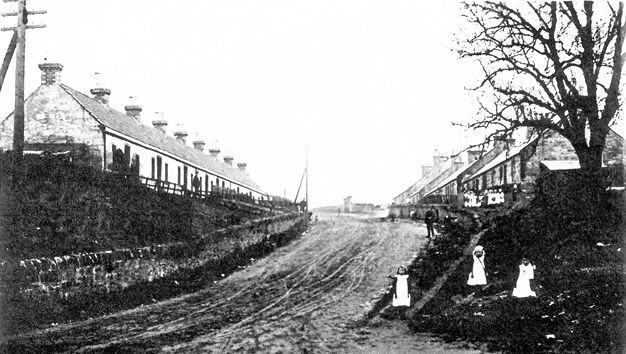 |
Early Donibristle village images supplied courtesy of Jim Brydie, Kelty.
--------------------------------------
Early pits were concentrated to the south of the village around Monziehall; later pits and mines worked to the north of the village, on Moss Morran, and closer to the mining town of Cowdenbeath.
 |
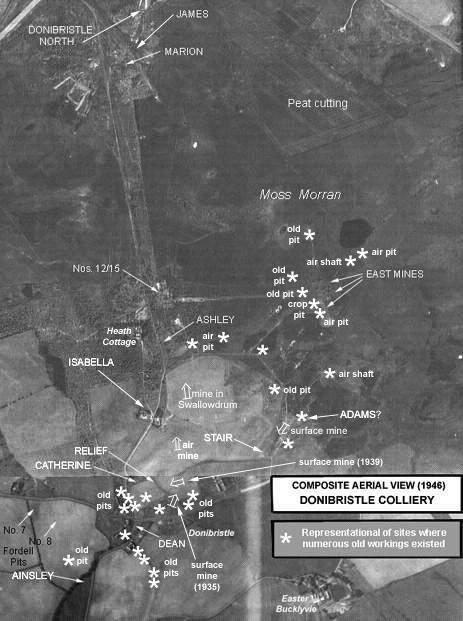 |
Our research to date has revealed the locations of a number of unidentified old pits and surface mines along with the following named pits, or mines, listed under Donibristle Colliery:
Earl's, Earl's Row, Ainslie, Countess, Meadow, Dean, Relief, Catherine, Isabella, Moor, Adams, Ashley, Engine, James, Marion, No. 12, No. 15, East and North.
| A range of information on a named pit or mine, including opening/closing dates, exact location, photographs of workings, details of shaft depths, descriptions of coal seams worked/abandoned, points of historical and/or social interest, etc., will be present in an individual index entry but general information pertaining to the colliery which is often difficult to allocate to an individual pit or mine, is reported in this general entry to which reference will be made from the individual index entries. |
|---|
-----------------------------------
Donibristle Colliery
| Source Date of Information (Owner) |
|---|
| Manager / Under-Manager / Men underground / Men above ground / Coal seams worked |
| pre 1830 (Donibristle lands owned by Earl of Moray) |
| 1830 (Messrs Grieve and
Nasmyth) Mr George Grieve and Mr Alexander Nasmyth take a lease of the Donibristle coalfield. |
| 1833 (Messrs Grieve
and Nasmyth)
[From Fifeshire Journal.] |
| 1836 (Mr. George
Grieve)
J. Culross, Constable. [From Dunfermline Register.] |
| 1837-1859 (Messrs
George Grieve and Alexander Nasmyth, Sen.)
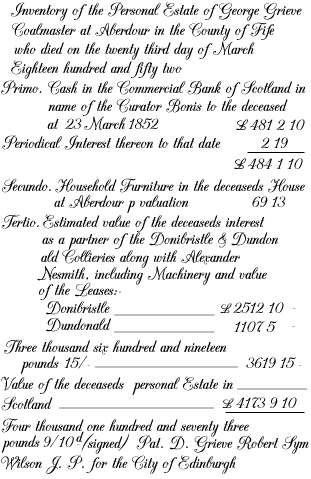
[From Dunfermline Registers.] 1841/42 - David Nasmyth, agent to Donibristle Colliery Mr. George Grieve, Coalmaster - died 23 March, 1852. (See reproduction of Inventory following this table.) 1857 - Mr. James A. Nasmyth succeeds his father. Mr. G. J. P. Grieve succeeded his father, Mr. George Grieve, who died in March, 1852. |
| 1870-1872 (Grieve
& Nasmyth)
J. A. Nasmyth, Manager; G. J. P. Grieve, Shipping Agent [From Dunfermline Registers.] |
| 1873 (Grieve &
Nasmyth)
(Isabella Pit, No. 12 Pit and Mine - see individual entries) |
| 1874/77 (Grieve
& Nasmyth)
(Isabella Pit, No. 12 Pit, Marion Pit and James Pit (sinking 1874) - see individual entries) |
| 1878/79 (Grieve
& Nasmyth)
(Isabella Pit, Marion Pit and James Pit - see individual entries) |
| 1880 (Grieve &
Nasmyth)
(Isabella Pit, Marion Pit and James Pit (opening) - see individual entries) |
| 1881/82 (Grieve
& Nasmyth)
(Isabella Pit, Marion Pit and James Pit - see individual entries) J. A. Nasmyth becomes sole lessee in 1881 on retiral of Mr G. J. P. Grieve. |
| 1890 (Donibristle
Colliery Co.)
(Marion Pit, James Pit and No. 12 Pit - see individual entries) |
| 1893 (Donibristle Colliery Company) |
| Alexander Nasmyth, manager. |
| 1896 (Donibristle Coal Company) |
| Alexander Nasmyth / ------------ / 230 / 67 [Donibristle*] |
| Gas, household, manufacturing and steam coals. |
| 1902 (Donibristle Colliery Co. Ltd) |
| Alexander Nasmyth / ------------ / 262 / 81 [Donibristle*] |
| Gas, household, manufacturing and steam coals. |
| 1904 (Donibristle Colliery Co. Ltd.) |
| Charles Carlow Reid / ------------ / 311 / 85 [Donibristle*] |
| Gas, household, manufacturing and steam coals. |
| 1905 (Donibristle Colliery Co. Ltd.) |
| Charles C. Reid / ------------ / 390 / 93 [Donibristle*] |
| Gas, household, manufacturing and steam coals. |
| 1908 (Fife Coal Co. Ltd.) |
| Charles C. Reid / ------------ / 498 / 124 [Donibristle*] |
| October: Death of Mr Alexander Nasmyth, former underground manager. |
| 1911 (Fife Coal Co. Ltd.) |
| Charles C. Reid / ------------ / 509 / 85 [Donibristle*] |
| * Individual working pits or mines not listed |
| 1913 (Fife Coal Co. Ltd.) |
| May: Mr Spalding, Bowhill No. 2
pit undermanager, appointment manager at Donibristle Colliery. Sept: Mr John Burt, under-manager, Donibristle Colliery, secured a position as manager in West of Scotland. He is succeeded by Mr Peat, some time assistant manager to Mr Proven, Dalbeath. |
| 1918 (Fife Coal Co.
Ltd.)
(Marion Pit, James Pit, Nos. 12, 15 Pits and East Mine - see individual entries) |
| 1922 (Fife Coal Co. Ltd.) |
| May: Mr Andrew Hutt promoted to undermanager at Lumphinnans No. 1 Pit. |
| 1924 (Fife Coal Co. Ltd.) |
| Feb: Mr James Methven, under manager, replaces Mr James McLean, under manager, Foulford Colliery. |
| 1928 (Fife Coal Co. Ltd.) |
| George Marshall / Richard Brown / 122 / 39 [Nos. 12, 15] |
| Household coals. Glassee, Lochgelly Splint. |
| George Marshall / John Hunter / 344 / 94 [James & Marion] |
| Household and steam coals and blaes. Mynheer, Fourteen Feet, Glassee, Diamond, Five Feet. |
| George Marshall / ------------ / 26 / 2 [East Mines] |
| Household coals. Glassee. |
| 1938 (Fife Coal Co. Ltd.) |
| George Marshall / ------------ / 19 / 8 [Donibristle] |
| Coaling at Donibristle Colliery is thought to have ceased around 1939. |
 |
| Please see Stories Link: Bowman Story, for information on Nasmyth/Bowman family connections with this colliery. |
|---|
Donibristle Colliery (19th century report)
| Name of coal | Thickness | Quality | Class |
|---|---|---|---|
| Lochgelly Splint | 7 ft. | 1st class | Steam |
| Lochgelly Parrot | 4 ft. 6 in. | 1st class
and 2nd class |
Steam
Cannel |
| Mynheer Coal | 5 ft. 7 in. | Good | Household |
| Five Foot Coal | 4 ft. 10 in. | 2nd class | Household |
| Dunfermline Splint Coal | 4 ft. 10 in. | 1st class | Household |
| (There are three 3rd class seams of steam coal at this Colliery which have not been worked.) | |||
----------------------------------------
Information on some seams worked in Donibristle Colliery
(based on reports from 1900 and 1934)
In the Dunfermline coalfield, various thin seams of coal
were found between the Five Foot and the Eight Foot Coal
seams. One of these, which was only 1 ft. 3 in. thick,
increased towards the east until, in the Donibristle
Colliery, it became a workable seam 5½ ft. thick, known
as the Mynheer. [Mynheer = my Lord].
The Eight Foot Coal took the name of the Glassee in this
district where it consisted of two bands, the upper being 5
ft. 2 in. thick, the lower 2 ft. 4 in. thick, with a parting
between them of fireclay measuring 1 ft. 9 in. thick. The
Swallowdrum Coal in the Donibristle Colliery attained a
considerable development and began to include the well-known
Lochgelly Splint and Parrot seam.
The following section was observed in the Colliery:
| Shale | - |
| COAL | 1 ft. 3 in. |
| Blaes (shale) | 6 in. |
| COAL | 9 in. |
| Band | 1 ft. |
| COAL (Craw) | 1 ft. 2 in. |
| Blaes (shale) | 3 in. |
| COAL (Lochgelly Splint) | 7 ft. 3 in. |
| Blaes and bands | 1 ft. |
| COAL (Cherry) | 2 ft. |
| Dugger | 3 in. |
| COAL (Parrot) | 4 ft. |
| Blackband Ironstone | 1 ft. |
| Freestone | 21 ft. |
This combined seam cropped out about 130 yards to the
south-east of the Isabella Pit whence it ranged
north-eastwards under Moss Morran into the Lochgelly
Coalfield where it was known as the Lochgelly Splint and
Parrot. In the Donibristle ground, a seam known as Duddie
Davie lay 70 ft. above the Splint and Parrot seam. It was 3
ft. thick, rested on a pavement of fireclay 8 ft. thick, and
was overlain with 19 ft. of freestone.
The Fourteen Foot Coal of Cuttlehill, Donibristle and
Lochgelly may possibly have been the equivalent of the higher
coals of Townhill. It cropped out at the Ashley Pit of the
Colliery.
Plans of Abandoned Seams & DatesNote: abandonment dates do not relate to individual pit closures but to the abandonment of seams which had ceased to be worked. Not worked for a period of time, it was quite normal for some coal seams to be re-opened for working at a later date or at a different location. |
|---|
| Plans of Abandoned Seams & Dates for Donibristle | Pits or Mines designated in Plans |
|---|---|
| COAL; Splint; Mynheer (1838) | Ainslie, Catherine, Dean, Relief |
| COAL; Unnamed seam (1851) | Ashley, Engine, Isabella, Relief |
| COAL;
Splint (1850); Fourteen Feet (1919);
Gorman (1920); Jewel; Wee Coal (1921); Mynheer; Glassee; Five Feet. |
Catherine, Isabella, Relief, Nos. 12, 15 |
| COAL; Five Feet; Dunfermline Splint or Lower Splint (November, 1916) | Earl's Row |
| COAL;
Glassee; Swallowdrum (March, 1918)
(Later workings have been added to the plan of the Glassee Coal. The amended abandonment date in respect of this seam is 6th April, 1928.) |
East |
| COAL;
Five Feet (1918); Mynheer (1920); Lower Splint or
Dunfermline Splint (1926)
(Later workings in the Mynheer seam from No. 12 Pit were added to this plan. The amended abandonment date is 25th January, 1928.) |
Isabella, James, Marion, Nos. 12, 15 |
| COAL; Swallowdrum; Two Feet (1927) | James, Marion |
| COAL; Gorman or Rough (1927) | North |
| COAL;
Fourteen Feet; Gorman; Diamond; Swallowdrum;
Jewel (1927) |
Nos. 12, 15 |
| COAL; Five Feet; Dunfermline Splint (April, 1928) | Earl's Row |
| COAL; Two Feet or Wee Coal (1929) | Nos. 12, 15 |
| COAL; Two Feet or Wee Coal (1933) | James, Marion |
| COAL; Five Feet; Lochgelly Splint and Parrot; Glassee; Mynheer (1933) | Nos. 12, 15; Isabella, Catherine, James, Marion |
| COAL; Swallowdrum; Diamond; Fourteen Feet (1933) | James, Marion |
------------------------------------
"Fifeshire Journal"
9 November, 1833
SUPERIOR SPLINT COAL
MESSRS. GRIEVE and NASMYTH, of the DONIBRISTLE COAL
COMPANY, Lessees of the Earl of Moray's great Moss Marron
Coalfield, beg to intimate, that they have recently opened a
new Pit of very Superior Splint Coal, which combine
the rare qualities of quick ignition, and rich and
powerful flame, with strength of heat and durability; while
they are free from white ash, sulphur or clinker, and burn to
a black cinder; and, thus, they form a cheerful, warm, and
clean house-fire, as well as powerful and profitable Furnace
Coal.
They are found AND WARRANTED admirably to suit
Baker's Ovens, Breweries, Distilleries, &c. or
Steam-Packets.
LAND SALE PRICES are moderate, quality considered, as at the
adjacent Collieries;
AND
SHIPPING PRICES, free on board at Aberdour, with 1¾ d. per Ton, Shore-Dues and Stowage are as follows, viz:-
Splint Great Coal, Shipped carefully by hand, and free
from small, 8s. 6d. per Ton
Splint Chew Coal, Screened, 6s. 6d. per Ton
Splint Small or Culm, Screened, 4s. 0d. per Ton
Parrot or Gas Coal, 10s. 6d. per Ton.
N.B. No inferior Seam is wrought or mixed with these
Coals.
The Harbour at Aberdour has recently been improved, so as
to accommodate vessels of great draught, there being 11½
feet water at neap, and 16 feet water at low spring tides,
alongside the loading berths; and being on the opposite shore
to, and only six miles from, Leith, it not only possesses
peculiar advantages in connection with that port, such as
vessels being able to run across and save water in the same
tide, and without ballast; but also, is below all
those straits or narrow passages which preclude sailing
vessels in bad weather from working up or down the Forth;
whilst it is remarkably safe and well sheltered; and has soft
clayey and even ground as the bottom. Nor can any harbour be
of more easy ingress or egress.
Orders to be addressed to the managing partner in the
Shipping Department, Mr Geo. Grieve, at Aberdour, Fife.
November 1, 1833.
------------------------------------

Commission (reported in 1842)
Accidents occurred, 1841
Mr. David Nasmyth, agent for lessees of the Donibristle Colliery:
"....... One fatal accident occurred three days since. Helen Bowman, a putter, was caught by the pit-clothes, at the shaft-bottom, by the basket-hooks, was dragged to within five fathom of shaft-head, and fell; she lingered two days; ..........."
------------------------------------
Catherine Walter, sixteen years old, putter: "Father died some time gone of dropsy from sitting in damp work and bad air."
"........ used to work with Helen Bowman, who is lying dead in the next cottage; she fell from near top of pit-shaft, as the hook caught her clothes; she was picked up by her brother and the young man to whom she was going to be married next week; she was being dragged up as they were descending; she lingered near two days, and was attended by Dr. Forsyth, of Inverkeithing."
------------------------------------
Mr. David Nasmyth, agent for lessees of the Donibristle Colliery:
"....... and a man, Peter Campbell, was killed by a stone from the roof some months since."
------------------------------------
"Dunfermline Journal"
May, 1854
On the morning of the 11th current, a man named Adam Adamson was employed along with another man in cutting a mine in a coal pit at Donibristle Colliery, when they came to a stone in the roof, which after repeated unsuccessful efforts to remove, still remained apparently firm, upon which the men sat down under to consult on the best means of displacing it. While so situated the stone suddenly became detached from the roof, and in the fall struck Adamson so severely on the head that he died about ten minutes thereafter. He was unmarried, and 50 years of age.
-------------------------------------------------
"Dunfermline Journal"
27 November,
1857
This issue carried news of the death of Alex. Nasmyth, Esq., coalmaster and successful mining engineer, on 7th November, as a result of being thrown from his gig on Thursday, 29th October. Mr Nasmyth, who was associated with Donibristle and Dundonald Collieries, in Fife, for many years, was buried in the parish of Aberdour.
-------------------------------------------------
"Dunfermline Saturday Press"
1 August, 1863
DONIBRISTLE COLLIERY
The workmen of this colliery have just sent their annual contribution to the friends of the Royal Infirmary, Edinburgh, amounting this year to five pounds six shillings.
------------------------------------
"The Scotsman"
14 November, 1863
WANTED Immediately, a CERTIFICATE TEACHER for Donibristle Colliery School. Salary £52 per Annum. Free House and Coals, besides Participation in the Capitation Grant. An Assistant and Pupil Teacher are already employed. Apply to J. A. Nasmyth, Esq., Bucklyvie, Aberdour, Fife.
------------------------------------
"Dunfermline Saturday Press"
6 May, 1865
On Friday, the men working at Donibristle Colliery struck work, thus augmenting the number of colliers on strike in the northern part of Aberdour parish. The strike will exercise a prejudicial effect on the shipping trade in coal both here and at Burntisland. Some foreign captains had to be refused cargoes here last week, but were successful in obtaining coal at St. David's.
------------------------------------
"Dunfermline Saturday Press"
8 October, 1870
The workmen of this colliery have commenced work, after a strike of four weeks, on the terms their employers were quite willing to concede at the first; but, then, nothing but 4d. on the ton would suffice. The misery that strikes entail on workmen and their families will surely preclude similar madness in the future.
------------------------------------

"Dunfermline Saturday Press"
4 August, 1883
On Thursday forenoon, while George Seath, a miner, was working on an incline in one of the pits belonging to the Donibristle Coal Company, the chain holding two of the hutches broke, and running down the rails, the hutches passed over Seath, and inflicted such serious injuries that he only survived a short time. Deceased was unmarried.
------------------------------------
"Dunfermline Saturday Press"
3 May, 1884
William Renton, pit-bottomer, Springfield, Crossgates, in the employment of the Donibristle Coal Company, had his left leg fractured on Monday by a piece of coal falling down the shaft from a hutch. He was attended by Dr. Nasmyth and Dr. Menzies, and is progressing favourably.
------------------------------------
"Dunfermline Saturday Press"
3 November, 1894
A young man named David Paterson, residing at Arthur Place, Cowdenbeath, died on Saturday from the effects of injuries sustained while employed in a pit at Donibristle Colliery. Deceased was run down by a runaway hutch on a wheelbrae, or incline, on Friday afternoon last week, and was badly bruised from head to foot. What makes the accident all the more sad is the fact that deceased was engaged to be married today.
------------------------------------
"Dunfermline Saturday Press"
24 August, 1895
A young man, Thomas Innes, while working in Donibristle Pit, met with an accident on Thursday. It appears he had been lifting a hutch on to its rail when his fingers were caught between them. He was attended to by Dr Thomson, who, after examining the fingers, found it necessary to amputate one of them.
------------------------------------
"Dunfermline Press"
13 August, 1898
The Donibristle men are complaining about their standard weight. It appears that 21 years ago a standard of 7 cwts., beyond which no hutch should be filled, was fixed, and any coal above that quantity is forfeited. At the time this arrangement was introduced, it was not a great hardship upon the men, as the capacity of the hutch would not ordinarily exceed that weight. In recent years hutches of larger size have been introduced, but no change has been made on the standard. A deputation waited on the employer last week with a view to get the grievance remedied.
------------------------------------
"The Scotsman"
25 March, 1899
A FIFE MOOR ON FIRE. - Fire broke out on Thursday among the heather on Moss Morran, an extensive tract of moorland lying between Cowdenbeath and Donibristle. At least one hundred acres were affected by the flames, which at one time were in such dangerous proximity to the pithead framework and coal bings of two shafts in the centre of the Moss that men had to be employed to cut the surrounding heather. The fire raged during Thursday night, and the occupants of dwelling-houses at one side of the Moss had to keep a look-out lest their dwellings might be burnt. So near was the fire to the houses that some pigs had to be removed. The fire was practically extinguished yesterday. About thirteen years ago the heather went on fire during the summer and burned for many days.
------------------------------------
"Dunfermline Press"
16 June, 1900
The dispute at Donibristle, which has been dragging along two weeks, has now been finally settled. The cause of the dispute was a change in the screening operations. ...
------------------------------------
"Dunfermline Press"
1 March, 1902
This issue carried the news that Mr Robert Birrell was leaving Donibristle Colliery to fill an appointment at Bowhill Colliery.
------------------------------------
"Dunfermline Press"
30 August, 1902
DONIBRISTLE COLLIERY COMPANY
Among the new joint stock companies registered this week, the following appears:- "The Donibristle Colliery Company (private company), Donibristle, Cowdenbeath, to purchase and take over as a going concern the business carried on by James Armstrong Nasmyth and Alexander Hogg Nasmyth, both coalmasters at Donibristle, Fife, capital £30,000, in £5 shares; the subscribers are all members of the Nasmyth family."
------------------------------------
"Dunfermline Press"
29 November, 1902
Workmen of the Donibristle Colliery met in Cowdenbeath to give a presentation to Mr William Wilson, winding engineman, who was finally leaving after a long, useful, and honourable career with the colliery.
------------------------------------
"Dunfermline Press"
Saturday, 10 January, 1903
DEATH OF MR JAMES A. NASMYTH
OF MIDDLEBANK
This issue announced the death of Mr James A. Nasmyth, Donibristle Colliery, one of the best known coalmasters in Fife. His father established the Donibristle Colliery with Mr George Grieve, and on his father's death he became a partner in the business. Twenty five years later he became sole lessee of the Donibristle minerals. Latterly, two sons were associated with management of the concern.
------------------------------------
"Dunfermline Press"
29 August, 1903
The employees of the Donibristle Colliery Company, Limited, have contributed the sum of £16 to the funds of the Edinburgh Royal Infirmary.
------------------------------------
"Dunfermline Press"
5 December, 1903
While Frank Rafferty, brusher, Kenny's Buildings, was employed at his work at the Donibristle Colliery on Saturday afternoon, a large stone came away from the roof and fell upon his shoulders. Rafferty was also severely injured about the face.
------------------------------------
"Dunfermline Press"
26 November, 1904
This issue carried the news that Mr A. Nasmyth had retired from the management of Donibristle. His successor was Mr Reid.
------------------------------------
"Dunfermline Press"
10 June, 1905
This issue carried the news that a number of the workers of the Donibristle Colliery, manager Mr Charles C. Reid, had arranged a presentation to Robert Storie, on the occasion of his marriage.
------------------------------------
"Dunfermline Press"
26 August, 1905
It was reported that Mr C. Carlow Reid, manager of Donibristle Colliery, was made the recipient of gifts, from the workers of the colliery, on the occasion of his marriage.
------------------------------------
"Dunfermline Press"
17 March, 1906
This issue carried the news that Mr George Walls, engine-keeper, West Pit, Hill of Beath, was leaving to occupy a similar position in Donibristle Colliery.
------------------------------------
"Dunfermline Press"
14 July, 1906
COAL-CUTTING MACHINE AT DONIBRISTLE
Donibristle manager has this week introduced the coal-cutting machine into one of the Company's pits. The men working on the seam where the "iron man" is employed were offered a considerably reduced ton price for "stripping" the faces, with which they were dissatisfied. After negotiations, the price was slightly improved, and it is expected that the men will make a trial of the arrangements for at least a fortnight. Any of the miners who are still dissatisfied the manager is prepared to place in other parts of the colliery. From the careful and conciliatory attitude taken up by the manager, it is likely that the wages difficulty will be got over without trouble.
------------------------------------
"Dunfermline Press"
2 March, 1907
This issue announced the departure of Mr William Birrell, Donibristle Colliery, to fill the position of department manager at Fordell Colliery.
------------------------------------
"The Scotsman"
12 September, 1908
FIFE COLLIERIES COMBINE.
Several years ago it was supposed that the Fife Coal Company had
control of the largest mining undertaking in Scotland. Now there seems no
doubt about it. Colliery after colliery has been merged into the business,
which still has its headquarters in Leven, where it made a small beginning.
The Cowdenbeath Coal Company was the first important capture.
The lessees of some of the smaller collieries were induced from time to time
to sell to the leading company. Now the latest announcement is that the
Donibristle Colliery is to be taken over by the Fife Coal Company. It has
come out as a rumour, but there is very good reason for believing that it
has a substantial foundation in fact. The missives may not yet have been
signed, but there seems to be no doubt that the transaction is practically
completed. The price which it is said is to be paid for the undertaking is
between £120,000 and £150,000.
Donibristle Colliery is one of the oldest now being worked in Fife. So far as
more than one generation can remember, it has been in the hands of the
Nasmyth family, to whom it was a source of wealth. The daily output of the
three pits of which it consists is from 800 to 900 tons, and there is still a
large field unworked.
------------------------------------
"Dunfermline Press"
12 September, 1908
Mr Robert G. Rintoul has been presented with a gold watch and appendant by workmen of Donibristle Colliery on the occasion of his leaving to fill another situation. ..
------------------------------------
"Dunfermline Press"
3 October, 1908
On Friday morning last week, while climbing Croft Garry Brae, Mr Alexander Nasmyth, formerly underground manager to the Donibristle Coal Company, dropped down and expired almost immediately. Dr Spence, Burntisland, who examined the body, certified that death was due to heart failure.
------------------------------------
"Dunfermline Press"
31 October, 1908
It is stated that the acquisition of the Donibristle Company's concern by the Fife Coal Company is almost completed, and that the agreement between the latter and the Lochgelly Iron and Coal Coy., only now awaits the sanction of the superior.
------------------------------------
"Dunfermline Press"
9 October, 1909
A shunter named James Russell, twenty-three, residing at Parker's Buildings, Cowdenbeath, met with a terrible death at the Donibristle Colliery on Tuesday. A train of waggons had been taken out of the siding at the washer to be removed to No. 12 Pit. It is conjectured that Russell was in the act of jumping on the buffer of the first waggon while the train moved up the main road, and that he fell before the wheels. The driver, whose engine was in the rear, noticed his disappearance, and going forward found the young man lying underneath a wheel of the second truck. Death had been instantaneous. Deceased belonged to Juniper Green, Edinburgh.
------------------------------------
"Dunfermline Press"
16 October, 1909
Under the Fatal Accidents Inquiry Act, an inquiry was held in the Sheriff Court, Dunfermline, on Thursday - before Sheriff Shennan and a Jury - into the circumstances attending the death of James Marshall, shunter, lately residing at Morayfield, Cowdenbeath, who was killed by being run over by a loaded waggon on the mineral railway at Donibristle Colliery. Those giving evidence included:- Andrew Morton, locomotive driver, Baldridgeburn; Robert Faulds, haulageman; Charles Hastie, joiner, Cowdenbeath, employed at Donibristle; and Peter Hughes, miner, High Street, Cowdenbeath. The jury returned a verdict in accordance with the evidence led.
------------------------------------
"Dunfermline Press"
10 June, 1911
This issue carried the news of the death at his residence Middlebank, on Saturday, of Mr Alexander Hogg Nasmyth, coalmaster. A trained colliery manager and engineer, Mr Nasmyth was a partner with his late father in the Donibristle Coal Company, and he was a director of the Fife Coal Company after the Donibristle concern was acquired by the Company. Deceased, who was not married, was 64 years of age.
------------------------------------
"Dunfermline Press"
1 July, 1911
DONIBRISTLE COLLIERY OF OTHER DAYS.
ABERDOUR AS A COAL SHIPPING PORT.
By the death of Mr A. H. Nasmyth, a link which connected modern Donibristle with the village of other days
has been broken. How long coals have been gotten at Donibristle it is impossible to say, but it is quite within the
bounds of possibility that in the sixteenth century, before the "Bonnie Earl" of Moray was done to
death on the rocks in front of the historic house of Donibristle, the mines near the edge of Moss Morran were
being laid under tribute by the Church to the extent of providing fuel for the ecclesiastical fathers on the island
of Inchcolm.
The coal workings of early days were confined to a point near Monziehall farm, a little to the south of the village.
The operations were of a most primitive type, and would present a striking contrast to the up-to-date colliery of today.
The coal was struck at the crop, and the seams were followed by day-levels, the roadways never touching a point
lower than they could be drained of water by the burns in the immediate vicinity. In the Kirk-Session Records of
the parish of Aberdour we have glimpses now and again at features connected with the coal workings of those
early times.
On March 14th, 1697, the Kirk-Session enacted "that no seaman, master, or servant in this parish presume
to cross the water to Leith, as has been their custom, upon the Lord's day with coals or any other goods
on pain of being rebuked before the congregation and a penalty to the box of £4." The "Watchers"
appointed by the Kirk-Session of Aberdour were evidently as vigilant on the Forth as they were on the streets of the
village, and at the risk of operations being suspended at Donibristle Colliery on the Mondays, the result of the
intervention of the ecclesiastical fathers was the complete suspension for a time of the Sunday coal shipments
to Leith.
That the coal trade flourished despite the stoppage of the Sunday traffic is apparent from a Kirk-Session entry
dated 1721. On the Kirk box being opened on February of this year the members of the Session were astonished
to find that it contained the sum of £674 18s, and seven bonds for "big sums" for the poor of the
parish.
Dr Ross, the historian of the parish, commenting on this entry says:- "The coal trade was at that time giving
full employment to a great many, and this not only at the north end of the parish where the pits were, but to those
who were employed in carting the coal to the harbour, those who loaded the vessels there, and to the skippers
and those who traded between the harbour and Leith."
In consequence of the dip in the workings, the Monziehall coalfield was a restricted one, and on the natural
drainage of the burns being found impossible, the old miners changed the venue of operations to a point a
little further north, where the coal was got thrown nearer the surface by a dyke.
A water level was carried from a clump of trees near Earl's Row to the edge of Moss Morran. The level
drained the coals to a depth of eight fathoms. In the summer months the miners were bold enough to run
dooks in the coal seams to a lower depth than the water course, and a primitive system of ladling the water
which collected from dam to dam was had recourse to. In the winter months the dooks became completely
flooded, and as time wore on the management hit upon the expedient of introducing hand wooden pumps.
As the working extended the hand pumps became overpowered, and it was then that the Donibristle coal
workers of the eighteenth century hit upon the idea of sinking a shaft and erecting a water wheel for driving
the pumping gear. On the farm of Bucklyvie water was stored at various points for driving the wheel. On the
summer months, however, the water fell short of requirements, the pump was stopped, and the workings
became flooded.
Inability to cope with the drainage of the workings led to the abandonment of operations, and the miners of
Donibristle colliery were compelled to seek work at the adjoining colliery of Fordell, while at Aberdour the
coal shipments became reduced to a mere bagatelle. Evidences of the Bucklyvie water storage ponds
can be traced on some of the fields to this day.
Operations remained practically suspended at Donibristle colliery until 1830, when Messrs A. Nasmyth, and
George Grieve entered into partnership, and took a lease of the field from the Earl of Moray. Messrs Nasmyth &
Grieve decided to try their fortunes in the southern field on Monziehall farm, and the results fully justified their
choice. In the "Earl's" pit the Dunfermline splint seam was struck at a depth of 20 fathoms,
and it was found that the water which had led to abandonment 150 years before had vanished because of
the Fordell pits having been operating upon an adjoining field at a lower level. The motive power for raising
the coals was a horse gin. In 1833, however, the company sank a pit which took the name of the "Countess".
On this pit a steam winding engine was erected, and the seams being struck at a much lower level than had
previously been touched, a steam pumping engine was found necessary. As many as five pits were sunk
on the fields to the south of the Kirkcaldy road.
In 1838 the company decided to tackle the northern section of the field, and the "Isabella" pit was
sunk to the Dunfermline splint on the southern fringes of Moss Morran. A powerful pumping engine for the
times was erected on this pit, and for the colliery of today it is used as a "stand-by". Even in the
driest of seasons water is met with at every turn in the great Moss, and in wet weather the peat is a moving
mass of material. Pits pierced in the centre of such a moss would in ordinary circumstances be flooded with
water to such an extent as to defy the best of pumps. In Moss Morran, however, a thick seam of boulder
clay underlies the heather, and it affords protection from flooding from surface water. The liquid condition of
the moss was forcibly brought home to one's mind in August 1901, when the mining operations from
below reached a point in the boulder clay which enabled the peat water to break into the pit workings,
and to bring about what is known as the "Donibristle disaster".
With the re-opening of Donibristle Colliery in 1830, history repeated itself at Aberdour, and the old harbour
once more became a scene of activity. Fifty years ago the most of the coals shipped from Fife ports
were carried to the Baltic and other foreign parts in comparatively small sailing vessels. During the winter
months the foreign shipments were trifling, and the most of the coals raised at the pits were stocked. With
the return of the shipping season all became activity at the pits and at the shipping ports. Up till the late
sixties there was no railway to Donibristle colliery, and the whole of the output of from 30,000 to 40,000 tons
a year was carried by carts to Aberdour and other places. During the busy shipping season as many as
fifty horses and carts could be counted on the highway between Donibristle colliery and Aberdour harbour.
Carting commenced at the small hours of the morning, and the crack of the driver's whip could be
heard until a late hour in the evening. With the advent of the Moss Morran railway the coal depot at
Aberdour was closed, the horses were withdrawn from the road by the Goat Quarry and Whitehill dog
kennels, and Aberdour ceased to be a coal shipping port.
In no part of the country is there a richer coalfield lying at a depth of 105 fathoms than is under the
pink heather of Moss Morran, and the coals drawn since 1840 from a comparatively restricted area
have been enormous.
Mr Alexander Nasmyth died in 1857, and he was succeeded by his son, Mr James A. Nasmyth, who is
held in loving remembrance by many friends in the western district of the county.
Mr Nasmyth took a practical interest in every department of work at the colliery, and at times when an
engineman was unavoidably absent he thought nothing of taking the winding engine by the handle
and doing duty for a whole shift.
He had a fine poetic nature, and above the initials of "J. A. N." contributions appeared in
the sixties and seventies in the Dunfermline Press from his pen.
Mr Nasmyth died in January 1903, and it was then that Mr A. H. Nasmyth became the head of
Donibristle Coal Company, a post which he held until two years ago, when the works were
acquired by the Fife Coal Company. During the latter years of the Donibristle Coal Company
considerable developments took place in the Moss, and more recently under the Fife Coal Company
the ramifications of the workings have been extended.
The village of Donibristle has not grown to the same extent as the colliery has done, a considerable
section of the miners finding housing in the burgh of Cowdenbeath. Old residents of Aberdour and
Donibristle to this day repeat incidents connected with the procession of coal carts, and often linger
among the days when the masts of Dutch old luggers presented the appearance at the harbour of
a small forest. The days of the carts and the luggers have gone, but happily Aberdour has an
asset in its sands, which are washed by the rippling waves of the Forth, and its charming walks by
the Hawcraig. The people of the prettily-situated village can well afford to allow the echoes of the
coal carts and of the old shipping days to linger only as a dream and a memory.
------------------------------------
"Dunfermline Press"
24 May, 1913
Mr Wm. Spalding, who has held the position of under manager in No. 2 Pit, Bowhill Colliery during the last three years was met in a social capacity in the Commercial Room of the Gothenburg on Saturday evening. Mr John Kellock, under manager, presided, and after a few introductory remarks called upon Mr George Smith to present their guest with a silver rose bowl and a pair of bracket candlesticks. Mr Spalding has received an appointment as manager at Donibristle Colliery, under the same Company.
------------------------------------
"Cowdenbeath & Lochgelly Times"
24 September, 1913
FIFE COLLIERY MANAGERSHIPS
... Mr John Burt, under-manager at Donibristle Colliery, has secured a position as manager in the West of Scotland. He is succeeded at Donibristle by Mr Peat, who has for some time acted as an assistant manager to Mr Proven at Dalbeath.
------------------------------------
"Dunfermline Press"
19 December, 1914
Under the Fatal Accidents Inquiry Act, an inquiry was held in the Sheriff Court, Dunfermline, on Thursday - before Sheriff Umpherston and a Jury - into the circumstances attending the death of John Kilgour, banksman, lately residing at 58 Arthur Place, Cowdenbeath, who died on 25 November from injuries received on 8 November at No. 2 (?) Pit, Donibristle Colliery, by falling into a surface excavation. Those giving evidence at the inquiry included:- Dr Selkirk, Cowdenbeath; Robert Scott, winding engineman at James Pit; George Russell, winding engineman at James Pit; George Fletcher, time keeper at James Pit; and William Spalding, colliery manager. The jury returned a formal verdict.
------------------------------------
"Dunfermline Press"
7 August, 1915
Marjory Rankine, daughter of Andrew Rankine, Arthur Place, Cowdenbeath, had one of her legs broken while following her employment as pithead worker at Donibristle Colliery.
------------------------------------
"Dunfermline Press"
22 July, 1916
Margaret Foley (17), daughter of Mr Daniel Foley, 48 Arthur Place, had one of her legs broken in four places while she was engaged as a pithead worker at Donibristle Colliery. The accident was the result of a full hutch running back on her from the conveyors. She was taken to the Dunfermline and West Fife Hospital.
------------------------------------
"Dunfermline Press"
10 July, 1920
Walter M. Smart met with a very serious accident in Donibristle Colliery, the roof coming away on top of him. He was conveyed to Dunfermline and West Fife Hospital.
------------------------------------
"Dunfermline Press"
18 June, 1921
DONIBRISTLE OUTCROP WORKINGS.
Work at the outcrop seams in Donibristle has been resumed on a larger scale than ever, although the miners' officials have made efforts to stop it. Local carters are engaged daily carting away full loads of coal, much of which is being sold in Inverkeithing.
------------------------------------
"Cowdenbeath & Lochgelly Times & Advertiser"
24 August, 1921
New Safety Device for Fife Pits
An apparatus has been devised by Mr John Hoggan, The Fife Coal Company's chief electrical engineer at Donibristle Colliery, for the prevention of accidents by runaway hutches at the head of self-acting inclines and at other haulage roads in pits.
It takes the form of a stop block on improved lines, and is built throughout of iron.
The manipulation of the block is exceedingly simple, and it is very cheap to erect. The blocks at present in use in most collieries are of the same type as those in use 50 years ago, while numerous accidents have been caused owing to their faulty construction.
Several mining experts have expressed high approval of this apparatus, which has been put into use at several collieries throughout Fife.
------------------------------------
"Cowdenbeath & Lochgelly Times and Advertiser"
6 February, 1924
COLLIERY CHANGES
Mr James Methven, under manager, Donibristle Colliery, has been appointed to succeed Mr James McLean as under manager at Foulford Colliery. Mr Methven is known to be a capable official of the Fife Coal Coy., Ltd., and no doubt he will prove himself an efficient under manager in his new sphere.
------------------------------------
"Dunfermline Press"
1 April, 1933
CLOSING OF DONIBRISTLE COLLIERY.
Donibristle Colliery, one of the oldest pits owned by the Fife Coal Company, Ltd., is to be closed shortly. Notices terminating employment have been posted, and the work of dismantling the pithead is expected to take place immediately. In all 250 men are involved. The step is not an unexpected one, as for some time past, rumours as to the closing of the colliery have been prevalent. The closing of the pit recalls the disaster of 1901, when several men lost their lives through an inflow of water and moss into the underground workings.
------------------------------------
"Dunfermline Press"
22 April, 1933
DONIBRISTLE COLLIERY.
PROPOSED SUSPENSION OF OPERATIONS.
The boundaries of the coalfields of Fife are gradually being reduced. Since
the pre-war year 1913 work has been completely suspended at the collieries
of Rosebank, Townhill, Lassodie, and Leven, and it recently intimated that
the operatives employed at Donibristle pits, which belong to the Fife Coal
Company, Ltd., would be on one day's notice instead of the usual
fourteen days. Work will ultimately be suspended at the pits, and the
coal which remains in the seams which are being operated upon will
be worked from the Mossbeath shafts and adjoining collieries. Meantime
it is anticipated that all the miners will find employment in practically the
same seams as those on which they are present engaged.
Donibristle Colliery has a large history. In far-off days, when colliery
fittings were of a primitive kind, operations were entirely confined to
the sloping banks between the village of Donibristle and Monziehall Farm.
A reason for this is not far to seek. Water levels to the south were easily found,
and the levels provided drainage for the "day-mines" and the
workings connected with them. On the levels being found to be ineffective
for drainage, a shaft to the upper seams was sunk and a water-wheel erected.
The pumping-gear driven by the water-wheel worked smoothly enough; but in
the summer months the supply of water was meagre in the extreme, and
work was consequently abandoned.
Happily the miners found work at the adjoining colliery of Fordell under Sir
John Henderson, who, before the passing of the Act of 1799, gave his
miners their freedom, and in whose days the once historic "Fordell
Parade" was established.
ADVENT OF THE NASMYTH FAMILY.
In 1830, Mr George Grieve and Mr Alexander Nasmyth (grandfather of
Dr T. G. Nasmyth of Edinburgh, and Mr Norman Nasmyth of Glenfarg)
entered into a partnership and took lease of the coalfields of Donibristle
from the Earl of Moray.
Operations were commenced with the sinking of a pit to a depth of 20
fathoms, and in the shaft the Dunfermline Splint and Five Feet were
struck. In 1833 a third shaft was sunk and on it pumping gear was
erected which effected drainage for the whole colliery.
Developments went on apace, and on the death of the original
proprietors they were each succeeded by sons - Mr Alexander
Nasmyth by Mr James A. Nasmyth, and Mr Grieve by Mr G. P.
Grieve. On the latter retiring, Mr Nasmyth became sole proprietor.
In 1895 Mr Nasmyth was joined in partnership by his eldest son,
Mr A. H. Nasmyth, and in 1902 the Donibristle Limited Liability
Company was formed; and then Mr Norman Nasmyth, like his
father and the eldest brother, was taking a practical interest
in all the work connected with the colliery.
MOSS MORRAN.
Between 1890 and 1900 great developments took place,
new shafts being sunk, and the coal seams tackled more extensively
under Moss Morran.
From 1835 to the summer of 1901 the Company had worked
coal under the Moss, and had enjoyed a complete immunity
from serious accident.
On the 26th August of the latter year, however, a subsidence
took place at the top of an incline in the Mynheer Seam of
No. 12 Pit, and running moss broke into the workings.
The moss poured into the workings like a river, and in the
evening, when the roll was called, it was found that ten of the
miners who had been engaged in the pit and four rescuers
had failed to make their way to the surface. Ultimately, six men
were rescued, and of the eight who perished four were operatives
who had risked their lives in the work of rescue.
A quarter of a century ago, the colliery was acquired by the
Fife Coal Company, Limited.
THE LATE MR JAMES A. NASMYTH.
Mr James A. Nasmyth, by whose enterprise the Donibristle
coalfield was largely developed, did not confine his activities to
Donibristle works. He was one of the founders of the Fife Coal
Company, and was a director from the date of the inception of the
Company to the date of his death in January 1903. At the cutting
of the first sod of the Mary Pit at Lochore in 1902, Mr Thomas Aitken,
the then chairman of the Company, said: "During the existence
of the Company, Mr Nasmyth's services have been of great
value. His intimate, practical knowledge of the business was always
freely placed at the Company's disposal. At a critical period
of the Company's history he nobly stood in the forefront. Had
he acted differently then, the position of the Company might not
have been what it is today."
Since the death of his brother, Mr Alexander Nasmyth, Dr T. G.
Nasmyth has been a director in the Fife Coal Company. Dr Nasmyth
is also a director in the Commercial Bank.
ABUNDANCE OF COAL IN FIFE.
In the pre-war year 1913 the coal output of the county of Fife was
9,680,280 tons, and the number of persons employed in and about
the mines was 29,332. In 1931 the output was 6,664,171 tons,
and the persons employed numbered 20,009.
These figures show a depressing decrease. Readers of the Dunfermline
Press must not, however, run away with the idea that the decrease
is due entirely to the fact that the areas of the coalfields operated
upon have been much restricted in recent years.
There are still great stretches of coal to work inland and under the
Forth, and for centuries as many persons could be employed in the
county as was the case in 1913, if the demand for coal were to rise.
The decreases in output and the number of operatives are due largely
to the fact that in foreign countries the coalfields have in recent years
been extensively developed, and their imports of British coal have
been reduced. The cargo exports to Russia in 1913 amounted to
6,000,000 tons. In 1931 the Russian exports amounted to 330,558 tons,
and in 1932 it was 884,408 tons. In some months recently the shipments
were nil.
On the Continent of Europe, Russia has become a competitor for
trade, and Poland is a formidable rival.
WORLD-WIDE REVIVAL NEEDED.
The present trade depression is so great that a world-wide revival
is needed. While looking hopefully for this revival, every effort must be
put forth to increase the consumption of coal at home. Foreign petrol
will some day give place to petrol extracted from British coal, and fuel
oil will also come from the same source.
The extraction processes have yet to be perfected, however, but
patience and perseverance will some day record success. Meantime,
coalowners, miners, exporters, and merchants must by combined
efforts make the best of the abnormal situation, and take care that
nothing will occur which will prevent them taking full advantage of
better times when they come, and also of the epoch-making change
which will be introduced when petrol and fuel oil will be extracted
from coal at a price which will pay employer and employed.
------------------------------------
"Dunfermline Press"
23 January, 1937
THE LATE DR NASMYTH.
The death of Dr Thomas Goodall Nasmyth removes a personality closely associated with the county of Fife throughout the course of a long life. He was a native of Auchterderran and a son of a former Donibristle colliery owner. ...
------------------------------------
"Dunfermline Press"
28 August, 1937
MINING DEVELOPMENT NEAR COWDENBEATH.
SURFACE MINE TO BE OPENED.
Excavation work with a view to the opening of a surface mine was commenced this week by the Fife Coal Company, Ltd., slightly to the north of Donibristle village, near Cowdenbeath. The seam of coal, it is hoped, will last for several years, but it is not definitely known how many men the new development will employ.
------------------------------------
"Dunfermline Press"
20 November, 1937
LINK WITH DONIBRISTLE COLLIERY DISASTER.
By the death this week of John Richardson, 37 Chapel Street, Cowdenbeath, another link with the Donibristle Pit Disaster of thirty-six years ago has been severed. Deceased, who was sixty-eight years of age, belonged to Hill of Beath, and according to a cutting from the Dunfermline Press of that time, he played a heroic part during rescue operations. ...
------------------------------------
"Dunfermline Press"
4 February, 1939
DONIBRISTLE MINE.
THIRTY MINERS RECEIVE NOTICE.
About thirty miners at the Donibristle Surface Mine, which is operated by the Fife Coal Company, Ltd., have received notices terminating their employment at the end of next week. This step, it is understood, has been taken on account of the undecided nature of the future of the mine.
------------------------------------
"Dunfermline Press"
13 May, 1939
DONIBRISTLE PIT DISASTER RECALLED.
The death took place in Kirkcaldy Hospital on Saturday night of Mr James Dick,
Wellesley Road, Methil, who was the second last survivor of the rescue squads in the
Donibristle Pit disaster of 1901, in which several Cowdenbeath and district miners lost
their lives.
The only remaining survivor of the rescue squads is now ex-Bailie Sheddon, Cowdenbeath. ...
Mr Dick went to the Wemyss coalfield in 1903, residing at Buckhaven, Wemyss, and
latterly Methil. He worked for a long number of years in Michael Colliery, East Wemyss,
and later in Rosie Colliery, Wemyss. He retired three years ago after having been over
fifty years a miner. He was in his 81st year. ...
------------------------------------
"Dunfermline Press"
11 October, 1941
Notes by Observer.
Ex-Baillie Sheddon, Cowdenbeath, who passed away last week, was not, it seems,
the last survivor of the heroic miners who took part in the rescue operations at the Donibristle
Colliery disaster in August 1901.
A correspondent points out that Mr Bernard Canavan, Chapel Street, High Valleyfield, played
a conspicuous part in the operations, and was awarded with the others for the gallantry
displayed. Mr Canavan took part in the rescue operations following the explosion in October
1939 at Valleyfield Colliery, where he is still employed.
------------------------------------
"Dunfermline Press"
18 October, 1941
DONIBRISTLE COLLIERY DISASTER.
RESCUE STORY RECALLED.
SIR, With reference to the paragraph in last week's issue of the Press regarding ex-Baillie
Sheddon, Cowdenbeath, not being "last survivor of the heroic miners who took part in the rescue
operations at the Donibristle Colliery disaster in August 1901," it is quite correct to say that he was
by no means the last survivor of the rescuers, as there were many who took part in the rescue work. It is,
however, true to say that he really was the last survivor of the quartet of rescuers who figured prominently
as the Donibristle heroes, namely, John Jones, Robert Law, James Dick, and John Sheddon.
I have no doubt that what was stated in the report concerning the death of ex-Baillie Sheddon referred to
what I have said of the quartet, and to those with a knowledge of the facts there could be no misunderstanding
at all.
During the first days of the disaster there were many heroes, some of whom received no recognition at all for
what they did voluntarily, without fee or reward. That Bernard Canavan played a conspicuous part in the
rescue work no one will deny, and no doubt there are others still alive who then did their bit in the thickest
of the fight to rescue the entombed miners.
After the shadow of death had passed from the scene of the disaster, Bernard Canavan was one of those
who took part in the erection of the concrete shaft which was built in the fatal hole where the moss had
poured into the underground workings and entombed the search party, consisting of Thomas Rattray (oversman),
Andrew Paterson, Wm. Hynd, and James McDonald.
In quite another connection some of us have vivid recollections of Bernard Canavan's "heroic actions"
on the football field, as in the nineties of last century "Barney" was one of the best footballers in
Cowdenbeath and the county of Fife.
Yes! certainly honour the brave ones of dark Donibristle, and honouring the living, forget not the dead. - Yours, &c.,
JOHN W. BEVERIDGE.
Cowdenbeath, 14th October 1941.
SIR, I was very interested to read in "Observer's" notes in last Saturday's issue
of the Press that Mr Bernard Canavan, Chapel Street, High Valleyfield, took part in the rescue operations
at the Donibristle disaster of 1901, and was rewarded along with my late father and Messrs Robert Law (my uncle),
Jack Jones, and James Dick.
According to the records of the disaster in the possession of my family, there is no mention of Mr Canavan's
name as a member of the rescue party, and I would like to know just what part Mr Canavan took on these far-off
days when the moss flooded in and claimed the lives of the first heroic band. I wish to point out that I do not intend
to cast doubt in any way on the above-mentioned statement regarding Mr Canavan's part in the disaster, but
I am naturally curious owing to my close connection with this event.
While I am writing, may I point out that it was not the late King Edward VII., but the late King George V.
who, as Prince of Wales, made the representations to my father and his fellow rescuers. - Yours, &c.,
A. B. Sheddon.
29 Randolph Street, Cowdenbeath, 13th October 1941.
INTERVIEW WITH MR CANAVAN.
A Dunfermline Press representative had an interview with Mr Canavan, following the receipt of Mr
Sheddon's letter. He stated that, as far as he knows, most of the other men who actually took part in the
rescue operations have died. He was employed at the Fife Coal Company's Kirkford Colliery when the
accident occurred, and he and his mates, P. Burns and C. Sullivan, were sent for by Mr Rowan, who was
manager at Kirkford, to go to Moss Morran. These men formed one of the first squads on the job, and they
were engaged in making a new entrance to the mine. After this was completed they were relieved by Messrs
Jones, Sheddon, Dick, and Law.
They were not many hours away from the job when they were recalled owing to the fact that the new entrance
they had made had collapsed.
After more work, a windlass was erected on the hill, and Robert Law was the first man to go down with a rope,
to which the entombed men were tied at 6 feet intervals.
James Woods, Kelty, and he were the men who loosened the rope off the men when they came to the surface.
At this stage Mr Canavan related how the men were almost lost again through the excitement caused by the
onlookers on the hill at the appearance of the rescued men. Robert Law was the last man to come up on the
rope. Although not so well rewarded as some of the men, Mr Canavan sets great store by the gold medal with inscription
which he had presented to him at the time.
Mr Canavan is in excellent health, and is still working underground every day at Valleyfield Colliery, and, as stated last
week, took a prominent part in the rescue operations at the recent Valleyfield disaster.
Mr Canavan is a quiet and backward man, and did not give the newspaper representative the impression that he
was boastful of anything he may have done. When pressed for a statement, he laughing replied: "Oh, it's no'
worth mentioning at all."
THOSE WHO RECEIVED "SPECIAL HONOURS".
Our Cowdenbeath correspondent writes:- Anent the comment last week re the Donibristle Colliery disaster that
Baillie Sheddon was not the last of the "heroic miners who took part in the rescue operations", there is no
doubt that is true, but so is the paragraph referred to. On the occasion of the disaster a large number of men displayed
gallantry in the rescue operations, but a few were selected for special honours, including presentation of a gold watch,
£100, and a medal and diploma of the Grand Priory Order. These were the few who have been ever since
referred to as "the Donibristle heroes", and of these the last man was Baillie Sheddon. They entered the
mine and were entombed in most cases.
A large number of men also took part in the rescue apart from the men referred to, and they were honoured with
the presentation of badges. It is believed that quite a large number of these men are still alive.
------------------------------------
"Dunfermline Press"
8 November, 1958
Development of Opencast Coal Site
Work on the development of a large opencast site at Donibristle, with estimated reserves of over 330,000 tons
of top quality Dunfermline Splint coal, is expected to start before the end of the year. An official of the Opencast
Executive of the N.C.B. told a Dunfermline Press representative that it was hoped to start producing
coal from the site early in 1959.
The site covers an area of 178 acres to the north of the village of Donibristle and to the east of Crossgates.
Two drag-line machines, each of with a 6-cubit yard capacity bucket, will be in operation on the site, and coal
will be extracted to a maximum depth of 92 feet. There are several seams on the site in addition to the noted
Dunfermline Splint. These are the Lochgelly Splint, the Parrot, Glassee, and Mynheer, all of the best quality.
Coaling will finish about the middle of 1961 and by the autumn of the following year the land will have been back-filled
and restored. Parts of the site have been affected by deep-mine subsidence, and these ponded areas will be filled in
and the land improved for agricultural use.
The coal produced from the Donibristle site will be screened at the Opencast Disposal Centre at Kelty.
------------------------------------
"Dunfermline Press"
21 May, 1960
Former Pit Manager
The death has occurred at Gourock of a former West Fife mine manager, Mr George Marshall. Mr Marshall, who resided for many years at Hill of Beath, came to Fife originally as under-manager of the Donibristle pits. He was later promoted manager and transferred to Mossbeath Colliery, Cowdenbeath, where he was employed until the closure of that pit. Subsequently he took over the managership of Blairenbathie Mine, and retired about ten years ago. Mr Marshall, who was 77 years of age, is survived by his daughter.
------------------------------------
