Owners: Henry Chisholm
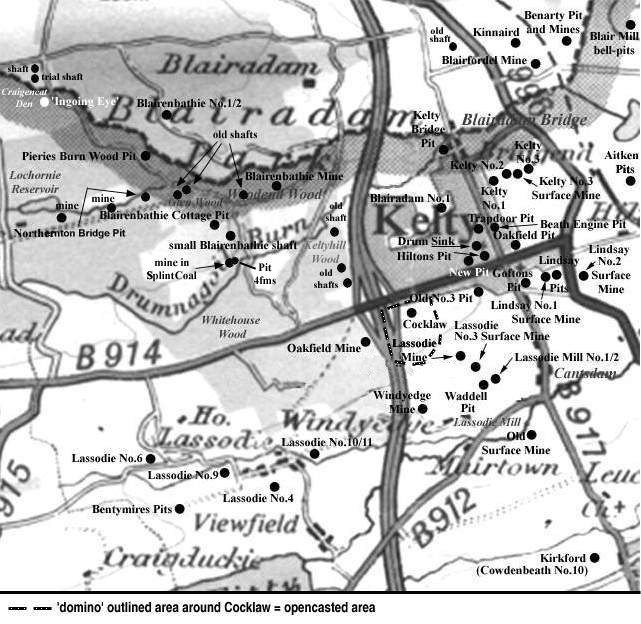
The old estate of Benarty, lying on the south facing slopes, at the western end of Benarty Hill, was formerly known as Blaircushnie, later shortened to Blair. Blair Mill lies less than half a mile to the south-west of Benarty House just off the Hill Road, a popular short-cut used by local drivers going between Ballingry and Kelty.
 |
Coal mining must have taken place here from early times
with written records relating to the mid sixteenth
century. Local historians have also reported that the use
of women and children as 'coal-bearers' was common
at the Blair pits and mines in the early part of the
eighteenth century. With such scanty records, it is
difficult to determine when these small, early bell-pits
and mines ceased coaling. It is quite likely that they had
become disused by the 1820s when bigger, and deeper, mines
were beginning to appear in the Crosshill and Lochore areas
to the east.
The late Mr Archibald 'Bauldie' Cook, Lochgelly, left
several written accounts of early mining in the Lochgelly area when
the activity was just approaching commercialisation. In one of his
accounts he describes Henry Chisholm, an Englishman, who came to
Scotland to begin his first mining operations at Blair Mill, on the
west end below Benarty Hill. He was assisted by his sons and
apparently put down several small pits which worked the coal
successfully for many years. It is said that pumping at the coalworks
was undertaken by hand-made wooden pumps. Chisholm and his sons
eventually took a lease of the minerals of Lochgelly Estate where
his family, and their descendants, worked for many years. One of
the pits is thought to be have been called the 'Chisholm Pit'
but reference to this name and location have not yet been observed on any old
plans.
It is also stated that Henry Ness, who opened up a mine in the Benarty
area just to the west of Blair Mill, worked through from his mine into the
old workings of the Chisholm pits finding several wooden tools and pieces
of Chisholm's early wooden machinery.
[We have noted the death of Janet Hodge (47), at the Blair Heugh in March, 1698. Her father, David Wilson, was also a collier.]
-----------------------------------------------
Possible coal seams worked at, or near, the Blair Mill bell-pits and mines
(based on a report from 1934)
The outcrop of the Kelty Main Coals, the highest member of the
Main group of coals, could be followed from the north of Kelty No. 1
Pit and then east of Blairadam where it swung north-eastwards by
Benarty mine to the mill dam at Blair Mill. The position of the
Kelty Main outcrop to the north was uncertain but it was believed
to have run parallel with the Den and 100 yds. east of it, just
to the west of Benarty House.
[A record of this site is known to
be held by RCAHMS.]
-----------------------------------------------
"The Scotsman"
21 June, 1828
To be SOLD by public roup ...
THE ESTATE of EAST BLAIR, lying in the parish of Ballingry, and county of Fife;
extending to 592 imperial acres, or thereby, of the best quality, with Mansion-house,
Garden, and Offices. This property lies on a gentle declivity, with a South exposure,
near to, and looking into, the beautiful Park and Grounds of Blairadam, from which it
is separated by the great road leading from Queensferry to Perth, and is within five
miles of the town of Kinross. The lands are partly let on a lease, in which there is a
break in case of a sale, and partly in Grass Parks from year to year. The free valued
annual worth is £492, ascertained by a report from Mr James Wood, late at Balboughty;
and there are upwards of 28 acres under valuable old wood, and thriving Plantations.
The Mansion House is in a tolerable repair, and fit to accommodate a respectable
family. The lands are held of the crown, and are valued in the Cess Books at
£240 13s 4d, Scots. It is known that seams of coal of considerable value exist
under these lands, which have been worked at no distant date.
-----------------------------------------------
