Blairenbathie Pits and Mines, Kelty

Owners: Beath and Blairadam Coal Company (BBCC)
Fife and Kinross Coal Company (FKCC)
Fife Coal Company (FCC)
National Coal Board (NCB)

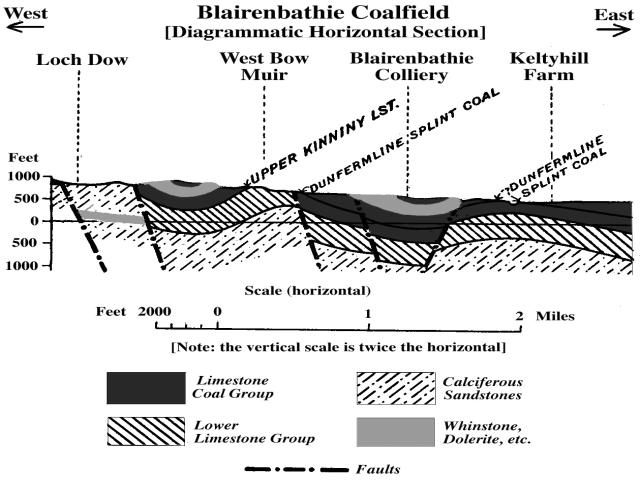
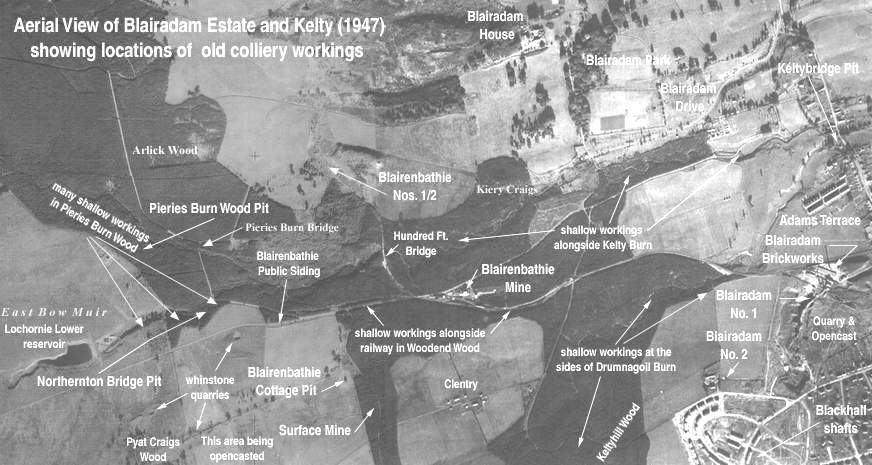
Coal has been worked in the Kelty area from the 1570s, when it is recorded that Lord William Douglas of Loch Leven was granted a Feu Charter to Kelty Heugh Colliery (in the Cocklaw estate) by the Commendator of Dunfermline Monastery. Documents indicate that this colliery was very old and had belonged to the Monastery for considerable time. The Blairenbathie area lying just to the north-west of Cocklaw was also extensively mined in earlier times from many small, shallow 'Blairenbathie pits or mines' too numerous to identify all locations individually with any accuracy.
A number of Blairenbathie workings can be identified in some detail and these are represented in this entry.
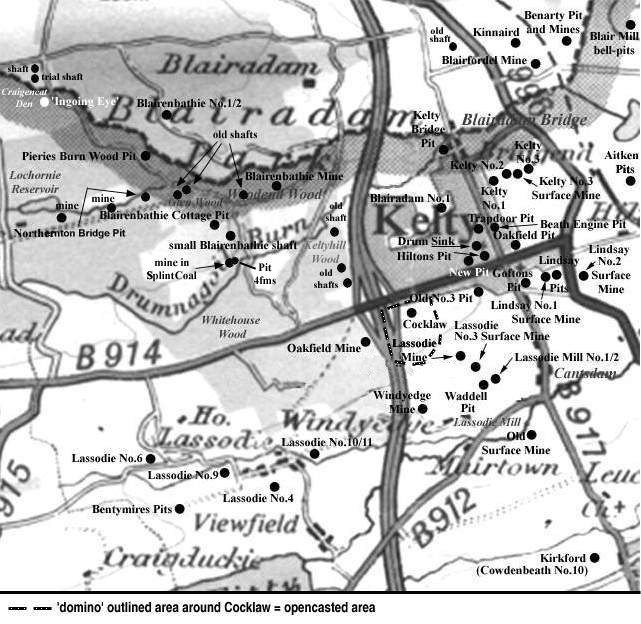
Click on Maps, Aerial View or Images to Zoom In

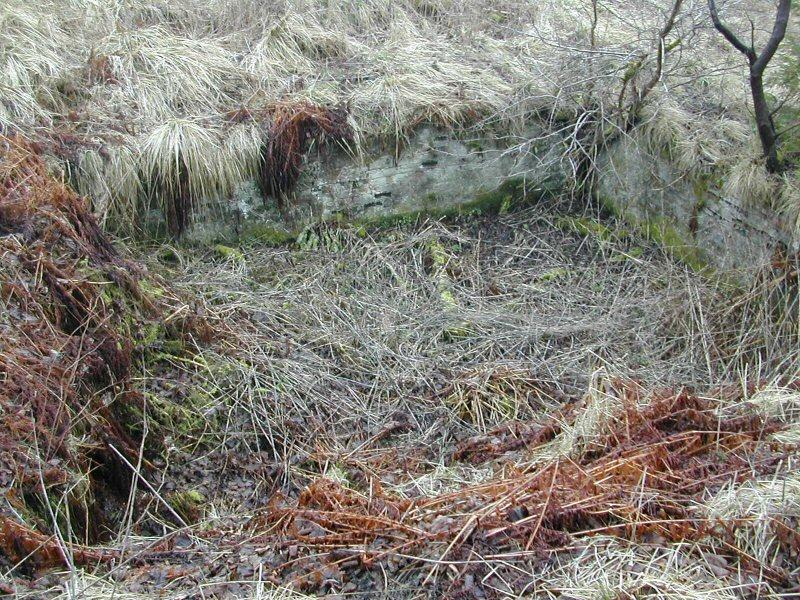
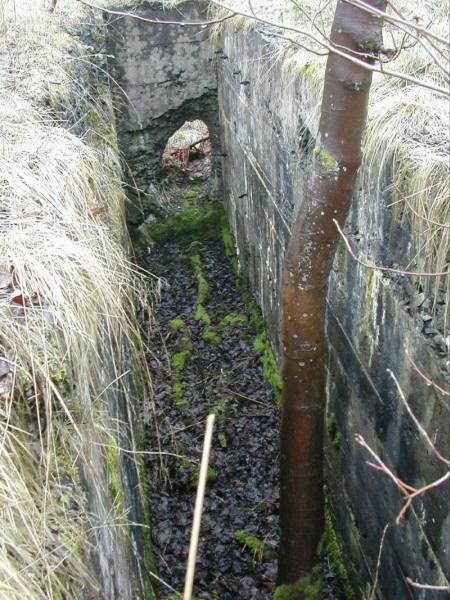
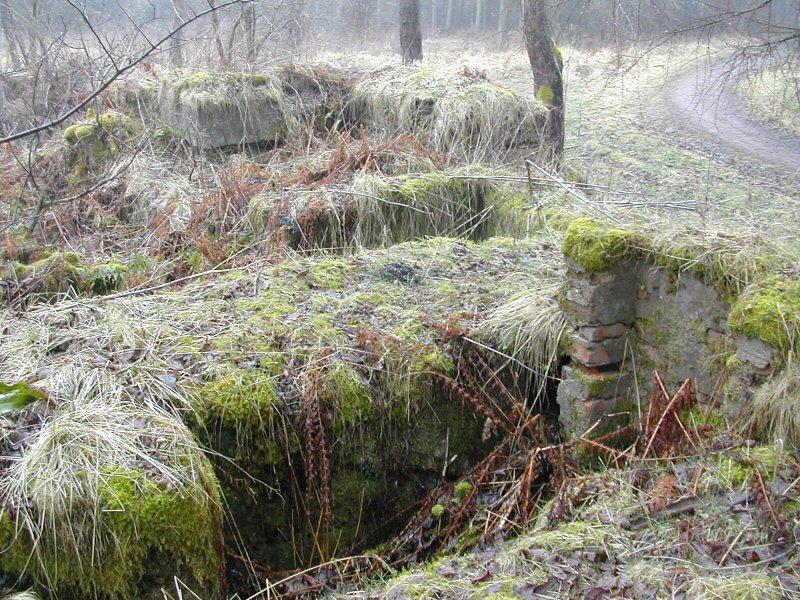
[The photographs of old ruins at the Blairenbathie Pits, Kelty, were kindly sent by Wallace Shackleton, Kinross Cycling Club.]

---------------------------------------

Source Date of Information Supplied - Blairenbathie Colliery
Manager / Under-Manager / Men underground / Men above ground / Coal seams worked
1874 (Fife Coal Company)
Mr J. Beveridge, under-manager.
1898 (Fife and Kinross Coal Company, Limited)
Sinking of the Blairenbathie Nos. 1, 2 Pits.  J. Allan, manager.
1901 (Fife Coal Co. Ltd.)
The Fife Coal Company acquire the Blairenbathie pits.
1902 (Fife Coal Co. Ltd.)
J. Allan / ------------ / --- / ---
1907 (Fife Coal Co. Ltd.)
June: Mr George Shearer Christie, manager, moves to New Cumnock.
1908 (Fife Coal Co. Ltd.)
Mr Joseph Provan / ------------ / 248 / 50
1911 (Fife Coal Co. Ltd.)
Nov: Mr Joseph Provan appointed manager of Dalbeath Colliery.
1914 (Fife Coal Co. Ltd.)
Apr: Mr John Duncan, manager.
1916 (Fife Coal Co. Ltd.)
Jul: Mr John Duncan, manager.
1918 (Fife Coal Co. Ltd.)
Sep: Departure of Mr Robert Aitchison, manager, to Donibristle Colliery.
New manager is Mr James Roden, ex-Mary Colliery, Lochore.
James Roden / Wm. McM. Campbell / 200 / 56
1919 (Fife Coal Co. Ltd.)
Jul: Departure of Mr James Roden to Cowdenbeath district.
Mr Wm. Campbell appointed manager.
1920 (Fife Coal Co. Ltd.)
May: Mr James Rattray, former undermanager, Lassodie Mill, appointed to management.
1922 (Fife Coal Co. Ltd.)
January: Mr Monaghan, manager, departs to take up a similar post at Lumphinnans Colliery.
Mr John Fleming, new manager, is appointed from Lassodie Mill Colliery.
1925 (Fife Coal Co. Ltd.)
May: Mr John Fleming, manager, is appointed manager of Valleyfield Colliery.


The short historical note which follows has kindly been contributed to explain the existence of the numerous shallow workings frequently mentioned in geological memoirs from which some site information is obtained and which are common to the excavations around Kelty Burn, Pieries Burn, Drumnagoil Burn, Lochornie Burn, Woodend Wood and Keltyhill Wood - all locations to the west of Kelty.

M. Martin & Webmasters

Following the last Ice Age (about 30,000 years ago) the land was covered by thick beds of glacial deposits comprising sand, clays and gravels. Subsequent streams and rivers cut through these relatively soft deposits and exposed the solid layers of rock (including coal) in the sides of the valleys and gorges formed by the erosive action of the water. History tells us that coal was most likely to be first mined at, or near, these locations. Dunfermline Glen, Esk Valley in the Lothians, Rhonda Valley in Wales, Tyneside in Northumberland and the Ruhr in Germany are typical examples.
On a smaller scale, this pattern is apparent in the Beath/Blairadam Estates where the coal seams, sloping to the rockhead from the Kelty and Lochore basins, were exposed by the erosive action of the Lochornie, Pieries, Drumnagoil and Kelty burns.
The age of what was to be known as 'Keltyheuch' was established when, in 1291, Dunfermline monks made reference to "coal being got from an open 'heuch' or level run in from the sides of the Kelty and other burns".
Sylvius Picolomini, a papal envoy makes reference, in 1435, to the 'black stones' which were dug from the earth and distributed from the church doors to half-clad beggars.
Hector Boece, a historian, also refers to the 'black stanes' in 1526.
A charter from the Commendator of the Monastery of Dunfermline was granted to William Douglas of Lochleven in 1572. The Commendator commented that "The Heuch is an old one and had been occupied by Lord William Douglas and his predecessors, their tenants, colliers and servants many years bygone beyond the memory of man."
After the estate was purchased by the Lord High Commissioner Adam, he made observations on the extent of, and the methods of working, the coal seams.
1772
I have seen all the lawn up to the doors of the house (Blairadam) covered with coal.
(Not many stately homes would use their lawns as a coal stockyard!).
1778
Workings were opened up along the banks of the Kelty burn, abandonment taking place in each case as the coals dipped below the level of the stream.
1831
Workings in the Woodend ..... and Northernton Park of Blairenbathie were all irregular. A pit seems to have been put down wherever they could get out coal, and had been deserted as soon as water drove them out of it.

This summary should serve to explain the references in the 'coal seams worked notes' encountered in a number of site entries to "lines of spoil heaps alongside burns being evidence of former coal workings". Improvements in pumping and winding machinery then led to the sinking of deeper shafts away from the confines of the banks of the Kelty burns where the 'easy coals' were by then largely exhausted.


Harry Adamson, Cowdenbeath

-----------------------------------------------

Old Parish records are a great source of information in spite of the many variations in spellings of names, etc., laid down in these documents. The names of some early miners, and the dates when they were working the early, small coalworks, are revealed in records of births, deaths, and marriages, the first of these records often accompanied by colourful descriptions of what they had been up to, and with whom!

13 Jan 1628, James Thomson, collier in Blairnebathie, and Marion Gib had Elspet; witnesses, John Thomson, James Baverage, John Baverage. Baptised in Cleish kirk "becaus of the cauld wether and evill way."

-----------------------------------------------

Statistical Account - Parish of Cleish - 1791

... There is also coal in the estate of Blair, belonging to John Adam, Esq., of Maryburgh. It has produced £180 a year; but it has not been wrought for some time, on account of its vicinity to the proprietor's house. ... The fuel used in the parish is coal and peat, with both of which the inhabitants are well supplied. Coal is got in two places, about a mile distant from the east and south east parts of the parish. The price, on the spot, is 6d. for 18 stone of great coal, and 4d. the small coal or chews. These coals are of excellent quality. ...

-----------------------------------------------

Statistical Account - Parish of Cleish - 1839

... There is coal on the estate of Blair-Adam, which was formerly wrought to a considerable extent; it is a branch of the Kelty coal. As it is near the proprietor's house, it has not been wrought for many years. There is also coal in the hill, but the seams are thin, and nearly perpendicular, so as not to be worth working. ...

-----------------------------------------------

A small pit, known locally as Blairenbathie Cottage Pit, was sunk by the Beath and Blairadam Coal Company around the mid-1850s. It was 177 ft. deep and had the usual collection of satellite, shallow, drift mines around it. Working was difficult due to geological disturbances and water problems and the pit was taken over by the Fife Coal Company in 1872. The newly formed company is believed to have sunk a pit (4 fathoms?) the following year to the Five Foot Coal seam at Blairenbathie Park but by 1876 the small Blairenbathie pits and mines were closed, along with the Northerton Bridge Pit, in a drive to improve the quality of FCC's products. Seams worked at these early Blairenbathie locations, in addition to the Five Foot, included the Dunfermline Splint and Glassee Coals.

Another small pit, 4 fathoms deep, located around a quarter of a mile to the south of the Blairenbathie Cottage Pit, features on an abandonment plan of November 1876, adjacent to a trial mine on the Splint Coal, the mine having a dip of 1 in 3.

A section of the Splint seam was recorded as having the following composition:

Section of Splint Coal at Trial Mine
Blaes [Roof]
Blaes   } 1 ft.
Coal     } 2 ft. 2 in.
Fireclay } 1 ft. 6 in.
Sandstone [Pavement]

-----------------------------------------------

In an article, written in December 1898, we find references to later Blairenbathie operations leading to the establishment of the Blairenbathie Nos. 1, 2 Pits: "... Some time ago, the Fife and Kinross Coal Company, Limited, was floated with a capital of £70,000 with the object of working the Blairenbathie mineral field forming the west coalfield of the estate of Blairadam. The Company have been fortunate in securing Mr Allan as manager. Mr Allan has had great experience in mining operations in the West of Scotland, and he has commenced operations on such a scale as to indicate that he intends establishing a first-class colliery. The field extends to fully a square mile, and it has been proved by bores being put down on the dip and the rise of the metals. The bores brought up the following results:-

Depth (fathoms) Seam Thickness

27

Rough Coal 5 ft. 6 in.

45

Main Coal 6 ft. 6 in.

47

Cairncubie Upper 3 ft. 6 in.

47

Cairncubie Lower 2 ft. 8 in.

49

Duddie Davie 5 ft.

52

Swallowdrum 2 ft. 3 in.

111

Glassie 3 ft. 10 in.

134

Five Foot 4 - 5 ft.

152

Dunfermline Splint 2 ft. 8 in.

All these seams are of good quality. Two pits are in the process of sinking and all the machinery has been contracted for. Mr Allan and his directors have chosen what is undoubtedly the best site for the pits. The site chosen is a point about half-a-mile west from the mansion house of Blairadam.
It is the basin of the surface, and the bores show that it will also prove the basin of the mineral field. Indeed, the pits are likely to strike into the deepest part of the coal basin, and from every side it is contemplated that the coals will be worked to the rise. Should this expectation be realised, it will be an easy matter to run the coals into the pit bottoms without extensive haulage.
No. 1 Pit is 16½ feet by 10 feet, and No. 2 12 feet by 10 feet. For No. 1, a tandem combined pumping engine has been contracted for. The engine will have a six-foot stroke, and will work at the rate of from 6 to 5 strokes a minute. All the gearing will be of the best type, the two plungers being 17 inches in diameter. A pair of coupled winding engines have been ordered for each shaft, and steam will be provided for the whole machines by four Lancashire boilers. The base has been laid for a chimney stalk 125 feet high, and the work of constructing the flues is being pushed on with all vigour.
Two well-known Airdrie firms, Messrs Gibb & Hogg, and Mr Martin, are supplying the pumping and the winding engines, and Mr Marshall of Motherwell, secured the contracts for the boilers.
The chimney stalk and the flues have been placed in the hands of Mr Street, Cowdenbeath, while Mr Adams, High Blantyre, is to undertake the pithead frame work.
The well-known pit sinkers, Messrs Ford and McAllum, have been entrusted with the sinking of the shafts. The old Blairadam railway runs to a point within a quarter of a mile of the site of the pits, and from here it is intended to extend the line to the works. A thick wood and a glen separate the pits from the railway, and the connection, short as it is, will involve considerable expenditure. The trees are being cleared with all possible speed, and the management of the pits hope that the railway connection will be made within six months.
Meantime, a light railway has been run to the point where the Blairenbathie line terminates to the pits, and over this line it is intended to convey the material for building operations and the lighter portions of the machinery.
Two pretty heavy layers of whin rock fall to be cut through in both shafts. Whin, of course, adds considerably to the cost of sinking, but with the explosives in use nowadays, even whinstone is got through in a wonderfully short time.
The pits are to be lined with wood from top to bottom. They will be worked on the double-cage system - a ton of coal being brought to the surface every run. The Upper seams will be tackled in No. 2 Pit, and in No. 1, the pumping pit, the Dunfermline Splint and the Five Foot seam will be developed.
Meantime, the Company will only have the old row of houses at Blairenbathie, but as time goes on, they will proceed with the erection of houses on the estate of Blairadam, near Kelty. ... "

-----------------------------------------------------
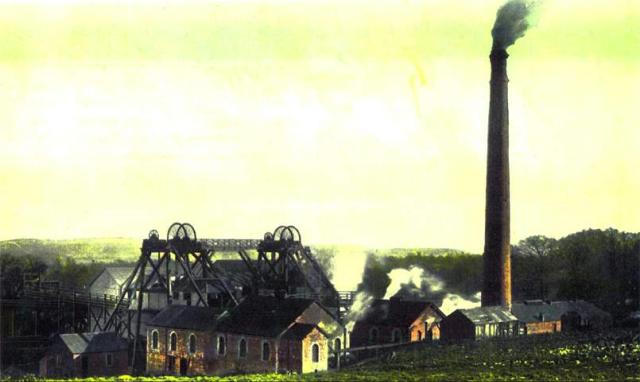

Click on Image to Zoom In

Plans of Abandoned Seams for Blairenbathie Pits or Mines designated in Plans
COAL; Five Feet (August, 1876) KELTY:
Blairenbathie or Blairadam No. 2
COAL; Splint; Seam unnamed, at seventeen fathoms (November, 1876) BLAIRADAM LANDS:
Blairenbathie
; Northertown Bridge
COAL; Five Feet; Glassee BLAIRENBATHIE
COAL; Five Feet BLAIRENBATHIE (DISTRICT)
COAL; Five Feet; Lochgelly No. 1; Lochgelly No. 2; Lochgelly No. 3; Lochgelly No. 4;
Diamond; Swallowdrum; Main; Dunfermline Splint (9 April, 1925)
Blairenbathie Nos. 1, 2

---------------------------------------------

Information on coals worked at, or near, Blairenbathie Pits and Mines

(based on reports from 1930 and 1934)

The Sulphur or Stink Coal of the Blairenbathie coalfield had a better development than was usual in the Kelty area. On the south-west side of the Craigencat fault (the western boundary of the Blairenbathie Coalfield), where the seam had been proved in a number of bores, it lay in a thick bed of blaes and was in two or three leaves.
The upper leaf was from 1 ft. 10 in. to 2 ft. 2 in. thick and was separated by a foot or two of coaly blaes from an underlying seam of parrot coal. On the north-east side of the fault, near Blairenbathie farm, the coal reached around 3 ft. 11 in. but it thinned out as it was followed northwards. A typical section measured in the small surface mine 300 yds. east of the farm, where the coal was worked as the Dunfermline Splint, had the following composition:

Blaes -
COAL 2 ft. 6 in.
Fireclay 1½ in.
COAL 1 ft. 3½ in.
Fakes -

In the Maryburgh region to the east, the coal did not exceed 1 ft. 2 in. Near the Blairenbathie Pits, in the centre of the syncline (see sketch map), an average section gave 2 ft. 6 in. of sulphury coal separated by 1 ft. of blaes from an 8 in. thick parrot coal, both reported as "foul". In the west near Craigencat Cottage, the section had the following composition:

Blaes with balls 12 ft. 9 in.
COAL 2 ft. 3 in.
Soft parting 2 in.
COAL 6 in.
Coaly blaes 2 in.
Sulphur 2 in.
COAL 11 in.
Fakes -

Around the Nos. 1, 2 Pits, Dunfermline Splint Coal was close to 3 ft. thick, an average section having the composition below:

Grey fakes -
Blaes 6 in.
COAL 2 ft. 7 in.
Dark fakes 2 ft. 5 in.
Sandstone -

Towards the west of the syncline, the coal was 2 ft. 4 in. thick with a blaes roof and a sandstone pavement.

In another surface mine at Woodend Wood, near the railway, the Dunfermline Splint measured 2 ft. 8 in., of which the lower half was soft coal. Nearer Maryburgh (to the east), the seam was thought to split into two thin leaves separated by sandy layers. Some 2 to 3 fathoms above the Dunfermline Splint, and separated from it by sandstone, was a coal of 1 ft. to 1 ft. 3 in. which was associated with parrot and ironstone. (This seam may have been a leaf of the underlying Splint rather than the representative of the true Two Foot Coal of other districts.)

The Five Foot Coal here was of good quality and was extracted from the shallower parts of the coalfield by "crop-pits" and "ingaun' een".
[Ingaun' een or "in going eyes" were the mouths of drift or surface mines.]
In the south of the field the Five Foot was a composite seam measuring around 3 ft. 6 in. thick. At Blairenbathie Cottages, where a small area was worked from the surface mine, the Five Foot Coal was from 3 ft. 6 in. to 4 ft. with a blaes roof and a fakes pavement. Nearer the outcrop at Maryburgh, the coal was 'firm' and around 3 ft. 2 in. to 3 ft. 9 in.

To the north-west of Blairenbathie Nos. 1, 2 where it was most extensively worked in the district, the coal was 4 ft. thick with a roof of faky blaes and a sandstone pavement. Traces of old surface workings could be seen in the burn south-east of Craigencat Cottage and in the north bank of the eastern reservoir at Lochornie, about 80 yds. from the embankment. Above the Five Foot seam was a thick bed of blaes with ironstone nodules in which lay two thin seams of coal. The upper of these, about 15 ft. above the Five Foot Coal, may have reached a thickness of 1 ft. 3 in. and probably corresponded to the Pittencrieff Ironstone of Dunfermline and the Jewel Coal of Cowdenbeath.

Mynheer Coal was a thin seam not systematically exploited at Blairenbathie. In the south it was found to be a soft coal of about 1 ft. 6 in. but in the north-east, approaching Maryburgh and Kinnaird, it improved in quality and thickness, reaching 2 ft. 6 in. of hard coal. In the centre of the field the coal was very variable and could be represented by a mere streak of coaly blaes. At its best it was a 1 ft. 10 in. coal with a hard fake roof and a sandstone pavement. In the west, near the outcrop, several bores gave varying thicknesses from 1 ft. 3 in. to 1 ft. 7 in. of coal.

The Glassee Coal lay from 8 to 10 fathoms above the Mynheer seam and was poorly developed in the Blairenbathie coalfield, ranging from 2 ft. 3 in. to 3 ft. 9 in. thick.

In Blairenbathie No. 2 Pit, the Glassee Coal seam was cut at 77 fathoms from the surface providing the following section:

Blaes -
Ironstone 3 in.
COAL 2 ft. 6 in.
Fakes -

Shallow workings of the Glassee Coal, around 2 ft. 7 in. with a foul rib, are known to have taken place at Pieries Burn Wood, at the outcrop in Lochornie Burn, west of Northerton Bridge Pit, and from several small pits in Northerton Wood.

There was considerable difficulty in identifying the individual members of the Main Group of coals in the Blairenbathie district as an irregular group of whinstone sills was intruded in to the sediments.

South of the Kelty Burn, where the lowest sheet of whinstone was at the surface along the centre of the incline, several members of the Group were preserved.

In No. 8 Bore, Blairenbathie, just 200 yds. south of the farm, the following section was cut immediately below the surface mine:

Fakes -
COAL 1 ft. 9 in.
Fireclay 1 in.
COAL 1 ft. 9 in.
Fireclay 11 in.
COAL 1 ft. 1 in.
Fireclay 1 ft. 10 in.
COAL 1 ft. 8 in.
Fakes -

These coals were considered to represent the Eight Foot Coals of Townhill, and the Lochgelly Splint and Parrot Coals of Cowdenbeath.

In No. 1 Bore, Blairadam, just 50 yds. west of Northerton Bridge, a 4 ft. 6 in. seam of Lochgelly Parrot Coal at the surface was worked from several pits towards the dip. To the east, between Blairenbathie Cottages and Glen Wood, one of the lower members of the Group was worked from a shallow pit, and traces of an old drainage level could be seen opening into Kelty Burn just east of the mineral railway to the Blairenbathie Pits. Whether this was one of the Lochgelly Coals was not certain but it was unlikely that it was one of the higher Jersey Coals.

From the information available, it was concluded that the thick group of coals which underlay the whinstone in the southern area represented the Lochgelly Splint and Parrot Coals, with occasional burnt remnants of the Swallowdrum and Jersey seams where the sill had locally transgressed upwards.

In No. 2 Bore, Blairenbathie, where two whinstone sills were pierced, the following section was recorded below the lower sill:

Fakes and balls -
COAL (burnt) with parting 1 ft. 11 in.
Blaes, faky 1 ft. 8 in.
COAL, foul 2 ft. 11 in.
Sandstone and various strata 21 ft. 6 in.
COAL 5 ft.
Strata, various 10 ft. 5 in.
COAL, No. 1 Lochgelly Seam 5 ft. 1 in.
Fakes and blaes 5 ft. 11 in.
COAL, No. 2 Lochgelly Seam 3 ft. 10 in.
Sandstone and fakes 3 ft.
COAL, No. 3 Lochgelly Seam 3 ft. 4 in.
Fakes and blaes -

Locally known as Lochgelly No. 1, Lochgelly No. 2 and Lochgelly No. 3 Coals, and cut about 61 fathoms from the surface, the three bottom seams were worked from Blairenbathie Nos. 1, 2 Pits towards the south and west (the lower two may have been the Eight Foot or Lochgelly Coals). Just north of the pits, the whinstone transgressed downwards and Nos. 1, 2 and 3 Coals were successively burnt and cut off along a roughly east-west line. A bore put down 260 yds. north-west of the pits showed that the Lochgelly Coals were almost entirely destroyed, their only representatives being two thin burnt coals found 97 fathoms from the surface and immediately below the whinstone.

The 5 ft. coal recorded in No. 2 Bore, Blairenbathie, occurring 10 ft. above No. 1 Lochgelly Coal, was considered to be the Swallowdrum Coal.

Swallowdrum Coal with a total thickness of 6 ft. 9 in., including a 2 in. parting and 1 ft. 7 in. of foul coal, was cut at 51 fathoms in No. 1 Bore and a small area of the coal was worked to the north-west of the pits.

Jersey Coals, lay about 4 fathoms above the Swallowdrum Coal, but were not workable to the south of the Kelty Burn being burnt and foul.

The Kelty Main Coal at the top of the Main Group was not known south of the Kelty Burn but it was cut in both Blairenbathie Pits at 37½ fathoms from the surface and a considerable section was worked to the north-west. Where the whinstone sill was in two leaves, the Kelty Main Coal lay between them and was burnt and sooty. Its outcrop was probably to be found in the strip of disturbed sediments which form the northern bank of the Kelty Burn from the railway bridge to Pieries Burn Bridge. The thick Kelty Main Coal also outcropped about 130 yds. east of Blairadam gardens.

A seam of Kelty Blackband Ironstone (7 in. coal on 8 in. ironstone) lay 4 fathoms above the Main Coal but this was not of economic value locally.

Little was known about the Rough Coal in the Blairenbathie district. The Rough Coal lay within 20 fathoms of the surface at the Blairenbathie Nos. 1 & 2 Pits and was in two leaves (upper 3 ft., lower 2 ft. 6 in.) separated by 4 ft. of stone. About 100 yds. east of Blairadam House, a seam 10 ft. thick was at one time worked from the surface and traces of its outcrop were still visible towards the north-east.

-------------------------------------------

"The Scotsman"
5 August, 1870
COALFIELDS ON BLAIRADAM ESTATE.

TO BE LET, and entered to immediately, in whole or in part, and
for such periods as may be agreed on,
THE COALFIELDS of CLENTRY, BLAIRENBATHIE, and LOCHORNIE, adjoining to Kelty and Beath Collieries on the Kinross-shire Railway.
A series of Bores recently put down proves excellent Seams of Coal, and a trial pit is open which shows the quality and thickness of one of the Seams.
A branch line is formed and working from the Railway to the existing Pits, and a survey has been made for a extension to the Coalfields above named.
Apply to Mr DOWIE, Factor, Blairadam; or Messrs GEDDES, M. E., 9 Melville Crescent, Edinburgh, who will give particulars.
July 8, 1870.

-------------------------------------------

"Dunfermline Press"
2 May, 1874
KELTY - SUPPER

The contractors - Messrs. E. Muir and R. Ramsay - for the making of the new pit, Blairenbathie, having finished their contract, they and their men were kindly entertained to supper on the 18th inst., in Oakfield Inn, by the manager, Mr. C. Carlow.

[The underground manager at this time was Mr. J. Beveridge. The pit was sunk on the estate of Mr. W. P. Adam, of Blairadam.]

------------------------------------


"Dunfermline Press"
11 July, 1874

On Tuesday, while a brusher named Robert Ramsay was employed in Blairenbathie new pit, belonging to the Fife Coal Company, a lump of stone fell from the roof and struck him on the left side of the neck and shoulder, causing some rather severe bruises. He was attended by Dr. Mungall, Cowdenbeath.

------------------------------------

"Dunfermline Press"
6 August, 1898
NEW FIFE COAL COMPANY

This week the recently-formed Coal Company, known as the Fife and Kinross Company, began to sink a pit on the Blairadam estate, nearly three miles to the west of the old colliery village of Kelty. Should the venture prove a success it will mean that another colliery village will spring up in Fife.

------------------------------------

"Dunfermline Press"
26 November, 1898
A PROBABLE NEW COLLIERY VILLAGE

The Directors of the new Fife and Kinross Coal Company in their first annual report, hold out high hopes to the shareholders. Should the new venture turn out a success, a new colliery village will be created in the north-west of Fife.

------------------------------------

"Dunfermline Press"
14 January, 1899
KELTY - NEW RAILWAY

Mr John Martin, contractor, Dunfermline, has secured the contract for the proposed new railway for the Fife and Kinross Coal Company at Blairenbathie.

------------------------------------

Blairenbathie Nos. 1, 2 was sunk to the north of the earlier Blairenbathie locations by the Fife and Kinross Coal Company, in 1898, to a depth of 674 ft. and was served by a spur from the Blairadam/ Blairenbathie mineral line. The line crossed the Kelty Burn by the scenic 'Hundred Foot Bridge'. The pits were taken over by the FCC in 1901 and continued working in difficult geological conditions until 1925 when they were closed due to the general slump in trade.

A journal of the North British Railway Study Group makes interesting comments:
The line from Blairadam to Blairenbathie had a rising gradient of 1 in 30, surpassed only by the infamous 1 in 20 gradient on the Kirkcaldy Harbour branch line.
The shunters were given special instructions:
An incline brake must be provided on trains from Blairadam to Blairenbathie and back and must be furnished with at least 6 sprags. Guards must pin down sufficient wagon brakes at top of incline in accordance with P.D.W.B. (i.e. Pin Down Wagon Brakes) instructions and speed down incline must not exceed 4 miles per hour.

Special trains were run from Kelty to the colliery to take miners to and from there at the start and finish of shifts. There would be an alighting platform at the colliery sidings.
Colliery platforms for workers' trains were found elsewhere in Fife, notably at Blairfordel (near Kelty), Lumphinnans and, in the east of the Kingdom, at Largoward.

------------------------------------

"Dunfermline Press"
17 February, 1900

The mangled remains of a tramp labourer named Robert Small, thirty-five years of age, were found on Thursday on the railway near Blairadam Colliery. He had been run over by a train, and it is believed that he was killed instantaneously. Deceased only started work at Blairenbathie Colliery on Wednesday.

-------------------------------------------------

"Dunfermline Press"
23 February, 1901

Henry White, forty years of age, residing at Kelty, was admitted to the Dunfermline Cottage Hospital, on Tuesday afternoon, suffering from injuries sustained earlier in the day at Blairenbathie Colliery, in the county of Kinross. White's right leg had been severely injured, and it was found necessary to amputate it above the knee.

-------------------------------------------------

"Dunfermline Press"
27 April, 1901
FIFE AND KINROSS COAL COMPANY

Another illustration of the great extent to which the coalfields of Fife are being developed falls to be recorded in the success which is attending the operations of the Fife and Kinross Coal Company. This Company was formed three years ago for the purpose of working what is known as the Blairenbathie coalfield, on the estate of Blairadam. Two pits have been sunk, and the winding engines are capable of raising an aggregate output of 1000 tons daily. The main coal, which is five feet thick, was found at a depth of 46 fathoms; the Cairncubie seam, four feet four inches thick, at a depth of 49 fathoms; and the Lochgelly splint at a depth of about 51 fathoms. Difficulties in working the Lochgelly splint were encountered, and it was decided to sink to the Dunfermline splint.
The five-feet seam was struck at a depth of 86 fathoms, and on Saturday a flag was hoisted at the pithead to indicate that the Company had succeeded in reaching the Dunfermline splint. The coal is of good quality, and being free from the difficulties encountered in the upper seams, it is expected that the development of the Dunfermline splint and five-feet seam will prove extremely profitable for the Company. In anticipation of the successful working of the seams, coal-picking and cleaning plant has been got, and the necessary staging will be erected without delay. The old Blairenbathie railway has been extended to the pits. The contractor for the railway and for the erection of a bridge over the Kelty burn was Mr John Martin, Dunfermline. It is expected that ere long the Company will be obliged to erect workmen's houses on the Blairadam estate, near Kelty.

-------------------------------------------------

"Dunfermline Press"
7 September, 1901

This issue carried the news that the Fife and Kinross Coal Company was to be wound up, the report issued by the Directors stating that the cash resources of the concern have been completely exhausted.

--------------------------------------------------

"Dunfermline Press"
9 November, 1901

Blairenbathie Colliery, which was exposed to sale by public roup within Dowell's Rooms, George St., Edinburgh, last week, but failed to find a purchaser, has been acquired by the Fife Coal Company, Limited. The Fife and Kinross Company spent from £40,000 to £50,000 on the colliery. Indeed, they exhausted all their capital. The colliery was exposed at the upset price of £15,000.

--------------------------------------------------


"Dunfermline Press"
7 March, 1903

A fatal accident befell James King, miner, Lower Oakfield, Kelty, on Monday. While deceased was at work in Blairenbathie Pit, belonging to the Fife Coal Company, Limited, about two tons of stone and coal came away. King saw the fall coming and gave cry, but was unable to get out of the way, and was crushed to death. Deceased was married, and leaves a large family to mourn his loss.

----------------

"Dunfermline Press"
28 March, 1903

An inquiry, under the Fatal Accidents Inquiry Act, was held at Kinross on Tuesday, into the circumstances attending the death of James King, miner, Lower Oakfield, Kelty, who lost his life in the Fife Coal Company's works at Blairenbathie on the 2nd inst. He had been engaged at the face when a large quantity of coal and stone came away upon him. Sheriff Kincaid Mackenzie presided. The relatives of the deceased were represented by Mr Weir, miners' secretary. The jury returned a formal verdict.


"Dunfermline Press"
8 October, 1904
FATAL ACCIDENT INQUIRY

A public inquiry was held - before Hon. Sheriff-Substitute J. Dean Leslie and jury at Kinross, on Tuesday - in regard to the death of William Black, miner, who resided at Grieveland Terrace, Kelty, and who died from injuries sustained while working in Blairenbathie Pit in November last year, by a stone falling from the roof and striking him on the head. The jury returned a verdict in accordance with the evidence.

--------------------------------------------------

"Dunfermline Press"
24 June, 1905

A young lad named Muirhead, residing at Adams Terrace, Kelty, had one of his legs fractured while he was at work in Blairenbathie Colliery on Monday.
While employed in Blairenbathie Pit, on Tuesday afternoon, a young miner, named John Newton, residing in Croall Place, was struck by a runaway hutch, and had one of his legs fractured in two places.

--------------------------------------------------


"Saturday Dunfermline Press"
17 March, 1906

A blasting accident, whereby two men were injured, one of them fatally, occurred on Monday at Blairenbathie Pit, belonging to the Fife Coal Company. The names of the men are:- John Clark, Adam's Terrace, Kelty; and John Murie, Dick's Buildings, Kelty. They were using gelignite and are supposed to have been stemming a hole when the explosion occurred. The men were fearfully injured. Both had their eyesight totally destroyed, and Murie's right arm was so badly shattered that on his removal to the Dunfermline and West Fife Hospital, the limb was amputated by Dr. Tuke. The unfortunate man succumbed to his injuries on Tuesday morning. Clark received a serious abdominal wound, and injuries about the chest and neck. In fact, the force of the explosion was such that pieces of wood and coal had become embedded in the flesh of the chests and necks of both of the unfortunate victims of the accident. Dr. Carment, Kelty, who had temporarily attended to the injured men, accompanied them to the hospital, whither they were conveyed in the ambulance van.


"Dunfermline Press"
5 May, 1906

... William Haxton, between forty and fifty years of age, residing at Norris Cottage, Kelty, was fatally injured at Blairenbathie Colliery, belonging to the Fife Coal Company. Haxton had been engaged clearing away some redd in the road to his working place, when a large stone suddenly came away on the top of him and crushed him to the ground. It required the assistance of four to remove the stone, and, this done, it was found that Haxton was still alive, but seriously injured. No time was lost in getting medical assistance, but the injured man succumbed on his way home in the ambulance waggon. ..

----------------------------------------------

"Dunfermline Press"
2 June, 1906

Two fatal accident inquiries were held before Sheriff-Substitute J. Dean Leslie and juries at Kinross on Tuesday into the circumstances attending the deaths of John Murie, miner, Forrest's Buildings, Kelty, and Wm. Haxton, miner, Norris Cottage, Kelty, from injuries sustained in the course of their employment in Blairenbathie Colliery on 12th March and 30th April last respectively. Formal verdicts were returned.

----------------------------------------------

"Dunfermline Press"
30 March, 1907

This issue carried the news that Peter Sneddon, checkweigher, Blairenbathie Colliery, was accidentally killed at Cowdenbeath Station by a pilot engine coming from Kelty. Sneddon was fifty years of age and a widower.

----------------------------------------------

"Dunfermline Press"
22 June, 1907

This issue carried the news that Mr George S. Christie, manager, Blairenbathie, was leaving to take up a new position in New Cumnock. Mr Colin Terris made the presentation.

----------------------------------------------

"Dunfermline Press"
6 July, 1907

George Malcolm, Kirk Row, and George Haddon, Dewar's Row, both miners, have been admitted to the Dunfermline and West Fife Hospital suffering from burning injuries sustained in the Blairenbathie Pit. The men, it is stated, were stemming a shot when it prematurely exploded.

----------------------------------------------

"Dunfermline Press"
30 July, 1910

On Monday afternoon, a miner, named Peter Downie, who resided in Kinross, was fatally injured while at his work in Blairenbathie Colliery, on the Blairadam estate, by being crushed by a waggon.

----------------------------------------------

"Dunfermline Press"
11 November, 1911

On Saturday Mr Joseph Provan, manager of Blairenbathie Colliery, was presented with a roll top desk by the officials and workers on the occasion of his transference to Dalbeath. At the same time, Mrs Provan was made the recipient of a gold brooch. Mr John Butters, oversman, presided and made the presentations.

----------------------------------------------

"Cowdenbeath Mail"
Saturday, 20 January, 1912

Daniel McVicar or Graham, miner, was seriously injured in Blairenbathie Colliery on Tuesday by being caught by a brace of runaway hutches, and dragged for a considerable distance. One of his legs was broken, and his side crushed.

---------------------------------------------

"Dunfermline Press"
17 May, 1913

A large electric installation is in course of completion at the Fife Coal Company's Blairenbathie Colliery. It is expected that within a short time employment will be found at the colliery for many additional men. At all the pits in the neighbourhood work is plentiful at present.

---------------------------------------------

"Dunfermline Press"
25 October, 1913

While engaged as a miner in Blairenbathie Colliery, Duncan Cameron, residing at Grandsell Place, Kelty, had his collar-bone fractured by a fall of stone from the roof.

---------------------------------------------

"Dunfermline Press"
28 March, 1914
KILLED BY A RUNAWAY HUTCH

An inquiry was held in the Sheriff Court, Kinross, on Tuesday, before Sheriff-Substitute J. Dean Leslie and a jury, into the circumstances attending David M. Brown, who resided at 43 Croall Place. The finding of the jury was to the effect that on the morning of Friday, 27th February, deceased, while engaged at work as a bencher within No. 2 Pit of the Blairenbathie Colliery, belonging to and worked by the Fife Coal Company, Limited, was struck by a runaway hutch, and was instantaneously killed.

---------------------------------------------

"Dunfermline Press"
12 August, 1916

Mr John Sturrock, colliery cashier, Cowdenbeath, was met by managers and representatives of Blairadam and Blairenbathie Collieries on Monday and presented with a gold albert and appendage (inscribed) on the occasion of his leaving the collieries to join the Army. Mr J. Wilkie made the presentation.

---------------------------------------------

"Dunfermline Press"
12 August, 1916

While endeavouring to place a large piece of coal in a hutch at Blairenbathie Pit on Friday last week, William Johnston, miner, Keltyhill Road, had his leg broken below the knee. The coal unexpectedly broke, and a portion fell on his leg.

---------------------------------------------

"Dunfermline Press"
21 September, 1918

Mr Robert Aitchison, who has been manager at Blairadam and Blairenbathie Collieries for some time, has been transferred to a similar position at Donibristle. His place at Kelty is being taken up by Mr Roden from the Mary Pit, Lochore.

---------------------------------------------

"Cowdenbeath & Lochgelly Times & Advertiser"
9 July, 1919
COLLIERY MANAGER PROMOTED

The appointment of Mr Wm. Campbell as manager of Blairenbathie Colliery has created a considerable amount of satisfaction amongst his numerous friends and admirers. Commencing in the Mary Pit, Lochore, as an oversman, his zeal and integrity and his undoubted ability steadily earned for him the respect of his employers, with the result that promotion followed promotion.
Promoted to under-manager at the Mary, then transferred to the same position at Blairenbathie, the question of further promotion was only a question of time. His many friends wish him every success in his new position.

---------------------------------------------

"Dunfermline Press"
19 July, 1919

Mr Jas. Roden, lately manager at Blairadam and Blairenbathie Collieries, has been presented with a set of books and a wallet of Treasury notes by the workers, on the occasion of his transference to Cowdenbeath district. ...

---------------------------------------------

"Dunfermline Press"
20 December, 1919

While at work as repairers in Blairenbathie Colliery early on Thursday morning, Thomas Smith and Robert Thomson, both residing in Kelty, were seriously injured by a fall from the roof. The men were buried, and were released only after some strenuous hours of work by their fellow-workers.

---------------------------------------------

"Cowdenbeath & Lochgelly Times & Advertiser"
26 June, 1920

Geo. Walkinshaw, Church Street, Kelty, was killed in Blairenbathie pit while working as a brusher on Saturday. He leaves a widow and three children.

------------------------

"Dunfermline Press"
26 June, 1920

While at work in Blairenbathie Pit, early on Sunday morning, Robert Walkingshaw, Church Row, Kelty, met with his death through a fall of stone. Deceased was about forty years of age. He leaves a widow and three young children.

---------------------------------------------

"Dunfermline Press"
5 February, 1921

While at work in Blairenbathie Pit on Saturday, Wm. Truran was badly injured about the back and lower part of the body by a fall of coal from the face. Truran was removed to his home in Woodend, Kelty, where he is making satisfactory progress towards recovery.

---------------------------------------------

"Dunfermline Press"
9 July, 1921

... In the Kelty area, the men are faced with a serious state of affairs. There, only something like 6 per cent. of the pit workers have been absorbed. Blairenbathie and Benarty Pits have not so far been opened at all; and the conditions at other pits, in the way of damage by flooding and otherwise, is such that a long time must elapse before there is anything like a general resumption. Meantime, in all the areas where the pumping gear has been put out of action by flooding, strenuous efforts are being made to make good the damage, which, in many instances, has been found to involve the installation of new plant.

---------------------------------------------

"Dunfermline Press"
30 July, 1921

... Blairadam and Blairenbathie Collieries are gradually getting into motion again. Nothing has been done so far in Benarty Colliery, about one-fourth of the men being unemployed. The suffering is still very acute.

---------------------------------------------

"Dunfermline Press"
27 August, 1921

Work was resumed at Benarty Colliery on Monday, the first start since the coal trade dispute, and a few extra men are being engaged daily. The men employed at Blairadam and Blairenbathie are being hard hit, only working about two or three days per week. The Aitken and Lindsay Pits are working steadily, and the output is already far in excess of that secured for some years. Work is likely to be suspended for a day or two at the Lindsay Colliery, where the management have been forced to install heavier electrically-driven winding gear with a view to coping with the increased output.

---------------------------------------------

"Dunfermline Press"
17 September, 1921

While working at the coal face in Blairenbathie Colliery on Tuesday, Samuel Smith, residing with his parents at Dunn's Row, Kelty, was injured through a pick striking and setting off a charge of gelignite which, unknown to him, had failed to explode the previous night. The unfortunate lad was seriously injured about the face and was removed to Dunfermline and West Fife Hospital.

---------------------------------------------

"Dunfermline Press"
1 October, 1921

No improvement is yet taking place in the amount of work being obtained at Blairadam and Blairenbathie Collieries, where the workers have now had almost a year's short time, irrespective of work lost during the strikes.

---------------------------------------------

"Dunfermline Press"
30 June, 1923

... In Blairenbathie Colliery on Saturday morning, Thos. Pryde, residing at Dewar Place, Kelty, was severely injured about the back by a fall of stone from the roof. After being attended to by Dr A. C. Keay, he was removed to Dunfermline and West Fife Hospital. Pryde is a well-known member of the local brass band.

---------------------------------------------

"Dunfermline Press"
29 December, 1923

A fatal accident occurred in the Fife Coal Company's Blairenbathie Pit, Kelty, yesterday forenoon. The victim was David Wright (48), a repairer, residing at Keltyhill Road, Kelty, who was struck by a stone which came away unexpectedly from the roof. Deceased lost his life on the twenty-fifth anniversary of his wedding. ...

---------------------------------------------

"Dunfermline Press"
29 December, 1923

Mark McGreavie, jun., 15 years of age, residing in Adam's Terrace, Kelty, met with a serious accident in Blairenbathie Pit on Wednesday morning, through being caught by a fall of stone from the roof. He received serious injuries to his head and back, requiring twenty-four stitches into the wounds.

---------------------------------------------

"Cowdenbeath & Lochgelly Times"
2 January, 1924

As often happens about a holiday season, there were two fatal mining accidents last week. ...
[The first miner killed was William Duncan (15) - see Lassodie Mill entry for separate report.]
Under somewhat similar circumstances David Wright (48), who resided at Keltyhill Road, Kelty, met his death on Friday forenoon, having been struck by a stone from the roof while working in Blairenbathie Pit, Kelty. Deceased was a native of Cowdenbeath, his parents, for many years, residing in Rose Street prior to their death. Mr Wright was the first secretary of the Scottish Colliery Fireman's Union, for which he did a considerable amount of pioneer work.
During the war he was on active service, and, after being demobilised, took a leading part in forming the Kelty Ex-Servicemen's Club, and securing the erection of a recreation hut for the members. A sad feature in connection with the death of the deceased was the fact that he was killed on the 25th anniversary of his marriage.
Mr Wright is survived by a widow.

------------------------------------

"Cowdenbeath & Lochgelly Times"
18 February, 1925
KELTY PIT FIREMAN'S DEATH

In the presence of Sheriff Umpherston and a jury, an inquiry was held in Kinross Sheriff Court on Wednesday, concerning the death of James Fowler, fireman, Kelty. From the evidence, it appeared that Fowler, on 29th January, 1923, had said he strained his back while lifting hutches in Blairenbathie Pit. Dr Sanjana, Kelty, who attended him, said deceased suffered great pain from his back, and as he got gradually worse he sent him to Edinburgh Infirmary. He was later removed to Liberton, where he died on 13th January from disease of the spine. In his opinion, this was caused through the accident. In all these cases there must be an injury first.
The jury returned a verdict that Fowler's death might have been caused through an accident.

------------------------------------------------

"The Scotsman"
Effect of Slack Trade
19 February, 1925

Work at the collieries in the Cowdenbeath district has been slack for some months and the Fife Coal Company, Ltd. have given the workers of Foulford and No. 9 Pits, Cowdenbeath, and of Lassodie Mill and Blairenbathie Collieries, Kelty, fourteen days' notice for the termination of employment. Certain workers in the pits of Raith Colliery, belonging to the Lochgelly Iron and Coal Co. Ltd., have received notices to the same effect.

------------------------------------------------

"Cowdenbeath & Lochgelly Times"
13 May, 1925

Mr John Fleming, who has been colliery manager at the Fife Coal Company's Blairenbathie Colliery, has been promoted to the important charge of manager at Valleyfield. He succeeds Mr Andrews, who has been transferred to Kelty district.


--------------------------------------------------------------------------------


BLAIRENBATHIE SURFACE MINE

Owners: FCC ; NCB

Click on Images to Zoom In

The Blairenbathie Mine was one of the series of low cost, high productivity drift mines, developed in 1945 by the F.C.C. on similar lines to those as described for Benarty Mine. Unfortunately, the relatively poor geological conditions which plagued the Blairenbathie coalfield prevented the mine from reaching the productivity of Benarty Mine.
In its first two years the mine was called the Lindsay No. 2 Surface Mine.


Mine opened: 1945 Mine closed: 1962
Source Date of Information Supplied
Manager / Under-Manager / Men underground / Men above ground / Coals seams worked
1945 (Fife Coal Co. Ltd.)
------------ / ------------ / 11 / 12 / Household and steam coals. Five Feet.
1946 (Fife Coal Co. Ltd.)
Aug: Mr George Marshall, manager at Benarty, appointed manager at Blairenbathie Mine.
1947 (NCB)
G. Marshall / ------------ / 65 / 24 / Gas, household and industrial coals
Approx. annual output = 8,000 tons.
1948 (NCB)
G. Marshall / ------------ / 60 / 23 / Household coals. Five Feet.
1949 (NCB)
G. Marshall / ------------ / --- / --- / Gas, household & manufacturing coals.
1950 (NCB)
G. Marshall / ------------ / 108 / 15 / Gas, household and manufacturing coals. Five Feet.
1951 (NCB)
G. Marshall / ------------ / 115 / 15 / Gas, household and manufacturing coals. Five Feet.
1952/53 (NCB)
G. Marshall / ------------ / 128 / 16 / Gas, household and manufacturing coals. Five Feet.
1954/55/56 (NCB)
Mr D. C Anderson, under-manager No. 2 Pit, Minto Colliery, appointed manager
D. C. Anderson / ------------ / 128 / 16 / Gas, household & manufacturing coals. Five Feet.
1957 (NCB)
Feb: Mr D. C. Anderson, manager, appointed manager at Minto Colliery.
(Vacant) / ------------ / 129 / 21 / Gas, household & manufacturing coals. Five Feet.
1958 (NCB)
J. C. Kennedy / ------------ / 130 / 21 / Gas, household, industrial and steam coals.
Five Foot, Lochgelly Splint.
1959 (NCB)
J. C. Kennedy / ------------ / 130 / 21 / Gas, household, industrial and steam coals.
Dunfermline Splint, Lochgelly Splint.
1961 (NCB)
Robert Gibb / ------------ / 123 / 19 / Gas, household, industrial and steam coals.
Dunfermline Splint, Lochgelly Splint.
1962 (NCB)
Apr: Mr Robert Gibb appointed manager at Kinglassie Colliery.

--------------------------------------------------

"Dunfermline Press"
5 February, 1944
MINING DEVELOPMENT AT KELTY
Outcrop Seams to be Worked.

What is believed to be a valuable coalfield at Kelty is to be exploited. It is probable that operations will be commenced at an early date and that an exceptionally large quantity of first-class coal will be secured.
The coalfield is on the Blairadam Estate, and lies under three farms - Blairenbathie Farm, Kelty Hill Farm, and Lochornie Farm, and consists of over two hundred acres.
Boring operations have been successful, and early reports are that four seams of coal have been found nearing the "crop out". Three are valuable seams - the Mynheer, Five Feet, and Dunfermline Splint, the fourth being the Sulphur Seam, or what is known in mining circles as the "Stink Seam", because of the quantity of sulphur to be found in the seam. The usual method of sinking a pit will be departed from, and the system of surface working will be adopted.
The boring shows that all the seams have been reached with a fifty feet bore, one seam being only four feet from the surface where it crops out. The method adopted will be similar to what is done in securing surface coal in England, namely, the removal of the earth from the top seam. When it is laid bare it will be mechanically extracted.
One man on the scene said that probably a thousand tons a day will be taken out, and in that case the coal will keep a large number of men employed for years.
A few years ago while workmen were engaged digging for clay for the Blairadam Brickwork they came across a unidentified roadway a few feet from the surface, a little over two feet square, but perfect in shape, and it was calculated that the working was about two hundred years old. The seam was further exposed by the working of the quarry, and it is expected that one of the first scenes of operations when the arrangements are completed will be at the quarry.
A few years ago the estate was taken over by the Forestry Commission, and they have requisitioned the land immediately above the coal.

--------------------------------------------------

"Dunfermline Press"
21 February, 1948
OPEN-CAST COAL WORKINGS.
Blairenbathie Output.

In relation to the criticism by the Dunfermline branch of the National Farmers' Union of open-cast coal workings, published last week, it is interesting to record the output of coal expected from the open-cast coal workings at Fairfield and Blairenbathie, both units of which work conjointly. The workings at Blairenbathie, which are situated near Kelty, to the north of the Gask Road, were commenced only two months ago, and are capable of producing about 2000 tons of coal per week.
Fairfield, at Lassodie, and Blairenbathie are expected by the National Coal Board to produce approximately 250,000 tons of coal jointly until they are exhausted. They are worked alternate weeks, according to the situation at each.

MINING RECORD

On Wednesday of last week, a record output for a day's working was won from Fairfield, when 1661 tons of coal were wrought. The weekly output for a five and a half days' week at this site exceeds 7000 tons, giving an average of approximately over 1200 tons.
About 200 men are employed at Fairfield and Blairenbathie. The 300 tons drag-line at Fairfield, which has been responsible for so great an output, is at present being overhauled, but substitute machinery is being employed until the drag-line is operable again.

--------------------------------------------------

"Dunfermline Press"
20 February, 1954
Colliery Manager's Retirement

Mr George Marshall, who recently retired from the position of manager of Blairenbathie Colliery, was honoured by his colleagues of the National Coal Board at a dinner attended in the Green Hotel, Kinross, by production officials of the West Fife Area. ... Mr Marshall, who was the recipient of a cheque handed over by Mr James Hutchison, area production manager, started his mining career as a pony driver at Grangemouth Colliery in 1896. Later he attended the Technical College and Mining School in that area, and in February 1924 accepted an appointment with the Fife Coal Company, Ltd., at Donibristle. After five years he was promoted manager of Mossbeath Colliery, a position he held until 1945. Afterwards he was manager of Benarty Mine for one year before being transferred to Blairenbathie.

--------------------------------------------------

"Cowdenbeath & Lochgelly Times"
21 January, 1955

Miners of the Lindsay Colliery, Kelty, and Blairenbathie Mine, West Fife, winners of the NCB Output Competition, are donating their prize money of £100 and £50 respectively to retired miners and charitable institutions. This was announced on Friday when the cheques were handed over to Mr George Mullin, Area General Manager. He congratulated the collieries on their success and on the wise use they were making of the money.

--------------------------------------------------

"Dunfermline Press"
22 January, 1955
COAL OUTPUT AWARDS AT KELTY
Handed Over to Charities

The unselfishness of the miners of the Lindsay Colliery and Blairenbathie Mine, Kelty, in allocating the prize-money which they had won in the National Coal Board output competition to "assist those less fortunate in life than themselves" was warmly commended last Friday afternoon when (as briefly reported in The Dunfermline Press last Saturday) the prize monies were distributed at a meeting held in the Lindsay Colliery canteen. ...

--------------------------------------------------

"Dunfermline Press"
12 March, 1955
Blairenbathie Miners Win Safety Award
Teamwork Was the Secret of Success

The need for new ideas in the mining industry was stressed by Mr H. R. King, Production Director of the Scottish Division Board of the N.C.B., when he spoke at a complimentary dinner given in the N.C.B. Central Works canteen, Cowdenbeath, last Friday evening to mark the winning of the N.C.B. West Fife Safety League by Blairenbathie Colliery. ...

FORMER OPERATIONS

Mr John Archibald, proposing a toast to the winning colliery, said that prior to the present Blairenbathie mine being driven, there were, at various periods, another three sites in operation, one being Northern (sic) Bridge Pit at the terminus of Blairenbathie branch railway. This pit was sunk to the Lochgelly Splint but only worked for a short period. Secondly, there were two shafts sunk to the five-foot, about 30 fathoms in depth near Blairenbathie Cottages, but again this only worked a small area of coal. Thirdly, there were two shafts which were sunk to a depth of 112 fathoms, and they worked the Lochgelly group of coals, the Glassee and five-foot seams. The managers of this colliery included Messrs John Allan, Christie, Penman, Roden, Proven, and John Fleming. For many years and until this colliery closed down in 1925, the late Mr John Butters was undermanager. He died at the age of 96.
Mr Archibald said that the present Blairenbathie Mine was one of the small surface mines put down in 1945 to give a more immediate output to help the coal position at that time. The method of coal getting in this surface mine was as old as mining history - traditional mining practice, combined with modern mechanical methods.
A successful method of narrow drivages and short panel extractions was being operated, and the method of working was by stoop and room. The extraction was completed without brushing, packing, or other non-productive operation, which is always associated with longwall.
The transport on the main drift mine was by a 250 h.p. diesel rope-haulage, drawing two-ton drop-bottom cars in races of five. Coal production from Blairenbathie had been greatly hampered by water, contour faults, and difficult conditions. It was therefore all the more creditable to the workmen and management that for 1954 not only did they have the best safety record, but they also won the output competition. "Therein," added Mr Archibald, "you find the complete proof of the statement that 'a safe mine is an efficient mine.'"
Mr Archibald presented to the members of the Blairenbathie Safety Committee brochures giving a detailed history of their pit. The brochures were compiled by Mr P. W. Brown, area planning engineer. ...

--------------------------------------------------

"Dunfermline Press"
23 February, 1957
N.C.B. Group Manager to Retire

Mr George Hutchison, sen., N.C.B. group manager, who resides at Perth Road, Cowdenbeath, retires on 31st March. He will be succeeded by Mr James Haynes, manager of the Aitken Colliery.
Mr Haynes' successor will be Mr Alex. Wallace, manager of the Minto Colliery, who will be succeeded by Mr David Anderson, manager, Blairenbathie.

--------------------------------------------------

"Dunfermline Press"
1 March, 1958
Pit Safety Diplomas Presented
West Fife Area's Achievement

At a dinner held in Cowdenbeath Miners' Welfare Institute last Friday evening, trophies and diplomas were presented to West Fife Area and Cowdenbeath No. 7 Colliery winners respectively of the national mine safety competition and the West Fife Safety League for 1957. ... Mr John Archibald, depute area production manager (planning), in proposing a comprehensive vote of thanks, announced that the runners-up in the competition had been Blairenbathie and Fordell, and two of the larger collieries, Minto and Kinglassie, had been placed third.

--------------------------------------------------

"Dunfermline Press"
20 December, 1958
Electrician Injured

A Cowdenbeath man was seriously injured in an accident at Blairenbathie Mine on Tuesday. He is 48-year-old electrician, John Ross, 231 Foulford Road. Mr Ross had been working in the Dunfermline Splint development areas when he was crushed by a haulage. He was removed to Bridge of Earn Hospital suffering from a fractured ankle, and chest and facial injuries.

--------------------------------------------------

"Dunfermline Press"
21 May, 1960
Former Pit Manager

The death has occurred at Gourock of a former West Fife mine manager, Mr George Marshall. Mr Marshall, who resided for many years at Hill of Beath, came to Fife originally as under-manager of the Donibristle pits. He was later promoted manager and transferred to Mossbeath Colliery, Cowdenbeath, where he was employed until the closure of that pit. Subsequently he took over the managership of Blairenbathie Mine, and retired about ten years ago. Mr Marshall, who was 77 years of age, is survived by his daughter.

--------------------------------------------------

"Dunfermline Press"
1 April, 1961
Safety Awards To West Fife Pits

Diplomas to the Nellie Colliery, Lochgelly, as winners of the West Fife Area Accident League for 1960, and to Blairenbathie Mine for showing the best improvement for 1960 over the previous three years, were presented at a function held at Cowdenbeath. Mr T. D. M. Scrimgeour, Fife Area general manager, presided.
The presentation of the diploma to Nellie Colliery was made by Mr D. J. Skidmore, production director for Scotland, who, in congratulating Mr Charles Frew, manager, his junior officials and workmen on winning the award, expressed his concern at the general increase in the number of mining accidents throughout the county.
In reply, Mr Frew said this was the first time the Nellie Colliery had won the honour and he acknowledged that it could not have been made possible without the co-operation of everyone employed at the pit.
The diploma to Blairenbathie Mine was handed over by Mr John McArthur, of the Miners' Union, and accepted by Mr R. Gibb, manager. ...

--------------------------------------------------

"Dunfermline Press"
3 February, 1962
Output Of Coal Has Increased

... Throughout last year recruitment was maintained at a level sufficient to meet vacancies at the collieries. Where juveniles, fit for employment underground, presented themselves, all were engaged.
Vacancies arising towards the end of the year were held open at a number of pits to provide places for the men becoming redundant at Blairenbathie Mine, which was scheduled for closure by exhaustion at the end of the year.

--------------------------------------------------

"Dunfermline Press"
28 April, 1962
Colliery Manager's New Post

Mr James Kennedy, manager at Kinglassie Colliery, takes over as manager at Glencraig Colliery on Monday in place of Mr Peter Johnston, who is retiring. Mr Kennedy, a native of Ayrshire, was formerly under-manager at Glencraig Colliery and Jenny Gray Colliery, Lochgelly. The new manager at Kinglassie Colliery will be Mr Robert Gibb, a Glencraig man, who was manager at Blairenbathie Mine.

-------------------------------------------

"Dunfermline Press"
20 December, 1996
Residents fear opencast 'arc of destruction'

An opencast objector has predicted the despoliation of West Fife if a new mine is allowed in Blairadam Forest.
Chairman of West Fife Environmental Defence Alistair Harper was speaking at a Fife Council hearing on plans to remove 600,000 tonnes of coal over seven years from the heart of the forest.
The mine would work six days a week with Sunday maintenance, producing coal for Longannet Power Station.
The application by W. W. Graham (Contractors) has been greeted by 602 letters of objection from local residents worried about the threat of noise, dust and the loss to the public of the popular woodland. …

-------------------------------------------

"Dunfermline Press"
14 February, 1997
Forest mine given green light

Plans to remove coal by opencast methods at Blairenbathie, near Kelty, were given the green light by councillors - immediately after they rejected Scottish Coal's controversial Greenbank application. …

-------------------------------------------

"Dunfermline Press"
17 July, 1998
Opencast firm seeks all-clear for blasting

An opencast mining company wants to blast for coal at its site near Kelty - despite originally claiming it was not necessary.
Bathgate-based William W. Graham (Contractors) was last year granted permission to remove 600,000 tonnes of coal over a seven-year period from Blairenbathie Farm, at Blairadam Forest. …

-------------------------------------------

"Dunfermline Press"
14 August, 1998
Villages support opencast proposal

Community councillors in Kelty have come out in favour of plans to extend working hours on an opencast site.
Concerns had been expressed about noise levels and vibrations from the Blairenbathie site.
But, at their meeting last Thursday, community councillors voted 10-two in favour of the application for test and operational blasting and extension of working hours from 8 am to 7 pm - providing all safeguards imposed by Fife Council are strictly observed. …

-------------------------------------------

"Dunfermline Press"
11 September, 1998
Opencast blasting bid blocked

Councillors have overturned the recommendations of planning officials at the Blairenbathie opencast site near Kelty.
Neighbouring residents feared the resulting ground vibration could damage their homes. …

-------------------------------------------

"Dunfermline Press"
16 October, 1998
Opencast boss denies cash offer allegation

A mining company has been given the green light to start blasting on an opencast site near Kelty - despite allegations that the firm's owner offered a neighbouring resident money in an attempt to persuade her to withdraw her objections.
In a letter to the west area development committee, Kelty North and West councillor Alex Rowley raised concerns about alleged payments of £200 per year offered by William Graham, of William W. Graham (Contractors) Ltd to Mrs I Scott, Clentry, near Kelty.
But immediately after his planning application was approved by eight votes to five at Wednesday's development meeting, Mr Graham denied the allegations. …

-------------------------------------------

"Dunfermline Press"
23 October, 1998
Council orders inquiry after opencast decision

An investigation has been ordered by Fife Council following a decision to grant a mining company permission to start blasting on an opencast site near Kelty.
William W. Graham (Contractors) Ltd last week received approval from the council's west area development committee for production blasting at Blairadam/Blairenbathie - just weeks after an application for test blasting was refused. …

--------------------------------------------------


Go Home