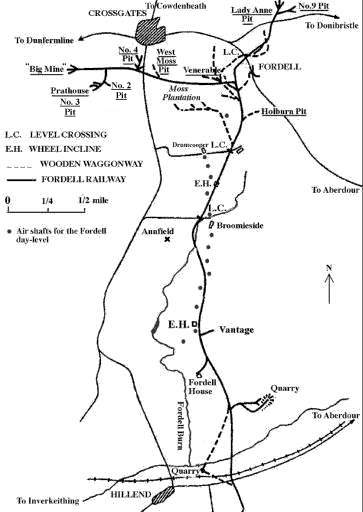
The Bulwark Pit was located to the north-west of Ansonhill and between Mossgreen and Coaledge. Sunk to a depth of 275 ft., the opening and closing dates of this small pit are not known.
 |
 |
| See Central Fife Index Entry 'Fordell Pits & Mines' for more information. |
|---|
Information on coal seams worked at, or near, Bulwark Pit, Fordell
(based on a report from 1934)
Along the western half of the Cowdenbeath Coalfield, from
Fordell to the Ochil fault, the lower coals of the Main group
were affected by a persistent, thin sheet of olivine-basalt,
usually bleached to 'white trap'.
In a bore at the Bulwark Pit, it was cut about 11 fathoms
above the Glassee and measured 4 ft. 7 in., while traces of
it, in the form of 'white jocks', were encountered in
the Lochgelly Splint and Parrot workings near Crossgates,
just west of the Bulwark.
Jewel Coal, or Pittencrieff Blackband Ironstone of
Dunfermline, a thin coal with ribs of parrot and associated
impure clayband ironstones, was mined here. The coal was in
two leaves: an upper one of 6 in. and a lower one of 5 in.
They were separated by about 13 ft. of fine-grained
sediments. These thin coals became foul further north and 500
yds. away were represented by thin beds of coaly blaes.
The Glassee Coal, which was the highest member of the
Dunfermline group, lay from 8 to 12 fathoms above the
Mynheer. The intervening strata were variable but usually
contained a thick sandstone with a thin coal near its top. In
the Bulwark Pit, 4 ft. 6 in. of hard splint was recorded
below a thick bed of blaes, while to the north of Fordell
School, the seam thickened to 6 ft. but had a number of
partings.
