Owners: Beath & Blairadam Colliery
Company
Blairadam Coal Company
Fife Coal Co. Ltd.
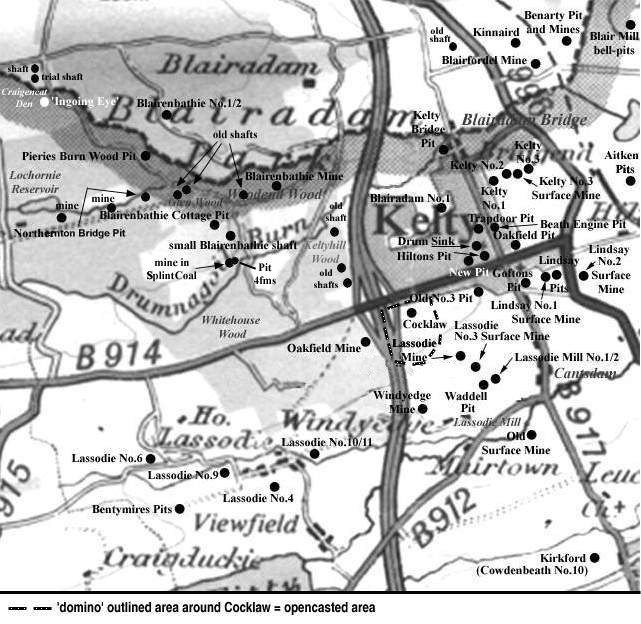
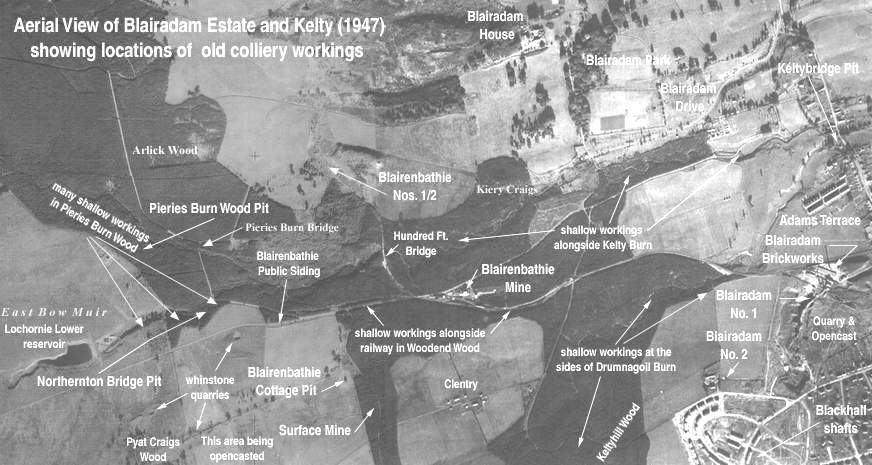
The Beath & Blairadam Colliery Company probably sunk the Blairadam Nos. 1, 2 in 1860. These coalworks were to the north-west Kelty, just west of the locations of the old Beath/Kelty No. 1 and No. 3 Pits and in 1872, for the price of £22,000, the Beath and Blairadam Company was taken over by the newly formed Fife Coal Company.
 |
 |
 |
 |
Records reveal that coal had been worked around the Kelty area from 1572, when Lord William Douglas of Loch Leven was granted a Feu Charter to Kelty Heugh Colliery by the Commendator of Dunfermline Monastery. Documents apparently reveal the Colliery was old, having belonged to the Monastery for many years. Kelty Heugh was in the then estate of Cocklaw. In these early years, Kelty coals were worked by individuals under lease, or by landowners such as the Adam Family, on Blairadam lands, and the Earl of Moray, on the Barony of Beath.
Statistical Account of Scotland Extract - Beath Parish - 1796
"Beath is a small inland parish, about four English miles long, and three broad, situated on the west end of the county and synod of Fife, and presbytery of Dunfermline. The Earl of Moray is patron. ... There is only one coalliery in the parish at present, belonging to John Symes, Esq., of Cartmore; several other seams of coal have been wrought formerly, and may still be wrought, as most of the ground seems to contain that mineral."
Statistical Account of Scotland Extract - Beath Parish - 1833 (revised 1836)
"At present there are three collieries in operation in the parish. ... The increase of population is owing to the additional number of hands employed at the collieries .... Amount of sales at the Kelty colliery from January 1834 to January 1835 = £2920 13s. 0d. The other two collieries have been at a stand for a year or two. ... There are very few persons in the parish above six years of age who cannot read. In general, the people are alive to the benefits of education. There are, however, some exceptions, chiefly among the colliers. ... The fuel used is coal, of which there is great abundance at a reasonable price."
Interestingly, a later record, from 1869, mentions three
collieries within the parish of Beath, all owned by the Beath
and Blairadam Coal Company:
1) Beath; 2) Kelty; 3) Loch Fitty, but by 1880 a record
shows the Beath and Blairadam Colliery under the control of
the Fife Coal Company.
Into the later decades of the nineteenth century, the number of pits in and around Kelty mushroomed at an amazing rate!
 |
Fife Coal Company records from the 1870s and 1880s list
the Blairadam No. 1 as a mine dipping at 1 in 2½ working
the Five Feet Coal, while Blairadam No. 2 was apparently sunk
to a depth of 29 fathoms to work the same seam.
Some confusion exists, however, over the ownership/operation
of the Blairadam coalworks in the final years of the 19th
century. One source suggests that Blairadam pits were
eventually operated by a new company, the Blairadam Coal
Company, with which Mr. James Terris was associated either as
director or agent (his son, Colin, and other family members,
may also have been associated with this Company. In the
History of the Fife Coal Company, it states that, in
1872, Mr. James Terris, overseer of the pits at Blairadam,
was appointed underground manager at a salary of £200 a
year.
A later entry in the History of the Fife Coal Company
states that, in 1902, Blairadam Colliery, with its brickworks
and two pits were purchased by the Fife Coal Company. It
possible, from this limited information, to suggest that
perhaps the Blairadam pits reverted to the care of the
Blairadam Coal Company (under James Terris) in either the
late 1880s, or early 1890s, until 1902.
In an article, written in December 1898, we find
references to the Company and the coals worked: "...
Operations are going on briskly at Blairadam Colliery. The
Company made a very good start some years ago; but as fate
would have it, they ran into a stretch of calcined coal with
their Dunfermline Splint seam. Happily, the Company were
plucky enough to cut through the burnt coal, and for some
time they have had before them a considerable stretch of the
very finest Dunfermline Splint coal. There is now not the
slightest trace of calcined minerals in the faces; and during
these prosperous times, the Company has been doing
splendidly. The blaes which overlie the seams of coal make a
capital fireclay and, in the hope that the utilisation of the
blaes might prove a profitable concern for the Company, a
Hoffman Kiln was recently erected in the vicinity of the pits
and the work of brick-making commenced. The machinery is all
of the most approved type, and the output is already as much
as 10,000 bricks per day.
Since the work of brick-making actually commenced, the demand
has quite reached expectations, and the management
contemplate the erection of two Newcastle kilns.
...
... It may be interesting to state that Lord Chief
Commissioner Adam, the present proprietor's
great-grandfather, wrote 'Observation on Blairadam',
and in the work, a good deal of space is devoted to the coal
seams. For instance, he tells us that on Blaircrambeth there
was a very rich seam of coal. This seam was nine feet thick.
The general sale was for some time given up, but in 1772, he
renewed the working of this seam for sale; and, he had seen
all the lawn, from a beech tree, he mentions, up to almost
the door of the house, covered with coal. In 1778, when it
was reported that the upper rooms or lines of working were
exhausted, the pits were closed.
The only drainage works the old mines had were the levels
running into the Kelty burn, so the workings were confined to
very small patches. The Lord Chief Commissioner also
mentioned attempting to work the coal near Craigencat, and
incidentally refers to a survey which he got specially from
an engineer.
Arguing from the report, the Chief Commissioner says that
'there is a great value of coal' in the west
of the estate, and continues by saying 'that the time
may come when, even by the means of a steam-engine, it may be
very advantageous to work the coal.' It looks like
the time forecasted by the learned Lord Chief Commissioner -
the time for working the coal advantageously with a
steam-engine - had already come. ... "
------------------------------------
| Blairadam pits opened: ~1860 | Blairadam pits closed: 1924 |
|---|---|
| Source Date of Information Supplied | |
| Manager / Under-Manager / Men underground / Men above ground / Coal seams worked / Shaft Details | |
| 1860-72 : Beath and Blairadam Colliery | |
| Mr James Gray, Commercial Manager. | |
| J. Terris,
Manager
[From Dunfermline Registers] |
|
| 1873 (Fife Coal Co.) | |
| No. 1
Mine: C. Carlow, Jun. / ------------ / --- / --- /
D'cast ----- : U'cast (8 x 6) 300 ft.
Mine dips 1 in 2½. Ventilated by steam from underground engine. |
|
| 1874 (Fife Coal Co.) | |
| No. 1
Blairadam: John Beveridge / ------------ / Five Feet
/ 92 / 35 / D'cast (8 x 6) 450 ft. : U'cast -----
Mine dips 1 in 2½. Ventilated by exhaust steam from underground engine. |
|
| No. 2
Blairadam: John Beveridge / ------------ / Five Feet
/ 23 / 12 / D'cast (13 x 5½) 174 ft. :
U'cast (5 x 5) 30 ft.
Natural ventilation. |
|
| 1875 (Fife Coal Co.) | |
| No. 1
Blairadam: John Beveridge / ------------ / Five Feet
/ 24 / 8 / D'cast (8 x 6) : U'cast -----
Mine dips 1 in 2½. 1,200 feet long. Ventilated - exhaust steam u/g engine. |
|
| No. 2
Blairadam: John Beveridge / ------------ / Five Feet
/ 29 / 13 / D'cast (13 x 5½) 174 ft. :
U'cast (5 x 5) 30 ft.
Natural ventilation. |
|
| 1876 (Fife Coal Co.) | |
| No. 1
Blairadam: John Beveridge / ------------ / Five Feet
/ 12 / 7 / D'cast (8 x 6) : U'cast -----
Mine dips 1 in 2½. 1,200 feet long. Ventilated - exhaust steam u/g engine. |
|
| No. 2 Blairadam: John Beveridge / ------------ / Five Feet / --- / --- / D'cast (13 x 5½) 174 ft. : U'cast (5 x 5) 30 ft. | |
| 1877 (Fife Coal Co.) | |
| No. 1
Blairadam: John Beveridge / ------------ / Five Feet
/ --- / --- / D'cast (8 x 6) : U'cast -----
Mine dips 1 in 2½. 1,200 feet long. Ventilated - exhaust steam u/g engine. |
|
| No. 2 Blairadam: John Beveridge / ------------ / Five Feet / --- / --- / D'cast (13 x 5½) 174 ft. : U'cast (5 x 5) 30 ft. | |
| 1878-82 Beath and Blairadam Colliery (Fife Coal Co.) | |
| No. 1 Blairadam Mine is listed as downcast for Beath No. 1 Pit, Kelty (John Beveridge, Manager) | |
| 1890 (Blairadam Coal Co.) | |
| Kelty, No.
1 : Thomas Crookston / ------------ / Five Feet,
Dunfermline Splint / 58 / 10 /
D'cast (6½ ft. dia.) 172½ ft. : U'cast (11 x 7½) 291 ft. Ventilated by furnace. |
|
| 1891 (Blairadam Coal Co.) | |
| March: Mr. Crookston, 18 months manager, Blairadam Colliery, left to fill a similar position in Kirkintilloch. | |
| 1893 (Blairadam Coal Co.) | |
| Robert Love, manager. | |
| 1896 (Blairadam Coal Co.) | |
| George Wilson / ------------ / 84 / 17 / Household, manufacturing and steam coals. | |
| 1902 (Fife Coal Co. Ltd) | |
| J. Allan / ------------ / 142 / 21 / Household, manufacturing and steam coals. | |
| 1903 (Fife Coal Co. Ltd.) | |
| September: Mr George Shearer Christie, undermanager. | |
| 1904 (Fife Coal Co. Ltd) | |
| James Curley / ------------ / 210 / 40 / Household, manufacturing and steam coals. | |
| 1905 (Fife Coal Co. Ltd.) | |
| James Curley / ------------ / 193 / 40 | |
| 1908 (Fife Coal Co. Ltd.) | |
| James Curley / J. Bogie / 223 / 49 | |
| 1911 (Fife Coal Co. Ltd.) | |
| ---------- / ---------- / 198 / 63 | |
| 1913 (Fife Coal Co. Ltd.) | |
| Jun: Mr James Erskine, colliery manager. | |
| 1914 (Fife Coal Co. Ltd.) | |
| Mar: Mr James Erskine, manager, moves to manage Dalbeath Colliery. | |
| 1916 (Fife Coal Co. Ltd.) | |
| Jun: Mr William
Bridgewood, colliery manager, moves to Lindsay Colliery. Mr James McDonald appointed manager at Blairadam and Benarty Collieries. |
|
| 1917 (Fife Coal Co. Ltd.) | |
| Jul: Mr James McDonald appointed manager at Mossbeath Colliery. | |
| 1918 (Fife Coal Co. Ltd.) | |
| Sep: Departure of
Mr Robert Aitchison, manager, to Donibristle Colliery. New manager is Mr James Roden, ex-Mary Colliery, Lochore. |
|
| James Roden / Alexander Lyle / 158 / 49 | |
| 1919 (Fife Coal Co. Ltd.) | |
| Jul: Departure of Mr James Roden to Cowdenbeath district. | |
| 1920 (Fife Coal Co. Ltd.) | |
| ---------- / A. Lyle /
280 / 96 No. 3 Surface Mine 12 / 3 |
|
| 1923 (Fife Coal Co. Ltd.) | |
| Mr Alex. Thomson, manager. | |
| 1924 (Fife Coal Co. Ltd.) | |
| August: Alexander Lyle, under-manager, moves to Benarty Colliery in same capacity. | |
| 1928 (Fife Coal Co. Ltd.) | |
| ------------ / John Butters (Brickworks) / 10 /2 / Blaes. | |
| 1929 (Fife Coal Co. Ltd.) | |
| ------------ / John Butters (Brickworks) | |
Blairadam Colliery (19th century report)
| Coal seams worked | Thickness | Quality | Class |
|---|---|---|---|
| Main Coal | 6 ft. 6 in. | Good | Steam |
| Kinglassie Splint | 4 ft. 4 in. | Fair | Splint |
| Coal (not identified) | 3 ft. 8 in. | Fair | Splint |
| Coal (not identified) | 3 ft. 6 in. | Good | Splint |
Information on coals worked at, or near, Blairadam Pits, Kelty
(based on reports from 1930 and 1934)
The old No. 1 Mine and No. 2 Pit, Blairadam, were working
coals in the 19th century (from 1860s?). Later Blairadam pits
were opened up but all coal mining at Blairadam had ceased by
1924.
At No. 2 or Blair Pit, which lay to the north of Cocklaw Farm, Kelty,
a section of Five Foot Coal was recorded as 4 ft. 9 in. thick
but the coal was burnt near the outcrop to the west of
Keltyhill Farm.
The Mynheer Coal seam, typically 3 ft. 9 in. and overlain by
3 in. slaty blaes and 5 in. ironstone, was worked here at the
No. 1 Pit, the thick overlying blaes being worked open-cast
for brick making.
Large areas of the Glassee Coal were worked "stoop and
room"*. Unfortunately, the lower part of the seam,
typically ironstone (4 in.), blaes (1 ft. 2 in.), COAL (3 ft.
6 in.), COAL, rough, (1 ft.), proved to be foul.
Workings here recorded the Bank, or Lochgelly Parrot, Coal
as thin but where the Bank Coal came to the surface in the
Blairadam area, there is still ample evidence of old workings
and numerous small pits along the banks of the Kelty Burn,
just 400 yds. west from Blairadam Bridge.
The Bank Coal was overlain by a thick, coarse sandstone
which formed the high ground on both sides of the Kelty Burn.
[* This was a system of working a coal seam by a network of
galleries, separated by broad pillars or stoops.]
| Plans of Abandoned Seams for Blairadam | Pits or Mines designated in Plan |
|---|---|
| COAL; Seam unnamed (1888) | BLAIRADAM (ESTATE) |
| COAL; Five Feet; Dunfermline Splint (December, 1910) | Blairadam Nos. 1, 2 |
| COAL; Upper Splint (August, 1920) | Blairadam No. 3; Kelty No. 3 |
| COAL; Dunfermline Splint (October, 1924) | Blairadam No. 1 |
| COAL; Glassee; Mynheer (December, 1924) | Blairadam No. 1; Kinnaird |
---------------------------------------------
Blairadam Brickworks, Kelty
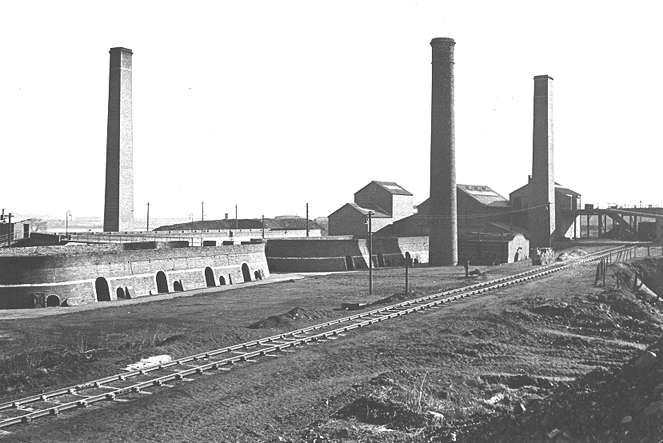
This was established by the Fife Coal Co., Ltd., after the closure of the Blairadam Pits, and a report from 1928 shows this site producing blaes with a workforce of 10 men (underground) and 2 surface workers, overseen by the under-manager, Mr. John Butters.
 |
-----------------------------------------------
Statistical Account - Parish of Cleish - 1791
... There is also coal in the estate of Blair, belonging to John Adam, Esq., of Maryburgh. It has produced £180 a year; but it has not been wrought for some time, on account of its vicinity to the proprietor's house. ...
The fuel used in the parish is coal and peat, with both of which the inhabitants are well supplied. Coal is got in two places, about a mile distant from the east and south east parts of the parish. The price, on the spot, is 6d. for 18 stone of great coal, and 4d. the small coal or chews. These coals are of excellent quality. ...
-----------------------------------------------
Statistical Account - Parish of Cleish - 1839
...There is coal on the estate of Blair-Adam, which was formerly wrought to a considerable extent; it is a branch of the Kelty coal. As it is near the proprietor's house, it has not been wrought for many years. There is also coal in the hill, but the seams are thin, and nearly perpendicular, so as not to be worth working. ...
-----------------------------------------------

"Dunfermline Saturday Press"
27 March, 1875
On Monday, David Fotheringham, a pony-driver, met his death in a very sudden manner, at No. 2 Pit, Blairadam, belonging to the Fife Coal Company. He was engaged in shifting a hutch at the pit-head, and not observing that the cage was removed, he was precipitated down the shaft, and killed instantaneously. Deceased was fourteen years of age.
[Footnote: The Scotsman of 24 March 1875 identified the young pony-driver who lost his life as David Adamson.]
------------------------------------
"Dunfermline Saturday Press"
23 November, 1889
STRIKE OF MINERS AT KELTY
The miners, numbering about fifty, employed at Blair Colliery, near Kelty (belonging to Mr. Terris), have come out on strike in consequence of their employer refusing to advance wages 7½ per cent. along with the other coalowners in the country. The employer is not a member of the Fife and Clackmannan Coalowners' Association, and he refuses to give the increase in question on the ground that the wages paid are higher than those earned at other collieries.
------------------------------------
"Dunfermline Saturday Press"
9 December, 1893
On Saturday, Michael Brown, miner, Kelty, while engaged in the underground workings of Blairadam Colliery, a stone weighing two cwt. fell from the roof and injured his head and fractured his right leg.
------------------------------------
"Dunfermline Saturday Press"
29 February, 1896
THREATENED STRIKE AT BLAIRADAM COLLIERY
A notice has been posted at Blairadam Colliery, intimating
a reduction in the hewing rate, equivalent, it is said, to a
15 per cent. reduction in wages. The men employed at that
colliery met on Monday, and unanimously resolved to put in
their warnings.
The notices were duly lodged on the following day. The matter
was under the consideration of the Wages Committee of the
Fife and Kinross Miners' Association, at a meeting on
Wednesday night. The Committee approved of the action of the
men, and instructed Mr Weir, the Secretary, to write to the
Company asking for the withdrawal of the intimation, and in
the event of their being unable to agree to this suggestion
requesting them to receive a deputation of the men along with
himself (Mr Weir), and Mr Innes, the president, to consider
the situation.
------------------------------------
"Dunfermline Saturday Press"
21 March, 1896
SETTLEMENT OF THE BLAIRADAM STRIKE
The miners employed at Blairadam Colliery (Messrs Terris & Company) struck work on Monday last week because a partial reduction in wages outside the general reduction was enforced. The men offered to continue at work on the condition that only half of the reduction be imposed. The employers could not see their way to agree to the compromise at first, but on Saturday they complied with the men's terms, and work was resumed on Monday this week.
------------------------------------
"Dunfermline Saturday Press"
5 September, 1896
DISPUTE AT A FIFE COLLIERY
Fifty miners employed at Blairadam Colliery, where a
check-weigher was appointed last week, declined to work on
Saturday, on the ground that the management had, to a certain
extent, interfered and imposed reductions which the men
considered were outwith their contracts. In the course of the
day, Mr Weir, the Union secretary, had a meeting with the
men, and subsequently waited on one of the managing
Directors.
An arrangement was come to under which the men started work
on Monday again on the old conditions. A deputation of the
men, accompanied by the Secretary, waited on the Directors
and manager on Tuesday in order to have matters finally
adjusted.
------------------------------------
"Dunfermline Saturday Press"
28 November, 1896
John Dunn, mining contractor, Kelty, met with a somewhat serious accident while working in No. 2 Pit, Blairadam Colliery, on Tuesday. He had forced a shot in order to bring away some coal, but without the results anticipated. He at once commenced holing again, but as he had failed to put in a support, the coal came suddenly away and fell upon him. His left collar bone was broken in three places, and his shoulders severely bruised. Dr Ross, Kelty, attended to his injuries.
------------------------------------
"Dunfermline Saturday Press"
5 June, 1897
John Weir Low, miner, Keltyhead, was instantaneously killed in the underground workings of the Blairadam Colliery, yesterday morning, by a fall of coal from the roof.
-------------------
"Dunfermline Saturday Press"
3 July, 1897
This issue carried the Report on the Fatal Accident Inquiry into the death of John Weir Low, held in Dunfermline, at which George Wilson, manager, Blairadam Colliery; Andrew Hunter, pit inspector; James Muir, miner; and, John Low, deceased's father, gave evidence. A verdict was returned to the effect "that deceased had been killed on 4th June, in No. 2 pit, Blairadam, by a stone falling upon him."
--------------------------------------------
"Dunfermline Press"
25 June, 1898
Daniel Cairney, miner, Keltyhead, was injured in No. 1 Pit, Blairadam, on Monday. He had prepared a shot at the working face, and after lighting the fuse was making for a place of safety when he fell. His lamp went out, and he was left in the darkness. Before he had time to rise again, the shot went off, and some of the small coal struck him on the right arm and side, cutting and bruising him.
--------------------------------------------
"Dunfermline Press"
1 April, 1899
Thomas Paterson, a young Dunfermline miner, met with an accident on Monday in the underground workings of No. 2 Pit, Blairadam Colliery, wrought by the Blairadam Coal Company, Limited. A piece of coal fell from the face striking him on the right leg, breaking the leg between the knee and ankle. He was conveyed to the Dunfermline Cottage Hospital.
--------------------------------------------
"Dunfermline Press"
10 March, 1900
James McKenna, tramp pit sinker, Blairenbathie, was found lying injured on Tuesday morning in an engine house at Blairadam Colliery. His right leg was fractured between the knee and ankle, and both his feet were injured, some of the toes being terribly shattered. It is supposed that the unfortunate man had been crushed between the crank of the engine and the sole plate. Dr Brown, Kelty, ordered his removal to the Dunfermline Cottage Hospital.
--------------------------------------------
"Dunfermline Press"
17 March, 1900
George Hunter, miner, Blairfordel Cottages, met with a serious accident on Wednesday in the underground workings of No. 2 Pit, Blairadam Colliery. About a ton of coal fell from the roof upon him while he was engaged at the working face. His injuries were of a serious nature, the base of his skull being fractured, as also his breast bone. He was attended by Dr Brown, who ordered his removal to the Dunfermline Cottage Hospital.
--------------------------------------------
"Dunfermline Press"
6 July, 1901
BLAIRADAM COAL CO. LTD.
This Company has secured a lease of the Blairfordel coalfield on the Blairadam estate. It is intended to reopen a mine formerly worked, and extend it to the Dunfermline splint. A contract has been entered into with Messrs Todd & Son, engineers, Dunfermline, for a powerful haulage engine. The Company recently erected a brickwork at their Blairadam works, and the machinery is capable of producing 10,000 bricks per day.
--------------------------------------------
"Dunfermline Press"
3 May, 1902
CURIOUS RESULT OF A MINERS' STRIKE
A mining correspondent writes:- As stated last week, the strike at Blairadam colliery has been settled by an agreement, under which the men affected are to find work in other pits belonging to the Fife Coal Company. It turns out, however, that several of the men went back to the pits at Blairadam, presumably upon the conditions against which they struck work. Strange to say, some of these men were the most uncompromising in their attitude when they came out on strike. There is a probability that strike pay will not be allowed them in consequence of their curious actings.
--------------------------------------------
"Dunfermline Press"
6 June, 1903
On Thursday morning, John Gainer, miner, Blackford Place, Kinross, was injured in the Dunfermline splint seam of No. 2 Pit, Blairadam Colliery, Kelty. He was charging a shot at the coal face when a piece of coal fell from the roof upon him, fracturing his left leg. He was attended to by Dr Moir, Oakfield.
--------------------------------------------
"Dunfermline Press"
8 August, 1903
Between two and three o'clock yesterday afternoon William Scott, pit drawer, a lad between fifteen and sixteen years of age, residing with his father, Thomas Scott, miner, Kelty, was fatally injured in the underground workings of No. 2 Pit, Blairadam Colliery. The lad's father also received injuries to his hands as a result of the accident.
--------------------------------------------
"Dunfermline Press"
29 August, 1903
John McDonald, haulage attendant, Kelty, met with an accident in No. 1 Pit, Blairadam Colliery. He was riding on the first of a race of four loaded hutches, which were being drawn from the five-foot seam to the pit bottom. When passing over a crossing the drawbar of the first hutch broke, with the result that the hutches came to a sudden standstill. McDonald was thrown against the roof, and received injuries to his back. He was attended to by Dr Moir, Kelty.
--------------------------------------------
"Dunfermline Press"
5 September, 1903
Under the Fatal Accidents Inquiry Act, an inquiry was held in the Sheriff Court, Dunfermline, on Wednesday - before Sheriff Gillespie and a jury - into the circumstances attending the death of a miner named William Scott, at No. 2 Blairadam Pit, on 7th August. Those giving evidence included:- George Shearer Christie, underground manager; Thomas Scott, miner, Woodend Park, Kelty (father of deceased); Samuel Robertson, miner, Blairenbathie Road, Kelty; A. Fotheringham, miner, Pleasance, Kelty (contractor who employed the Scotts); Andrew Cooper, miner, Woodend Park, Kelty; and Martin McGrady, pit inspector, Keltyhead. A formal verdict was returned by the jury.
--------------------------------------------
"Dunfermline Press"
26 September, 1903
While working an electric coal-cutting machine in the splint seam of No. 2 Pit, Blairadam Colliery, on Wednesday, John Burt (34), miner, residing at Bellevue Place, Kelty, received serious injuries. He was in a kneeling position at the rear of the cutter, when a sleeper fell from the roof on to the top of the machine, which, springing back, caught him on the left leg, which was severely lacerated. He was attended by Dr Robert Moir, Kelty, who ordered his removal to the Dunfermline Cottage Hospital. At the Hospital it was found necessary to amputate the injured leg between the knee and the ankle.
--------------------------------------------
"Dunfermline Press"
9 April, 1904
Mr George Terris, retired coalmaster, died on Tuesday at his residence at Oakfield, Kelty. The deceased gentleman, who was sixty-nine years of age, was one of the members of the Blairadam Coal Company, whose pit was sold to the Fife Coal Company three years ago.
--------------------------------------------
"Dunfermline Press"
3 June, 1905
While boring a hole in a stone in the Mynheer seam at No. 1 Pit, Blairadam Colliery, on Wednesday, Thomas Renshaw, brusher, had his left leg fractured between the knee and the ankle, by a stone which suddenly came away. The injured man was conveyed to his home at 59 Dewar's Row, Kelty, where he was attended by Dr Moir.
--------------------------------------------
"Dunfermline Press"
4 November, 1905
James Cameron, carter, Forester's Buildings, Kelty, had his right leg fractured at Blairadam Colliery on Monday. He was standing on the wheel of his cart when he slipped, and his foot and part of his leg got between the spokes, causing injuries as stated.
--------------------------------------------
"Dunfermline Press"
18 November, 1905
Michael Curly, miner, Adam's Terrace, Kelty, was injured by a stone falling upon him from the roof in No. 2 pit, Blairadam Colliery, on Saturday. The injuries consisted of bruises on the back and left side of the body. Curly was removed to his home in the Kelty ambulance van.
--------------------------------------------
"Dunfermline Press"
13 January, 1906
A number of the employees of Blairadam Colliery met in the Oakfield Inn on Saturday to do honour to Mr John Dunn, Blairadam Terrace, and Mr Andrew Smith, Ashgrove Place, both enginemen at Blairadam Colliery, and who are leaving for New Zealand. ...
--------------------------------------------
"Dunfermline Press"
16 June, 1906
A brusher named Thomas Stark, residing at Millar's Buildings, Kelty, was accidentally killed at Blairadam New Pit about six o'clock on Thursday night. Stark had been engaged brushing, and was breaking up a stone, when another came away, and knocked him down. On the stone being removed, it was found that he had been crushed to death.
-------------
"Dunfermline Press"
30 June, 1906
Under the Fatal Accidents Inquiry Act, an inquiry was held in the Sheriff Court, Dunfermline, on Thursday - before Sheriff Shennan and a Jury - into the circumstances attending the death of Thomas Stark, brusher, lately residing at Miller's Buildings, Kelty, who was killed in No. 2 pit, Blairadam Colliery on 14th June, by a fall from the roof. Those giving evidence at the inquiry included:- John Dawson, brusher, 8 Lower Oakfield; and Mark McGreavie, foreman, Keltyhead, Kelty. A formal verdict was returned.
--------------------------------------------
"Dunfermline Press"
29 June, 1907
James McKenzie, miner, Millar's Buildings, was crushed about the chest by a fall of coal in Blairadam Pit on Saturday. Dr Carment attended the injured man, who was removed to his home.
--------------------------------------------
"Dunfermline Press"
28 September, 1907
John Ness, a pithead worker, residing at Croall Place, Kelty, met with terrible injuries, from which he succumbed within an hour, on the mineral railway at Blairadam Colliery, on Friday evening last week. Suffering from deafness, Ness failed to hear the approach from behind of a train of waggons which were being shunted to the pit. What exactly happened was unobserved by those in charge of the engine, which was pushing the wagons, but the circumstances pointed to the man having been knocked down, and the wheels of at least seven of the wagons must have passed over his body. The legs were almost severed from the trunk, and the skull was badly fractured. Deceased, who was upwards of sixty years of age, belonged to Cowdenbeath.
--------------------------------------------
H. M. Inspector of Mines Report 1907
Mr. Robert McLaren's Report
Fatal Accident at Blairadam, Fife
Owner: Fife Coal Co., Ltd.
7 November, 1907
William Ford, 16, Pony Driver. Deceased was riding on a loaded rake of tubs coming up an engine haulage dook, and at a low part of the roadway his head came in contact with the roof.
------------------------------
"Dunfermline Press"
9 November, 1907
William Ford, a pony driver, residing at Pleasance, Kelty, was admitted to the Dunfermline and West Fife Hospital yesterday, suffering from serious injuries received in the course of his employment at Blairadam Colliery on Thursday evening.
------------------------------
"Dunfermline Press"
23 November, 1907
FATAL RESULT OF AN ACCIDENT
William Ford, a young pony driver, who resided at Pleasance, Kelty, has died in Dunfermline and West Fife Hospital, as the result of injuries received a month ago at Blairadam Colliery.
------------------------------
"Dunfermline Press"
7 December, 1907
Under the Fatal Accidents Inquiry Act, an inquiry was held in the Sheriff Court, Dunfermline, on Thursday - before Sheriff Shennan and a Jury - into the circumstances attending the death of John Ford, pony driver, lately residing at 2 Railway Row, Kelty, who was injured on 7 November on the engine plane or haulage dook in the Mynheer seam in No. 1 Pit, Blairadam Colliery, by being crushed between a hutch on which he was riding, and the roof, and died on 20 November in the Dunfermline and West Fife Hospital, from the effect of said injuries. Those giving evidence included:- Nurse Ina Angus; James Curley, colliery manager; George Downie, haulage engineman, Main Street, Kelty; Patrick Kavany, brusher; and Joseph Arthur, haulageman. A formal verdict was returned by the jury.
--------------------------------------------
"Dunfermline Press"
15 February, 1908
ANOTHER PIT DISASTER
COLLAPSE OF A ROOF AT BLAIRADAM COLLIERY
THREE LIVES LOST
Before the mining community of Fife have had time to recover from the shock of the Mary Pit disaster,
by which three men lost their lives less than a fortnight ago, another catastrophe, equally serious from the
point of view of loss of life, falls to be recorded.
The scene of the latest mishap, which occurred at an early hour on Thursday morning, was the No. 2, or
Blair Pit, Blairadam Colliery, belonging to the Fife Coal Company, Limited. Sunk twenty odd years ago, the
pit, along with a sister pit, known as No. 1, was originally wrought by the Blairadam Coal Company, which,
six years ago, was merged into the Fife Coal Company Limited.
No. 1 Pit is sunk to a depth of twenty-five fathoms, at which level the Dunfermline splint seam is found at
a thickness of slightly over four feet. It was in the Dunfermline splint seam that the accident occurred.
Thursday was an idle day at the pit, which is worked on the three-shift principle, coals being drawn on only
one of the shifts, two of which are devoted to brushing and repairing. For a period of eighteen months
electric coal-cutting machines have been in use in the section, and it was three miners who were attending
to one of these "iron men", as the cutters are called, who were the victims of the accident.
The names of the men were:-
Joseph McCallum (30), Black Road, Kelty, the leading machineman;
Daniel Cairney (31), Pleasance Row, Kelty, an assistant; and
Robert Park (24), 10 Adams's Terrace, Kelty, also an assistant.
Along with Patrick Brogan and Michael Wilkinson, brusher, and Peter McClusky, fireman, these were the
only men who were in the section when the accident occurred. Brogan and Wilkinson, the latter of whom is
a lad still in his teens, had been engaged clearing away stones from the face preparatory to the machine
being set in operation by McCallum, Cairney, and Park. They had completed the duties assigned to them,
and had proceeded a distance of twelve yards or thereby from their companions when they were startled
by a tremendous crashing sound - a sound which, experience had taught them, meant that the roof or sides
had collapsed. Concerned as to the safety of those who had been left in charge of the machine, the two
men returned to the face to find that practically the whole of the roof, stretching a distance of twelve yards,
had fallen in, enveloping the cutter and its attendants. McClusky, the fireman, who was still in the vicinity,
was communicated with, and he, along with Brogan and Wilkinson, at once set about to do what they could
do to extricate their entombed comrades. Cairney, who had been struck down by the edge of the fall, was
the first to be discovered. The poor fellow had been caught at the middle of the body, and on a lamp being
shone upon his face, which protruded from the edge of the debris, it was seen that he was beyond all human
aid. Little hope was accordingly entertained as to the likelihood of the others, who had received the full force
of the fall, being got out alive.
Meanwhile, Mr James Curley, the manager, had been informed of the mishap. It was two hours later, however,
before a serious effort could be made to extricate the bodies. Shortly before six o'clock, the men proceeding
to their work were startled to find an ambulance waggon in waiting at the pithead, and on being apprised of the
fate of their three fellow-workmen, they descended the shaft to go to the Dunfermline splint seam. Among the
first to go down, after the manager, were William Kennedy, residing at Union Buildings; David Sneddon,
Adam's Terrace; James Boyle, Woodend; John Wilkinson, Woodend; and Patrick Wilkinson, Adam's
Terrace, the two last-mentioned being contractor brushers. The task of clearing away the fall was one which
involved Herculean effort. The roof, stretching a distance of twelve yards, and weighing considerably upwards
of twenty tons, had come away in practically a solid mass. Picks and wedges were utilised to break up the
material, and the difficulty of speedily clearing the place was added to by reason of the limited accommodation in
which the rescuers had to conduct their operations. The body of Cairney was the first to be sent up the shaft,
and it was close upon nine o'clock until the searchers came upon the remains of the other two men.
Asphyxiation was probably the cause of death in each case, because on neither of the bodies were bruises
of a serious nature discernible.
Falls from the roof have accounted for comparatively few fatalities in the Blairadam Pits. In the Dunfermline
splint seam the roof is composed of freestone, and has all along been regarded by the miners as a safe roof
under which to work. Inquiry showed that there had been a strict observance of the rules regarding props,
which are required to be set at a distance of not less than five feet apart. According to miners who are
acquainted with the place in which the men met with their death, no human foresight could have prevented
the accident. A geological disturbance of some magnitude is regarded as the only possible explanation.
The roof, which is of a thickness aggregating three feet, carried with it all the propping wood, which was
smashed into splinters.
In the course of Thursday forenoon, Mr Robert McLaren, H. M. Chief Inspector of Mines for the Eastern
District of Scotland, Mr Henry Rowan, the Fife Coal Company's general manager, and Mr Charles
Augustus Carlow visited the pit and made an inspection. Later in the day, Mr McLaren made the usual
communication to the Home Secretary apprising him of the accident.
Unlike the disaster at the Mary Pit, the victims of Thursday's calamity were married men, and leave
widows and families to mourn their loss. McCallum is survived by three dependants, and Cairney and Park
by two each.
At neither of the Blairadam Pits was a start made on Thursday. During the course of the day, the majority of
the men, some of whom bore traces of the tremendous physical exertion to which they had subjected
themselves in extricating the bodies, did little else than discuss the disaster, which cast a gloom over
the entire village.
---------------------------
"Dunfermline Press"
22 February, 1908
Amid general manifestations of mourning the remains of the victims of the recent disaster in No. 2 Blairadam Pit - Daniel Cairney, Joseph McCallum, and Robert Park - were interred in their last resting place in Beath Churchyard on Saturday. The three hearses were preceded by members of the local lodge of the British Order of Ancient Free Gardeners, in regalia; a large number of villagers took up a position in the rear; the cortege being completed by nine carriages, in which the relatives and more immediate friends were accommodated. The services in the cemetery were of a simple character.
---------------------------
"Dunfermline Press"
28 March, 1908
Under the Fatal Accidents Inquiry Act, an inquiry was held in the Sheriff Court, Dunfermline, on Thursday - before Sheriff Shennan and a Jury - into the circumstances attending the death of Joseph McCallum, machineman; Daniel Cairney, miner; and Robert Park, miner, who were killed on 15 February in No. 2 Pit, Blairadam Colliery, by a quantity of stone falling upon them from the roof. Those giving evidence at the inquiry included:- James Curley, manager; Patrick Brogan, brusher, 47 Adam's Terrace, Kelty; Michael Wilkinson (19), brusher; James Bogie, oversman; and Peter McClusky, pit fireman. A formal verdict was returned.
--------------------------------------------
"The Scotsman"
10 June, 1910
THE LATE MR JAMES GRAY, LEVEN. - Mr James Gray, Oakley Lodge, Leven, died there yesterday, aged eighty years. At the age of three years he lost his father, and when about ten years old he went to work in the pits at Kilsyth. The workers went out at half-past three in the morning, went down in baskets, and were in the pit for fourteen hours. While still under twenty he began work at Oakley with the Forth Iron Company. At this time he took every opportunity to improve his education. In 1872, when the Fife Coal Company was formed, he was commercial manager at Blairadam. He was appointed secretary of the new company in that year, and this post he held until 1904. During these years, the undertaking increased from two pits, with an output of 90,000 tons yearly, to a large amalgamation, with a score of pits and an output of 2¾ millions. Mr Gray was one of the founders of the Leven Penny Savings Bank, and session clerk and senior elder of Scoonie Parish Church.
--------------------------------------------
"Dunfermline Press"
20 January, 1912
Wm. Pryde, machineman, Cleish, had one of his feet so severely injured in Blairadam Colliery by an electrical coal cutter that the foot has been amputated.
--------------------------------------------
"Cowdenbeath & Lochgelly
Times"
18 September, 1912
Thomas Close, miner, residing at Bridgend, Kelty, met with a serious accident while at work in the Blair Pit, Kelty, belonging to the Fife Coal Company. Close was in the act of firing a shot, when from some cause unknown the charge exploded, causing serious injuries to his face and neck, and it is feared that his eyesight will be impaired.
--------------------------------------------
"Cowdenbeath & Lochgelly
Times"
30 April, 1913
COWDENBEATH LAD KILLED IN MINE
Another unfortunate mining accident took place yesterday, when a boy named John
McMillan, about 15 years of age, who resided in Cowdenbeath, was fatally injured while
at work at Blairadam Colliery , belonging to the Fife Coal Company.
Particulars are not yet to hand as to how the accident occurred, but it is stated that he
was struck about the head and neck by a hutch, death being instantaneous.
--------------------------
"The Scotsman"
30 April, 1913
BOY MINER KILLED. - John Macmillan (14), son of a miner, residing in Cowdenbeath, lost his life in the Mynheer Seam of No. 1 Pit, Blairadam Colliery, yesterday, by being crushed between a hutch and a tree supporting the roof on a brae.
--------------------------
"Dunfermline Press"
3 May, 1913
John Macmillan (14), son of Thomas Macmillan, miner, 10 Thistle Street, Cowdenbeath, lost his life in the Mynheer seam of No. 1 Pit, Blairadam Colliery, on Thursday. The boy, who was engaged as a drawer, had been in the act of turning a hutch on the plates on a brae when it slipped forward and jammed him against a "tree". Death was caused by suffocation. No marks were left on the body.
--------------------------
"Dunfermline Press"
14 June, 1913
Under the Fatal Accidents Inquiry Act, an inquiry was held in the Sheriff Court, Dunfermline, on Thursday - before Sheriff Umpherston and a Jury - into the circumstances attending the death of John McMillan (14), drawer, lately residing at 10 Thistle Street, Cowdenbeath, who died on 29 April on a brae in No. 1 Pit, Blairadam Colliery, from injuries received by a loaded hutch crushing him against a prop. Those giving evidence at the inquiry included:- James Erskine, colliery manager; Hugh Wotherspoon, pit fireman; Thomas McMillan, junior, drawer, a brother of the deceased; John Wilson, drawer; and Thomas McMillan, father of deceased. The jury returned a formal verdict.
--------------------------------------------
"Dunfermline Press"
21 February, 1914
William Clark (36), miner, Brown's Buildings, Main Street, Kelty, was struck by a fall of material from the roof in the Mynheer section of Blairadam Pit on Monday. He received a fracture of the left thigh bone. Dr Moir attended the injured man.
--------------------------------------------
"Dunfermline Press"
21 March, 1914
Mr James Erskine who has been appointed manager at Blairadam Colliery for some years has been appointed to more responsible duties at Hill of Beath as successor to Mt Proven. Mr James Erskine removes at an early date and carries with him the good wishes of a wide circle of friends.
--------------------------------------------
"Dunfermline Press"
11 April, 1914
Mr Erskine, manager, Blairadam Colliery, had a hearty send-off from miners and other workers on the occasion of his transfer to Dalbeath Colliery.
--------------------------------------------
"Dunfermline Press"
24 June, 1916
Mr William Bridgewood, colliery manager, who has been transferred from Blairadam to the Lindsay Colliery, has been presented by the Blairadam workmen with a wardrobe as a token of respect. Mr James Wilkie made the presentation at a social gathering in No. 1 Gothenburg on Saturday.
--------------------------------------------
"Dunfermline Press"
12 August, 1916
Mr John Sturrock, colliery cashier, Cowdenbeath, was met by managers and representatives of Blairadam and Blairenbathie Collieries on Monday and presented with a gold albert and appendage (inscribed) on the occasion of his leaving the collieries to join the Army. Mr J. Wilkie made the presentation.
--------------------------------------------
"Dunfermline Press"
10 February, 1917
KELTY - MINERS' FIRE COAL
The contract for the driving of the workmen's fire coal has been let as follows. From Blairadam Pit to northern district - Messrs McNally Bros., at 1s 1d per load; from Lindsay Pit to the other portion of the village - Messrs H. & A. Inglis, at 1s 6d per load.
--------------------------------------------
"Dunfermline Press"
26 May, 1917
William Philp (58), miner, residing at Keltyhead, Kelty, died suddenly in No. 1 Pit, Blairadam Colliery, on Monday morning. When he left home at about five o'clock in the morning he was in his usual health. Between six and seven o'clock, a couple of workmen found him in a stooping position, with his head on the pavement. The men, receiving no reply, laid Philp on his back. He expired within a few minutes. Dr Moir, who saw the body at the pithead, certified that death was due to natural causes.
--------------------------------------------
"Dunfermline Press"
18 August, 1917
PITHEAD GIRLS' DRIVE
The pithead girls at Blairadam Colliery had a drive to Aberdour on Saturday, when, despite the showery weather, a pleasant time was spent.
--------------------------------------------
"Dunfermline Press"
21 September, 1918
Mr Robert Aitchison, who has been manager at Blairadam and Blairenbathie Collieries for some time, has been transferred to a similar position at Donibristle. His place at Kelty is being taken up by Mr Roden from the Mary Pit, Lochore.
--------------------------------------------
"Dunfermline Press"
19 July, 1919
Mr Jas. Roden, lately manager at Blairadam and Blairenbathie Collieries, has been presented with a set of books and a wallet of Treasury notes by the workers, on the occasion of his transference to Cowdenbeath district. ...
--------------------------------------------
"Dunfermline Press"
17 July, 1920
Under the Fatal Accidents Inquiry Act, several inquiries were held in the Sheriff Court, Dunfermline, on Thursday - before Sheriff Umpherston and a Jury - into the circumstances attending the deaths of several miners from roof falls including Charles McHale, lately residing at 5 Inglis Street, Dunfermline (Blairadam Pit, Kelty). ...
--------------------------------------------
"Dunfermline Press"
18 December, 1920
A few of the workers in Blairadam Colliery met in the Gothenburg supper-room on Saturday. Mr Harry Hodge occupied the chair. Mr John Duncan presented Mr David Sinclair with a silver cake basket as a token of respect; and Mr Jas. Philp, on the occasion of his departure for Australia, was presented with a silver cigarette case and walking-stick.
--------------------------------------------
"Dunfermline Press"
12 February, 1921
The pits have been kept running all week with the exception of Blairadam Colliery, where the men have only been allowed to work on alternate days. This is causing much discontent among the men, their opinion being that as the collieries are under one Company, the work could be more equally divided.
--------------------------------------------
"Dunfermline Press"
19 February, 1921
All the pits in Kelty have worked full time this week, with the exception of Blairadam Colliery, where the men have only secured work on Tuesday and Thursday, being idle all the rest of the week.
--------------------------------------------
"Dunfermline Press"
26 February, 1921
COAL TRADE. - Work is progressing fairly well at all the collieries, with the exception of Blairadam, where only some ten days have been worked during the last four weeks.
--------------------------------------------
"Dunfermline Press"
5 March, 1921
Fully eighty men at Blairadam Colliery have had to seek other employment owing to the stoppage of two sections of the pit. Many have found work in the Aitken and Lindsay Pits, which are working every day, while only three days per week are being worked at Blairadam.
--------------------------------------------
"Dunfermline Press"
5 March, 1921
Mr Matthew M. Lindsay, who has been back-shift oversman at Blairadam Colliery for some time, has been transferred to one of the Blairenbathie pits in a similar capacity. Mr Lindsay obtained his colliery manager's certificate at the last examination.
--------------------------------------------
"Dunfermline Press"
19 March, 1921
Blairadam Colliery only worked two days last week, and was idle on Tuesday and Thursday this week. Many of the men are feeling the pinch, as short time has continued for the last ten weeks.
--------------------------------------------
"Dunfermline Press"
30 July, 1921
... Blairadam and Blairenbathie Collieries are gradually getting into motion again. Nothing has been done so far in Benarty Colliery, about one-fourth of the men being unemployed. The suffering is still very acute.
--------------------------------------------
"Dunfermline Press"
27 August, 1921
Work was resumed at Benarty Colliery on Monday, the first start since the coal trade dispute, and a few extra men are being engaged daily. The men employed at Blairadam and Blairenbathie are being hard hit, only working about two or three days per week. The Aitken and Lindsay Pits are working steadily, and the output is already far in excess of that secured for some years. Work is likely to be suspended for a day or two at the Lindsay Colliery, where the management have been forced to install heavier electrically-driven winding gear with a view to coping with the increased output.
--------------------------------------------
"Dunfermline Press"
17 September, 1921
A section of men employed in Blairadam Colliery have received fourteen days' notice to terminate their employment, it having been decided to stop the section in the meantime. Over thirty men will be thrown out of work, and owing to the amount of unemployment that exists, there is not much prospect of their obtaining work at the other pits in the district.
--------------------------------------------
"Dunfermline Press"
1 October, 1921
No improvement is yet taking place in the amount of work being obtained at Blairadam and Blairenbathie Collieries, where the workers have now had almost a year's short time, irrespective of work lost during the strikes.
--------------------------------------------
"Dunfermline Press"
24 March, 1923
While at work in Blairadam Colliery, Joe Stark, residing in Black Road, Kelty, had his face badly cut through being hit with some bars which were being conveyed on a bogie which had inadvertently left the rails.
--------------------------------------------
"Dunfermline Press"
12 May, 1923
While working at the coal face in the Glassie section of the Blairadam Colliery on Tuesday, James Muirhead had one of his hands severely injured by a sudden burst of coal. He was examined by Dr Moir, who had him removed to the Dunfermline and West Fife Hospital, where it was found necessary to amputate two fingers. Muirhead is well-known in Fife juvenile football circles, having kept goal for Kelty Glen Rovers for the last two years.
--------------------------------------------
"Dunfermline Press"
1 December, 1923
Mr James Ford, sen., who sailed this week for New Zealand, was met by a few friends in the Gothenburg Supper Room on Saturday when Mr Arthur Bennett presented him with a pipe and tobacco pouch from the Blairadam Burns Club, and a pocket book and Treasury notes from his fellow-workers in Blairadam Colliery.
--------------------------------------------
"Cowdenbeath & Lochgelly
Times"
13 August, 1924
Mr Alex. Lyle, who has been under-manager at Blairadam for a number of years, has been transferred to Benarty Colliery in a similar capacity.
-------------------------------------------
"Dunfermline Press"
11 July, 1936
BLAIRADAM BRICKWORK STRIKE.
SIXTY EMPLOYEES INVOLVED.
A dispute at the Fife Coal Company's Blairadam Brickworks over a question of wages culminated on Wednesday in the employees, numbering sixty in all, deciding on strike action. Although negotiations have been proceeding with a view to a settlement, no agreement had been reached late yesterday afternoon.
-------------------------------------------
"Dunfermline Press"
18 July, 1936
After a four days' strike, the employees of the Fife Coal Company's Blairadam Brickworks resumed work on Monday. ...
-------------------------------------------
"Cowdenbeath Advertiser"
21 January, 1944
WELL KNOWN COLLIERY BLACKSMITH KILLED
KNOCKED DOWN BY TRAIN
George Robertson (76), 46 Adams Terrace, Kelty, employed at Kelty Power Station, belonging to the Fife Coal Company, died from injuries sustained on Friday night, when he was struck by a passenger train going towards Perth. Deceased, who is survived by a wife and family, was formerly employed at Blairadam Colliery, and had the reputation of being one of the finest blacksmiths in the country.
-------------------------------------------
"Dunfermline Press"
16 September, 1950
... Mr and Mrs Colin Terris, the Gardens, Kelty, ... this week celebrated the diamond anniversary of their wedding.
Began Work at 12
Mr Terris, who is a native of Kelty, and a Justice of the Peace for the County,
was born in 1868, and throughout his lifetime has rendered notable service to the
community. The day following his twelfth birthday, he applied for employment with
the Fife Coal Company, and started work at the old No. 1 Pit, Kelty. He worked
there until it was closed down, and was transferred to the Lindsay Colliery, where
he was employed for fully fifteen years.
Subsequently he was pithead contractor at Blairadam Pit until 1926, and for the
next ten years was housing factor with the Fife Coal Company, Ltd., a position
from which he retired after completing half a century's service. ... In his early
days in the mines, Mr Terris as delegate of the Kelty miners, was associated with
many of the old-time personalities of what was then the Fife and Clackmannan
Miners' Union, and it was as a representative of the miners that he attended
the ceremony of cutting the first sod prior to the sinking of the Aitken Pit. The
ceremony was held on 25th March 1893, and Mr Terris replied to the toast of "The
Miners" on that occasion. ...
-------------------------------------------
"Dunfermline Press"
17 January, 1959
750 Fewer Miners in West Fife
The overall manpower in the West Fife Area of the National Coal Board is now 14,000,
showing a total reduction of 750 since the beginning of 1958. A standstill in recruitment has been
maintained during the year, with the exception of Comrie and Valleyfield Collieries.
This is revealed in the annual survey of the West Fife Area, which also states that the output position
at the end of November showed a reduction of 360,000 tons compared with the same period in the
previous year. No Saturday working has taken place since the end of April, and all the collieries
have operated on a five-day week basis. Ten per cent of the Area output is now power-loaded,
and steps are being taken to increase this proportion. ...
The survey, after reporting progress on the sinking of new shafts at Bowhill and Valleyfield Collieries, and drilling operations in the Firth of Forth near Culross, refers to other developments in the Area. ...
An "amenities block," which is understood to be the first of its kind for brickwork operators in Scotland, was put into use at Blairadam Brickworks in November. The building contains separate shower baths; clean and dirty clothes lockers; de-dusting equipment for working clothes and overalls; a fully equipped first-aid room; and separate mess rooms for male and female employees.
-------------------------------------------
"Dunfermline Press"
7 December, 1979
Going, going, gone …..
In the space of only a few seconds each, two of Kelty's most outstanding landmarks - the
tall chimneys of the former Blairadam Brickworks - were reduced to rubble on Monday, marking the
start of a major transformation planned for the village.
The chimneys have stood in the centre of the village since the brickworks were built at the beginning
of the century, and many of the villagers turned up to have one last look before the explosive charges
were set off and the chimneys came crashing to the ground. …
-------------------------------------------
"Dunfermline Press"
20 December, 1996
Residents fear opencast 'arc of destruction'
An opencast objector has predicted the despoliation of West Fife if a new mine is allowed in Blairadam Forest.
Chairman of West Fife Environmental Defence Alistair Harper was speaking at a Fife Council hearing on plans to remove 600,000 tonnes of coal over seven years from the heart of the forest.
The mine would work six days a week with Sunday maintenance, producing coal for Longannet Power Station.
The application by W. W. Graham (Contractors) has been greeted by 602 letters of objection from local residents worried about the threat of noise, dust and the loss to the public of the popular woodland. …
-------------------------------------------
"Dunfermline Press"
14 February, 1997
Forest mine given green light
Plans to remove coal by opencast methods at Blairenbathie, near Kelty, were given the green light by councillors - immediately after they rejected Scottish Coal's controversial Greenbank application. …
-------------------------------------------
