Owners: Beath and Blairadam Coal Company
Records reveal that coal had been worked around the Kelty area from 1572, when Lord William Douglas of Loch Leven was granted a Feu Charter to Kelty Heugh Colliery by the Commendator of Dunfermline Monastery. Documents apparently reveal the Colliery was old, having belonged to the Monastery for many years. Kelty Heugh was in the then estate of Cocklaw. In these early years, Kelty coals were worked by individuals under lease, or by landowners such as the Adam Family, on Blairadam lands, and the Earl of Moray, on the Barony of Beath.
Statistical Account of Scotland Extract - Beath Parish - 1796
"Beath is a small inland parish, about four English miles long, and three broad, situated on the west end of the county and synod of Fife, and presbytery of Dunfermline. The Earl of Moray is patron. ... There is only one coalliery in the parish at present, belonging to John Symes, Esq., of Cartmore; several other seams of coal have been wrought formerly, and may still be wrought, as most of the ground seems to contain that mineral."
Statistical Account of Scotland Extract - Beath Parish - 1833 (revised 1836)
"At present there are three collieries in operation in the parish. ... The increase of population is owing to the additional number of hands employed at the collieries .... Amount of sales at the Kelty colliery from January 1834 to January 1835 = £2920 13s. 0d. The other two collieries have been at a stand for a year or two. ... There are very few persons in the parish above six years of age who cannot read. In general, the people are alive to the benefits of education. There are, however, some exceptions, chielfy among the colliers. ... The fuel used is coal, of which there is great abundance at a reasonable price."
Interestingly, a later record, from 1869, mentions three
collieries within the parish of Beath, all owned by the Beath
and Blairadam Coal Company:
1) Beath; 2) Kelty; 3) Loch Fitty, but by 1880 a record shows
the Beath and Blairadam Colliery under the control of the
Fife Coal Company.
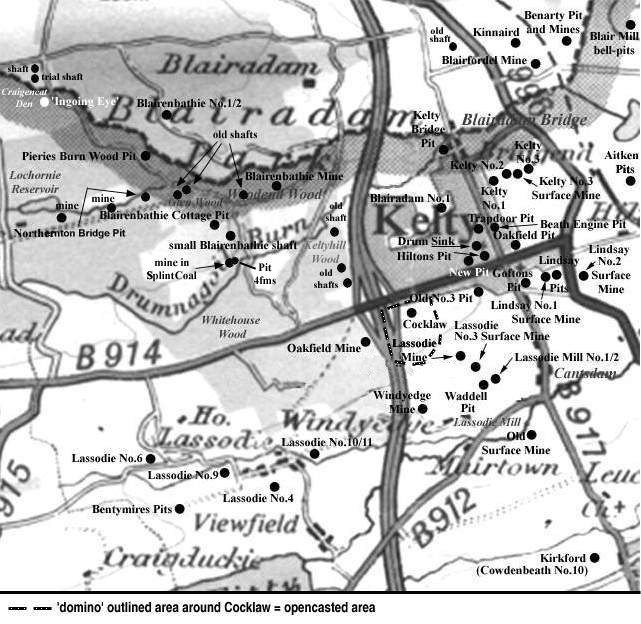
The Beath Engine Pit was one of around 50 or more small, nineteenth century pits working coal in Kelty and was located just to the east of Main Street at its junction with Bath Street. The exact opening and closing dates for the Beath Engine Pit are not known but it possibly was working from the 1850s to the 1870s.
 |
 |
In the later decades of the nineteenth century, the number of small pits in and around Kelty mushroomed at an amazing rate! Reproducing the old maps showing each and every one of those very crowded sinkings accurately has not been attempted since many of these so-called 'pits' were only small holes in the surface of the land, many overlapping with others by several feet. The index does, however, have individual entries for those pits recognised by name or number.
 |
Kelty Colliery (19th century report)
| Name of Coal | Thickness | Quality | Class | |||
|---|---|---|---|---|---|---|
| Main Coal | Roof Coal | > | 1 ft. 10 in. | > | Good | Bunker Coal |
| Good Coal | > | 4 ft. 8 in. | > | |||
| Jersey Coal | Coal | > | 2 ft. 6 in. | > | Good | Steam |
| Stone | > | 2 ft. 4 in. | > | |||
| Coal | > | 3 ft. 8 in. | > | |||
| Bank Coal (Lochgelly Splint) | 4 ft. 5 in. | Good | Steam and 2nd class
Household |
|||
| Dunfermline Splint Coal | 4 ft. 7 in. | Good | Best Household | |||
Information on coals worked at the Beath Engine Pit, Kelty
The limited information uncovered at the present time states that the pit was sunk to the Main Coal seam at a depth of 180 ft.
| Plans of Abandoned Seams for Beath Engine Pit | Pits or Mines designated in Plan |
|---|---|
| COAL; Main (1852) | Beath Engine |
| COAL; Kinglassie Splint (1867); Two Feet (1869); Main (1872) | KELTY, Nos. 2, 3; Beath Engine; Engine |
Can do with more help on this pit
