Owners: Henderson, Wallace, & Co.
Wallace Bros.
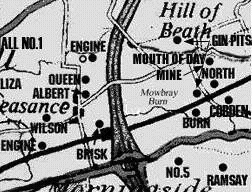
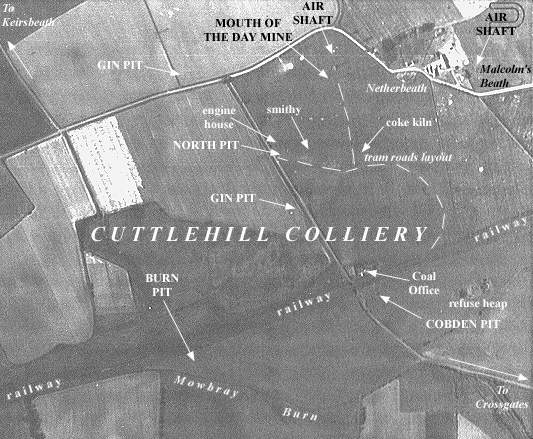
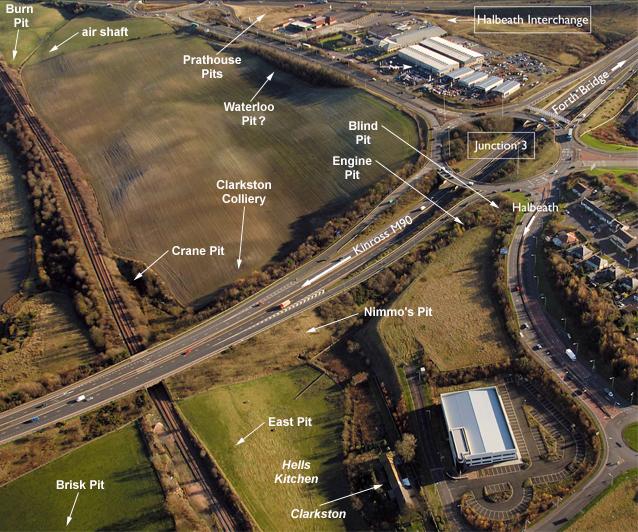
The Burn Pit, sometimes Burnside Pit, is believed to be
post-1850 with the sinking date possibly 1853-54. The pit was
located by the Mowbray Burn, south of the railway line, just
to the west of Crossgates and was probably the most important
pit at Cuttlehill Colliery working until the 1870s.
Details in the 1890 record suggest that perhaps either a
shallower sinking, also called Burn Pit, followed several
years after the closure of the old pit, or, the Mynheer seam
was worked at this later date from the old shaft.
An abandonment plan for the nearby Prathouse No. 4 or
Roadside Pit, dated 1898, indicates the Burn Pit sunk to the
Splint Coal at a depth of 64 fathoms. The Lower Eight Feet
Coal seam was reached in this pit at a depth of 14 fathoms.
[Records show the association of the Burn Pit with Halbeath
and Fordell Collieries during its time as a coal-work (see
abandonment plans below).]
 |
 |
 |
 |
 |
| Source Date of Information Supplied |
|---|
| Manager / Under-Manager / Men underground / Men above ground / Coal seams worked / Shaft Details |
| 1873 (Henderson, Wallace, & Co.) |
| C. A. Carlow / ----------
/ --- / --- / Five Foot and Splint / D'cast (13 x 5)
408 ft. : U'cast (8 x 6) 444 ft.
Furnace ventilated. Burn Pit is a downcast. |
| 1874 (Henderson, Wallace, & Co.) |
| C. A. Carlow / ---------- / 72 / 12 / Five Foot / D'cast (13 x 5) 408 ft. : U'cast (8 x 6) 444 ft. |
| 1875 (Henderson, Wallace, & Co.) |
| C. A. Carlow / ---------- / 66 / 10 / Five Foot / D'cast (13 x 5) 408 ft. : U'cast (8 x 6) 444 ft. |
| 1876 (Henderson, Wallace, & Co.) |
| Burn Pit stopped. |
| 1877 |
| March: Mr. James Thomson,
engineer, Halbeath and Cuttlehill Colliery
- appointed engineer/general superintendent of the new Leven colliery. |
| 1890 (Wallace Bros.)
Netherbeath Colliery |
| Burn Pit: W. W.
Muir / ---------- / 8 / 3 / Mynheer
D'cast (8 x 5) 96 ft. : U'cast (5 x 4) 105 ft. Natural ventilation. |
A writer, in 1889, gave the following information on the
Burn Pit:
"The Burn Pit got the splint coal at a depth of about
60 fathoms. This pit is on the south side of the large fault,
but was able to get hold of it in its workings, and helped to
determine its line and position.
In this pit, I may say without fear of contradiction, was
found some of the easiest worked splint and 5 feet coal,
combined with good quality, that has ever been seen, I
daresay, in Fifeshire - the most of it being worked by the
longwall system.
This pit was fitted with a pumping engine - not of the most
modern kind, but equal to all its emergencies - and pumped
the field in which was found a considerable quantity of
water. This pit lies very low from the railway, in
consequence of which an incline had to be resorted to, and an
engine fixed on the top to pull up the loaded waggons from
the pit to the sideway, which must have entailed a
considerable extra expense.
Some of the upper coals were also tried in this pit, but
were found to be thin, and the quality not what was
desired."
----------------------------------------------------
Information on coals worked at, or near, Burn Pit, Cuttlehill
(based on a report from 1934)
In the Burn Pit, Cuttlehill Colliery, the Five Foot Coal
seam was cut at 55 fathoms from the surface and was recorded
as being 4 ft. thick although it was thought to have been
exhausted around at the time of this report.
The Mynheer Coal, lying above the Fife Foot seam, was proved
at 45 fathoms from the surface and was 3 ft. thick and had an
8 in. ironstone band in the blaes forming its roof. As this
coal was followed northwards to the deeper part of the
coalfield, it split and was of little value.
The Glassee Coal was also worked at this pit as the
Blawlowan Coal, 2 ft. 2 in. to 3 ft. thick, and in two
leaves with a thin fake parting. The roof of this seam was an
irony blaes; the pavement was a sandy fireclay.
At the Burn Pit, the sandstone between the two seams
referred to as the Eight Foot or Lochgelly Splint and Parrot
Coals reached a thickness of from 6 to 7 fathoms. The lower
coal was worked to its outcrop and the overlying sandstone
could be seen at the surface forming a marked feature behind
Long Row Cottages and in the Lady Dean Plantation.
An old adit* to the coal could be seen in the bank of the
Mowbray Burn south of Lady Dean.
[* An adit is an opening or passage into a mine.]
| Plans of Abandoned Seams for Burn Pit | Pits or Mines designated in Plans |
|---|---|
| COAL; Mynheer (1854); Five Feet; Splint (1867) |
CUTTLEHILL
Burn, Gin, North |
| COAL; Five Feet; Splint |
HALBEATH
Burn |
| COAL; Splint; Five Feet; Lochgelly Splint (1866) |
CUTTLEHILL
No. 9, Burn, George, Humbug, North, Wellington |
| COAL; Mynheer (1869); Five Feet (1872); Splint (1874); Thief; Blawlowan; Upper Eight Feet. |
FORDELL
No. 4 or Roadside; Nos. 5, 9; Barnyard; Burn; Cuttlehill; Lady Ann; North; Vengeance; Wellington |
| COAL; Splint (1871); Five Feet (1876) |
CUTTLEHILL
Burn, North |
| COAL; Five Feet; Eight Feet; Dunfermline Splint (1873) |
CUTTLEHILL
Burn, North |
| COAL; Five Feet; Eight Feet; Splint; Lochgelly Splint; Parrot (November, 1876) |
HALBEATH AND CUTTLEHILL
Albert, Burn, Eliza, Fletcher, North, Queen, Whitefield |
| COAL; Five Feet; Lochgelly Splint; Glassee or Blawlowan; Mynheer; Dunfermline Splint (14 June, 1898) |
FORDELL
No. 3, No. 4 or Roadside, No. 5, Burn, Venerable |
| COAL;
Upper Eight Feet; Lower Eight Feet;
(11 September, 1899) |
CUTTLEHILL
Burn |
| Please see the GLOSSARY in the COALFIELDS section of the website for descriptions of mining terms. |
|---|
Footnote
Ian Cameron, Dalgety Bay, who was brought up in Crossgates, recalls from the 1940s that the fields near where the Burn Pit was located were known as the Coldrums or Cotherons. There was a right-of-way through there and much evidence of old workings - bings, gently sloping, covered with soil and grass - but no old shafts visible. He also recalls seeing the remains of the branch railway siding in the banking in the days when railway bankings were cut.
------------------------------------
"Dunfermline Saturday Press"
July 28, 1860
CROSSGATES - ACCIDENT
An accident occurred at the Burn Pit, Cuttlehill Colliery, on Saturday last by which two individuals have sustained very serious injuries. George Lindsay and his two sons were employed in holeing or undermining the coal, when hearing something crack above them, which they supposed to be the coal at which they were working, they started back from it. Unhappily, they had mistaken the nature and seat of the danger, for scarcely had they got four or five feet from the coal face, when a stone 6 or 7 feet in length, and 8 or 9 inches in thickness fell upon them from the roof. They were promptly extricated by some of their neighbours when it was found that the father's right arm was broken in two places, and his foot severely crushed, while the youngest son had his thigh fractured, besides sustaining other bruises. As soon as the sufferers were got out of the pit, they were conveyed in a cart to their house at Halbeath where they were attended by Dr. Bartholomew.
------------------------------------
"Dunfermline Saturday Press"
October 20, 1860
THE LATE DISASTER AT HALBEATH
We are happy to learn that, by the exertions of the
managers, the water which last week inundated the Halbeath
pits is now rapidly diminishing. No less than four years ago
the accident was foreseen, and provided for by the then
manager - Mr. Glass. Arrangements had been made by which the
miners could have got away from the pit without any danger,
had the water burst in upon them while in the pit; but
fortunately there was nobody in the pit at the time of the
accident. This is the reason why so little damage was done,
and it is certainly much ,ore pleasant for the managers to
know that, through their being prepared for the emergency, no
damage worth speaking of has been done, whilst otherwise the
accident might have resulted in serious damage to life and
property.
We understand that, if everything goes well, the Burn Pit
will be cleared in three weeks or a month, when work will be
resumed; but the Queen Pit will not be workable for a much
longer time.
------------------------------------
"Dunfermline Saturday Press"
December 8, 1860
HALBEATH COLLIERY
We are happy to understand that the influx of water which some time ago partially stopped mining operations here, is being rapidly overcome. The Burn Pit, where the largest number of men were employed, is now dry, and the only place where operations are hindered by the water is the five feet seam of the Queen Pit.
------------------------------------
"Supplement : Dunfermline Saturday
Press"
17 August, 1861
CROSSGATES - ACCIDENT
On Wednesday last week, while two men, John Auld and
George Mitchell, two pit sinkers, belonging to Crossgates,
were at work in the Burnside coal pit at Netherbeath, sinking
a shaft immediately below the one already in use, an accident
of a very serious nature occurred.
After having fired a shot, they signalled to the engineman
to draw them up out of danger; but the hook attached to the
kettle in which the men were in, was, by some means unhooked,
and before the men had time to rehook on the rope, the shot
went off, and some of the fragments of the dislodged rock
struck Auld, and cut him fearfully about the face and head.
We are glad to learn, however, that his wounds are not
dangerous. The other man Mitchell escaped unhurt.
------------------------------------
"Supplement : Dunfermline Saturday
Press"
31 October, 1863
ACCIDENT AT CUTTLEHILL COLLIERY
On Friday afternoon, while a boy named Walter Muir, a miner, residing with his father at Springhill, Crossgates, was employed "holeing" at the coal-face in Burnside Pit, Cuttlehill Colliery, a quantity of coal, weighing nearly 30 cwt., fell from the face, partly upon the boy, who was severely bruised about the head and shoulders. He was promptly extricated from his dangerous position by his father, who was working alongside of him at the time, and attended by Dr. Bartholomew, Inverkeithing, who entertains strong hopes of his recovery.
------------------------------------

"Dunfermline Saturday Press"
2 September, 1865
FATAL ACCIDENT AT CUTTLEHILL COLLIERY
A fatal accident occurred in Burnside Coal-pit, at Cuttlehill Colliery, near Crossgates, on Tuesday. A boy named William Adamson, twelve years of age, who was engaged in the pit driving the tubs of coals, was on that day found underneath a tub of coals which he had been driving. How the accident occurred has not yet transpired, but it is supposed that the tub of coals which he was driving had fallen above him, through some mistake of the boy. When removed from his position, the boy was found to be dead. Much sympathy is felt by the villages for the bereaved mother, as deceased was her only support. The father of the boy was also killed some years ago in one of the neighbouring collieries.
------------------------------------
"Dunfermline Saturday Press"
26 January, 1867
CROSSGATES - SERIOUS ACCIDENT
On Wednesday, a young lad about 15 years of age, named John Ditchburn, a miner, residing with his mother, Mrs Ditchburn, a widow, at Crossgates, while employed in the Burnside Coal Pit, Cuttlehill Colliery, the property of Henderson, Wallace, & Co., a stone weighing about one ton fell from the roof upon his back and crushed him to the ground, and the pick shaft with which he was working was thrust into his left side, breaking several of his ribs. Dr Bartholomew was immediately in attendance, and hopes are entertained of his recovery.
------------------------------------
"Dunfermline Saturday Press"
18 March, 1871
On Wednesday, an accident of a very serious nature took place in the Burnside Pit, belonging to the Halbeath Company. A man, named Bernard Clark, was in the act of pushing his empty hutch into the face of the workings, when a large portion of the brushing fell upon him, striking him severely about the head. He was at once conveyed home, and attended by Dr. Bartholomew of Inverkeithing, who found the poor man's skull was fractured, and his body otherwise injured. Little hope is entertained of his recovery.
------------------------------------
"Dunfermline Saturday Press"
1 April, 1871
CROSSGATES - PIT ACCIDENT
On Monday, while a miner, named Archibald Allan, was engaged holing at the coal face in the Burnside pit, a large quantity of coal and rubbish suddenly fell, cutting his face, and crushing him about the chest and other parts of the body. He was conveyed home, and, we are happy to say, he is now progressing favourably.
------------------------------------
"Dunfermline Saturday Press"
31 October, 1874
FATAL PIT ACCIDENT
On Saturday, while Thomas Cunningham, a mine inspector,
was engaged in the Burnside pit, Halbeath Colliery, an
immense lump of blae suddenly fell upon him from the roof,
causing his death almost instantaneously.
Cunningham was 47 years of age, and has left a widow and
family. William Oswald, another inspector, was struck by the
falling material, and sustained severe cuts on the head.
------------------------------------
"Dunfermline Saturday Press"
30 October, 1875
FATAL ACCIDENT
On Monday morning, Thomas Robertson, a pony driver, was accidentally killed in the Burn Pit, Halbeath Colliery. The body was found lying in front of a train of hutches on the main road of the pit, with the draw-chain twisted round one arm. Deceased was 14 years of age.
------------------------------------
"Dunfermline Saturday Press"
10 March, 1877
COLLIERY APPOINTMENT
Mr. James Thomson, engineer, Halbeath and Cuttlehill Colliery, has been appointed engineer and general superintendent of the new colliery about to be opened up at Leven, under the auspices of the Fife Coal Coy. (Limited). Mr. Thomson has been in the service of the Halbeath and Cuttlehill Coy. for many years (and was previously in the employment of the Lochgelly Coal Coy. for a considerable time), so that he has had much experience in mining operations.
------------------------------------
| See also West Fife Index entries
Halbeath Colliery, Cuttlehill Colliery and Netherbeath Pit for general information |
