PORTRAIT of Aitken
COAL, November, 1953
STORY BY SID CHAPLIN PHOTOGRAPHS BY HAYWARD SMEAD
ALTHOUGH SUNK a little over 50 years ago (1893-1896)
Aitken Colliery, Kelty, Fife, is linked to a mining tradition
which began before the Reformation, when ecclesiastical
mining engineers worked outcrop coal on the Kelty braes.
Coalmining in the area has other interesting historical
connections. Beyond Benarty Hill, not far from
the pit, is Loch Leven, famed for its trout, and for the
island castle where Mary Queen of Scots was
imprisoned. The father of her custodian was
William, 6th Earl of Morton. In 1606 he renewed a charter to
work the 'Keltiehaugh Colliery', of which there are
records going back to the 16th century.
Between Aitken and its neighbour, Mary Pit, is a sheet of
water known as 'The Meadows'. Once a loch,
it was drained by an owner of the Lochore estate towards the
end of the 18th century. Owing to subsidence from
the workings below it is now again a considerable sheet of
water rich in fish and wildfowl. It was
'Bonny Jeanie Jobson' daughter of a later owner of
the estate who married Sir Walter Scott's eldest
son. Not far away is Blairadam House, the home of the
Adam family, which produced architects as well as coal
masters. They put down shafts to the outcrop on their
estates. Chief Commissioner Adam (nephew of
Robert Adam, the famous architect), writing in 1772 said that
he had seen 'all the lawn almost to the doors of
Blairadam House covered with coal' stocked from the
various shafts.
But, until 1870, all this mining had scratched only the
outcrop and the shallow seams. It was only with the coming of
the Fife Coal Company that the lower seams were first
proved. Then the Lindsay pits (named after the first
chairman of the company) were sunk (in 1887), first to the
Lochgelly Splint Seam, then to the Dunfermline Splint Seam.
In those early days the company shrewdly created new pits
out of the profits of the old.
It was from Lindsay that a cross-measure drift was taken to
what was to be the site of Aitken Pit, and all the
underground preparatory work done for the new sinkings. Later
(about 1900) Aitken was to be the base for the same process
in the starting of its neighbour - Mary Pit.
Present at the cutting of the first sod of Aitken No. 1 shaft
(in 1893) was a future managing director of The Fife Coal
Company, C. A. Carlow.
Here is his slyly humorous account of the ceremony. 'In
keeping with the magnitude of the task, the celebrations
included the provision of a luncheon in a large marquee, to
which a considerable number were invited. The
prosperity of the venture was well toasted, and it is
understood that some of the people had just a little
difficulty in keeping on the narrow plank which formed a
footpath between the tent and the railway station, when it
came to the close of the proceedings.'
By early 1896 the cages were running to the Bank Coal Seam.
At the end of 1897 output had already reached 1,000 tons
daily. Two seams - Dunfermline Splint and Five Feet - were
discovered to be 'glistening Navigation coals',
ideal for steam-raising - a semi-anthracite, in fact.
Upon these navigation coals the colliery established a
world-wide reputation. Today, after a lapse of many years, the
famous Dunfermline Splint coals are being worked once
more. Other seams worked are the Seven Feet, Top and
Low Jersey, Top and Low Bank, and Glassee. They range in
thickness from 6 feet 6 inches to 20 inches.
After the first World War there was a period of
reconstruction and expansion. No. 2 shaft was
sunk. Surface and washery were reconstructed, and a
power-station was built, at that time the biggest colliery
power station in Scotland - it supplied a total of 13 pits with
electricity. Its two huge cooling towers are a landmark
for many miles.
The pit produces approximately 10,500 tons
weekly. Owing to the coal being 'easy got'
coal cutters were late in arriving. Today all the coal is
won by cutters, conveyed to central loading stations, and taken to
the shaft by endless rope haulage. Two of these are controlled
gravity haulers, run at a pre-determined speed of 1½ m.p.h.,
and are capable of handling 500 tons a shift. There are also
two locomotive haulages.
As well as the usual welfare committee, Aitken possesses a pit
benevolent scheme with some very original features. Every man
at the pit pays a contribution of sixpence a week. A new
member comes into benefit with his first sixpence. Off work
through sickness he can draw 10s. to 15s. weekly for 26
weeks, followed by 25 weeks at half-benefit. A payment of
£10 is made to widows after the death of a member. Wives
of members in hospital are given a travelling allowance of 5s.
a week. Average draw-out is £2,000 annually.
There is also a colliery 'draw' which is restricted to
workers at Aitken. Prizes are, of course, in goods to the
value of £20 for a threepenny ticket. Every fourth week
there is a sixpenny draw, with a first prize valued at £70,
and consolation prizes of suits, etc. Last year 40 radiograms were
won, as well as pianos and suites of furniture. This year,
with the opening of Kirk O'Shotts, a new prize was introduced.
Already four T.V. sets have been awarded and it is likely that they
will soon supersede the radiogram in order of popularity.
Committeemen sell tickets voluntarily, in their own
time, and surplus funds are devoted to a variety of good causes.
This year, for instance, grants of £12 each will be made to
eight nearby hospitals to finance Christmas parties for children and
adult patients. Concert parties are also sent to hospitals.
Donations are made to old folks' associations, the blind, and
many other Kelty bodies. Championship sports are held
annually for 12 schools in the West Fife area, with shield, cups
and prizes to the value of £50. Pit veterans are given a
day's outing in summer, a tea and concert in winter.
There is also a picnic (to the seaside) for children and parents,
attended by 1400 last year.
There are also subsidised buses to big soccer matches.
Organised on a rota system some thirty workers go in turn every
month during the season. All this entails a great deal of
work for officials and committee, but the emphasis is on voluntary
effort. Secretary and treasurer get a nominal fee for their work.
Chairman Dick McHale, who has provided a great deal of the ideas and
organisation of the scheme is unpaid and proud of the fact. He has
yet to win a prize!
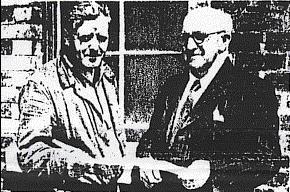
|
| MANAGER AND AGENT |
Born at Markinch, Fife, son of a miner and eldest of five
sons, all of whom became mine-workers, George Hutchison, agent (for
the Kelty group) left school at 14 to become a surface worker at
Balgonie Colliery, later went underground as pony-driver, collier
(with his father), then development worker. At 17 he started night
classes at Viewforth Technical School, went to Heriot-Watt College,
Edinburgh, on Saturday afternoons. One of seven students
coached by village schoolmaster, he alone stayed the full course:
Four years to win his 2nd and 1st class certificates, two additional
years of advanced study. Appointed overman at Aitken 30 years
ago, he later became undermanager in turn of the two pits.
He was manager at Lumphinnans No. 11 colliery, 1928-29; Mary colliery,
Lochore, 1930-38; agent Kelty group, 1938-41; agent Bowhill group,
1941-45;
appointed agent over the Comrie group, where he remained until 1947;
he then took over the Lochgelly group until his return to Kelty in
1949. Comment on this crowded career; ' Moving never
troubled me.' He has had charge of all but two West Fifeshire
pits. His principle for mining: Safe working and good
production are inseparable, Three sons, oldest of whom is in Area
Planning department. Interests: Gardening and motoring.
From Ayrshire, home of 'honest men and bonny lasses' came manager
James Haynes. Born 1912, he spent most of his boyhood at Rankinston,
an old ironstone and coal mining village. Son of a miner (still
working at 69) he won a bursary to Ayr Academy, but at 15 had to
leave owing to the 1926 strike. The second eldest of a
family of eight his wage at the pit helped to keep the family
when his father went to work in the mines of Canada. At the
coalface as a timber-drawer during his first year, was later in turn
(at Polquhairn and Holdsworth pits) brusher, stripper, mine-driver,
shaftsman and fireman. Ten years study at Kilmarnock Technical
College and Ayr Academy evening classes brought him his 1st class
certificate, under the able tuition of Robert Stephens, then a
lecturer at Kilmarnock (now at Dungavel Residential Training Centre).
He left Ayr in 1940 to become an overman at Lady Helen
colliery, Fife. Appointed undermanager within six months, six
months later manager, after being acting-manager three months.
Appointed manager of Kinglassie in 1947, Aitken 1948.
Family, boy 14, girl of 12, both at Beath High School, and a
baby girl nine months old. Interests: Motoring, fresh air. Unfulfilled
ambition: mining engineering didn't allow him the time to learn
the piano, but piano and the hands of pianists still fascinate him.
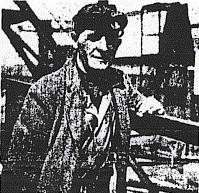 |
| SUPPORTS ECONOMY OFFICER |
Born at Kelty, son of a miner, Dick McHale is supports economy officer, branch delegate, Deputies' Association, and chairman of both pit welfare committee and benevolent scheme. Served with the Cameron Highlanders in France, first World War, seeing most major engagements and the occupation of Germany. Afterwards a drummer in the Kelty Pipe Band, later merged with the Duke of Athol's private regiment - the Scottish Horse. Went into second World War with the regiment, was later transferred to the Royal Engineers. As Company Sergeant Major with the 178 Tunnelling Coy. spent over three years on Gibraltar, supervised 4½ miles of tunnelling within the Rock, including quarters for some 2,000 men, five hospitals and four cinemas, and storage space for five years' stock of rations and equipment. Major job was making room for equipment to turn salt water to fresh; later another member of the company, an ex-miner, also a Kelty man, John Dunsmore, discovered an underground lake, the first fresh-water source ever to be found at Gibraltar. The lake was later sealed-up and Gibraltar water-sellers still ply their trade. His comment on all this: Kelty left its mark on Gibraltar. He afterwards returned to England to help make the underground headquarters from which D-Day operations were conducted. Released to return to mines (in 1944) he became deputy, then overman at Aitken, until he lost an arm underground. Absent only eight weeks he returned to his present job, His sons are both colliers, a daughter married to an Aitken worker. Four granddaughters. His major interest: Social welfare at his own pit (see above).
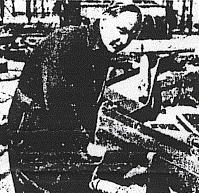 |
| FITTER |
Courage and determination made 31-year-old Charlie Stewart a craftsman. Born at Kelty, son of a miner, he had septic poisoning in his leg at 12, which left him permanently crippled. Served his apprenticeship as a turner at Aitken, and studied mechanical engineering at Dunfermline Technical College (5 years). A soccer fan his favourite team is Hearts of Midlothian.
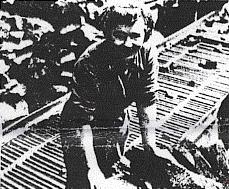
|
| SCREENER |
Wife of Cowdenbeath No. 7 pit collier, 22-year-old Lena Lister is the daughter of a miner. Leaving school at 14, she started work at a Dunfermline rubber factory, making sand-shoes. Married at 18 she later became a screener at Aitken, one of some 30 girl-screeners employed there. Prefers coal to rubber: 'The dust soon washes off; hours and wages and holidays better'. One child, Pearl (3).
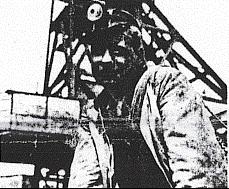
|
| ONCOST WORKER |
Captain of Cowdenbeath A.F.C., 25-year-old oncost worker Alex Menzies, son of an Aitken collier, started there when he was 14. He is on the committee of the Benevolent Scheme. His most exciting experience: When Cowdenbeath defeated Glasgow Rangers (at Glasgow) 3-2. After the final whistle Alex and two team-mates danced the Highland fling on the pitch in front of a roaring appreciative crowd. Married he has two sons (6 and 3 years of age), eldest already shaping into a soccer player. His ambition: To play for Glasgow Rangers.
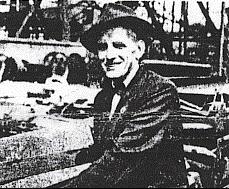
|
| HOLE-BORER |
A native of nearby Kelty (which once had distinction of having highest number of privately-owned houses of any town in Scotland) 54-year-old Willie Mill is chairman of the pits N.U.M branch, and a member of the Fife County Council. Now a hole-borer he started at Aitken in 1926 after working at a small drift mine near Kelty. Father a miner, as was his grandfather, who abandoned the pit to become first manager of Kelty Co-operative Society, founded by Lochgelly men whom Charles Carlow (founder of the Fife Coal Co.) brought to Kelty. These men complained that although wages were better the increase was swallowed by high prices. With the help of Charles Carlow the first Co-op shop was opened. Willie Mill helps to run the Old People's Welfare Society, financed by Aitken men, which provides some 40 old folk in the district with a meal on wheels service, chiropodist service, an Old Men's Club and annual concerts and trips. His proudest moment: When he helped Sassenach Bill Hamilton (son of a Durham miner) win the division for Labour with the biggest majority in Scotland. Has one son, a plumber, and one grandson.
