Historical Notes on Coal
Mining
1600 - 1699
- With the beginning of the 17th century, the shores of the
Firth of Forth were studded with coal pits and saltpans. It has been
estimated that before the end of the century there were as many as 50
coal pits with some producing 15,000 tons in a year.
- Not all these early enterprises were on the Fife coast; some were
found inland as far as Fordel and Cleish, in the county of Kinross.
- Collieries near the south coast of Fife, other than those at
Culross and Dysart, were to be found at Tulliallan, Kincardine,
Valleyfield, Newmills, Torry, Crombie, Limekilns, Inverkeithing,
Burntisland, Methil and Leven.
- There were also small collieries inland at Oakley, Carnock,
Pittencrieff, Dunfermline, Halbeath, Crossgates, Kelty, Lochgelly,
Kinglassie and Markinch.
1602
- Wooden rails along which animals drew trucks were in use in a
few collieries and mines. Eventually they were iron-plated to be
longer- lasting and the change to iron rails was a natural step.
Small railroads were also built linking the pits in a number of
small collieries.
1606
- In this year, a shortage of labour saw the Scottish Colliers
made into slaves and there they remained so for nearly two
centuries.
1614
- The family of Sir George Bruce, Castlehill (now Dunimarle)
possess a monopoly on the production of salt and iron girdles in
the Burgh of Culross and their interest in their coal-mining
operations in their local colliery is reported as lessening
around this time.
- More than a decade after the imposition of the heavy tax on
English coal had caused foreigners to go farther north for their
ladings, the recorded exports of coal are said to have reached 6,308
chaldrons. [Owing to the uncertain size of the chaldron, it is
impossible to say how much coal this figure represents, but if th chaldron used was that later adopted as the standard in Scotland,
then the recorded exports must have already reached 30,000 tons per
annum.]
1617
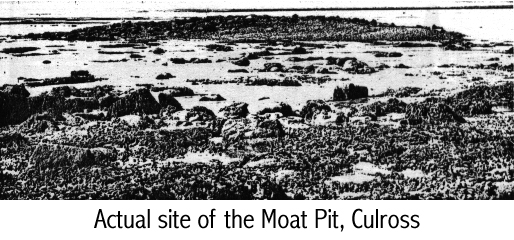
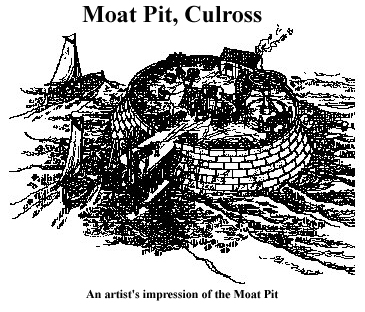
Moat Pit, Culross
- Although the first machine to raise water from a pit was
operating before 1600, it was still in innovation when one was
installed at the Moat Pit, as the Culross coal-working was
called. The machine was a water gin, a series of wooden buckets
attached to an endless chain passing over an axle stretched
across the pit mouth. Coal was sometimes raised by this
means.
- Bruce's achievement at Culross was regarded as the
greatest engineering triumph of the time.
- A popular story tells how King James VI of Scotland (James I
of Great Britain), in 1617, along with Sir George Bruce, entered
the Castlehill mine and surfaced at the Moat Pit, Culross. King
James panicked and shouted, "Treason!", as he was
always worried about being assassinated and he actually believed
that this was an arranged plot to kill him. The King was only
reassured when a rowing boat, moored alongside, eventually took
him ashore near Culross.
*** VISITING THE SITE OF
THE MOAT PIT ***
YOU MUST SEEK EXPERT LOCAL
GUIDANCE AND ADVICE AS CONDITIONS ARE ALWAYS CHANGING
- You will require to wear Wellington boots and to check if the
tidal situation is appropriate for a visit. Taking the ruined
pier below Dunimarle Castle as a starting point, and the place
where you can park your car, the remains of the pit lie slightly
east of south.
THE DIRECT ROUTE HAS KNEE-DEEP MUD IN
PLACES AND MUST BE AVOIDED!
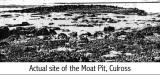
- So the best approach is from the most westerly red-roofed
house in the row of such houses and to move across some disused
mussel beds, swinging westwards to reach the site of the Moat
Pit. On the site you should still be able to see the remains of
the two concentric shafts built of stone blocks which, due to the
effects of time and tide, are now level with the reef on which
the Moat Pit once stood.
Click on Image to Zoom In
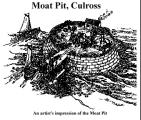
- The original shafts must have been tower-like structures
standing at least thirty feet above the sea bed. The centre shaft
is twelve feet in diameter and was the working shaft for the Pit,
the other being an air shaft with a gap of four feet between the
concentric walls. The outside diameter of the walls is fifty
feet.
Click on Image to Zoom In
- The coal was transported by ship which, considering the lack
of roads in those days, was a blessing! It is not so surprising
that Sir George Bruce made a fortune between his trade in coal
exports and his monopoly for making the Culross girdles *.
* A girdle is a flat sheet of iron, with a
handle, which is placed over a source of heat for making certain
types of cakes, scones and pancakes.
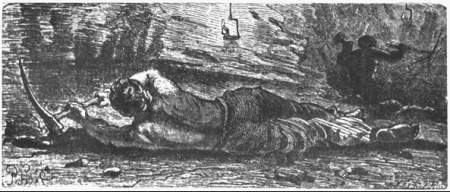
EARLY METHODS OF WINNING COAL
Miners had to crouch or lie full length to get at the coal seams
in constant danger from roof falls and without proper ventilation
or safety precautions of any kind.
1618
- John Taylor, the poet, who visited the Culross pit in 1618
described it as "unfellowed and unmatchable work. They
did dig 40 feet down, right into and through a rock. At last they
found sea cole. When men are at work below an hundred of the
greatest ships in Britain may sail over their head. The mine was
cut like an arch or vault, a man may walk upright in most
places."
Taylor also described the innovative drainage machinery
introduced at Castle Hill Pit, Culross, by Sir George Bruce:
"The sea at certaine places doth leake or soak into the
mine which by the industry of Sir George Bruce is all conveyed to
one well neare the land, where he hath a device like a horse mill
that with three horses and a great chain of iron going downeward
many fadomes with thirty six buckets fastened to the chain of
which eighteen go down to be filled and eighteen ascend up to be
emptied which doe empty themselves (without any man's labour)
into a trough that conveys the water into the sea
again."
1620
- This was the year that Gunter's chain (also known as Gunter's measurement or Surveyor's measurement) was introduced and used for land survey. It was designed by English clergyman and mathematician Edmund Gunter (1581–1626) long before the development of the theodolite and other more sophisticated equipment, enabling plots of land or mining areas to be accurately surveyed and plotted, for legal and commercial purposes.
Gunter used an actual measuring chain of 100 links. These, the chain and the link, have become units of their own.
The chain was, thus, a former measuring instrument 66 ft or 22 yds (20.1 m) long, subdivided into 100 links, each of which is a short section of wire connected to the next link by a loop.
The measure of length equivalent to a Gunter's chain, was equal to 1/10 furlong or 1/80 mile.
1625
- The Moat Pit, which came into operation in 1590, was finally
destroyed by a freak storm in 1625 when the pit was flooded due
to the concentric walls not being high enough.
The coal works at Culross were the greatest in Scotland but on
the very night that James VI was to die in London, the storm in
the Firth of Forth damaged both machinery and the moat.
- A writer, in 1625, tells us that, "The like of this
tempest was not seen in our time nor the like of it heard in
Scotland before. Salt pans were thrown down, ships and boats were
broken and the coal mines beside Culross were
drowned".
- The Moat Pit off Culross might well have been restored by its
enterprising owner but for the fact that Sir George Bruce died
shortly after this disaster. The pit never really recovered
although, a few years later, the Culross chalder (five
tons) was to be made the standard Scots coal measure.
1636
- Sir William Brereton said coal was sold along the Firth of
Forth for 3/- a chaldron (perhaps 30 cwt) with carriage
2/8d.
- There were coal heughs near Cuffabouts (Carriden) and
Grangemouth.
- From Elphinstone "great [large] coal is shipped
beyond the seas".
- Alloa had an excellent coal shipped out by the Dutch.
- The village of Torryburn, near Valleyfield, was the most
important place for shipping out small coal.
1644
- The Privy Council at various times had fixed
regulations for the price and sale of coal, and prohibiting the
export of it until all natives were supplied. As these were not
sufficiently attended to, Parliament in 1644, ratified and approved
the same, and appointed commissioners for the different districts
where coal was worked, to see that the provisions of the Act were
attended to; but the Earl of Dunfermline was exempted from the
operation of the Act as to his coal in the Crossgates of the Moor
of Dunfermline till 25th December 1646.
[From Early Records Relating to Mining in
Scotland collected by R. W. Cochran-Patrick of
Woodside.]
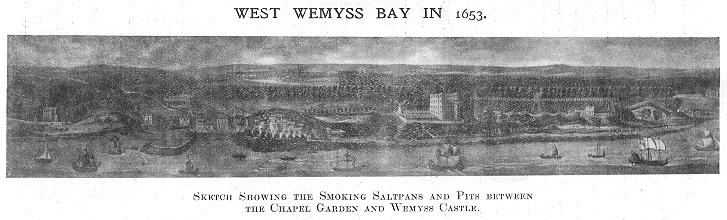
West Wemyss Bay in 1653
This sketch shows the smoking saltpans and pits
between the Chapel Garden and Wemyss Castle.
Click on Image to Zoom In
-------------------------------------------------
1659
- In this year we find an order in Lord
Sinclair's "factor" at Desart [Dysart], to furnish
Edinburgh Castle with 1000 loads of coal, the bailies of Desart to
transport them to Leith.
- The coalworks of Lord Sinclair, like those of Sir George Bruce at
Culross, extended under the Firth of Forth.
- Coal was being mined in the extreme east of Fife around this time
for, in the customs records, we find a tax collected on coal exports
from Crail, Anstruther, Pittenweem and St Monance.
-------------------------------------------------
1663
- The Culross chalder (five tons) was made the standard Scots
measure of coal.
1670
1671
- In this year the Dunfermline Town Council appointed a grieve
of the coal work, and report was made ...
... remember that one Scots Pound was very much
less than one Pound Sterling! ...
"This day report is maid yt the men yt work winning the
coall ar agried wt as followis viz. Rot Hogan to have 10s Thomas
Ffalconer and Jon Drummond each 8s and the rest each 6s 8d p.
diem, and David thomsone being prinll workman is referred for his
work and pains till eftwards." The grieve was to come in
weekly ilk Saturday night to give up a just account of the coals
sold. Presumably the sales were to the burgh householders at the
pithead.
1676
- The Bruce family of Culross appeared to have given up their
connection with the local coal pits in the area.
Lord Dundonald believed to have an interest in the local coal
mines and to the possibilities of working shallow coal seams to
the east of Culross.
He, too, is reported as commenting on the drainage system
introduced in the Castle Hill Pit: " Sir George Bruce
erected machinery consisting of the Egyptian Wheel, commonly
called chain and bucket, to drain the coal to the dip of the old
workings which since appear to have been only about five
perpendicular fathoms below the level of the high tide mark. Sir
George, by assistance of this machine, wrought one of the seams
of coal to the depth of forty perpendicular fathoms under and
within the high tide mark."
1679
- Tulliallan Colliery, in the extreme west of Fife, had an annual
output of approximately 15,000 tons coal; while Torry Colliery, a
few miles further east, produced more than 10,000 tons coal.
1689
- Ayr, in the west of Scotland, was exporting coals to Ireland
but, as Thomas Morer wrote, in 1689, coal was chiefly for the
gentry. "The common people deal in peat."
Nevertheless Fife, Ayrshire and the Lothians were already making
industry come to life although Lanarkshire was only beginning to
realise that its future lay in the rich coal seams below the
county.